
TigerGraph
ResourcesPathfinderDiscord(opens in a new tab)
Resources

Everything, In One Wall

Videos, courses, hands-on tutorials, docs, and blog posts. One place for every phase of learning.

TigerGraph
ResourcesPathfinderDiscord(opens in a new tab)

© 2026 Tiger Graph Dev Hub. All rights reserved.

  • Privacy Policy|
  • Terms of Service

Applied · 1

Clear all
  • Definition

Levels

  • All Resources
  • Beginner
  • Intermediate
  • Advanced

Categories

  • Videos514
  • Docs644
  • Glossary50
  • Blog posts222
  • Code & samples126
  • Graph Resources52

Assets

  • Definition36
  • Tutorial113
  • How-to guide319
  • Reference312

Tags

  • #Fraud and AML
  • #Entity resolution
  • #Recommendations
  • #GraphRAG and AI
  • #Graph machine learning
  • #Search
  • #Network analysis
  • #Performance and scale
  • #Running TigerGraph
  • #Evaluating graph

36 resources · page 2 of 3

NewestOldest
3 Col Grid2 Col GridList
DefinitionFeb 6, 2026

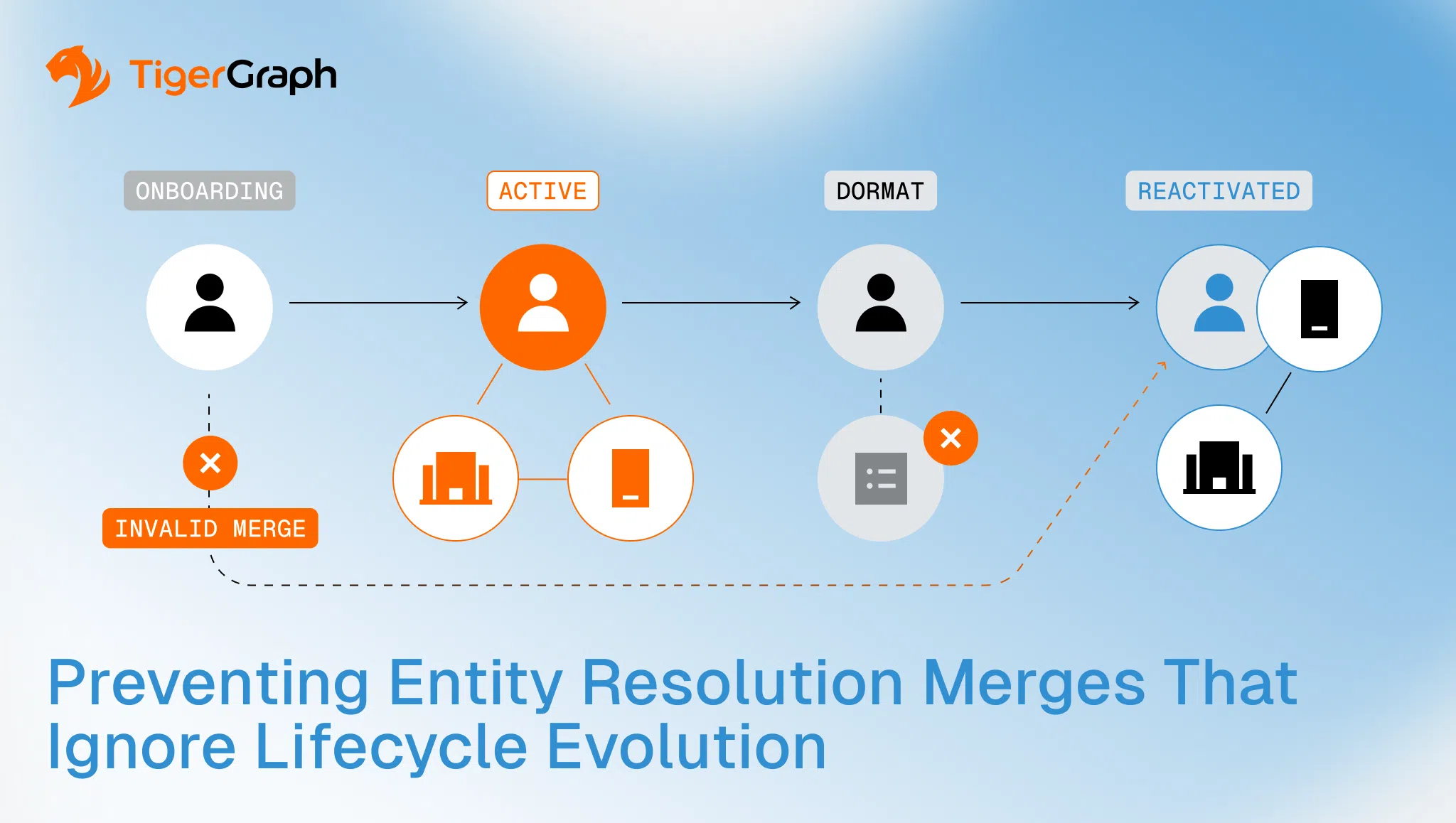
Preventing Entity Resolution Merges That Ignore Lifecycle Evolution

It feels logical to treat entity resolution as a convergence problem. As records arrive over time and attributes accumulate, confidence increases. Eventually, everything that belongs together is merged into a single, stable entity. But that model logic breaks down because identity does not stand still. The variables
Concept
109
  • Troubleshooting12
  • Security advisory4
  • Runbook
  • Article173
  • Case study26
  • Talk298
  • Release note24
  • Demo114
  • Webinar12
  • Event12
  • Report24
  • Discover
    Definition
    DefinitionJan 29, 2026

    Unstructured Data

    Unstructured data is information that does not follow a schema or fixed format. This unstructured data definition explains why the data is harder for systems to query directly, even though it often contains rich meaning. In practice, unstructured data is usually content created for humans rather than for databases. This includes

    Discover
    Definition
    BeginnerDefinitionJan 29, 2026

    Structured Data

    Structured data is information that is organized according to a predefined schema, with clearly defined fields, data types, and constraints. This structured data definition explains why structured systems are well-suited to consistency, validation and repeatable querying. When people ask what structured data is, they often know that it includes data stored

    Discover
    Definition
    BeginnerDefinitionSep 18, 2025

    Graph Neural Network (GNN)

    A Graph Neural Network is a machine learning architecture that learns from graph-structured data. Instead of treating data as flat tables or grids, GNNs learn how entities (nodes) relate to each other by passing messages across connections (edges) and aggregating neighborhood information over multiple layers.

    Discover
    Definition
    DefinitionSep 18, 2025

    Outlier Detection

    Why Does Outlier Detection Matter? Outlier detection spots data points that behave differently from the rest, and those differences often carry critical meaning. An outlier can be the earliest sign of fraud, a warning about a failing component, or a signal that something new and important is emerging. While traditional business intelligence tools focus on

    Discover
    Definition
    DefinitionSep 18, 2025

    Shared-Variable Computing in Graphs

    Shared-variable logic in graphs is a technique that lets different parts of a graph computation update and share information while the computation is still running. Instead of processing nodes and edges in isolation and only combining results at the end, shared-variable logic uses in-memory accumulators or temporary variables to

    Discover
    Definition
    BeginnerDefinitionSep 12, 2025

    Pattern Detection with Graphs

    Pattern detection with graphs is the process of identifying meaningful shapes, behaviors, or anomalies across connected data. Instead of examining events or records individually, graphs provide a broader perspective by illustrating how entities are interconnected. These links often form recognizable “patterns”—a fraud ring moving money through mule accounts,

    Discover
    Definition
    DefinitionSep 3, 2025

    Explainable AI with Graph Databases

    Explainable AI (XAI) with graph databases is the practice of making AI systems more transparent by grounding their decisions in graph structures. Instead of treating predictions as black-box outputs, graph databases show how entities and relationships influenced the outcome. Put simply, XAI means AI that can show its

    Discover
    Definition
    DefinitionAug 20, 2025

    Parallel Graph Processing

    Parallel graph processing is a method for accelerating complex graph operations by breaking them into smaller tasks that run concurrently across multiple processors. These processors might be multiple cores in a single machine or distributed across many machines in a cluster. The graph itself is divided, often by logical or

    Discover
    Definition
    DefinitionJul 18, 2025

    Vector Databases

    A vector database is a specialized type of database designed to handle high-dimensional data representations, commonly referred to as vector embeddings. These embeddings are created by machine learning models that numerically encode the essence or meaning of the data. Imagine each piece of data, whether it’s a document, image, or user profile,

    Discover
    Definition
    DefinitionJul 18, 2025

    Entity Resolution

    In a world where the same individual might appear as “Alex J.” in a CRM, “A. Johnson” in a transaction log, and “AJ-459” in a support system, entity resolution is what connects the dots. Entity resolution is the process of identifying when different data records—spread across systems, departments, or even geographies—refer

    Discover
    Definition
    DefinitionJul 18, 2025

    Digital Twin

    A digital twin isn’t just a 3D rendering or one-time simulation; it’s a living, breathing virtual version of a real-world system or process. Think of it as a digital counterpart that continuously evolves based on real-time data from its physical twin. From factory floors and supply chains to hospital patients and smart cities,

    Discover
    123