TigerGraph
ResourcesPathfinderDiscord(opens in a new tab)
Resources

Everything, In One Wall

Videos, courses, hands-on tutorials, docs, and blog posts. One place for every phase of learning.

TigerGraph
ResourcesPathfinderDiscord(opens in a new tab)

© 2026 Tiger Graph Dev Hub. All rights reserved.

  • Privacy Policy|
  • Terms of Service

Applied · 5

Clear all
  • Blog posts
  • Docs
  • Code & samples
  • Tutorial
  • Case study

Levels

  • All Resources
  • Beginner
  • Intermediate
  • Advanced

Categories

  • Videos514
  • Docs644

49 resources · page 1 of 5

NewestOldest
3 Col Grid2 Col GridList
IntermediateTutorial

Glossary
50
  • Blog posts222
  • Code & samples126
  • Graph Resources52
  • Assets

    • Definition36
    • Tutorial113
    • How-to guide319
    • Reference312
    • Concept109
    • Troubleshooting12
    • Security advisory4
    • Runbook
    • Article173
    • Case study26
    • Talk298
    • Release note24
    • Demo114
    • Webinar12
    • Event12
    • Report24

    Tags

    • #Fraud and AML
    • #Entity resolution
    • #Recommendations
    • #GraphRAG and AI
    • #Graph machine learning
    • #Search
    • #Network analysis
    • #Performance and scale
    • #Running TigerGraph
    • #Evaluating graph
    Oct 15, 2026

    Migrating from Neo4j to TigerGraph: A Practical Architecture, Data, and Query Playbook

    Moving from Neo4j to TigerGraph? Learn how to assess your architecture, map your data model, handle Cypher queries, and validate performance before cutover.
    Discover
    IntermediateTutorialAug 18, 2026

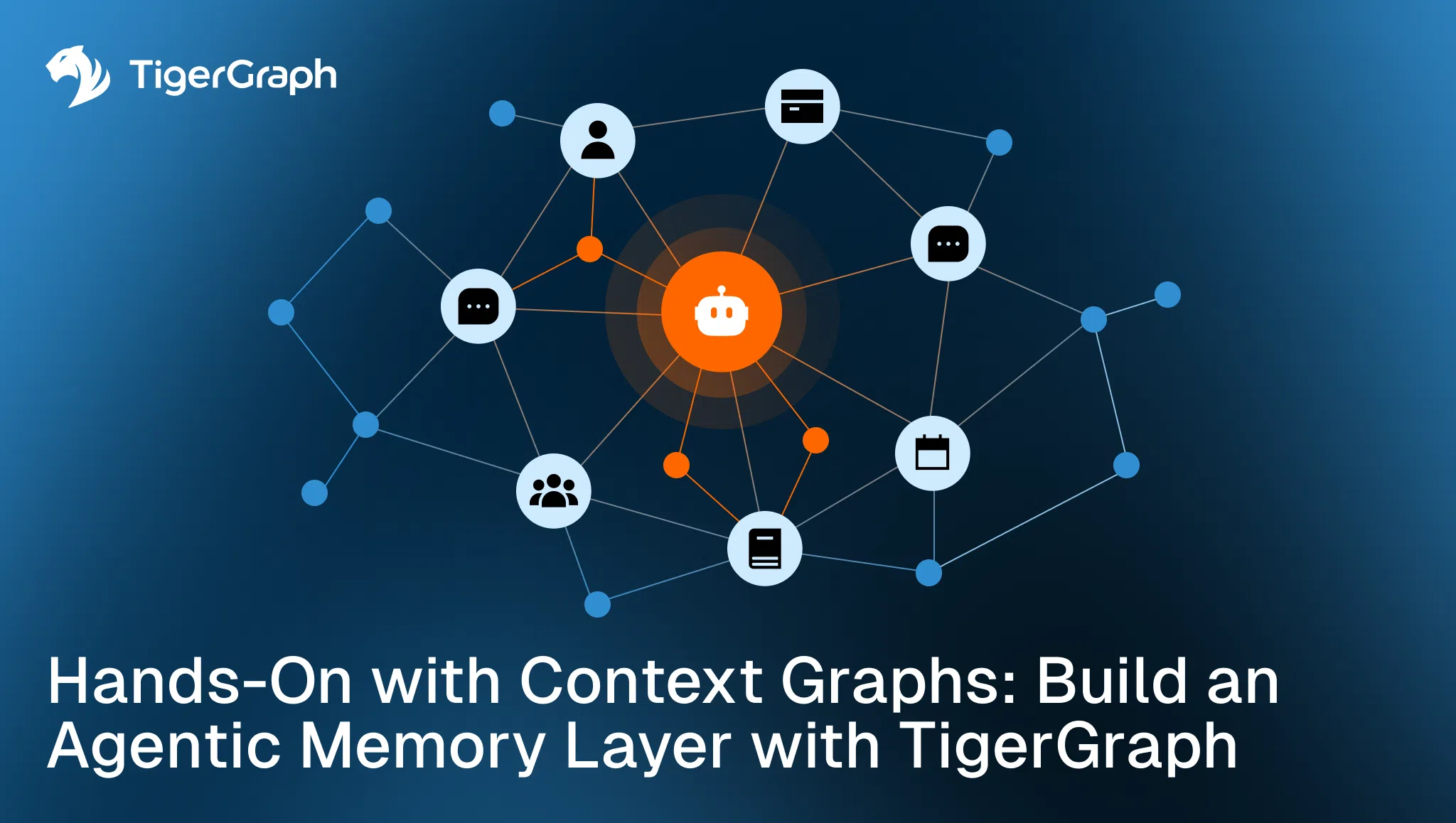
    Hands-On with Context Graphs: Build an Agentic Memory Layer with TigerGraph

    AI agents forget between sessions. Learn how to build a TigerGraph context graph that gives your agent persistent, relationship-aware memory in five steps.

    Discover
    IntermediateTutorialJun 6, 2025

    Understanding Model Context Protocol (MCP)

    The Model Context Protocol (MCP) is an open standard that aims to streamline how AI models, particularly Large Language Models (LLMs), connect with external data sources and tools. Think of it as a universal language that allows AI to access and utilize information from various systems in a standardized way.

    Discover
    AdvancedCase studyMay 29, 2025

    Precision Is the New Personalization, and Graph AI Helps Retailers Hit the Mark

    Traditional retail personalization strategies have often fallen short. Segment-based campaigns and rules-based engines deliver recommendations that are too broad, too late, or too irrelevant. At best, these experiences feel impersonal; at worst, they feel intrusive or out of touch. Today’s consumers expect

    Discover
    IntermediateTutorialAug 30, 2023

    Using Graph Machine Learning to Improve Fraud Detection Rates

    by Parker Erickson Fraud comes in all shapes and forms across many industries; from account takeovers, to transaction fraud, the financial services industry to healthcare, fraud is both prevalent and costly for many companies. As the world becomes further interconnected and increasingly digital, businesses must adapt to better fight fraudulent activities. In this blog, we

    Discover
    IntermediateTutorialAug 10, 2023

    Integrating TigerGraph and Large Language Models for Generative AI

    by Parker Erickson Introduction to Large Language Models Generative AI and Large Language Models are on everyone’s mind – they have been proven to be very useful tools for general purpose information found on the internet. However, businesses are left with the question: how can they ask questions about their data? What if they want

    Discover
    AdvancedCase studyJul 23, 2023

    Supercharging Fraud Detection: How a Leading Financial Institution Utilizes TigerGraph for Real-Time Entity Resolution

    In today’s fast-paced financial landscape, real-time fraud detection has become essential for safeguarding customer assets and preserving trust in financial institutions. One leading investment bank recently embraced an innovative solution to improve its fraud detection capabilities significantly. By adopting TigerGraph, a powerful graph database and analytics platform, the bank effectively anonym

    Discover
    Case studyJul 19, 2023

    Graphs for Good: Transforming Refugee Support with UAWelcome’s Revolutionary Project

    In a world where technology continually evolves, one innovative project stands out as a beacon of hope—UAWelcome. Harnessing the power of graphs for good, UAWelcome is revolutionizing the way refugees are supported as they start a new life in the US. With a profound commitment to making a positive impact, UAWelcome’s graph-based approach has streamlined

    Discover
    AdvancedCase studyMar 13, 2023

    Trillion edges benchmark: new world record beyond 100TB by TigerGraph featuring AMD based Amazon EC2 instances

    Graph databases have become increasingly popular in recent years, as they are uniquely suited to handle complex, interconnected data. As data sets continue to grow, scaling up graph databases to enterprise scale becomes a daunting task. Enterprises with hundreds of millions of customers and hundreds of billions of transactions require scale-out across: data, compute, security,

    Discover
    Tutorial
    AdvancedTutorial

    Build your graph in Savanna

    This is the browser path to a working graph on TigerGraph Savanna: a running workspace, a schema you designed, data loaded against it, and a GSQL query returning results. Budget about fifteen minute

    Discover
    Tutorial
    IntermediateTutorialv4.3

    Accumulators Tutorial

    GSQL is a Turing-complete Graph Database query language. Compared to other graph query languages, its biggest advantage is its support of accumulators — global or vertex local. This short tutorial aims to

    Discover
    Tutorial
    IntermediateTutorialv4.3

    GSQL Tutorials

    The GSQL ® Graph Database Language is more than just a query language. It also serves as a DDL (Database Definition Language). There tutorials will help you get starting learning and using GSQL. GSQL Tutorial

    Discover
    12345