
Summary
- Traditional KYC platforms score customers against attribute-level checklists, identity documents, sanctions screening, jurisdiction, but cannot resolve the ownership chains and counterparty networks where the most significant risk often sits.
- Graph analytics stores customers, beneficial owners, counterparties, devices, and external risk signals as a connected network, making the full relationship structure queryable in real time.
- The key KYC gap graph closes is beneficial ownership depth: a single graph query can resolve ultimate owners across many layers of corporate structure where row-based queries fail or run too slowly to be operational.
- Graph supports perpetual KYC by continuously capturing new transactions, counterparties, and adverse media signals, enabling risk reassessment as relationships change rather than on a fixed periodic review schedule.
- Graph is not a replacement for existing KYC platforms. It is the relationship intelligence layer those systems were never designed to provide, and TigerGraph is purpose-built to deliver it at enterprise scale.
A sanctioned individual sits two ownership layers above a corporate customer who passed onboarding with no apparent issues. The bank’s KYC platform never reached that far. The relationship surfaced only after a regulator’s inquiry.
That scenario is not unusual. Most enterprise KYC platforms are strong at attribute-level checks – they verify documents, screen names against sanctions lists, classify customers by jurisdiction, and apply risk-tier scoring rules. What they cannot do is resolve the network of relationships behind a customer, where some of the most significant risk indicators live. Those hidden relationships are increasingly where regulators expect institutions to demonstrate visibility—not just into the customer, but into the network surrounding the customer.
Legacy KYC platforms are built on relational data models. Each entity type – customers, beneficial owners, transactions, external risk data – occupies its own table. Connecting those tables requires joins that are expensive to run at investigation speed and impractical to chain across the multiple levels of corporate ownership that characterize real-world risk structures.
Graph analytics closes that gap by treating every customer, beneficial owner, counterparty, and risk signal as part of a single connected network – one that can be queried across many relationship levels in real time.
You’ll learn:
- Why traditional KYC reaches a structural ceiling when ownership chains grow complex
- What graph analytics adds to KYC risk assessment that attribute-level systems cannot deliver
- How graph and AI work together to enable perpetual KYC monitoring
- Where graph-powered KYC delivers the most value across banking and financial services
What Is Traditional KYC Risk Assessment?
KYC (Know Your Customer) risk assessment is the process financial institutions use to identify and score the risk a customer poses, based on identity verification, sanctions and PEP screening, jurisdiction classification, and business activity analysis. Modern KYC programs increasingly extend this to include the customer’s network of relationships – ownership structures, counterparties, and behavioral signals – because that network often reveals risk that individual-record checks miss.
A well-implemented KYC program answers two questions at onboarding: who is this customer, and how risky are they? Attribute-level checks – document verification, sanctions screening, PEP status, jurisdiction – address the first question reliably. The second becomes harder when the customer is a corporate entity with layered ownership or a counterparty network that extends across jurisdictions.
Relational KYC platforms create one table for each entity type: a customer table, a beneficial owner table, a transaction table, a sanctions reference table. To determine whether a customer’s ultimate beneficial owner is a sanctioned individual, a query must join those tables across multiple layers – and each additional layer of corporate structure multiplies the join complexity. At the third or fourth ownership tier, most operational systems either time out or return incomplete results.
That limitation is not simply a performance problem. It is a structural mismatch between a record-based data model and a relationship-based risk problem that faster hardware solves. It is a structural mismatch between the data model and the question being asked.
What Is Graph Analytics for KYC?
Graph analytics uses a graph database to store entities – customers, beneficial owners, transactions, addresses, devices, counterparties – and the relationships between them as a connected network. Queries follow chains of relationships across any number of levels without the join overhead that limits relational systems. For KYC, this means the full ownership structure, counterparty exposure, and risk signal network behind a customer becomes queryable in a single operation. Instead of reconstructing relationships at query time, graph stores those relationships as part of the data itself.
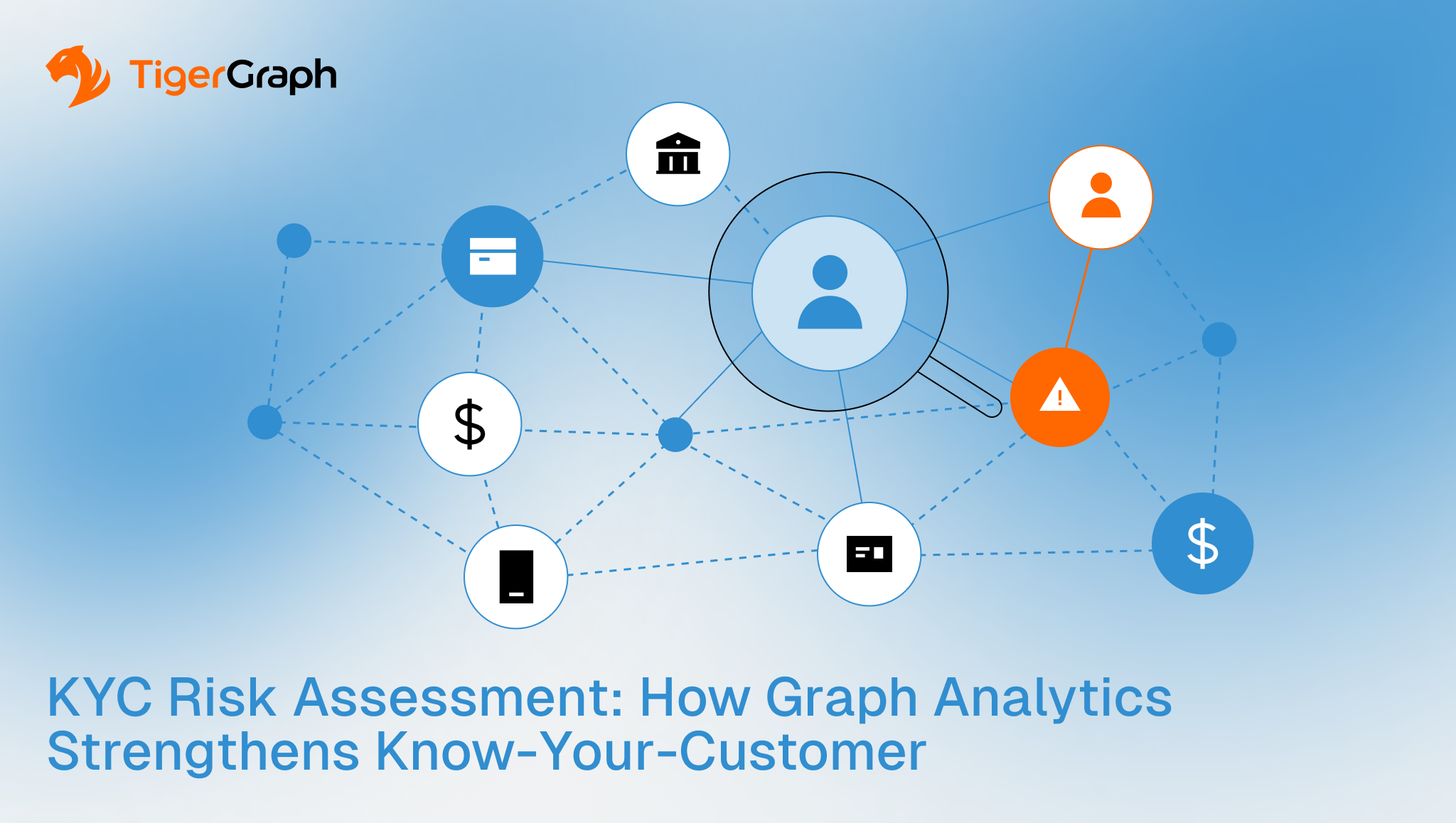
In a graph KYC model, every customer, beneficial owner, director, address, device, counterparty, and external risk signal becomes a node. Ownership, transactional, and attribute-sharing relationships become connections between those nodes. Together, they form a single structure that makes the entire customer network queryable at investigation speed.
The difference from a relational model is not just architectural – it changes what questions are operationally answerable. Resolving a five-tier ownership chain in a relational system requires five sequential joins. In a graph database, the same query follows the chain of relationships in a single operation. AsA top global bank demonstrates at 50 million transactions per day, graph-scale relationship analysis is production-ready for the most demanding financial services environments.
Graph vs. Traditional KYC: Key Differences
Despite its advantages, graph-based KYC is not intended to replace existing KYC platforms. It serves as the relationship intelligence layer – providing network context and real-time depth that attribute-level systems were never designed to deliver.
| Category | Traditional KYC | Graph-Enhanced KYC |
| Data model | Tables and lists, one per entity type | Connected network of customers, owners, and counterparties |
| Beneficial ownership resolution | Limited depth; complex structures require expensive joins | Configurable multi-level resolution in a single query |
| Risk scoring approach | Individual attribute scoring | Network-context-enriched scores |
| Risk refresh cadence | Periodic reviews | Perpetual, event-driven updates |
| Investigation workflow | Data assembly heavy | Analysis heavy |
| Explainability | Rules-based reasoning | Traceable relationship paths |
The distinction is architectural: traditional KYC optimizes for customer records, while graph optimizes for customer relationships.
The most consequential difference for compliance teams is beneficial ownership depth. A corporate customer with a sanctioned individual two or three tiers up in the ownership structure will pass attribute-level onboarding checks because those checks evaluate the direct customer record. Graph resolves the full ownership chain – identifying the ultimate beneficial owner and the path to them – before the account is opened rather than after a regulatory inquiry surfaces the relationship.
What Graph Analytics Adds to KYC Risk Assessment
With a graph structure, KYC risk assessment expands to include four capabilities that legacy platforms cannot deliver at operational speed.
Deep beneficial ownership resolution. A single graph query identifies ultimate beneficial owners across multiple layers of corporate ownership, including cross-shareholding arrangements and trust structures. Where a row-based query either fails or returns partial results at the third or fourth tier, graph follows the full ownership chain and returns both the ultimate beneficial owner and the complete ownership path used to reach that conclusion
Network-context risk scoring. A customer’s risk score reflects not only their individual profile but also the risk profile of the parties to whom they are connected. An otherwise low-risk customer with adverse media exposure two relationship levels away may warrant a higher score than their standalone profile suggests. That context is invisible to attribute-level systems.
Perpetual KYC monitoring. Because the graph continuously captures customer relationships, new transactions, beneficial owners, and external signals, risk can be reassessed as relationships change rather than on a fixed review schedule. This enables risk assessments to evolve as customer relationships evolve, rather than waiting for the next scheduled review. When a counterparty appears on a sanctions list, every customer connected to that counterparty is automatically flagged for reassessment – without waiting for the next periodic review cycle.
Unified case context for investigators. When an alert is triggered, analysts can view the full relationship neighborhood – counterparties, shared addresses, shared devices, transaction history, and adverse media – in a single interface. That consolidation reduces case preparation time and shifts analyst effort from data assembly to analysis.
Graph + AI: How the Combination Powers Perpetual KYC
Graph analytics and AI play complementary roles within the KYC stack. Graph provides the structural relationship context required for accurate risk assessment. AI delivers pattern recognition and adaptive scoring that turns those relationships into forward-looking risk signals.
Graph-computed features for risk models. Features such as centrality within suspicious-counterparty clusters, distance from known bad actors, and community membership improve KYC risk-scoring accuracy compared with attribute-only models. Consider a retail banking customer whose counterparty network places them three relationships from a cluster of accounts flagged for structuring activity – that structural signal, computed from the graph, would not appear in any attribute-level field.
Entity resolution at scale. Graph-based entity resolution unifies fragmented customer records across business lines, channels, and external data sources, creating the single customer view that effective KYC depends on. Without it, the same individual may appear as separate records in retail, wealth, and correspondent banking systems – each passing independent checks while the aggregate risk profile goes unscored.
Graph Neural Networks for emerging risk patterns. GNNs learn from structural patterns within customer and ownership networks, identifying configurations that have historically preceded sanctions hits or AML alerts. A new correspondent banking relationship whose network topology resembles a previously sanctioned trade-finance intermediary is flagged before a transaction occurs – not after one is reported.
Explainable AI for regulatory defensibility. When an AI model flags a customer for enhanced due diligence, the graph provides an inspectable relationship path behind that decision. Regulators expect AI-assisted KYC decisions to be explainable, and a traceable path through the ownership and counterparty network satisfies that expectation in a way that black-box scoring cannot.
Enterprise Use Cases: Where Graph-Powered KYC Applies
The following scenarios illustrate how graph analytics strengthens KYC and risk management across banking and financial services.
Onboarding due diligence for corporate banking. Graph resolves ultimate beneficial owners across complex ownership structures during onboarding, surfacing high-risk relationships before accounts are opened rather than after a regulatory inquiry.
Perpetual KYC for retail and wealth. Graph continuously monitors customer networks and automatically updates risk tiers as new transactions, counterparties, or adverse media emerge – reducing the risk of exposure between periodic reviews.
Correspondent banking risk. Graph maps respondent-bank networks several tiers deep, revealing indirect exposure to sanctioned entities, high-risk jurisdictions, or shell-bank intermediaries that direct relationship checks miss.
Crypto and digital asset KYC. Exchanges and custodians use graph to connect on-chain wallet activity with off-chain identity data, exposing synthetic-identity schemes and mule networks that evade traditional KYC controls.
Trade-based money laundering detection. Graph connects trade finance documents, counterparty relationships, shipping data, and customer profiles into a unified network, making price-anomaly, phantom-shipment, and circular-trade patterns associated with trade-based laundering easier to identify.
Graph-powered KYC delivers its greatest value at the intersection of these use cases – where a single customer may be a retail depositor, a beneficial owner in a corporate structure, and a counterparty in a correspondent banking relationship, and all three contexts need to be visible simultaneously.
Graph-Powered KYC: Periodic Reviews to Continuous Risk Intelligence
KYC has always been a relationship problem. Increasingly, regulators expect institutions to prove they can understand those relationships. The ownership chains, counterparty relationships, and behavioral signals that define true customer risk don’t live in a single record – they live in the connections between records. Graph analytics makes those connections visible, queryable, and actionable in real time. For compliance teams facing growing regulatory pressure to move beyond periodic reviews, that capability is no longer a nice-to-have. It is the foundation that perpetual KYC requires.
TigerGraph is purpose-built for this. Its enterprise-grade graph database supports deep beneficial ownership analysis, perpetual KYC monitoring, and explainable AI within a single production-ready platform. Explore TigerGraph pricing and free trial options to see how it fits your compliance stack.
FAQs
What is KYC risk assessment?
KYC risk assessment is the process financial institutions use to identify and score the risk a customer poses, based on identity verification, sanctions and PEP screening, business activity analysis, and – increasingly – the customer’s network of relationships. The network dimension matters because the most significant risk indicators often sit in ownership structures and counterparty connections that individual-record checks cannot see.
How does graph analytics improve KYC risk assessment?
Graph stores customer, ownership, and counterparty data as a connected network, enabling multi-level relationship analysis – deep beneficial ownership resolution, indirect counterparty exposure – that relational databases cannot perform at investigation speed. A query that requires five sequential joins in a relational system resolves as a single relationship-following operation in a graph database, returning the full chain with the path intact.
What is perpetual KYC, and why does it require graph?
Perpetual KYC is the practice of continuously refreshing customer risk based on real-time changes in the customer’s network – new transactions, counterparties, adverse media – rather than relying on a periodic review cycle. Graph databases are the natural foundation for this approach because they continuously store and update relationships. When a counterparty is added to a sanctions list, every connected customer can be flagged for reassessment immediately, without waiting for the next scheduled review.
Does TigerGraph support beneficial ownership analysis for enterprise KYC programs?
Yes. TigerGraph’s massively parallel processing enables deep beneficial ownership resolution across many ownership tiers in a single query – including cross-shareholding arrangements and trust structures that are difficult to resolve with row-based approaches. Its in-database ML feature generation and GNN support extend this into AI-assisted risk scoring and early detection of emerging risk patterns, while the graph provides the traceable relationship paths regulators expect for AI explainability.
How does graph help with fraud detection within KYC workflows?
KYC and fraud detection overlap significantly at the network level. Synthetic identities, mule account networks, and coordinated application fraud all share a structural signature – clusters of accounts connected through shared devices, addresses, or counterparties. Graph makes those structural patterns visible at onboarding and during ongoing monitoring, catching coordinated schemes that attribute-level fraud controls miss because they evaluate each account in isolation.