
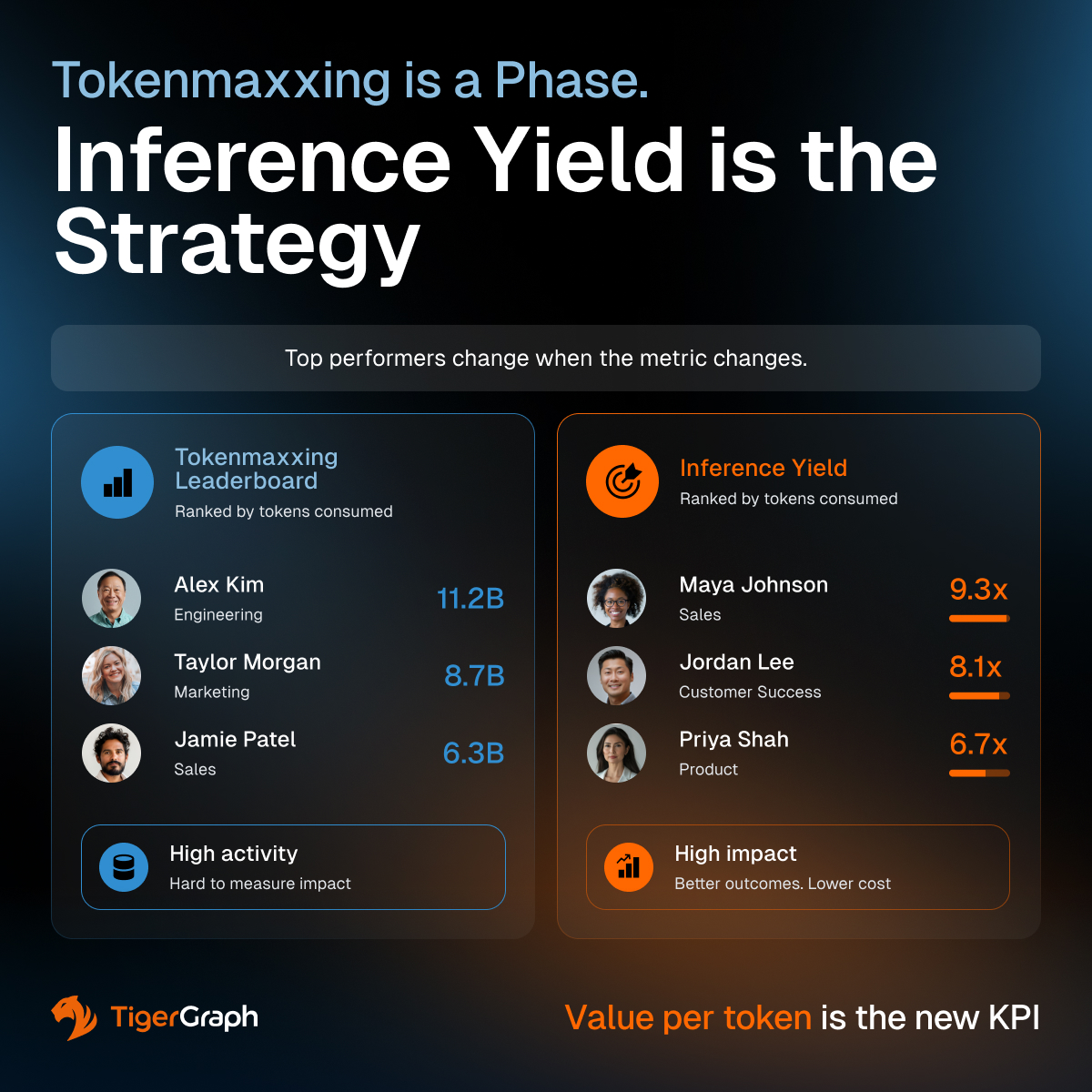
Tokenmaxxing is a Phase. Inference Yield is the Strategy.
Why the Next AI Race Won’t Be Won by the Companies That Burn the Most Tokens
A new behavior is emerging inside enterprise AI. Companies are ranking employees based on how many AI tokens they consume: leaderboards, incentives, even internal competition. It may sound extreme. It’s not. It’s a signal. The WSJ recently highlighted this trend in the article “Why Some Companies Say AI ‘Tokenmaxxing’ Is Key to Survival’ written by Isabelle Bousquette
It reflects a deeper reality: AI adoption is now existential. So companies are optimizing for what they can measure: Tokens. And tokens, right now, are the most visible proxy for “AI usage” inside the enterprise.
The Problem
Token consumption is easy to track. But it’s the wrong metric. Even the companies using it admit:
- it’s gameable
- it can drive waste
- it doesn’t tie cleanly to outcomes
Because: More tokens ≠ more intelligence. Tokens measure throughput. They do not measure precision, accuracy, or decision quality.
Tokenmaxxing measures activity. It does not measure value.
Why It Works and Why It Doesn’t
Tokenmaxxing exists for a reason. It forces adoption. It builds habits. It accelerates experimentation. In the early phase, that’s enough. It’s the equivalent of measuring “lines of code written” in the early days of software. It drives behavior. But not necessarily the right behavior. But it doesn’t scale. Because as AI moves into production, something else emerges:
The Token Tax
Every time an AI system is fed imprecise context:
- it consumes more tokens
- it takes longer to respond
- it produces lower-quality outputs
Under the hood, this is a compute problem: transformer attention scales super-linearly with context length. Double the tokens, and you don’t just double cost. You multiply it. Multiply that across thousands—or millions—of queries: And you’re not scaling intelligence.
You’re scaling waste.
The Real Shift
Enterprise AI is entering its second phase.
- From adoption → to optimization.
- From usage → to outcomes.
- From volume → to precision.
And that requires a new KPI: Inference Yield. Value per token. Not how much AI you use. How much value you extract from every interaction.
High-yield systems:
- use fewer tokens
- return higher-confidence outputs
- reduce downstream human intervention
- improve decision speed and accuracy simultaneously
This is where AI becomes an operating advantage. Not just a cost center.
Where AI Systems Break
Most enterprise AI systems today rely on: vector-based retrieval, loosely relevant context, large prompt windows. When context is weak, systems compensate with more of it. More data → more tokens → higher cost → lower signal. This creates a false sense of improvement: recall increases, but precision collapses.
This is how the token tax compounds. More context isn’t better. It’s just more expensive.
The Real Bottleneck
The constraint is no longer model capability. Frontier models are already “good enough” for most enterprise tasks. It’s context quality at inference time.
| If context is: | Then outcomes will be: |
| · fragmented | · inconsistent |
| · disconnected | · harder to trust |
| · weakly relevant | · more expensive to generate |
And critically: harder to operationalize at scale. This isn’t a prompt problem. It’s an architectural one.
Why Graph Changes the Equation
Graph solves the problem where it actually exists in context. By structuring relationships across data:
Graph enables:
- precise, high-signal retrieval
- multi-hop reasoning across connected entities
- context grounded in real-world relationships
Instead of retrieving “similar” data, graph retrieves “relevant” data—based on how things are actually connected.
The result:
- fewer tokens required
- faster response times
- higher-quality outputs
- built-in explainability
This is the difference between probabilistic context and deterministic context. At scale, this means analyzing billions of relationships in milliseconds, supporting real-time inference. Not less AI. Higher-yield AI.
From Tokenmaxxing to Inference Maxxing
The companies that win won’t: consume the most tokens and run the most prompts. They will minimize the token tax, maximize signal per query, and optimize context before inference. They will treat tokens as a constrained resource—not an unlimited one. They will maximize inference yield.
Conclusion
Tokenmaxxing reflects where the market is today. It helps drive adoption. But it is not a strategy. The next AI race will be won by companies that: Eliminate the token tax and maximize value per token. Because the goal isn’t to use more AI. It’s to get more value from every decision it makes. Every major technology wave follows this pattern:
- Phase 1: maximize usage
- Phase 2: optimize efficiency
- Phase 3: dominate outcomes
Enterprise AI is now entering Phase 2.
The future won’t be built by the companies that use the most tokens. It will be built by the ones that waste the least.