
Using Adversarial Graphs to Stress-Test AI with Competing Networks
AI systems are getting better at working with graphs, but that improvement raises a new question: How do we know a graph-powered system will hold up when conditions are less than ideal?
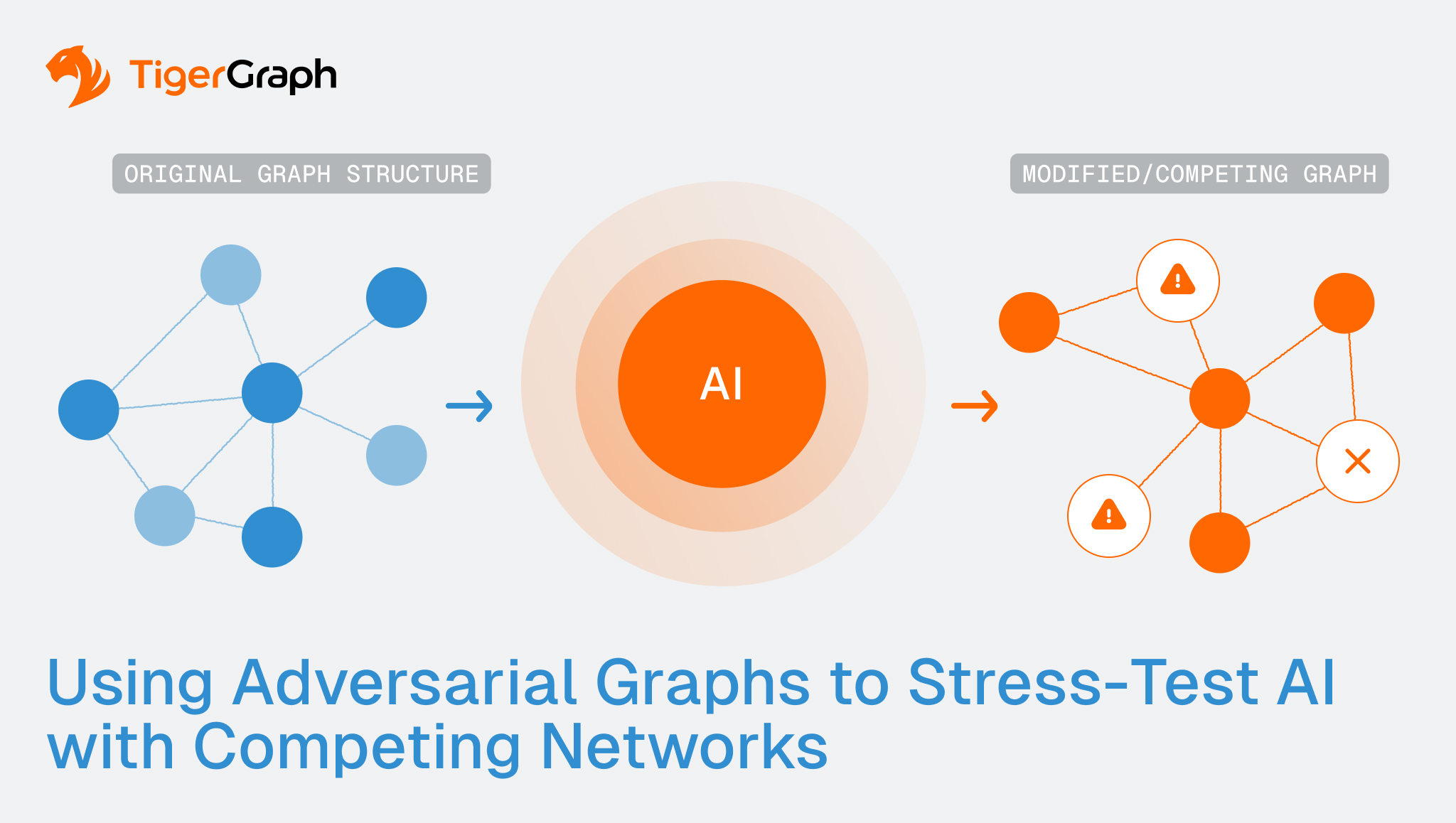
In machine learning, adversarial examples test how models behave when inputs are intentionally manipulated. A similar idea is emerging in graph research. Instead of altering pixels or text, adversarial graph techniques modify the structure of a graph itself by adding nodes, removing edges, or reshaping entire subgraphs to see whether a detection system can still make accurate decisions.
This is not a widely deployed practice yet. But as graph analytics power more fraud, AML, cybersecurity, and AI reasoning systems, the idea of “competitive” or adversarial graphs offers an intriguing direction for stress-testing resilience.
What is an Adversarial Graph?
An adversarial graph is a deliberately modified version of an existing graph. The goal is to test how well an AI or analytic system can detect meaningful patterns when the structure has been distorted.
These distortions can take many forms (which we’ll detail more below), including:
- adding new nodes that mimic legitimate entities
- removing critical edges to obscure relationships
- introducing misleading clusters or motifs
- modifying paths that affect traversal-based decisions
- reshaping neighborhoods to mimic fraud or evasion tactics
The graph becomes a competitor. And now the system must prove it can still reason correctly when the structure changes in unexpected ways.
Graphs Are Uniquely Sensitive to Structure
Most AI inputs are static. Change a pixel in an image or a word in a sentence, and the model sees variation, but the overall structure remains intact.
Graphs are different. A graph’s meaning lives in how everything connects. Change those connections, and the behavior of the system may change too.
For example, removing one edge can break a key path in a fraud network. Adding a synthetic node can create the illusion of a legitimate relationship. And slightly rewiring a community can alter centrality scores or anomaly rankings.
This makes graphs powerful for detection, and sensitive to structural manipulation.
The more graph-powered AI is used in regulated or adversarial environments, the more important it becomes to understand how these systems respond to intentional distortions.
How Competitive Graphs Could Stress-Test AI Detection Systems?
Although adversarial graphs are not commonly deployed in production systems yet, researchers see several promising use cases.
- Evaluating Model Resilience When the Graph Structure Changes
This use case is about the AI model itself and how well it handles imperfect or shifting data.
In real systems, graphs are never static. New relationships appear, old ones fade and occasionally the data is messy or incomplete. A resilient model should still perform well when these changes occur.
Adversarial or competitive graphs give teams a safe way to test this. Slightly modifying the structure reveals whether the model reacts appropriately or falls apart. These adjustments might include:
- removing edges the model expects to rely on
- inserting noisy or misleading relationships
- adding near-duplicate nodes that challenge entity resolution
- introducing alternate pathways that change how information flows
If the model becomes confused by small changes, it signals that the system may be relying too heavily on a narrow slice of the graph. These tests help teams identify weaknesses early, before similar issues appear in real data or in scenarios where attackers attempt to disguise their behavior.
- Evaluating Graph-Based Fraud or AML Models
An adversarial graph can mimic evolving fraud and money laundering tactics, including:
- Splitting transactions across multiple synthetic nodes
Launderers will break transactions into many small pieces so no single entity appears suspicious. Simulating this helps determine whether the model can still see the larger pattern when activity is intentionally fragmented. - Creating “clean” intermediaries
Illicit funds often pass through accounts or businesses that look low-risk at first glance. Adding these intermediaries into a test graph shows whether the model depends too heavily on superficial attributes instead of examining the full chain of relationships. - Rerouting paths through unexpected clusters
When known routes become risky, criminals redirect activity. They use go through new regions, customer segments or merchant types. Testing these scenarios demonstrates whether the system can detect suspicious movement even when it no longer follows familiar pathways.
This shows whether an AML or fraud system can still spot risky behavior when the structure of the network changes and criminals try to disguise their activity.
- Strengthening Graph Guardrails for AI Retrieval
In GraphRAG and hybrid retrieval systems, AI accuracy depends heavily on the graph structure.
Adversarial stress tests can reveal whether:
- The system retrieves the right entities under noisy or cluttered conditions
If the graph contains misleading duplicates or altered relationships, the retrieval layer should still surface the correct objects. Stress-testing ensures it does not get confused by small distortions. - Incorrect edges pull the model toward false context
A single misplaced connection can redirect an LLM’s entire reasoning chain. This shows how sensitive the system is to wrong or unexpected edges. - Validation layers (“graph guardrails”) catch structural anomalies
Guardrails are meant to block impossible or illogical outputs. Adversarial testing confirms that they still function even when the graph itself contains subtle errors.
This mirrors adversarial ML testing but focuses on connections instead of text or images.
- Understanding Graph Algorithms Response When the Structure Is Distorted
This use case is about the graph algorithms, not the AI model.
Many analytical workflows depend on algorithms like centrality, clustering, anomaly detection, or community detection. These methods interpret signals based on how the graph is shaped. When that shape changes, even a little, their results can change too.
Competitive or adversarial graphs help teams explore this behavior. By adjusting the structure in controlled ways, researchers can observe:
- whether key rankings stay consistent
• how communities or clusters shift when the network changes
• whether anomaly scores spike or flatten in unexpected places
• how sensitive the algorithms are to new shortcuts or added noise
This is especially important in areas such as fraud detection, AML, cybersecurity and risk analytics. In these workflows, the “signal” often comes directly from algorithmic outputs. If a slight structural change causes an important pattern to disappear, the team needs to know that before the system is used in production.
These tests help confirm whether the underlying analytics are stable—and whether they will continue providing reliable insights even when the real world changes around them.
Why This Matters Even if Adversarial Graphs Are Not Mainstream (Yet)
The move toward graph-aware AI means that more decisions depend on understanding how information connects across several steps, not just within a single record.
In many enterprise systems, the signal that matters does not sit in one place. It emerges only when the AI can follow chains of relationships. For example, with accounts linked to devices, transactions linked to merchants, suppliers linked to downstream facilities, or patients linked to clinical histories.
This kind of multi-hop reasoning is what allows AI to detect risk patterns, trace the impact of disruptions or understand customer behavior in context.
As organizations rely on AI to interpret these relationship-driven patterns, the importance of a graph model increases. The graph becomes the structure that ensures the AI does not miss connections, misinterpret dependencies or rely on incomplete context when making decisions.
As this trend accelerates, organizations will need stronger tools for evaluating:
- algorithmic robustness
- graph data quality
- sensitivity to manipulation
- resilience against evasion tactics
Adversarial graphs offer a conceptual framework for answering these questions. They are not a product category. They are an emerging idea, like how adversarial ML began. And like adversarial ML, they can reveal blind spots before systems encounter real-world pressure.
Where TigerGraph Fits into This Discussion
TigerGraph is not an adversarial graph generator but it does offer the technical foundation needed to study how graph-based systems behave when the structure of the network changes.
This is valuable because many modern detection and reasoning workloads depend on multi-hop relationships. If those relationships shift, weaken, or fragment, the downstream analytics may behave differently and teams need a safe way to test that.
Real-Time Multi-Hop Computation
TigerGraph can trace how a single modification in the graph influences behavior several steps away. This helps researchers understand whether a detection model remains stable when the surrounding topology changes, whether anomaly scores shift or whether important patterns become harder to see.
Schema-Governed Modeling
Because TigerGraph enforces clearly defined entities and relationships, unexpected or unusual structures stand out. This makes it easier to detect when a test graph intentionally introduces inconsistencies, shortcuts or extra connections to simulate adversarial conditions.
Parallel Processing Over Large Graphs
Scientific and security teams often need to test many variations of a graph at once. TigerGraph’s parallel processing enables them to run multiple small, controlled scenarios and compare how metrics, rankings, or alerts respond under each network version.
Graph Guardrails for AI
When TigerGraph is used in retrieval or reasoning workflows, it supplies structure that helps keep AI models aligned with real relationships. This includes:
• entity-level grounding so the model references the correct objects
• context verification to ensure retrieved data matches known structure
• structural validation to check whether generated statements make sense
These features make AI output more reliable, even when the data changes subtly, the exact scenario adversarial testing is designed to explore.
TigerGraph does not advocate adversarial graphs as a mainstream technique. But its architecture gives researchers and data teams what they need to safely simulate alternative scenarios, stress-test detection pipelines and evaluate how AI systems behave when the graph becomes more complex or less predictable.
Summary
Adversarial graphs extend the idea of adversarial machine learning into the graph domain. They introduce competing or modified versions of a network to evaluate how resilient an AI or analytics system really is.
While still largely conceptual, this approach offers value for fraud detection, AML, cybersecurity, anomaly detection, and graph-powered AI systems that depend on structural correctness.
Graphs carry meaning in their connections. Stress-testing those connections is a natural next step in understanding how graph-based intelligence behaves.
If your team is exploring graph analytics, building AI systems that rely on accurate structure, or evaluating the resilience of detection models, TigerGraph can help. Connect with the TigerGraph team to review graph analytics capabilities, discuss evaluation techniques, and explore architectures designed for reliability at scale.
Frequently Asked Questions
1. How do adversarial graphs reveal weaknesses in graph-based AI systems?
Adversarial graphs expose how easily an AI model can be misled by structural distortions—such as added nodes, missing edges, or rewired communities. By testing these altered networks, teams uncover fragilities in fraud detection, AML models, anomaly scoring, and graph-powered reasoning pipelines.
2. What types of structural attacks are most effective for testing AI resilience in graph environments?
Common structural stress tests include adding synthetic nodes, inserting distracting paths, removing high-value edges, reshaping neighborhoods, and creating deceptive clusters. Each technique highlights how sensitive graph models and algorithms are to small but meaningful topological changes.
3. Why are graph algorithms more sensitive to adversarial perturbations than traditional machine learning inputs?
Graph algorithms depend on connectivity, path structure, and multi-hop context. Even minor graph edits can change centrality rankings, anomaly scores, community assignments, or traversal outcomes—making graph systems inherently more vulnerable to structural manipulation than image or text models.
4. How can adversarial graph testing improve fraud, AML, and cybersecurity defenses?
Simulating evasion tactics—like fragmented laundering paths, clean intermediaries, synthetic identities, or unexpected routing—helps teams verify whether detection pipelines can still trace risk when adversaries deliberately reshape their behavior to avoid monitoring.
5. What role can TigerGraph play in evaluating AI robustness using adversarial graph techniques?
TigerGraph provides real-time multi-hop analytics, schema enforcement, and parallel processing—allowing teams to safely experiment with graph variations and observe how detection models, retrieval systems, and reasoning pipelines respond when network structure is intentionally distorted.