
Summary
- Standard RAG retrieves document chunks once in a single pass and cannot refine retrieval based on intermediate findings or self-correct when context is incomplete.
- Agentic RAG replaces that single-shot process with an iterative reasoning loop: agents plan execution, evaluate intermediate results, invoke specialized tools, and self-correct before producing a final answer.
- Graph databases make agentic retrieval relationship-aware, enabling agents to follow explicit connections between entities across multiple steps rather than approximating those connections through semantic similarity.
- Enterprise workflows in fraud detection, cybersecurity, supply chain, and customer intelligence require connected reasoning across multiple systems – exactly where agentic RAG with graph retrieval outperforms standard approaches.
- TigerGraph powers agentic RAG through relationship-aware retrieval, hybrid graph and vector search, adaptive agentic memory, and traceable decision paths built for production-scale enterprise deployments.
Standard retrieval-augmented generation has practical architectural limits for complex enterprise workflows. It retrieves relevant documents, passes them to a language model, and generates an answer in a single pass. For knowledge lookups and FAQ retrieval, that is often enough. For the work enterprise analysts, investigators, and operational teams actually do, it is not.
Investigating fraud means gathering evidence across multiple accounts, tracing transaction chains, evaluating intermediate findings, and asking follow-up questions before reaching a conclusion. Responding to a cybersecurity incident means connecting indicators of compromise across users, devices, credentials, and network events in real time. Resolving a supply chain disruption means tracing dependencies across suppliers, logistics partners, facilities, and customer orders before recommending a course of action. None of these workflows fit a single retrieval pass.
Agentic RAG addresses this by transforming retrieval from a one-shot step into an iterative retrieval-and-reasoning loop. AI agents retrieve information, evaluate what they have, determine what they still need, and retrieve again, refining their understanding before producing an answer. When paired with a graph database, agents gain the additional ability to follow explicit connections between entities, enabling the kind of multi-step relational reasoning that enterprise problems actually demand.
You’ll learn:
- How agentic RAG works and what makes it fundamentally different from static retrieval
- Why graph databases are the enabling layer for relationship-aware agentic reasoning
- Which enterprise scenarios require agentic RAG and how TigerGraph delivers it at production scale
What Is Agentic RAG?
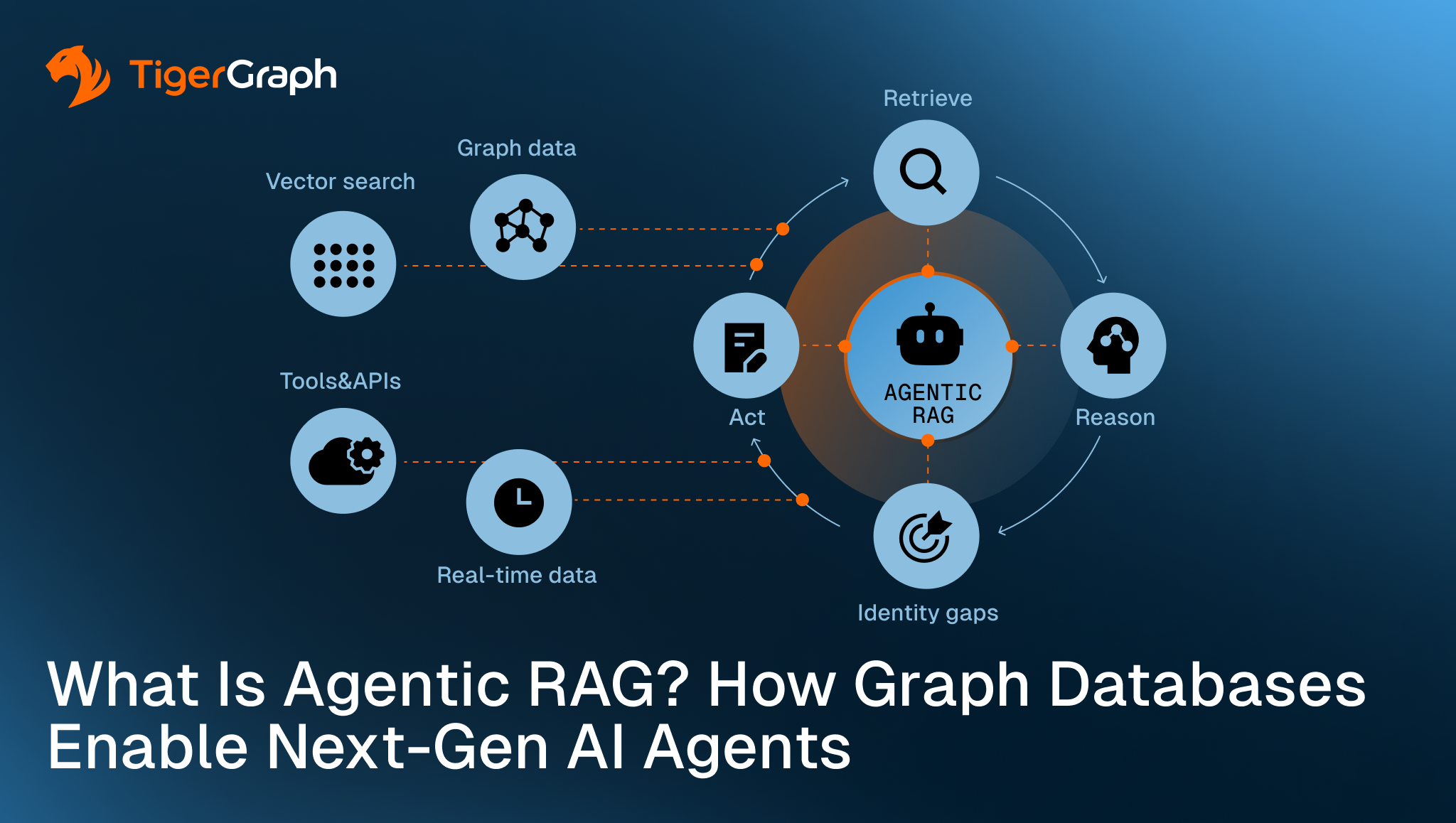
Agentic RAG is an AI architecture in which agents iteratively retrieve information, evaluate intermediate results, and determine whether additional retrieval is required before producing a final answer. Rather than following a fixed retrieve-then-generate pipeline, agentic RAG systems plan their own execution, invoke specialized tools, and self-correct when initial retrieval returns insufficient context. The result is an agent capable of handling multi-step workflows that no single retrieval pass could resolve.
The core shift in agentic RAG is the introduction of a feedback loop. After each retrieval step, the agent evaluates whether the evidence it has gathered is sufficient to answer the question or complete the task. If it is not, the agent determines what additional information it needs, formulates a new retrieval query, and continues. Retrieval becomes an ongoing component of the reasoning process rather than a single step that precedes it.
Agentic systems also plan their own execution. Rather than issuing a single search query, they decompose complex objectives into smaller reasoning tasks and invoke specialized tools as each step requires. An agent handling a fraud investigation might query a transaction database, then follow account relationships to connected entities, then cross-reference behavioral patterns, synthesizing findings at each step before reaching a conclusion. A standard RAG system handles the first query. The rest requires an agent.
A key practical difference is self-correction. A RAG agent can call multiple retrieval tools, including vector search, graph queries, and APIs, depending on what the current reasoning step requires. When intermediate results are insufficient, the agent recognizes this and adjusts its retrieval strategy. Standard RAG has no equivalent mechanism: a failed retrieval produces a degraded answer with no recovery path.
Why Agentic RAG Needs Graph
Enterprise information is inherently connected. Employees belong to teams, teams own products, products depend on suppliers, and suppliers serve manufacturing facilities. Security events connect users, devices, credentials, and network activity. Financial transactions link customers, merchants, accounts, and behavioral patterns. These relationships are often more valuable than the individual records themselves.
Vector retrieval excels at finding semantically similar content, but similarity alone does not capture how entities relate to one another. A document mentioning two suppliers is not the same as understanding which supplier supports which factory or which downstream orders depend on it. That understanding requires explicit relationships, and explicit relationships require a graph.
Graph databases provide this layer by storing entities and their connections as first-class objects. Rather than asking “which document is most similar to my question?”, a graph-powered agentic system can ask “which entities are connected to this customer?” or “which systems are reachable from this compromised endpoint?” A prominent bank uses TigerGraph to analyze 50 million transactions per day for exactly this kind of connected fraud signal. A graph-enabled agentic system can retrieve much more of the reasoning context within a single workflow by following explicit relationships. Standard single-pass RAG typically requires additional retrieval cycles or orchestration to reconstruct the same context.
With graph retrieval added, agents become relationship-aware: they can see who is connected to whom, how, and under what conditions. That awareness means richer context in fewer retrieval cycles, lower token cost, and the ability to build on findings across a session rather than starting fresh with each query. By combining hybrid graph and vector retrieval, organizations access semantic relevance and relational depth together.
Agentic RAG in Enterprise Practice
The difference between standard RAG and agentic RAG is most visible in enterprise workflows involving multiple systems, changing data, and decisions that depend on understanding relationships rather than simply retrieving documents.
Standard RAG has a defined role in these environments. For knowledge management portals, internal documentation search, and single-domain FAQ tools, static retrieval is appropriate and efficient. The case for agentic RAG becomes clear when the task requires gathering evidence across systems, refining conclusions based on intermediate findings, or following connections between entities before a reliable answer can be produced.
In each scenario below, standard RAG can surface relevant information. Agentic RAG extends those capabilities through iterative reasoning, relationship-aware retrieval, and adaptive decision-making. Across these examples, the architectural difference is not the language model—it is the retrieval process supporting the model.
| Enterprise scenario | Where standard RAG falls short | How agentic RAG solves it |
| Fraud investigation | Retrieves individual transactions or reports but cannot reason across connected accounts, identities, and behavioral patterns to uncover fraud networks. | Follows connections across accounts, transactions, and behaviors in a single reasoning loop to identify suspicious networks and escalate high-risk cases. |
| Supply chain operations | Retrieves supplier documents and shipment records but cannot determine which products, facilities, and customer orders depend on a disrupted supplier. | Retrieves connected supplier, logistics, inventory, and order relationships to identify downstream impacts in real time and recommend mitigation actions. |
| IT and network operations | Retrieves logs, incident reports, and threat intelligence but cannot reconstruct relationships between users, devices, credentials, and attack paths. | Follows connections across devices, identities, network activity, and threat patterns to produce explainable attack paths with traceable reasoning. |
| Enterprise knowledge | Retrieves relevant documents but treats each request independently, lacking relationship awareness and persistent context across interactions. | Reasons across policies, organizational structures, products, and operational systems, while adaptive memory preserves context across multi-step conversations. |
Although these scenarios span different industries and business functions, they share a common characteristic: answering the question requires understanding how entities connect. Whether those entities are accounts, suppliers, devices, or organizational structures, graph-enabled retrieval provides the context agents need to reason across those connections rather than treating each document as an isolated source of information.
How TigerGraph Powers Agentic RAG
TigerGraph powers agentic RAG through five capabilities that enterprise deployments require and standard vector retrieval cannot provide.
Relationship-aware retrieval. Agents retrieve connected enterprise context alongside semantically relevant content, allowing reasoning to incorporate both relationship structure and semantic similarity. This enables accurate multi-step reasoning across people, systems, events, and operational data in a single retrieval pass.
Adaptive agentic memory. Agents store and retrieve structured knowledge about prior decisions and relationships discovered across a session. Each step builds on what came before rather than starting retrieval from scratch, which reduces unnecessary retrieval cycles and keeps reasoning grounded in accumulated context.
Traceable decision paths. TigerGraph agents produce traceable decision paths: audit trails that show exactly how the agent reasoned from retrieved data to a conclusion. For regulated industries, this is not a reporting convenience; it is the condition under which an AI-generated answer can be acted on.
Hybrid graph and vector retrieval. A single query performs both semantic similarity search and graph-based relational retrieval together. Agents surface content that neither approach would find alone, combining the broad reach of vector search with the relational precision of graph queries.
MCP server integration. TigerGraph connects to popular AI frameworks and language models through MCP-based connectivity, allowing agents built on any major framework to use TigerGraph retrieval directly. The TigerGraph MCP Server lets agents build, retrieve from, and manage the graph without bespoke integration work.
Together, these capabilities address the core constraint that limits standard RAG in enterprise environments: agents are only as effective as the context they can access. TigerGraph’s native graph database, combined with integrated vector search and real-time data ingestion, ensures that context reflects current operational state rather than a stale document index.
TigerGraph also supports enterprise verticals directly through solution kits for fraud and financial crime detection, customer intelligence, cybersecurity, and supply chain operations. These pre-built accelerators cover the graph data models, retrieval patterns, and integration templates that enterprise teams would otherwise build from scratch, compressing months of implementation work into weeks. For organizations that need to move from proof of concept to production, solution kits eliminate the most time-consuming part of deployment: building the graph schema and retrieval logic that makes agentic reasoning accurate on real enterprise data.
Agentic AI Becomes Practical at the Graph Layer
Agentic RAG is the architectural foundation for enterprise AI agents that do real work. By combining iterative reasoning, tool use, and self-correction, it enables agents to handle complex multi-step workflows that static retrieval cannot reach.
Graph technology is what makes that capability production-ready. Relationship-aware retrieval gives agents the connected context they need to reason across entities rather than documents. Adaptive memory lets them build understanding across the full arc of a workflow. Traceable decision paths make their answers auditable rather than merely plausible.
For enterprises deploying AI in fraud detection, cybersecurity, supply chain management, or customer intelligence, the question is no longer whether agentic RAG is the right architecture. It is whether the retrieval layer underneath it can follow relationships at enterprise scale, keep pace with live operational data, and produce answers that can be audited, not just acted on in good faith. That is where TigerGraph makes the difference.
The pattern across enterprise deployments is consistent: agentic systems built on flat vector retrieval hit a ceiling when problems require connecting entities across systems. Adding graph retrieval helps overcome many of these architectural limitations by providing explicit relationship context that standard retrieval alone does not supply. Agents that previously required multiple retrieval cycles to approximate a relational answer can now retrieve connected context in a single pass, which reduces token cost, improves latency, and raises answer quality on exactly the queries that matter most.
Explore how TigerGraph delivers connected context for enterprise agentic AI. To see it running against your own data, request a demo or explore the free trial.
FAQs
What is agentic RAG?
Agentic RAG is an AI architecture in which agents iteratively retrieve information, evaluate intermediate results, and determine whether additional retrieval is needed before producing a final answer. Unlike standard RAG, which retrieves documents once and generates a response in a single pass, agentic RAG systems plan their own execution, invoke specialized tools, and self-correct when initial retrieval returns incomplete context. This makes agentic RAG suitable for complex, multi-step enterprise workflows that a single retrieval pass cannot resolve.
How does agentic RAG differ from standard RAG?
Standard RAG is a one-shot process: retrieve relevant document chunks via semantic similarity search, pass them to the language model, and generate a response. There is no feedback loop and no ability to refine retrieval based on what the model finds. Agentic RAG introduces a continuous evaluation loop in which the agent assesses whether it has enough context after each reasoning step, retrieves additional information when needed, and self-corrects before producing a final answer. The practical difference is that agentic RAG can handle problems that require gathering evidence across multiple steps; standard RAG cannot.
Why do agentic AI systems need graph databases?
Enterprise questions frequently require connecting information across multiple entities, systems, and relationship layers. Vector retrieval returns semantically similar documents but cannot follow explicit connections between entities. A graph database stores entities and relationships as first-class objects, enabling agents to query “which accounts are connected to this flagged entity through more than two transaction layers?” rather than “which documents are most similar to this query?” Graph retrieval gives agents relationship-aware context in fewer retrieval cycles, reducing token cost and improving reasoning accuracy on connected-data problems.
Does TigerGraph support agentic RAG natively?
Yes. TigerGraph combines a native graph database with integrated vector search and real-time data ingestion in a single platform. Agents can perform hybrid graph and vector retrieval in a single query, accessing both semantic similarity and relational context together. TigerGraph also supports adaptive agentic memory, allowing agents to store and retrieve structured knowledge about prior decisions across a session. MCP server integration lets agents built on major AI frameworks connect to TigerGraph retrieval directly, without custom integration work.
Which enterprise use cases benefit most from agentic RAG?
Agentic RAG delivers the greatest advantage in workflows where the answer requires connecting facts across multiple entities, systems, or relationship layers. The clearest examples are fraud investigation (tracing transaction networks across multiple account layers), cybersecurity threat analysis (connecting indicators of compromise across users, devices, and network events), supply chain disruption response (tracing downstream impacts across suppliers, logistics partners, and customer orders), and customer intelligence (assembling a complete view of a customer’s relationships and behaviors across fragmented data sources). In each case, the problem is defined by connections between entities, and graph-enabled agentic retrieval is the architecture that matches that structure.