
Summary
- Agentic AI systems fail in production when the data layer cannot retrieve connected, current, or explainable enterprise context. The root cause is rarely the model or the orchestration framework.
- Graph databases store business entities and their relationships as an explicit connected structure, enabling agents to follow relationship chains across accounts, suppliers, devices, and events in real time.
- Vector search and graph retrieval solve different problems: vector search finds semantically similar content; graph retrieval follows the relationships between specific entities. Enterprise agents need both.
- Four architecture patterns match graph to agent complexity: a single agent with a graph retrieval tool, multi-agent shared graph memory, an agentic RAG loop with graph as the retrieval substrate, and an MCP-connected agent with live graph access.
- TigerGraph’s agentic AI stack covers all four layers: tool access via MCP Server, retrieval via GraphRAG and hybrid search, data and memory via the graph database, and cloud deployment via TigerGraph Savanna. Preconfigured solution kits cover fraud detection, supply chain, and other enterprise use cases.
Your agentic AI system produces a confident recommendation. The plan is structured. The reasoning reads as sound. But the action it proposes is wrong. The failure has nothing to do with the model you selected or the orchestration framework you built around it.
The problem often begins in the data layer. The agent retrieved documents that mentioned the relevant supplier, account, or device, but it could not reconstruct the relationships among them. It did not know that the supplier feeds three production lines, that two of those lines share components with a flagged vendor, or that the account it approved had transferred funds through an entity under active review. The context it needed was never there to retrieve.
Most guidance concentrates on the visible layers: the model that plans, the framework that coordinates actions, and the tools the agent can call. The data layer is often treated as a connector added near the end of development. That approach works for demonstrations, but it becomes a production risk when an agent must reason across suppliers, accounts, devices, policies, incidents, or other connected business entities.
The central question is therefore not only, “Which model should the agent use?” It is also, “What data structure will give the agent current, connected, and explainable context?”
You’ll learn:
- The three data-layer failure modes that undermine most agentic AI systems in production
- How graph databases provide relationship-aware, real-time, and traceable context that vector search cannot
- Four architecture patterns for integrating graph into single-agent and multi-agent systems
- How TigerGraph maps its capabilities to each layer of the agentic AI stack
The Core Components of an Agentic AI Architecture
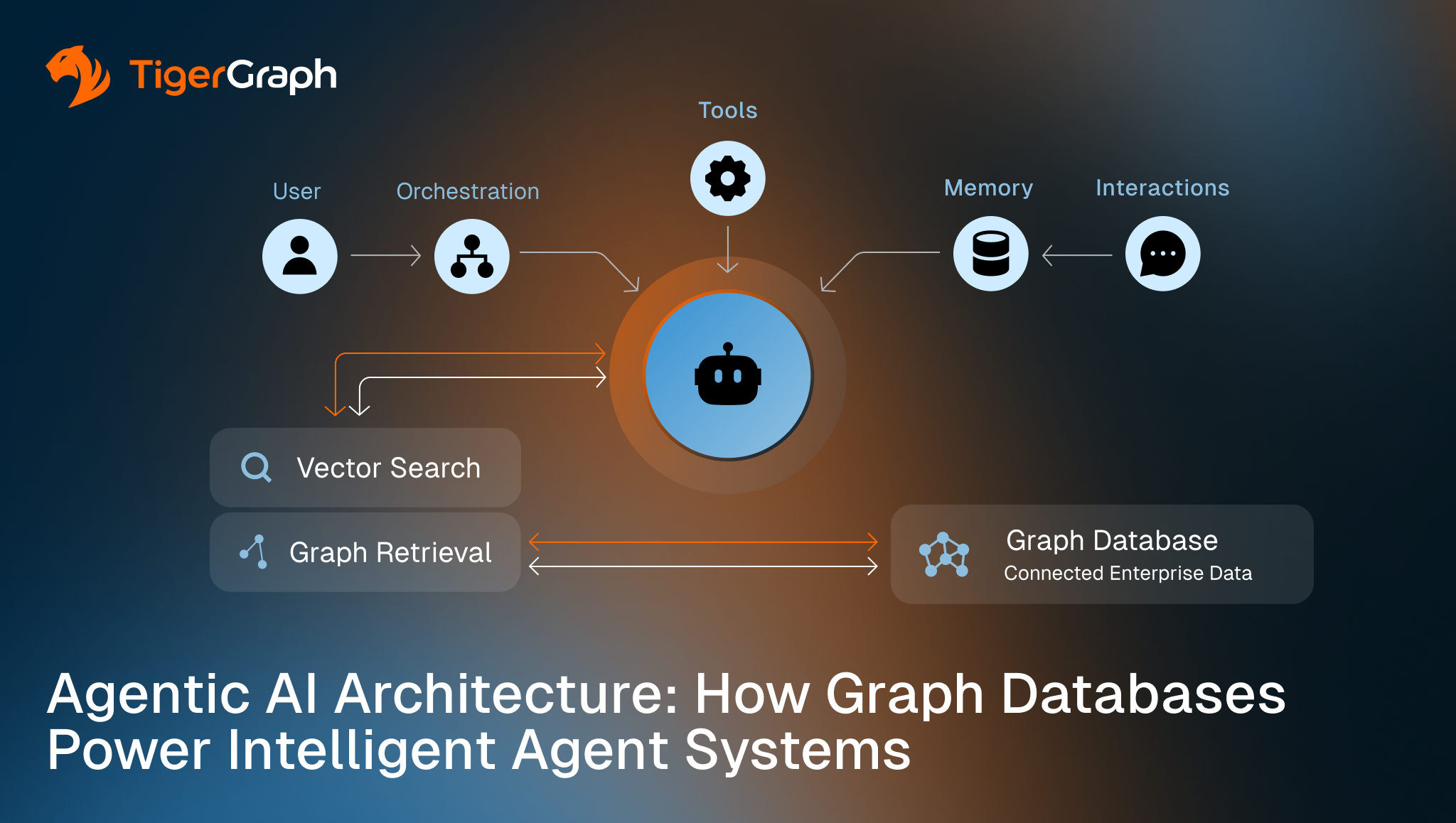
An agentic system is a collection of interacting layers. Each has a distinct responsibility, but the system succeeds only when information moves reliably between them.
The LLM is the reasoning engine. It interprets the goal, evaluates available context, develops a plan, and generates a response or action. Model quality cannot compensate for incomplete or misleading retrieval.
The orchestration framework manages the workflow. Frameworks such as LangChain, LlamaIndex, AutoGen, and CrewAI help developers define planning loops, tool selection, retries, and handoffs. In a multi-agent system architecture, the orchestration layer may also assign work to specialized agents and combine their results.
Tools connect the agent to external systems. These may include application APIs, search services, databases, ticketing systems, and analytical services. Tools turn the LLM from a text generator into a system that can gather information and take controlled action.
Memory preserves relevant state. Short-term memory maintains the active task. Long-term memory stores useful information across sessions, including prior decisions, recurring entities, and completed workflow steps.
The retrieval and data layer supplies grounding. The orchestration layer determines what the agent needs, the retrieval layer fetches it, and the resulting context is sent to the LLM. Current architecture guidance separates models, tools, memory, runtime, and agent development components because these choices affect performance, cost, security, and scalability.
Where Most Agentic Architectures Break Down
When your agent produces an unsupported answer or takes the wrong action, teams often blame hallucination, weak planning, or the selected model. Many failures, however, begin in the way enterprise context is stored and retrieved.
The Relationship-Chain Problem
Vector search is useful for finding passages with similar meaning. It is not designed to answer questions whose meaning depends on connected business relationships.
Consider a supply chain agent asked, “Which products and customers are exposed if this distributor stops operating?” The answer requires connections among the distributor, shipments, suppliers, components, production sites, inventory, products, and customer commitments. Documents that mention the distributor may provide background, but they do not reconstruct the dependencies needed for a decision.
The Staleness Problem
Many RAG pipelines depend on indexes created from periodic document snapshots. The agent may retrieve information that was correct when indexed but no longer reflects current inventory, account ownership, transaction activity, permissions, service dependencies, or risk status.
For an enterprise agent that acts rather than merely answers, stale context is an operational defect. A logical plan based on yesterday’s system state can still be the wrong plan.
The Explainability Problem
Similarity scores show that retrieved text is mathematically close to a query. They do not show why a supplier, account, device, or policy is connected to the decision. That limitation is structural: vector embeddings represent data as artificial numeric dimensions, and neither the embeddings themselves nor the search scores indicate which dimensions correspond to actual business relationships or how much weight each carries. The result is a similarity match without an audit trail.
That matters in fraud, compliance, healthcare, cybersecurity, and other consequential workflows. Reviewers need to see the entities, relationships, evidence, and sequence behind a recommendation. Replacing the LLM cannot create an audit trail if the underlying data layer never represented the relationships that justify the decision.
Why Graph Databases Belong in the Agentic AI Architecture
Relationship-aware retrieval lets an agent follow the relevant chain from a starting entity to the wider business context. A fraud agent can connect an account to transactions, devices, identities, addresses, and related accounts. A network operations agent can connect an alert to services, dependencies, recent changes, and affected customers.
Real-time operational context allows the agent to reason over changing events and relationships instead of relying only on periodic document snapshots. New transactions, incidents, ownership changes, inventory updates, and workflow decisions can become part of the context the agent uses.
Traceable decision paths make retrieved context inspectable. Rather than returning only a similar passage, the system can show which connected facts led to the recommendation.
Graph retrieval should complement, not replace, vector search. Vector search is well suited to unstructured content such as manuals, policies, case notes, and contracts. Graph retrieval is well suited to entity relationships, dependencies, history, and operational state. A hybrid architecture combines both before assembling the LLM context.
| Architecture concern | Generic retrieval approach | Graph-grounded approach |
| Context | Isolated records or similar passages | Relationship-aware retrieval |
| Reasoning cycle | Repeated searches to rebuild context | Context-guided reasoning |
| Memory | Often limited to a session | Adaptive agentic memory |
| Explainability | Limited visibility into result selection | Traceable decision paths |
The principle is straightforward: AI agents are only as effective as the context they can access.
Four Agentic Architecture Patterns with Graph
Graph can enter the agent stack through several patterns. The right choice depends on task complexity, the number of agents, data freshness, and how much shared context the workflow needs.
1. Single Agent with a Graph Retrieval Tool
One LLM-based agent receives a graph retrieval tool alongside web search, vector search, application APIs, and other tools.
The orchestration layer selects the graph tool when the task requires connected context. A customer service agent, for example, might use vector search to retrieve a warranty policy, then graph retrieval to connect the customer, product, purchase, prior cases, replacement history, and current entitlement.
This pattern fits self-contained applications with clearly defined responsibilities. It adds relationship intelligence without the coordination overhead of multiple agents. Current design guidance similarly describes a single-agent system as a model, a defined toolset, and instructions that enable planning and multi-step execution.
2. Multi-Agent System with Shared Graph Memory
Complex workflows often divide work among a planner, researcher, risk evaluator, policy checker, and execution agent. Without shared memory, agents may retrieve the same information, maintain conflicting task views, or lose context during handoffs.
A shared graph memory stores entities, relationships, observations, decisions, and task state. The research agent can add verified findings; the risk agent can attach an assessment; the execution agent can see approvals and dependencies before acting.
This pattern fits long-running workflows where agents must collaborate without repeatedly reconstructing context. Multi-agent reference architectures likewise use coordinator and specialized agents to divide complex processes into discrete tasks.
3. Agentic RAG Loop with Graph as the Retrieval Substrate
In an agentic RAG loop, the agent retrieves context, generates an intermediate answer or plan, evaluates whether the evidence is sufficient, and retrieves again when necessary.
Graph retrieval makes that loop more deliberate. Instead of receiving disconnected chunks, the agent receives connected context around the relevant entities. It can identify missing relationships, expand the investigation in a targeted direction, and stop when the evidence satisfies the task.
Hybrid retrieval strengthens the pattern. Vector search finds semantically relevant content, while graph retrieval verifies how that content relates to the actual customer, product, account, policy, or event. TigerGraph’s guide to Agentic GraphRAG explains how structural and semantic context support iterative, verifiable retrieval.
4. MCP-Connected Agent with Live Graph Access
The Model Context Protocol standardizes how agents interact with tools such as databases, file systems, and APIs. An MCP server exposes approved graph capabilities, and the agent queries or manages graph data through that controlled interface.
The orchestration layer decides when connected context is needed, the MCP client sends the request, and the server invokes the permitted graph operation. This pattern suits enterprise deployments that need live operational context without rebuilding static indexes for every change. It also creates a clearer boundary for tool permissions, validation, monitoring, and governance.
TigerGraph’s Agentic AI Stack
TigerGraph Agentic AI maps graph capabilities into the architectural layers used to build production agent systems.
Tool and data access: TigerGraph MCP Server. The server lets AI systems build, retrieve from, and manage a TigerGraph database through an agent-accessible tool interface. This supports MCP-connected agents and lets popular AI frameworks and LLMs access connected enterprise context without embedding database-specific behavior throughout the application.
Retrieval: TigerGraph GraphRAG and hybrid retrieval. TigerGraph combines knowledge graphs, vector search, and real-time enterprise data. Teams can use semantic similarity for unstructured content and relationship-aware retrieval for entities, dependencies, and operational context. The vector database integration supports this graph-plus-vector design.
Data and memory: TigerGraph Database. The database provides a connected representation of enterprise entities, relationships, events, and operational systems. That foundation supports context-guided reasoning, adaptive agentic memory, and traceable decision paths. A knowledge graph can also encode the domain meaning an agent needs to interpret enterprise data correctly.
Implementation patterns: TigerGraph Solution Kits. Preconfigured patterns for fraud detection, entity resolution, supply chain management, network analysis, and other use cases give teams a practical starting point without building from scratch.
Cloud deployment: TigerGraph Savanna. Savanna provides cloud infrastructure with independently scalable storage and compute, allowing teams to align graph resources with changing agent workloads.
Better connected context also reduces unnecessary retrieval and reasoning cycles because the agent receives the relationships needed to act instead of repeatedly searching for isolated fragments.
Build the Data Layer Before Scaling the Agent Layer
Agentic AI architecture spans the model, orchestration, tools, memory, retrieval, and data layers. Teams often invest heavily in the first three because they shape how an agent behaves in a demonstration. Production reliability, however, depends on whether the system can retrieve current, connected, and explainable enterprise context.
Graph databases address the three data-layer failures that undermine intelligent agents: incomplete relationship reasoning, stale operational context, and opaque retrieval. A sound agentic AI architecture implementation can begin with one agent and a graph tool, expand into shared graph memory for multiple agents, add iterative GraphRAG, or expose live graph capabilities through MCP. Each step brings the system closer to the connected, current, and explainable context that distinguishes production-grade agentic AI from a successful demonstration.
| Explore TigerGraph’s agentic AI capabilities and see how the MCP Server, GraphRAG, and solution kits work together. |
| Ready to build? Start with TigerGraph’s free tier or request a demo to see connected context in action for your use case. |
FAQs
What is agentic AI architecture?
Agentic AI architecture is the layered design of an AI system that can plan, retrieve information, take actions, and reason across multiple steps without continuous human direction. It typically includes an LLM as the reasoning engine, an orchestration framework, a tool layer connecting the agent to external systems, a memory layer, and a retrieval and data layer that supplies grounding context. The data layer is where most production failures originate: agents that cannot access current, connected enterprise data produce plans that are logically coherent but operationally wrong.
Why do AI agents fail to reason across connected enterprise data?
Most agentic AI retrieval relies on vector search, which finds semantically similar content but does not reconstruct relationships between specific entities. When an agent needs to know how a distributor connects to suppliers, production lines, inventory, and customer commitments, vector search returns relevant passages rather than the dependency chain itself. Graph databases store those relationships explicitly, allowing the agent to follow the actual connections rather than approximate them from document similarity.
What is the difference between graph retrieval and vector search in agentic AI?
Vector search finds content that is mathematically similar to a query using embedding representations. It is well suited to unstructured content: policies, manuals, case notes, and contracts. Graph retrieval follows the explicit relationships between named entities: accounts, transactions, devices, suppliers, services. The two methods are complementary. A robust agentic RAG loop uses vector search to identify relevant unstructured content and graph retrieval to verify how that content connects to the actual entities involved in the decision.
Does TigerGraph support agentic AI and multi-agent systems?
Yes. TigerGraph’s agentic AI stack is designed to serve all four layers where graph matters in agent systems. The TigerGraph MCP Server exposes graph capabilities as agent-accessible tools, compatible with LangChain, LlamaIndex, AutoGen, and other orchestration frameworks. TigerGraph GraphRAG supports hybrid retrieval combining graph and vector search. The TigerGraph database provides the shared memory and connected context that multi-agent workflows need. TigerGraph Savanna provides cloud deployment with independently scalable storage and compute.
How do I get started with a graph database in an agentic AI architecture?
The simplest entry point is a single agent with a graph retrieval tool. Define one use case where the agent must reason across connected entities: fraud investigation, supply chain impact analysis, or IT incident response. Connect a TigerGraph database to that agent as a retrieval tool alongside existing vector search. TigerGraph Solution Kits provide preconfigured starting points for fraud detection, entity resolution, supply chain management, and network analysis, reducing the time from initial setup to production-ready retrieval.