
Summary
- AI agents working across long-running enterprise workflows need more than conversation history: they need memory that preserves facts, decisions, and outcomes while maintaining context and continuity as the work evolves.
- Effective agentic memory requires entity continuity (consistent understanding of entities across interactions and over time), connected context (preserving the relationships among facts, actions, and outcomes), temporal awareness (distinguishing current from historical information), and traceable provenance (linking conclusions to the evidence behind them).
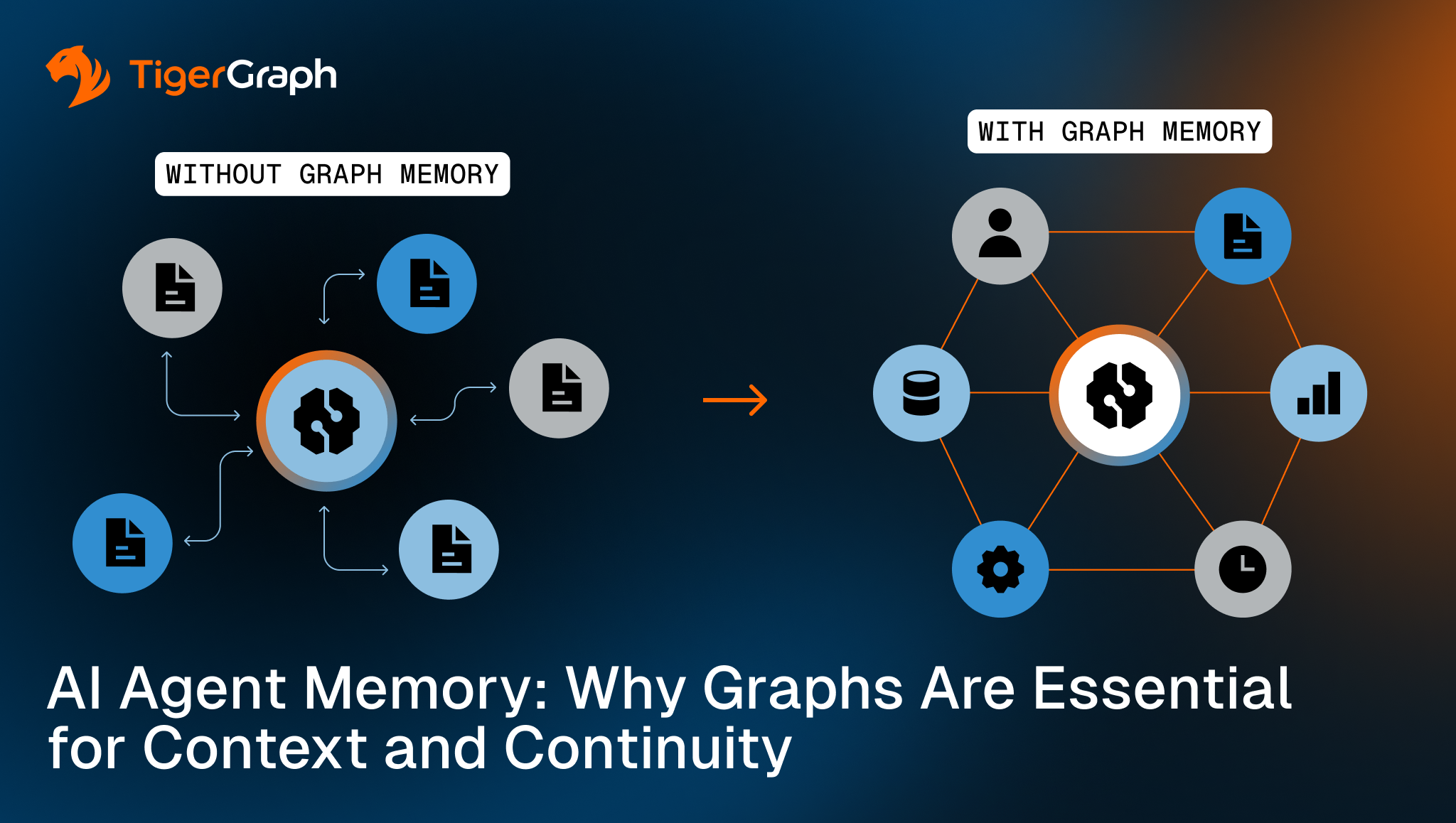
- Graphs provide a natural structure for agent memory because they store information as connected entities and relationships, enabling agents to recall not just isolated facts but how those facts connect to users, actions, policies, evidence, and outcomes.
- The strongest memory architectures combine graph retrieval with vector search: vector retrieval finds semantically similar content while graph retrieval provides explicit relationship context, dependencies, history, and provenance paths.
- TigerGraph provides an enterprise graph foundation for AI agent memory through its graph database, GraphRAG capabilities, vector search integration, and MCP Server connectivity for agent frameworks.
An enterprise fraud agent investigates a suspicious account on Friday. It links several transactions to a business, reviews an earlier alert, and records why the case needs more scrutiny.
On Monday, another transaction appears. If the agent starts from scratch, it may retrieve Friday’s notes. But finding those notes is not enough. It also needs to understand that the new account is connected to the same business, that an earlier customer was involved, and that an investigator already made a decision based on those relationships.
That is the problem agentic memory needs to solve.
AI agents working across long-running enterprise workflows need more than conversation history. They need persistent memory that preserves facts, experiences, decisions, and the relationships among them.
Graphs provide a natural foundation for that memory because they store context as a connected structure rather than a collection of isolated records. The result is AI agent memory that helps an agent recall what happened, understand how it relates to the present, and use that context to make its next decision.
You’ll learn:
- Why conversation history and vector retrieval alone are not sufficient for enterprise agentic workflows
- What makes graphs a natural structure for persistent, connected agent memory
- How connected memory changes what agents can do in financial crime investigation, supply chain operations, and enterprise knowledge workflows
- What enterprise-grade agent memory requires and how TigerGraph supports it
What Is Agentic Memory?
Agentic memory is the persistent system an AI agent uses to retain, retrieve, update, and apply useful information across steps, tasks, and sessions. It extends beyond the context window (which contains only the information available during the current inference) to preserve facts, experiences, decisions, and relationships that can influence the agent’s next action. Effective agentic memory allows an agent to maintain continuity, recognize patterns across interactions, avoid repeating failed approaches, and carry relevant context from one decision to the next.
Memory is related to context, but the two are not the same. A context window contains the information available to a model during a particular inference. Retrieval brings external information into that context when needed. Memory preserves useful information from previous interactions and actions so it can influence future work.
Agent frameworks commonly distinguish between short-term and long-term memory. Long-term memory is often divided into:
- Semantic memory: facts about users, organizations, policies, products, or systems
- Episodic memory: previous actions, interactions, decisions, and outcomes
- Procedural memory: instructions or learned patterns that guide how work should be performed
For an enterprise agent, short-term memory may contain the investigation currently in progress, while long-term memory preserves the customer, account, policies, previous alerts, and prior decisions related to that investigation.
The challenge is not merely retaining these memories. The agent must retrieve the right memory and understand how it relates to everything else it knows.
Why Simply Storing More History Is Not Enough
The simplest way to give an agent memory is to preserve conversation history. That works for short interactions, but it weakens as tasks become longer.
Conversation histories accumulate stale information, consume context-window capacity, and can distract the model from the current decision. Persistent storage solves retention, but another problem remains: organization.
Suppose an agent separately stores these facts:
Acme Manufacturing owns Northstar Components. Northstar Components supplies a pressure valve. The pressure valve is used in Product A. Product A is manufactured at a facility affected by a disruption.
Every fact is available. But retrieving only one or two may not reveal the full supply chain dependency. Vector search helps by finding semantically similar information. If an agent asks about a supplier disruption, vector retrieval can surface documents, messages, and previous cases discussing similar suppliers or disruptions.
But similarity and relationship are different questions. A supplier may not be semantically similar to a product, facility, shipment, or customer. What matters is that they are connected. Enterprise agents therefore need more than persistent storage and similarity retrieval. They need memory that preserves the structure connecting entities, events, evidence, and previous decisions.
Why Graphs Are a Natural Structure for AI Agent Memory
A graph represents information through entities and the relationships among them. That makes it well suited to memory where connections are as important as individual facts.
Entity Continuity
Enterprise information rarely gives an agent one clean record for every real-world entity. The same customer may appear in a CRM, transaction system, support platform, and fraud investigation database. A supplier may appear under different identifiers across procurement and logistics systems.
A graph can maintain a persistent representation of that entity and connect new information back to it. Instead of remembering several unrelated mentions of the same organization, the memory layer can preserve that those observations refer to one entity with multiple relationships and events.
Connected Context
The greater advantage is that memories do not have to exist in isolation. Consider a supply chain agent:
Supplier supplies Component. Component is used in Product. Product is manufactured at Facility. Facility serves Market.
A flat memory store can preserve each statement. A connected memory system preserves the relationships among them. When a supplier becomes unavailable, the agent can understand which components, products, facilities, and markets may be affected.
The same principle applies elsewhere. Financial crime agents may connect customers, accounts, devices, transactions, and previous investigations, while cybersecurity agents relate identities, vulnerabilities, applications, alerts, and remediation actions.
The relevant memory is often the network surrounding a fact.
Temporal Context
Useful memory must also distinguish what happened before from what is true now.
A supplier considered low risk six months ago may now be under review. A policy governing an earlier decision may have been replaced. An alert previously dismissed as isolated may become significant after related events appear.
Connected memory can associate events, decisions, relationships, and timestamps so an agent can ask what changed, what was true when a decision was made, which information is current, and what happened after a previous action.
Provenance and Explainability
Enterprise agents may also need to show why they acted. If an agent escalates a transaction, changes a supplier risk rating, or recommends a cybersecurity response, the organization may need to trace that decision back to the evidence behind it.
A connected memory structure can preserve links between a conclusion and the documents, events, entities, policies, or prior actions that informed it. This supports more explainable decision-making than a memory system that returns isolated snippets without their surrounding context.
Shared Memory
Connected memory also helps multiple agents work from the same enterprise context. Investigation, compliance, and reporting agents can share a governed memory layer of entities, events, relationships, and outcomes while retrieving only what their roles require.
From Passive Storage to Active Memory
The term agentic memory implies more than giving an agent access to a database.
A useful memory system must decide what deserves to persist, how new information relates to existing knowledge, when information should be retrieved, and when stale memory should be updated or retired.
A conceptual memory lifecycle looks like this: observe what happens, select what matters, connect it to existing knowledge, retrieve relevant memory, reason over the context, act, and update the memory with the outcome.
Enterprise agents should not remember everything forever. They should retain useful information, preserve important relationships, distinguish current from obsolete knowledge, and retrieve the right subset for each decision.
Agentic memory is therefore not simply RAG applied to old conversations. It is a memory system that evolves as the agent interacts with its environment.
Context Window vs. Vector Memory vs. Graph Memory
Different mechanisms solve different parts of the memory problem.
| Capability | Context Window | Vector-Based Memory | Graph-Based Memory |
| Persists across sessions | Limited by application design | Yes | Yes |
| Semantic similarity retrieval | Limited | Strong | Strong when combined with vectors |
| Explicit relationships | Weak | Limited | Strong |
| Connected context | Weak | Limited | Strong |
| Historical dependencies | Limited | Indirect | Strong |
| Provenance paths | Limited | Indirect | Strong |
| Best fit | Current task context | Similar content and examples | Persistent relational context |
This does not make vector search unnecessary. Vector retrieval is valuable when an agent needs semantically similar documents, messages, or prior cases. Graph retrieval is valuable when the answer depends on explicit relationships, dependencies, chronology, or provenance.
The strongest memory architectures can therefore combine semantic relevance with relational context rather than forcing organizations to choose one approach.
What Connected Memory Changes for Enterprise Agents
The value becomes clearer when agents move from answering questions to supporting operational workflows.
Financial Crime Investigation Agents
A financial crime agent may work across transactions, alerts, customers, accounts, devices, companies, and previous cases.
Persistent memory allows it to recall earlier investigations. Connected memory helps it recognize that a newly flagged account shares a device with an account investigated months earlier, belongs to a related company, or exhibits behavior linked to a prior case.
The agent does not simply retrieve an old report. It understands why the old investigation is relevant now.
Supply Chain Operations Agents
A supply chain agent can retain previous disruptions, supplier assessments, mitigation actions, and outcomes.
When a new supplier event occurs, connected memory places it within the network of suppliers, components, products, facilities, shipments, and markets. The agent can compare the current event with past disruptions while recognizing which dependencies have changed.
Enterprise Knowledge Agents
Enterprise knowledge agents need more than document retrieval. They may need to remember previous questions, decisions, policies, employees, systems, projects, and authoritative sources.
When a policy changes, connected memory can preserve which policy applied to an earlier decision, when it was effective, and which newer policy replaced it.
Across these examples, the pattern is the same:
Recall what happened, connect it to relevant context, reason over the relationships, take the appropriate action, and preserve the outcome for future decisions.
The value comes from remembering in a form that supports the next decision.
What Enterprise-Grade Agent Memory Requires
As agents take on consequential workflows, memory becomes part of enterprise AI infrastructure. An agent needs a memory that preserves the contextual and temporal fabric of what it has learned and done, building richer context as the work continues.
To fulfil that role, an enterprise AI agent memory layer should be:
- Persistent: Important information survives prompts, sessions, and restarts.
- Connected: Entities, facts, actions, policies, evidence, and outcomes retain their relationships.
- Current: Agents can distinguish active information from historical or superseded information.
- Selective: Retrieval surfaces decision-relevant memory instead of replaying the entire past.
- Traceable: Stored knowledge retains provenance.
- Governed: Agents retrieve only memory they are authorized to access.
- Scalable: Performance remains operational as agents, entities, events, and relationships accumulate.
These requirements become more important as enterprises move from copilots that generate responses to agents that investigate, recommend, coordinate tools, and act. Memory then becomes part of the agent’s decision infrastructure.
How TigerGraph Supports Persistent, Connected Agent Memory
TigerGraph provides an enterprise graph foundation for AI systems that need persistent, relationship-aware context.
Organizations can use graph structures to connect enterprise entities, events, interactions, decisions, documents, and operational signals instead of treating each as an isolated memory record.
TigerGraph also combines graph and vector capabilities. Vector search can retrieve memories or documents based on semantic relevance, while graph queries can expand from those results into the relationships surrounding them. This supports hybrid retrieval that combines similarity with connected enterprise context.
The result is a foundation for agent memory that can preserve identity, relationships, history, and provenance while incorporating new information over time.
TigerGraph does not replace the language model or agent framework. It provides the connected data layer from which agents can retrieve the context needed to reason and act.
For teams ready to move from architecture to implementation, the Hands-On with Context Graphs tutorial shows how this type of persistent, relationship-aware memory layer can be constructed.
Agents Need Memory That Connects the Past to the Present
The goal of agent memory is not to make an AI system remember everything. It is to help the agent retrieve what matters, how it is connected, what has changed, and why previous information matters to the decision in front of it.
As enterprise agents move from answering questions to executing long-running workflows, that distinction becomes critical. Persistent storage provides history. Connected memory turns that history into usable context.
Graphs provide the relationship structure needed to make that possible. Combined with semantic retrieval and real-time enterprise data, they give AI agents a persistent, explainable foundation for carrying context from one decision to the next.
Ready to build a graph-based agentic memory layer? Explore TigerGraph’s free tier or request a demo.
FAQs
What is agentic memory?
Agentic memory is a system that allows an AI agent to retain, retrieve, update, and apply information across tasks and sessions. It helps agents use previous facts, experiences, decisions, and outcomes when deciding what to do next.
How is AI agent memory different from a context window?
A context window contains the information available to a model during the current inference. AI agent memory persists useful information beyond that immediate context so it can be retrieved during future tasks or sessions.
What types of memory do AI agents use?
AI agents commonly use short-term memory for active task state and long-term memory for persistent information. Long-term memory may include semantic memory for facts, episodic memory for experiences, and procedural memory for instructions.
Can a vector database provide AI agent memory?
Yes. Vector databases can support agent memory by retrieving semantically similar facts, documents, and previous interactions. However, similarity search alone does not explicitly represent every identity relationship, dependency, history, or provenance path an enterprise agent may need.
Why use a graph database for AI agent memory?
A graph database preserves information as connected entities and relationships. That makes it well suited to memory where decisions depend on understanding how people, accounts, transactions, products, policies, events, and previous actions relate to one another.