
Summary
- Traditional master data management (MDM) reconciles fragmented records into trusted master entities but does not automatically capture the relationships among those entities: the accounts, households, devices, transactions, and organizations that surround every customer, supplier, and product.
- An MDM knowledge graph extends the MDM architecture with a relationship layer, connecting mastered entities to the people, systems, events, and objects around them without replacing the governance and stewardship functions of MDM.
- Entity resolution determines whether records from different systems describe the same real-world entity using deterministic rules, probabilistic matching, and relationship evidence from the surrounding graph.
- A golden record establishes the trusted attributes of a mastered entity, while the knowledge graph adds the connected context that supports Customer 360, fraud detection, supplier intelligence, and enterprise AI.
- TigerGraph is positioned within an MDM architecture as a relationship intelligence layer, supporting entity resolution, Customer 360, real-time connected context, and operational decision intelligence across large, highly connected datasets.
A trusted customer record does not tell you who that customer is connected to. It does not reveal shared devices, related accounts, hidden ownership structures, or relationships that expose fraud, risk, and business opportunity.
Traditional master data management establishes trusted identities. Knowledge graphs connect those identities to the broader network of relationships that enterprises need to understand and act on.
A customer might exist as one record in a CRM, another in a billing platform, and several more across ecommerce, support, and marketing systems. Master data management (MDM) helps organizations reconcile those records into trusted representations. But even after creating a reliable master record, another challenge remains: the customer is still connected to accounts, households, devices, products, transactions, organizations, and other customers.
An MDM knowledge graph adds this relationship context. Rather than treating a mastered entity as an isolated record, it connects that entity to the people, systems, events, and objects around it.
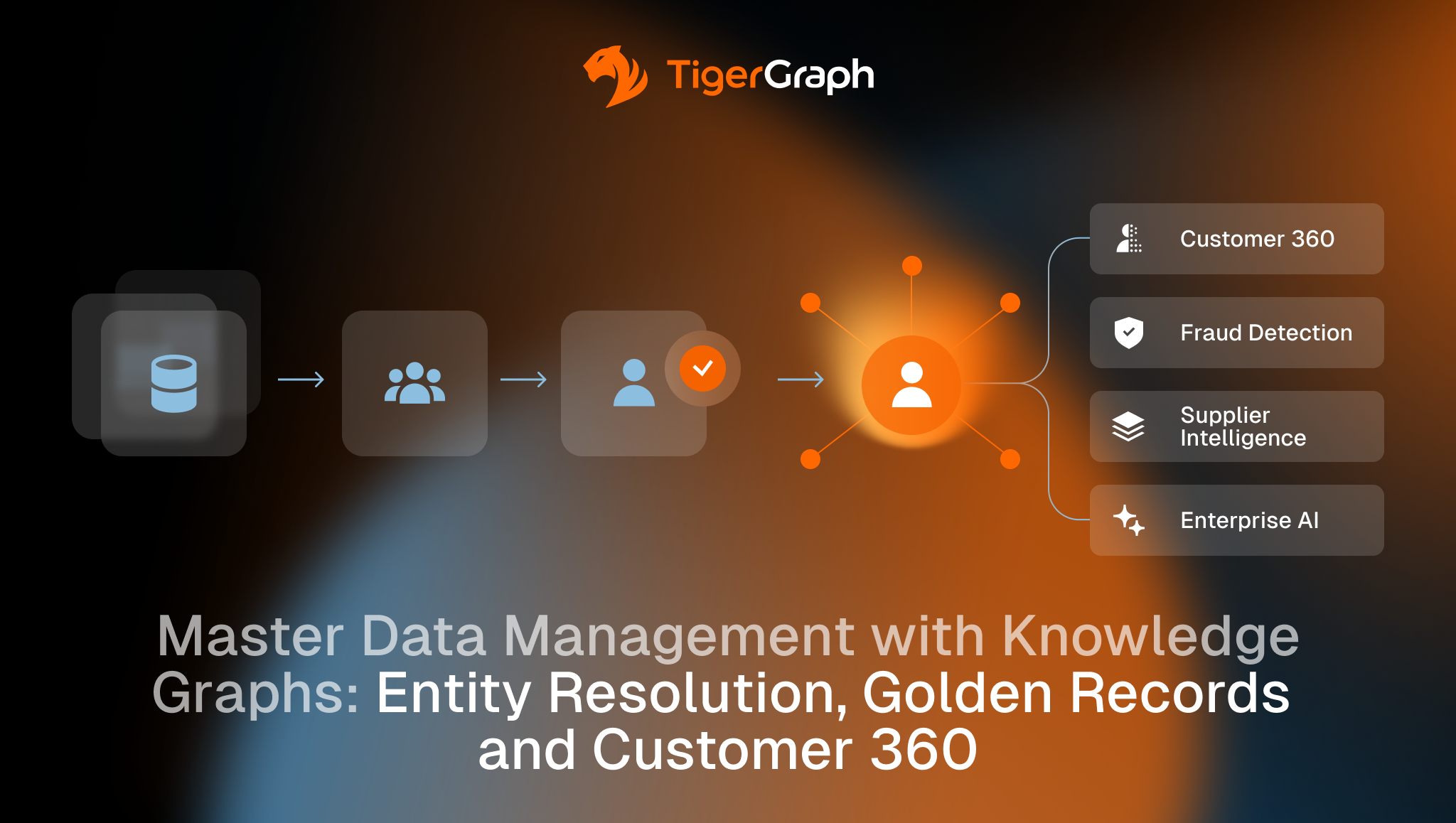
This creates a progression from fragmented records to resolved entities, governed golden records, connected knowledge graphs, and ultimately richer applications such as Customer 360, fraud detection, supplier intelligence, and AI.
You’ll learn:
- Why traditional MDM creates trusted records but misses the relationship context that makes those records operationally useful
- How entity resolution and golden-record management work, and where graph adds relationship evidence
- How a knowledge graph extends the MDM data model to support Customer 360, fraud detection, supplier intelligence, and enterprise AI
- How TigerGraph fits within an MDM architecture as a relationship intelligence layer
What Is Master Data Management, and Where Do Knowledge Graphs Fit?
Master data management is the set of processes and technologies organizations use to create consistent, trusted representations of important business entities across multiple systems.
Those entities commonly include customers, suppliers, products, accounts, employees, locations, assets, and organizations.
A typical MDM program ingests information from different systems, standardizes fields, identifies duplicate records, applies matching and survivorship rules, governs changes, and creates an authoritative representation of each entity.
That solves an important problem: determining what the enterprise believes to be true about a customer, supplier, product, or other business object. But mastering an entity does not automatically provide a complete understanding of its relationships.
Consider a customer whose trusted MDM record contains a name, address, email address, and customer ID. That information may be accurate, but the organization may also need to understand which accounts the person controls, which devices they use, which household they belong to, which products they own, and which transactions or interactions connect them to other entities.
This is where knowledge graph MDM becomes valuable. A knowledge graph represents entities alongside their relationships and context. Instead of replacing the governance, stewardship, survivorship, and data-quality responsibilities of MDM, the graph can extend the MDM architecture with a relationship layer.
Why Traditional MDM Models Struggle with Connected Enterprise Data
Traditional MDM models work well when the primary task is consolidating attributes.
For example, a customer record might show that Maria Johnson, customer ID 824615, lives at 100 Main Street and uses maria@example.com as her email address.
The problem is that real customers do not exist as isolated rows. Maria may belong to a household with two other customers. She may have three accounts, use four devices, own several products, interact through mobile and web channels, work for an organization that is also a customer, and share an address with another person whose identity has not yet been resolved.
A supplier creates a similar challenge. The master record may contain an official name, tax ID, location, and status, but understanding supplier risk may require connections to parent companies, beneficial owners, factories, products, shipping routes, contracts, and upstream suppliers.
As these relationships grow, three limitations become more important. First, relationship complexity increases. Connecting customers, accounts, devices, products, transactions, organizations, and interactions through traditional tables often requires increasingly complex joins. Second, many useful relationships are indirect. A customer may not be directly connected to a suspicious entity but might share a device with another account that shares an address with it. Third, relationships change continuously. A static master record can remain accurate while providing an incomplete picture of the entity’s current business context.
A graph-based MDM architecture addresses this by preserving the trusted entity while making its relationships directly queryable.
Traditional MDM vs. Graph-Based MDM
| Capability | Traditional MDM | Graph-Based MDM |
| Primary focus | Trusted entities, governance, survivorship | Trusted entities plus connected context |
| Relationship analysis | Varies by MDM platform and data architecture | Explicit, traversable relationships across entities |
| Entity resolution | Attribute matching, rules, and supported relationship evidence | Attribute matching enriched with multi-hop relationship signals |
| Hierarchies | Supports hierarchies according to platform capabilities | Flexible analysis across overlapping relationship structures |
| Data freshness | Batch or real-time, depending on implementation | Relationship context updated according to ingestion architecture |
| Primary value | Trusted master data | Relationship intelligence built on trusted master data |
| Primary focus | Trusted entities, governance, survivorship | Trusted entities plus connected context |
Entity Resolution: Turning Fragmented Records into Trusted Entities
Entity resolution is one of the foundational capabilities of master data management.
It determines whether records from different sources refer to the same real-world person, company, product, device, or other entity.
Entity resolution involves identifying and linking records that refer to the same real-world entity even when information is inconsistent, incomplete, or deliberately obscured.
How Conventional Entity Resolution Works
Conventional MDM entity resolution commonly combines several techniques.
Deterministic matching uses defined rules. Two records might be considered the same customer when they contain an identical customer number, email address, Social Security number, or other reliable identifier.
Probabilistic matching calculates how likely records are to represent the same entity when fields are incomplete or inconsistent. Names, addresses, telephone numbers, dates of birth, and other attributes can contribute to a match score.
What Graph Adds to Entity Resolution
Graph-based entity resolution introduces another source of evidence. It answers the question: do the relationships surrounding these records support the conclusion that they represent the same entity?
Consider two customer records with different names and email addresses. Attribute matching alone may produce an uncertain result. But graph analysis reveals that both records connect to the same verified payment instrument, device, and account. These relationships provide additional evidence that the records may represent the same person.
Crucially, graph analysis can also help distinguish between records that represent the same entity and different entities that are simply connected. That distinction helps reduce false matches while revealing relationships that conventional record matching may overlook.
From Entity Resolution to the Golden Record
Once records have been matched to the same real-world entity, the next step is deciding which values to trust.
Suppose a CRM lists Maria Johnson in Austin with the email maria.johnson@example.com, while billing records show Maria A. Johnson as Customer 84721 and support records list M. Johnson under the same account with Device 19283.
Entity resolution determines that these records describe the same customer. MDM rules then decide which name, address, email, identifiers, and other attributes become part of the trusted record. That becomes the golden record.
A golden record establishes what the organization trusts about an entity while a knowledge graph adds the relationships around it. For example, Customer 84721 can be connected to accounts, devices, purchases, service interactions, household members, employers, and other entities. The golden record remains the trusted identity, while the graph provides the surrounding context.
How a Knowledge Graph Extends the MDM Data Model
A traditional MDM data model often centers on attributes such as a customer’s name, email, address, phone number, and customer ID.
A knowledge graph extends that model by connecting the customer to related entities such as households, accounts, devices, products, transactions, locations, organizations, and service interactions.
This gives MDM teams several additional capabilities.
Relationship-Aware Master Data. Applications can analyze entities in context rather than one at a time. They can identify customers who share accounts, people who belong to the same household, suppliers with common ownership, or products that depend on the same manufacturer.
Flexible Hierarchies. Enterprise relationships rarely fit into a single hierarchy. A company may own subsidiaries, a supplier may operate several facilities, a customer may control multiple accounts, and products may belong to several categories or bundles. An MDM graph database can represent these structures without flattening them into one rigid model.
Provenance and Lineage. A graph can also connect mastered entities back to the records that contributed to them. Teams can trace where an attribute, identifier, or relationship came from and understand the evidence behind a match.
Continuous Enrichment. New transactions, devices, interactions, and relationships can be added to the entity’s context without expanding the golden record into an unwieldy collection of fields.
The result is an MDM model that combines trusted identity with connected context.
From Golden Records to a Connected Customer 360
Customer 360 shows how MDM and graph technology can work together. Traditional Customer 360 master data management combines information from CRM, billing, ecommerce, support, mobile, and marketing systems. Entity resolution determines which records belong to the same person, while golden-record management establishes the trusted customer profile.
That solves the identity problem, but it does not capture everything around the customer.
TigerGraph’s Customer 360 approach connects customer records with accounts, contacts, campaigns, interactions, opportunities, and other related information. This makes it easier to analyze customer journeys and engagement patterns that would otherwise be spread across separate systems.
A graph-based Customer 360 typically builds on five parts:
- Source systems: CRM, billing, ecommerce, support, mobile, marketing, and other applications provide customer data.
- Entity resolution: Matching identifies records that refer to the same customer.
- Golden record: MDM rules establish the trusted identity and attributes.
- Knowledge graph: The customer is connected to accounts, households, products, devices, transactions, interactions, and organizations.
- Customer 360: Applications use those relationships for personalization, recommendations, churn analysis, fraud detection, journey analysis, and next-best actions.
A unified customer record tells the organization who the customer is. A connected Customer 360 also shows how that customer relates to the rest of the business.
Knowledge Graph MDM Architecture: How the Pieces Work Together
Using a graph for MDM does not mean replacing every system that already stores enterprise data. The graph can sit alongside existing platforms and provide the relationship layer they lack.
1. Source Systems
Master data may come from CRM, ERP, ecommerce, billing, support systems, data warehouses, lakehouses, partner platforms, and external sources.
2. Data Ingestion and Standardization
Records are collected and normalized so that differences in names, addresses, identifiers, and formatting do not interfere with matching. Source and provenance information should be retained.
3. Entity Resolution
Deterministic rules, probabilistic matching, machine learning, and relationship evidence help determine which records represent the same entity.
4. Golden-Record Management
Survivorship, stewardship, data-quality, and governance rules determine which values become part of the trusted record.
5. Knowledge Graph
Mastered customers, suppliers, products, accounts, devices, organizations, locations, and other entities are connected through their relationships.
This adds relationship intelligence to an MDM architecture that might otherwise focus mainly on record consolidation.
6. Operational Use
Connected master data can support Customer 360, recommendations, fraud detection, KYC, risk analysis, supplier intelligence, analytics, and AI applications.
Where Graph-Based Master Data Management Creates Business Value
Once trusted entities and their relationships are available in the same system, they can support several business use cases.
Customer 360. Customer records can be connected to accounts, products, households, devices, transactions, and interactions. Sales, service, marketing, and recommendation systems can then work with a richer view of the customer.
Supplier and Vendor Intelligence. Supplier records can be connected to parent companies, beneficial owners, factories, contracts, products, locations, and upstream suppliers. This provides more context for supplier risk, concentration analysis, and supply chain visibility.
Financial Services and KYC. Financial institutions can connect customers to accounts, counterparties, beneficial owners, transactions, devices, and other identity signals. The same mastered identity can support both customer analytics and compliance workflows.
Fraud and Identity Intelligence. Fraud often spans several accounts or identities. Graph analysis can reveal shared devices, phone numbers, addresses, payments, accounts, and counterparties that connect records that appear unrelated when viewed separately.
AI and Enterprise Knowledge. AI applications benefit from trusted entities and their relationships. Instead of retrieving isolated records, an AI system can work with connected information about customers, products, organizations, policies, and transactions. For enterprise AI, MDM provides trusted identity while the knowledge graph provides context.
Why TigerGraph for Graph-Based MDM and Customer 360?
MDM establishes trusted entities. TigerGraph makes the relationships between those entities actionable.
TigerGraph combines native graph storage, distributed parallel processing, and multi-hop analytics to connect mastered identities across accounts, devices, transactions, households, and organizations. Rather than repeatedly reconstructing complex relationships through joins, enterprises can analyze connected entities directly to support entity resolution, Customer 360, fraud detection, and operational decisions at scale.
TigerGraph extends existing MDM investments with relationship intelligence while leaving governance, stewardship, and golden-record management with the systems responsible for those functions.
Several capabilities make it useful for graph-based MDM.
Entity resolution: TigerGraph can combine record attributes with relationship evidence to help connect fragmented customer and entity data.
Connected Customer 360: Customer identities can be linked to accounts, products, interactions, campaigns, devices, and other relevant context.
Enterprise-scale relationship analysis: TigerGraph is built for production workloads involving large and highly connected datasets.
Real-time operational intelligence: New interactions and relationships can be incorporated as they occur, allowing applications to work with current customer context rather than relying only on periodic batch updates.
Intuit provides one example. It uses TigerGraph across Customer 360, identity graph, fraud risk, and graph-based machine learning, with customer information normalized into connected entity views.
Organizations exploring this approach can learn more about TigerGraph’s Entity Resolution and Customer 360 capabilities.
From Trusted Records to Connected Enterprise Intelligence
Trusted records are the foundation. Connected relationships are what make them actionable.
MDM establishes reliable identities and attributes. Knowledge graphs connect those identities across accounts, devices, transactions, organizations, and interactions—providing the context needed for Customer 360, fraud detection, risk analysis, and enterprise AI.
TigerGraph brings this relationship intelligence to enterprise scale, helping organizations move beyond knowing who an entity is to understanding how it connects to everything else that matters.
Explore TigerGraph Entity Resolution and Customer 360 or request a demo to see how connected intelligence can extend your existing MDM architecture.
FAQs
What is a master data management knowledge graph, and how is it used?
A master data management knowledge graph combines trusted master entities with the relationships among them. It allows organizations to manage reliable customer, supplier, product, account, and organization data while preserving the connected context those entities exist within. Knowledge graphs can support entity resolution, hierarchy management, provenance, lineage, Customer 360, supplier intelligence, and other relationship-heavy MDM use cases.
What is entity resolution in master data management?
Entity resolution identifies records from different systems that refer to the same real-world person, organization, product, device, or other entity. Those records can then be consolidated into a trusted representation. Modern entity resolution combines deterministic matching on reliable identifiers, probabilistic scoring across attributes, and relationship evidence from the surrounding connected data.
What is a golden record in MDM?
A golden record is the trusted representation of an entity created after matching records from multiple sources and applying survivorship, data-quality, and governance rules. It establishes what the organization believes to be true about a customer, supplier, product, or other business entity.
What is the difference between a golden record and Customer 360?
A golden record contains the trusted attributes of an entity. Customer 360 adds the customer’s transactions, interactions, accounts, devices, products, relationships, and other context. The golden record answers who the customer is. Customer 360 answers how that customer connects to the rest of the business.
Can a graph database replace an MDM platform?
Not in most cases. A graph database can support entity resolution, hierarchy analysis, Customer 360, and relationship intelligence. A broader MDM platform typically handles stewardship, governance, survivorship, data quality, and distribution of master data. The most effective architectures use both: MDM governs trusted master entities and the graph connects those entities to their surrounding relationships.