
AI Is Facing a 19-Gigawatt Power Gap. Here’s the Fix.
The AI revolution has officially hit a physical wall. As the Wall Street Journal reports “ AI Is Using So Much Energy That Computing Firepower Is Running Out”companies are already rationing compute, facing outages, and making real-time product tradeoffs as demand for tokens and GPUs surges. At the same time, long-term infrastructure is not keeping pace, the Financial Times analysis points to a projected staggering 19-gigawatt gap between planned AI infrastructure and the actual power supply coming online in the next three years. This is no longer a future risk. It’s a present constraint with no near-term relief.
For the enterprise, the constraint isn’t just a lack of GPUs — it’s a fundamental crisis of AI compute capacity and power infrastructure. The question is shifting: not who has the biggest model, but who can generate the best outcome with the least compute.To scale, we must move away from energy-intensive approaches and toward high-efficiency, precision-context architectures.
The Shift from Training to Inference
While the early days of generative AI focused on the massive energy costs of training models, the industry has reached a tipping point. Inference — the act of running a model to answer a query — now represents the increasing majority of AI’s total energy demands.
The math of inference is simple but punishing. The energy required doesn’t scale linearly with context length — it scales super-linearly, because transformer attention mechanisms require each token to attend to every other token in the context window. Double the context, and you roughly quadruple the compute. This means that sending a large, unoptimized prompt to an LLM doesn’t just cost twice as much as a smaller one — it can cost many times more in GPU cycles and electricity. For enterprises running thousands of AI queries a day, this is where the power budget disappears.
This is exactly what the WSJ is signaling: token usage is surging, providers are metering access, and reliability is falling below traditional enterprise expectations.
How TigerGraph Solves the Inference Crisis
TigerGraph, acting as the context provider through GraphRAG (Graph Retrieval-Augmented Generation), attacks the dominant cost of AI: inference compute load per query.
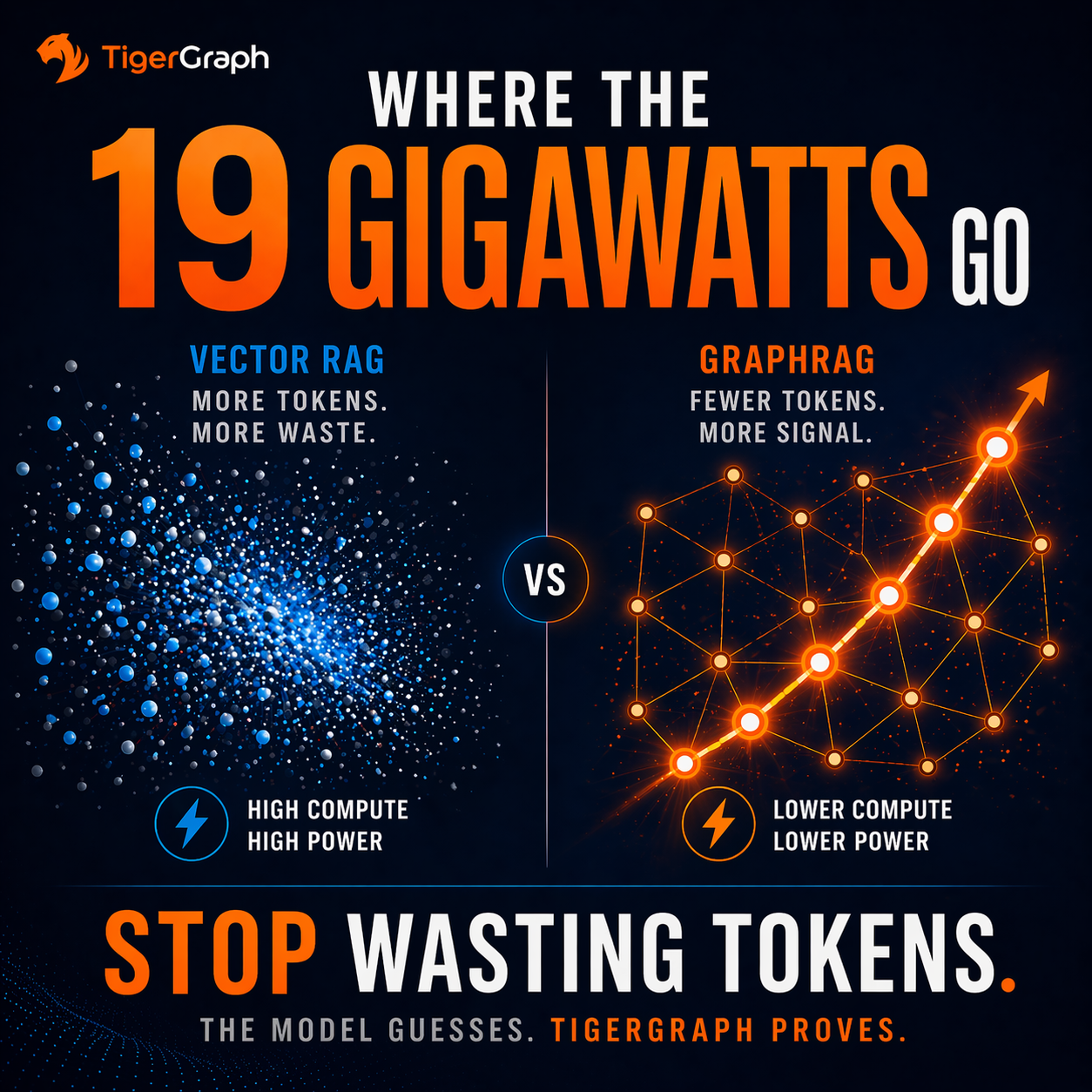
Up to 90% token reduction. Instead of “dumping” massive documents into an LLM to find an answer, TigerGraph’s graph engine surgically retrieves only the specific nodes and relationships required. In tested configurations against unoptimized RAG approaches, TigerGraph has achieved up to 90% token reduction — and because attention complexity scales super-linearly, a 90% reduction in tokens can translate to a far greater reduction in actual compute work.
In a world where compute is being rationed and power is constrained, this is the architectural shift that matters: reducing unnecessary tokens before the model is ever invoked.
Reduced inference compute load per query. By delivering a pre-connected structure of facts, TigerGraph eliminates the reasoning cycles the LLM would otherwise spend determining how Data A relates to Data B. That relationship work has already been done — at millisecond speed, by a purpose-built graph engine — before the model call is ever made.
A Win-Win: Benefits Across the AI Ecosystem
For the Enterprise: ROI and Accuracy
Cost efficiency. High-fidelity graph context allows enterprises to run smaller language models (SLMs) on tasks that previously demanded frontier-tier compute. These smaller models are cheaper and less power-intensive, while delivering equivalent or better accuracy — because the structural intelligence comes from the graph, not from the model’s parameter count.
Deterministic logic. In high-stakes industries like finance and supply chain, a probabilistic guess is a liability. TigerGraph provides a clear, auditable trail of how data points are connected, eliminating the compute-heavy correction cycles that hallucinations create downstream.
In a market where model providers are already making capacity tradeoffs, efficiency is no longer just about cost, it directly impacts availability and reliability.
For Model Providers: Throughput and Capacity
Maximizing GPU availability. When users send lean, graph-optimized prompts, provider hardware spends less time on each request. The same physical infrastructure serves more customers — a direct answer to the capacity bottleneck.
Offloading relationship traversal. TigerGraph is purpose-built for relationship traversal in a way that general-purpose compute architectures cannot match at scale. It completes 10+ hop traversals across billions of edges in milliseconds — work that would otherwise require multiple LLM reasoning cycles. Freeing frontier models from this structural work lets them focus on what they do best: high-value linguistic generation.
The Balanced View: The “Efficiency Stack”
TigerGraph provides the logical foundation for efficient AI, but it operates within a broader ecosystem of solutions tackling the 19-gigawatt problem that will exist for years.:
Mixture of Experts (MoE). Models that activate only a fraction of their parameters for any given query, reducing power draw per token without sacrificing capability.
Model Quantization. Shrinking model precision so they can run on lower-power hardware or at the edge, reducing data center dependency for many inference workloads.
Specialized AI Hardware. The rise of LPUs (Language Processing Units) and other inference-optimized chips that deliver significantly better energy-per-token metrics than general-purpose GPUs.
On-Site Energy (SMRs). A long-horizon investment — not a near-term fix — where some tech giants are funding Small Modular Reactors to reduce long-term grid dependency. Commercial deployment remains years away, but the direction signals how seriously the industry views the structural supply problem.
These approaches are complementary, not competing. Architectural efficiency improvements make models cheaper to run; precision retrieval makes each run more accurate. Both are necessary. Neither alone is sufficient.
Intelligence Over Volume
The Wall Street Journal has correctly identified that we are running out of computing firepower. The Financial Times adds the second layer: even if demand continues to surge, the underlying power infrastructure won’t catch up fast enough.
Together, this changes the equation for enterprise AI: brute-force approaches are no longer scalable, economically or physically.
By integrating TigerGraph into the AI stack, the enterprise moves from a brute-force search for answers to a precision strike of insight. In a world of constrained energy and restricted compute capacity, the most valuable AI won’t be the biggest model — it will be the one that uses the least power to find the truth.
If energy is the bottleneck, logic is the bypass. TigerGraph isn’t just a database. TigerGraph helps enterprises reduce wasted inference, improve answer quality, and get more value from every constrained unit of compute. It’s an efficiency engine for the age of inference.
——————–