
Summary
- Cyberattack path analysis maps the connected routes an attacker can take from an initial foothold to a high-value asset, going beyond individual vulnerabilities to show how they chain together.
- Most security tools evaluate findings in isolation; attack path analysis reveals how low-severity misconfigurations, dormant accounts, and permissive rules combine into exploitable routes.
- Attack path analysis is inherently a graph problem: enterprise environments are networks of identities, permissions, and systems, and an attack is a route through that network.
- Effective attack path analysis requires multi-source data integration, real-time model updates, pattern detection beyond known templates, and remediation prioritization ranked by risk impact.
- TigerGraph enables attack path analysis at enterprise scale by connecting identities, devices, credentials, permissions, and data assets into a unified relationship model that security teams can query in real time.
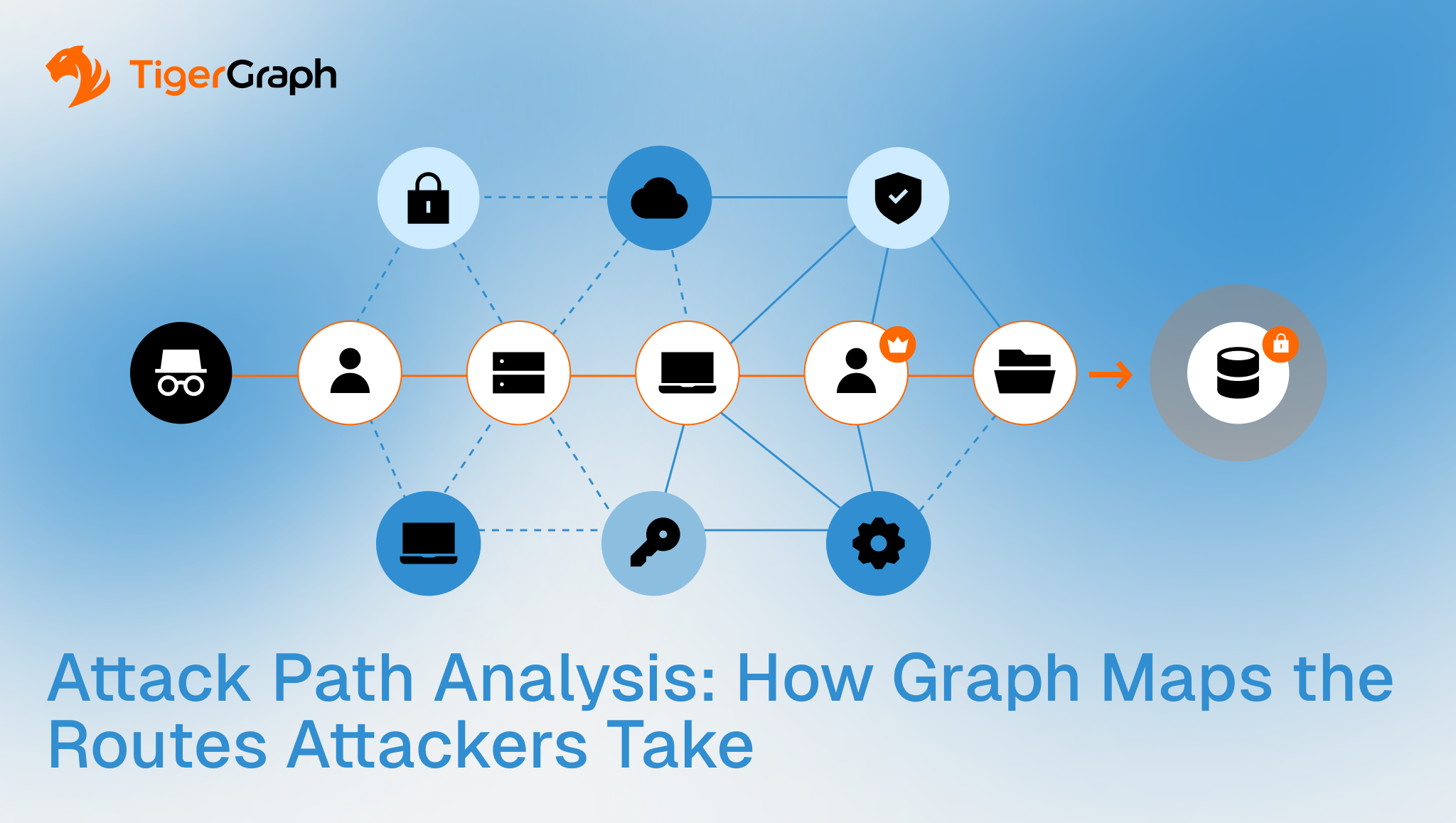
Sophisticated attacks rarely depend on one obvious weakness. An attacker may begin with a compromised contractor account, move through a shared credential, abuse an over-permissive cloud policy, and only then reach the system containing sensitive data. The entry point is almost never where the damage happens. The route between entry and impact is what security teams struggle to see. Understanding that route is not simply identifying individual weaknesses, it is what determines whether an organization can interrupt an attack before it reaches a critical asset.
That is the gap attack path analysis addresses. A low-severity misconfiguration, a dormant privileged account, and a permissive network rule may each look manageable in isolation. Connected in sequence, they create a direct route to a critical asset. Attack path analysis asks: what routes exist through this connected environment of identities, systems, permissions, credentials, and data? It shifts security analysis from evaluating isolated findings to understanding how those findings combine into exploitable attack paths. For CISOs, security architects, and senior security engineers, that question turns fragmented security findings into cyber risk analytics that show which routes are exploitable, which assets are exposed, and which remediation actions will reduce the most risk.
In this article, you’ll learn:
- What attack path analysis is and how it differs from vulnerability scanning
- Why attack path analysis is inherently a graph problem
- What capabilities effective attack path analysis requires to work at enterprise scale
- How TigerGraph enables real-time attack path discovery and remediation prioritization
What Is Attack Path Analysis?
Attack path analysis maps the sequence of steps an attacker could realistically take to move from an initial foothold to a high-value target. That foothold might be a compromised user credential, an exposed service, a vulnerable endpoint, or a misconfigured cloud identity. From there, attack path analysis traces the connected chain of access rights, trust relationships, network reachability, and system dependencies that could carry the attacker forward. The objective is not simply to identify weaknesses. It is to understand how attackers can chain those weaknesses together.
The key distinction is that attack path analysis does not simply ask, “What is broken?” It asks, “How do the broken things connect?” Vulnerability scanning produces a list of weaknesses ranked by severity. Attack path analysis produces a map of routes ranked by exploitability, business impact, and proximity to critical assets. In other words, attack path analysis maps how vulnerabilities, misconfigurations, permissions, assets, and identities combine into exploitable routes.
That distinction changes prioritization. A critical Common Vulnerabilities and Exposures on an isolated test machine may be less urgent than a medium-severity misconfiguration that sits on a live route to a production database. Conversely, a risky identity relationship may not trigger a traditional scanner at all, even though it gives an attacker the next step in a privilege-escalation chain.
Attack path analysis (APA) supports two operating modes. Proactive APA continuously models the environment to find and close dangerous routes before attackers use them. Reactive APA reconstructs the route taken during an incident so teams can identify every system touched, every credential abused, and every additional asset reachable from the same entry point.
Why Attack Path Analysis Is Inherently a Graph Problem
An enterprise environment naturally behaves like a graph. Users, devices, service accounts, applications, workloads, databases, cloud resources, and network segments are the points in the environment. Permissions, sessions, trust relationships, authentication flows, network routes, API calls, and data-access relationships are the connections. An attack path is a route through that connected structure. The architecture of the enterprise already resembles a graph; attack path analysis simply makes that structure visible.
This is why graph-powered cybersecurity is such a strong fit for attack path management. Traditional security tools often analyze logs, vulnerabilities, or events in isolation. Graph-based approaches model how users, devices, applications, and systems interact over time, making it possible to trace attack paths, detect lateral movement, and explain how an alert connects across systems.
Relational database systems struggle with this class of question because the number of intermediate steps is not known in advance. Consider the query: “Can an attacker reach customer financial data from this compromised account through any chain of permissions, services, or systems?” In a relational model, that requires joining across identity tables, access-control tables, asset inventories, network flows, cloud policies, endpoint state, and data classifications. Joining is making new tables that are the combination of existing tables in order to find out how entities relate to one another. Each additional step adds query complexity and computational effort.
A graph database treats the same question as a search across its existing paths. For example, a contractor account has access to a shared service account. That service account can update a deployment pipeline. The pipeline can deploy to a production environment. That environment contains a data store with regulated customer information. In a graph model, that chain is represented directly as connected relationships and can be queried as a route from account to asset.
The algorithmic match is also direct. Attack path analysis depends on operations such as finding the shortest route to a crown-jewel asset, enumerating alternative routes, identifying common choke points, and ranking which identity, permission, or system appears on the most dangerous paths. Those are graph-algorithm questions.
TigerGraph’s graph algorithms such as shortest path, PageRank, and community detection can run across large connected datasets.
At enterprise scale, this matters. A large organization may have millions of identities, endpoints, workloads, policies, and network relationships. Attack path analysis cannot check those relationships one pair at a time. It must evaluate the connected environment as a whole.
What Effective Attack Path Analysis Needs to Cover
Many APA implementations fall short because they cover only part of the environment. A cloud-only view may miss identity relationships from an on-premises directory. A vulnerability-only view may miss the service account that makes a medium-severity weakness exploitable. An endpoint-only view may miss the cloud storage bucket the attacker can ultimately reach.
Effective attack path analysis needs four capabilities.
First, it must integrate multiple data sources. Attack paths cross boundaries: identity and access management, endpoint telemetry, cloud configuration, network topology, vulnerability data, SaaS access, data classification, and application ownership. The value of attack paths depends on the available source data and whether critical assets are defined. That reinforces a central APA reality: incomplete data produces incomplete paths. Comprehensive attack path analysis depends on comprehensive relationship visibility.
Second, the model must stay current. Access relationships change constantly. Accounts are provisioned, policies are edited, workloads are deployed, and cloud services appear or disappear throughout the day. If the APA model only runs on periodic snapshots, it may miss the short-lived route that attackers can exploit right now. Real-time network security analytics require fresh relationship context, not yesterday’s topology.
Third, attack path analysis must detect both known and novel patterns. Known templates matter: credential theft to privilege escalation, vulnerable workload to sensitive data, exposed service to lateral movement. But sophisticated attackers often find paths that do not match a predefined rule. Pattern detection with graphs helps here because graph analysis can reveal multi-step structures, suspicious chains, and emerging patterns that conventional rules miss.
Fourth, APA must prioritize remediation, not just enumerate paths. Security teams do not need a beautiful map of every theoretical route if the map does not tell them what to fix first. They need to know which account to disable, which permission to remove, which configuration to change, or which system to isolate to eliminate the greatest number of dangerous paths with the least operational disruption. The value of attack path analysis lies as much in remediation prioritization as in attack path discovery.
How TigerGraph Enables Attack Path Analysis at Enterprise Scale
TigerGraph is designed for the multi-source, multi-step relationship analysis that attack path analysis requires. Instead of treating security findings as isolated records, TigerGraph connects identities, devices, applications, credentials, permissions, services, vulnerabilities, alerts, and data assets into a unified relationship model that security teams can query in real time. That unified model enables analysts to understand the complete attack surface rather than isolated fragments of it.
For attack path analysis, that means a security team can ask questions such as:
- Which exposed identities can reach a critical database through any sequence of access relationships?
- Which service accounts sit on the most routes to production systems?
- Which cloud misconfiguration creates access to sensitive data when combined with identity permissions?
- Which remediation action breaks the most paths to crown-jewel assets?
TigerGraph’s advantage is deep relationship analytics at scale. Its cybersecurity threat detection solution helps security teams that need to integrate and query across multiple data sources quickly: attacks are chains of events across interconnected entities. That aligns directly with the requirements of attack path management.
TigerGraph also supports real-time model updates. As logs, access changes, endpoint signals, and cloud events stream in, the graph can reflect the current environment. That is critical because APA is only operationally useful when it represents live exposure. A stale attack graph may explain yesterday’s risk, but defenders need to know what routes exist now. Attack path analysis becomes operational only when it reflects the current environment rather than a historical snapshot.
Multi-source integration is another key requirement. Attack paths often span identity systems, cloud platforms, network segments, and endpoint state. TigerGraph can serve as the relationship intelligence layer that connects these sources into one queryable model, allowing security teams to detect paths that would be missed if each tool were analyzed separately.
Graph algorithms make the analysis actionable. Shortest-path analysis identifies the most direct route from an entry point to a target. All-paths analysis can reveal alternative routes. Centrality can identify accounts, systems, or permission grants that act as high-impact choke points. Combined with AI and machine learning, graph features can also enrich risk models with structural context: distance to a crown-jewel asset, number of reachable sensitive systems, number of privileged accounts in a path, or the concentration of paths through a single identity.
Just as important, every path is explainable. A TigerGraph-powered APA result can show the named account, specific permission, affected system, reachable asset, and chain of relationships that produced the risk. That replaces opaque risk scores with evidence analysts can validate and act on.
Graph as the Foundation for Enterprise Attack Path Analysis
Attack path analysis is a graph problem. The fundamental question it asks is: “What connected routes exist from an attacker’s entry point to a critical asset?” That question is a path-finding query over a network of relationships.The better an organization understands those routes, the earlier it can interrupt an attack before compromise becomes business impact.
Graph databases provide the analytical foundation for answering it at enterprise scale. They model the full attack surface as a connected environment, query it for exploitable routes, rank paths by risk and impact, and translate the result into prioritized remediation actions. Graph transforms attack path analysis from a reactive investigation exercise into a proactive operational capability.
The application-layer APA market is growing quickly, validating the importance of attack path visibility across modern security programs. But underneath the category is a deeper infrastructure requirement: organizations need a graph foundation capable of handling hybrid environments, real-time updates, multi-source security data, and deep relationship analysis.
TigerGraph provides that foundation. To see how graph can strengthen threat detection, lateral-movement analysis, and attack path management, explore TigerGraph’s Cybersecurity Threat Detection solution, start a free trial, or request a demo.
TigerGraph combines graph analytics, real-time relationship intelligence, and enterprise-scale performance to help security teams identify, prioritize, and eliminate attack paths before they are exploited.
FAQs
What is attack path analysis in cybersecurity?
Attack path analysis maps the sequence of steps an attacker could realistically take from an initial foothold (such as a compromised account, an exposed service, or a misconfigured identity) to a high-value target. Unlike vulnerability scanning, which scores individual weaknesses, attack path analysis shows how those weaknesses connect into exploitable routes through your environment.
Why is graph the right technology for attack path analysis?
Enterprise environments are networks: identities, devices, applications, credentials, and data assets connected by permissions, sessions, and trust relationships. A graph database models these relationships directly and supports the path-finding operations (shortest path, all-paths enumeration, choke-point identification) that attack path analysis requires. Relational databases struggle with this class of query because the number of intermediate steps is not known in advance.
What is the difference between proactive and reactive attack path analysis?
Proactive attack path analysis continuously models the environment to find and close dangerous routes before attackers use them. Reactive attack path analysis reconstructs the route taken during an incident, identifying every system touched, every credential abused, and every additional asset reachable from the same entry point. Both modes benefit from a real-time, continuously updated graph model.
Does TigerGraph support real-time attack path modeling?
Yes. TigerGraph supports real-time model updates, allowing the attack graph to reflect changes in access relationships, cloud configuration, and endpoint state as they happen. This is critical because attack path analysis is only operationally useful when it represents live exposure. A stale graph shows yesterday’s risk, not what routes exist right now.
How does attack path analysis improve vulnerability prioritization?
Attack path analysis reorders vulnerability priorities by exploitability and proximity to critical assets rather than severity score alone. A critical vulnerability on an isolated test machine may be less urgent than a medium-severity misconfiguration on a live route to a production database. Attack path context lets your security team focus remediation on the findings that create the most dangerous routes, maximizing risk reduction per action.