
Summary
- Graph databases are a type of NoSQL database, but the NoSQL category spans four architecturally distinct storage models: document, key-value, column-family, and graph – they are not interchangeable.
- Each NoSQL type was optimized for a different problem: document stores for flexible content retrieval, key-value stores for fast lookups, column-family stores for time-series and sparse data, and graph databases for deeply connected relationship data.
- The defining difference in a graph database vs NoSQL comparison is relationship handling: graph databases store and follow relationship chains natively, while the other NoSQL types require application-level logic or pre-modeled access patterns to approximate the same result.
- When your data problem is fundamentally about connections – fraud rings, supply chain dependencies, customer identity resolution, network security – a graph database is the right tool. For content management, caching, or event streams, the other NoSQL types are better suited.
- Most mature enterprise data stacks use multiple NoSQL types alongside relational databases. Graph databases are rarely a wholesale replacement; they are the specialized layer that handles connected-data workloads that other systems cannot
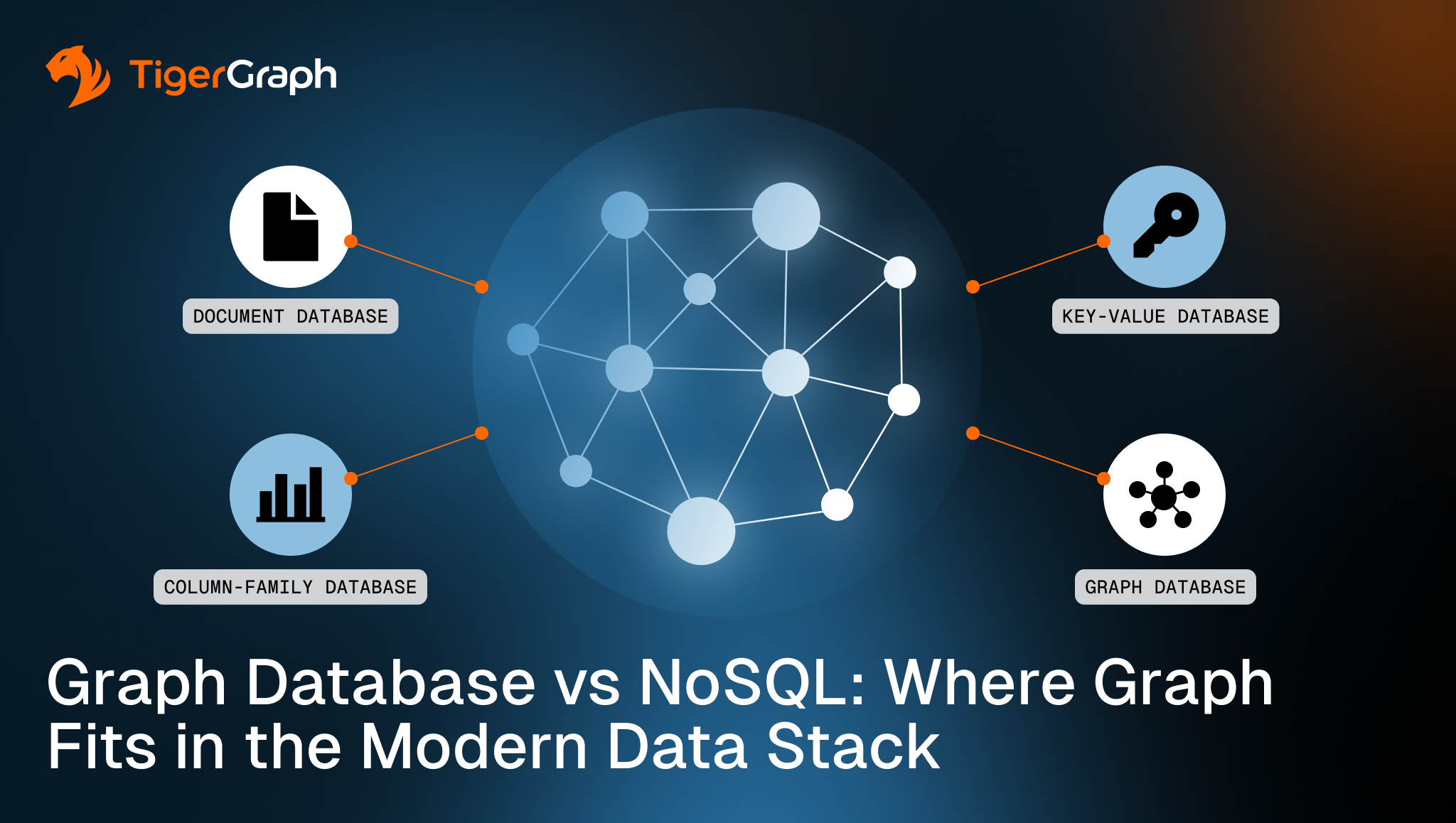
If you’re evaluating a graph database vs NoSQL options and wondering where graph actually fits, you’ve been handed an incomplete frame. A graph database is a NoSQL database. But calling it “NoSQL” hides the reason organizations adopt it. Graph is the only NoSQL model built around relationships as first-class data. That distinction fundamentally changes the kinds of questions a database can answer. The NoSQL category spans four architecturally distinct storage models: document, key-value, column-family, and graph. Each one was designed to handle a specific class of data problem that the relational model handles poorly. The question for any data architect isn’t “graph database vs NoSQL” in the sense of picking sides. It’s understanding which NoSQL type – or which combination – belongs in your stack.
The real distinction isn’t structured versus unstructured data. It’s connected versus disconnected data. That difference has become even more important as enterprise AI systems increasingly need connected context rather than isolated documents.
This article breaks down that decision. By the end, you’ll understand:
- How the four main NoSQL types differ in data model, relationship handling, and best-fit workloads
- Where the graph database vs NoSQL distinction actually matters – and why relationship handling is the deciding factor
- When to reach for a graph database instead of document, key-value, or column-family stores
- How graph databases fit as a specialized layer in a modern polyglot data stack
What Is NoSQL?
NoSQL is a broad category of database systems that do not use the relational model for data storage. Rather than organizing data in rows and columns across joined tables, NoSQL databases store data in formats optimized for specific access patterns – documents, key-value pairs, column families, or relationship graphs. The term “NoSQL” is now understood to mean “not only SQL,” reflecting that many NoSQL databases support SQL-like query syntax alongside their native query models.
One persistent misunderstanding is that NoSQL means “no SQL.” That was the original intent when the term was coined, but it hasn’t been accurate for well over a decade. Many NoSQL databases added SQL or SQL-like query support because so many engineers already knew SQL. The real distinction isn’t the query language – it’s the underlying storage model.
Relational databases store every entity type in its own table and record relationships by embedding keys across tables. This works well for structured, normalized data where the access patterns are predictable. It breaks down when data is too complex, too sparse, too unstructured, or too interconnected to fit cleanly into tables.
NoSQL databases address those gaps. There are four main types:
- Document stores keep data as self-contained documents, typically in JSON or BSON format. Structure is flexible and varies from document to document. Examples: MongoDB, Couchbase.
- Key-value stores keep data as simple key-identifier/value pairs. The value can be almost anything. Examples: Redis, Amazon DynamoDB.
- Column-family stores organize data by column groupings rather than rows, suited to wide, sparse datasets. Examples: Apache Cassandra, Apache HBase.
- Graph databases store entities as nodes and relationships as first-class connections, then follow chains of those connections to answer questions about how things are related. Examples: TigerGraph, Neo4j.
Graph databases are NoSQL, but they solve a fundamentally different problem from the other three types. Understanding that difference is the point of this article.
What Is a Graph Database?
A graph database stores entities alongside their properties and relationships in an interconnected network, where both are queryable. This mirrors real-world structures – networks, supply chains, payment systems, organizations – where connections between things are as analytically important as the things themselves.
What sets graph databases apart from other NoSQL types is how they query. Following a chain of relationships across multiple entities requires no table joins or re-issued queries at each step – the database follows native connection pointers directly. Unlike other NoSQL models, graph treats relationships as first-class data rather than references that must be reconstructed later. The database traverses connected context directly instead of forcing applications to rebuild it at query time.
How Non-Graph NoSQL Types Handle Relationships
The strongest argument for graph databases becomes clear when you put a relationship-heavy query in front of each NoSQL type. Take an anti-money laundering (AML) investigation: the goal is to trace funds backward through a chain of companies and accounts to determine whether the money came from an illegal source and identify every entity it passed through.
This is where the difference stops being theoretical and becomes architectural. Every NoSQL model stores data differently. Only graph is designed to understand how that data connects.
Here is what that looks like across the four NoSQL types:
A document store might hold transaction receipts or company records as individual documents. To trace the money, you’d query the first document, extract the counterparty reference, issue another query for that counterparty’s document, and repeat – as many times as the chain is long. The further you go from the starting point, the more queries you issue, and the harder it becomes to reconstruct the full path. There is no native way to understand relationships between companies or people along its path without significant application-level logic.
A key-value store offers fast lookup for any single record but almost no native relationship concept. Tracing a transaction chain requires an external index or full application-layer reconstruction. For AML investigation at any depth, this model is effectively unworkable.
A column-family store doesn’t model this kind of data at all. Column-family stores are designed for wide, sparse event data – sensor readings, log streams, time-series – not for entity-to-entity relationship chains.
A graph database handles this natively. Each account, company, and transaction is a node. Each transfer is a connection. The query “follow the money: show me every entity this account is connected to within four relationship steps, and flag any that appear on a watchlist” runs as a single, continuous operation. TigerGraph processes that kind of query in milliseconds, across billions of relationships, without the performance degrading as the dataset scales.
The other NoSQL types aren’t wrong for their intended workloads. A document store is excellent for content management. A column-family store is ideal for IoT time-series data. The point is that when the question you are trying to answer is fundamentally about how things connect, a graph database is the only NoSQL type designed to answer it efficiently.
Graph Database vs NoSQL: Side-by-Side Comparison
Some characteristics are shared across NoSQL varieties – flexible data models, horizontal scalability, non-relational storage. The comparison table below focuses on where the types diverge, particularly on relationship handling, which is where the graph database vs NoSQL distinction has the most practical consequence.
| Graph | Document | Key-Value | Column-Family | |
| Data model | Nodes, relationships, properties. Entities and connections stored with equal primacy. | Document trees organized by subject or metadata. Self-contained units. | Key/value pairs. Value can be a simple scalar or a large binary blob. | Wide, many-column tables. Many columns are sparse or empty per row. |
| Relationship handling | Follows relationship chains natively. No joins or re-queries needed at each step. | Multiple repeated queries, or external application logic required to reconstruct relationships. | Lookup, then re-lookup on each result. Relationships require external indexes or application logic. | No native relationship concept. Cross-entity relationships must be pre-modeled at schema design time. |
| Multi-hop query support | Native. Performance stays consistent regardless of overall dataset volume. | Not natively supported. Application-layer reconstruction required. | Not natively supported. Impractical beyond one or two steps. | Not natively supported. Possible only if relationships were hard-coded into the column model at design time. |
| Schema flexibility | Very flexible. New entity types, relationship types, and properties can be added without restructuring the existing graph. | Very flexible within self-contained documents. Cross-document relationships require schema changes. | Limited to key/value structure, though value types can vary widely. | Limited to denormalized wide tables. Adding new relationship types is expensive. |
| Primary enterprise use cases | Financial crime detection, supply chain resilience, customer intelligence, entity resolution, cybersecurity threat detection, knowledge graphs for AI. | Content management systems, product catalogs, user profiles, applications with dynamic document schemas. | Caching, session management, gaming leaderboards, ad-tech, any workload requiring fast, simple lookups. | Sensor monitoring, IoT data analysis, log analytics, website click tracking, event stream applications. |
For enterprise architects, the multi-hop support row carries the most weight. The other NoSQL types don’t just handle relationship chains more slowly – they don’t natively support them at all. If your queries regularly cross more than one or two entity boundaries, you are either running your graph database workload on the wrong system or building expensive application logic to compensate.
When to Use Each NoSQL Type
Understanding where the graph database fits in a graph database vs NOSQL decision requires knowing what each type was designed for.
Document stores are designed for self-contained data units where structure varies and flexibility matters. Content management systems, product catalogs, and user profile storage are natural fits. The defining signal: your queries are mostly about retrieving or filtering individual documents, not following chains of references between them.
Key-value stores are designed for lookup-heavy applications with simple, predictable access patterns. Real-time leaderboards, session management, and read-heavy caches are ideal use cases. The defining signal: your access pattern is almost always “give me the thing with this key,” and relationships between records are handled outside the database.
Column-family stores are designed for time-series and other wide, sparse datasets. IoT sensor streams, log analytics, event streams, and website click tracking are strong fits. The defining signal: your data has a time or event dimension, many possible attributes per record, and most rows have only a small subset of columns populated.
Graph databases are designed for connected data: any workload where the question you are answering is about how entities relate to one another, not just what individual records contain. Fraud detection, real-time recommendations, supply chain analysis, identity resolution, network security threat detection, and agentic AI infrastructure are all graph-native workloads. The defining signal: your most important queries cross multiple entity boundaries, and the relationships between records are as analytically significant as the records themselves.
Where Graph Fits in the Modern Data Stack
When evaluating graph database vs NoSQL options for your architecture, the most important principle is that graph databases are not a replacement for the other NoSQL types – they are a specialized layer for connected-data workloads that the other types cannot handle effectively.
Operational decision intelligence. Graph databases are the right layer for real-time decisions that depend on relationship context – fraud scoring, credit risk, and threat detection are the clearest examples. A Global Bank uses TigerGraph to analyze over 50 million transactions per day for fraud patterns that only become visible when relationships across accounts, counterparties, and behaviors are analyzed together. Document or key-value stores surface that kind of analysis too slowly, if they can surface it at all.
AI and ML enrichment. Graph relationship context improves model accuracy and is the preferred infrastructure for GraphRAG and knowledge graph AI pipelines. When an AI system needs to reason about how entities are connected – not just what they are individually – graph provides the structural context that vector embeddings alone cannot supply.
Data quality and entity resolution. Entity resolution programs that unify fragmented customer, counterparty, or organizational records across enterprise systems are graph-native workloads. Graph can construct a single, queryable view of a customer across dozens of source systems without requiring a full data warehouse migration.
Network and dependency modeling. Supply chains, IT infrastructure, and organizational hierarchies are all naturally graph problems. When your supply chain analysis needs to trace the cascading impact of a single supplier disruption across five tiers of upstream and downstream dependencies, no other NoSQL type models can structure as effectively.
Polyglot complement. In most mature data stacks, graph databases sit alongside document stores, key-value stores, and relational databases – each handling the workload it was designed for. Graph takes the relationship-heavy queries that would require complex, slow application logic elsewhere. Replacing your existing stores with a graph database is rarely the right move; deploying a graph database alongside them for the workloads it excels at almost always is.
Graph add-ons bolted onto document or relational databases with different underlying storage models will not deliver the same performance as a purpose-built graph database for these workloads.
The Right Tool for Connected Data
A graph database doesn’t replace the other tools in your stack – it completes them. Document stores, key-value stores, and relational databases handle the workloads they were built for. Graph handles the one they can’t: understanding how everything connects.
If your most important analytical questions cross more than one or two entity boundaries – fraud patterns, supply chain dependencies, customer identity, network threats – that’s the signal. The question isn’t whether you need graph. It’s which part of your stack needs it first.
TigerGraph is built for that layer: enterprise-grade, production-ready, and designed for the relationship-intensive workloads where performance, accuracy, and explainability directly affect business outcomes. Request a personalized demo to see how it fits your architecture.
FAQs: Graph Database vs NoSQL
Is a graph database a NoSQL database?
Yes. Graph databases are a type of NoSQL database. Like other NoSQL types, they are non-relational in storage model, offer flexible data structures, and – in the case of enterprise graph databases like TigerGraph – support horizontal scalability. What distinguishes graph databases from other NoSQL types is how they model and query relationships: connections between entities are stored natively and followed directly, without application-layer reconstruction.
What is the difference between a NoSQL Graph DB and a document database?
Document databases store self-contained records with minimal native relationship structure. To follow a reference from one document to another, you issue a new query. Graph databases store relationships as first-class objects alongside the entities they connect. Following a chain of connections across multiple entities – a five-step relationship chain in a fraud investigation, for example – requires one query in a graph database and many sequential queries in a document store.
When should I use a graph database instead of MongoDB or Cassandra?
Use a graph database when your queries require following chains of relationships across multiple entities. MongoDB (a document store) and Apache Cassandra (a column-family store) are not designed for that class of query – multi-hop relationship analysis is not natively supported in either. When your most important analytical questions involve how things connect rather than what individual records contain, a graph database is the right tool.
Can I use a graph store alongside my existing NoSQL database?
Yes – and in most mature enterprise data stacks, that is exactly how graph databases are deployed. Polyglot persistence, using multiple database types within the same system, is standard practice. Each type handles the workload it was designed for. Graph databases are typically added for connected-data workloads: fraud detection, entity resolution, supply chain analysis, and similar relationship-heavy problems. It is rare for a graph database to fully replace an existing document or key-value store; it almost always complements them.
What makes TigerGraph different from other NoSQL graph databases?
TigerGraph is built for enterprise production environments, not developer experimentation or small-scale pilots. It combines ACID compliance, massively parallel processing for deep multi-hop analytics, and real-time update capability in a single native graph platform. That combination makes it viable for mission-critical workloads – financial crime detection, customer 360, supply chain resilience – where performance, accuracy, and explainability directly affect business outcomes.