
Summary
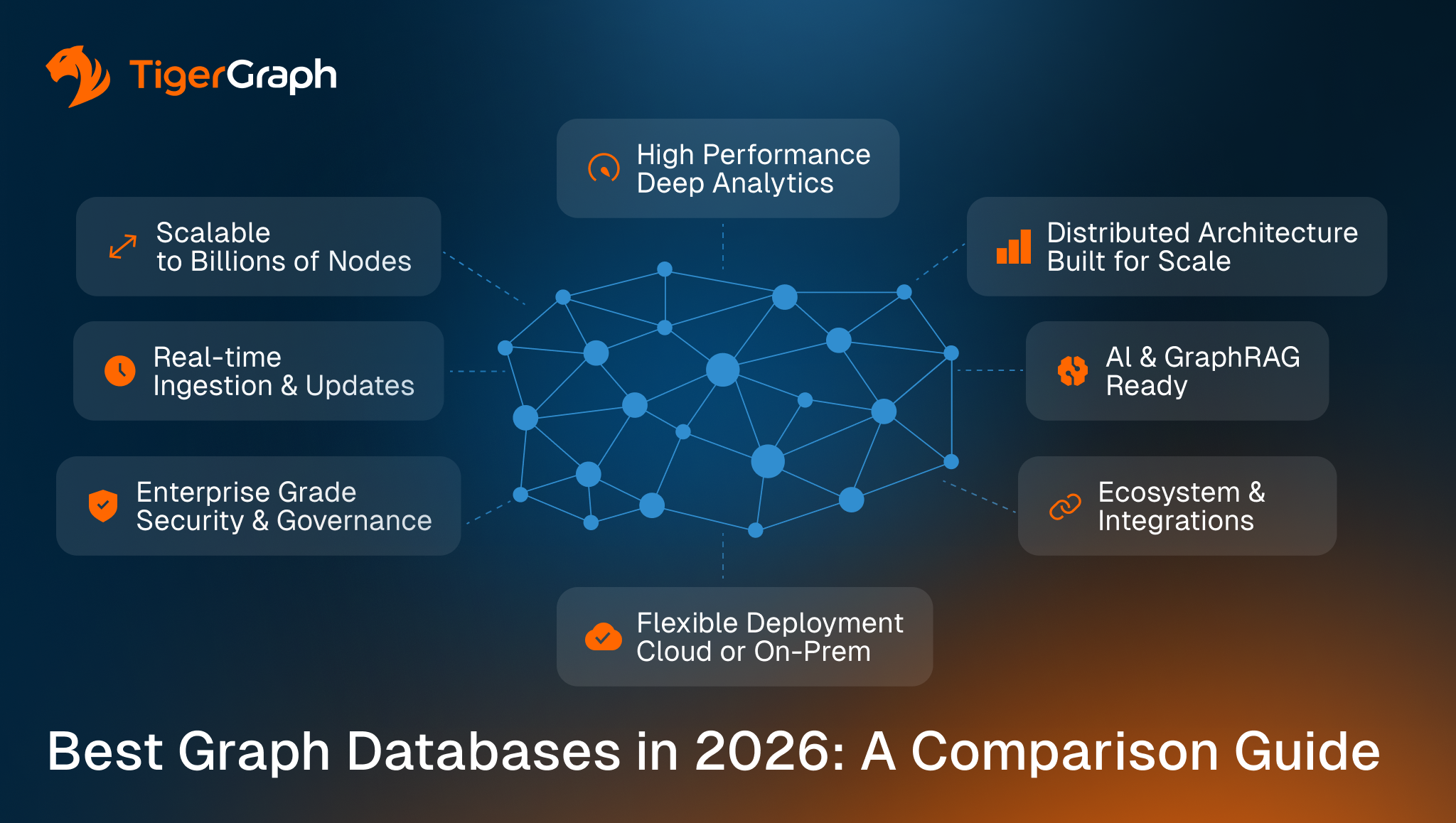
- The best graph databases in 2026 serve distinct workloads: enterprise analytics, developer prototyping, managed cloud, in-memory streaming, and zero-ETL graph query layers each have different leading platforms.
- TigerGraph leads for production-scale, real-time relationship analytics – fraud detection, AML, customer 360, supply chain, and enterprise GraphRAG – where deep multi-step queries must complete in milliseconds across billions of records.
- Neo4j is the most widely adopted graph database and the natural starting point for developer-led projects, knowledge graphs, and mid-scale applications where community resources and developer ergonomics matter most.
- Amazon Neptune is the default choice for AWS-centric teams that need a fully managed graph service supporting both property graph and RDF workloads without managing infrastructure.
- Choosing the right graph database in 2026 means matching the platform to the workload – not the most recognized brand name.
Evaluating the best graph databases in 2026 is not the same decision it was five years ago. The category has matured into distinct tiers: enterprise analytics platforms, developer-friendly databases, managed cloud services, in-memory engines, and graph query layers over data lakes. Each tier optimizes for different things. The right choice depends on your workload and the complexity of the relationships you need to analyze as well as the operational requirements of the applications those relationships support.
Several forces are reshaping that graph database decision. AI systems increasingly require connected context to reason accurately, which has made GraphRAG a mainstream enterprise pattern rather than an experiment. ISO GQL is reducing query-language lock-in concerns. Distributed graph architectures have matured for production workloads at the petabyte scale. And the performance gap between purpose-built graph platforms and multi-model alternatives has become visible on deep, real-time relationship queries. For many enterprises, graph is no longer evaluated solely as a database. It is increasingly evaluated as part of the AI and decision intelligence architecture.
This guide compares the leading graph databases against the criteria that matter most in 2026.
You’ll learn:
- How to evaluate graph databases by workload, not just feature lists
- What differentiates TigerGraph, Neo4j, Amazon Neptune, ArangoDB, Memgraph, Dgraph, and JanusGraph
- Which platform fits which enterprise use case
- Where the market is heading and what it means for architecture decisions
How to Evaluate Graph Databases in 2026
One recommendation: benchmark the queries your business actually depends on, not just simple traversals or synthetic performance tests. Multi-hop relationship depth, concurrent users, real-time updates, AI retrieval quality, explainability, and latency under production workloads often reveal far more than benchmark numbers alone.
Enterprise buyers should weigh these dimensions when comparing platforms:
Multi-step relationship performance at scale. The database must stay fast as query depth increases across a large graph, not just on one or two direct relationships. This is where purpose-built graph platforms most consistently outperform multi-model alternatives.
Scalability and parallelism. Enterprise workloads need distributed processing, elastic scaling, and the ability to run operational and analytical queries simultaneously without performance compromise.
AI and GraphRAG integration. Graph databases increasingly need to support graph-grounded retrieval, graph machine learning, and hybrid graph-plus-vector workflows for generative AI pipelines. As GraphRAG adoption accelerates, buyers should evaluate not only vector retrieval capabilities but also how effectively a platform retrieves connected context and preserves explainability.
Query language support. Evaluate support for GSQL, Cypher, openCypher (the open-source specification derived from Cypher and maintained independently), GQL, Gremlin, SPARQL, or AQL against your team’s skills and portability requirements.
Real-time ingestion and governance. For fraud detection, cybersecurity, and operational decisioning, batch analysis is not enough. Regulated industries also require role-based access, encryption, and auditability at enterprise grade.
7 Leading Best Graph Databases in 2026
1. TigerGraph
TigerGraph is an enterprise graph and vector database platform built for real-time relationship intelligence across large, highly connected datasets. Its massively parallel processing architecture enables deep link analytics on billions of relationships without performance degradation. It is designed for organizations where graph is part of the operational system itself, not simply a developer tool or analytical add-on.
TigerGraph supports GSQL, openCypher, and GQL pattern matching in the same execution engine. Its native hybrid graph-plus-vector search enables GraphRAG pipelines that retrieve connected, explainable context before LLM invocation.
A top global bank uses TigerGraph to analyze 50 million transactions per day for coordinated fraud detection. Jaguar Land Rover reduced supply chain analysis time from 3 weeks to 45 minutes. These are production deployments at enterprise scale.
Pricing model: TigerGraph Savanna uses compute-and-storage pricing based on workspace size and hours of use, with a free tier, a standard paid tier, and a Business Critical tier for high-availability production environments. Bring Your Own Cloud (BYOC) and self-managed enterprise licensing are also available.
Strengths: Deep multi-step relationship queries at scale; native hybrid graph and vector search; GraphRAG and graph ML workflows; nine pre-built solution kits for fraud, AML, customer 360, supply chain, and cybersecurity workloads.
Trade-offs: More platform than a small team needs for lightweight prototyping or a low-concurrency knowledge graph.
Best for: Fraud detection and AML at enterprise scale, customer 360, supply chain analytics, cybersecurity threat analysis, entity resolution, and production-scale GraphRAG. Organizations whose competitive advantage depends on understanding complex relationships in real time are the strongest fit.
2. Neo4j
Neo4j is the most widely adopted graph database and the default starting point for developer-led graph projects. Its Cypher query language, mature tooling ecosystem, and AuraDB managed cloud service make it easy for teams new to graph to move quickly. The community resources and driver support are also quite strong in the category.
Pricing model: AuraDB Professional starts at $65/GB/month (up to 128 GB); AuraDB Business Critical at $146/GB/month (up to 512 GB, 99.95% SLA, multi-zone availability). A free tier covers learning and prototyping. Self-managed Enterprise Edition is also available under annual subscription.
Strengths: Developer ergonomics; large community; mature tooling; good fit for knowledge graphs and mid-scale application graphs.
Trade-offs: Enterprise buyers should benchmark carefully for very large graphs or high-concurrency, deep real-time analytics workloads where multi-step query performance at scale is the deciding factor. As with any graph platform, the right choice depends less on popularity and more on how well the architecture aligns with the workload.
Best for: Developer prototyping, knowledge graphs, application graphs, and mid-scale personalization. Neo4j is a widely adopted starting point; organizations whose graphs scale to billions of relationships with real-time requirements often evaluate additional options as those needs emerge.
3. Amazon Neptune
Amazon Neptune is AWS’s fully managed graph database service. It supports property graph workloads through Gremlin and openCypher, and RDF semantic graph workloads through SPARQL. Neptune Analytics, a separate in-memory engine, adds graph algorithm capability (PageRank, community detection, shortest path, vector similarity) for analytical workloads that can analyze tens of billions of relationships in seconds.
Pricing model: Neptune Database supports on-demand instance pricing (from $0.348/hour for a db.r5.large instance in US East), Neptune Serverless (billed per Neptune Capacity Unit-hour), and Database Savings Plans. Storage is billed per GB-month. Neptune Analytics is billed separately and can be paused at 10% of the normal compute rate.
Strengths: Deep AWS integration; fully managed infrastructure; supports property graph and RDF; Neptune Analytics adds in-memory graph algorithm capability.
Trade-offs: AWS-native design limits portability. Specialized tuning for demanding deep-analytics workloads is constrained within the managed-service model. Organizations already standardized on AWS may find these trade-offs acceptable, while those seeking broader deployment flexibility should evaluate portability requirements early.
Best for: AWS-centric teams building knowledge graphs, identity graphs, recommendations, and fraud detection on existing AWS infrastructure.
4. ArangoDB
ArangoDB is a multi-model database supporting graph, document, key-value, search, and vector workloads through a single platform and query language (AQL). Its value is architectural simplicity: teams that need graph as one component of a broader data model can avoid adding a dedicated graph database to their stack.
Pricing model: Community (open-source) and Enterprise editions, with managed and self-managed deployment options.
Strengths: Flexible multi-model design; AQL covers multiple data types; useful when graph is one part of a broader application model.
Trade-offs: Multi-model flexibility involves performance trade-offs on the most demanding graph analytics workloads.
Best for: Applications that need graph, document, key-value, and vector in one database, particularly when no single workload requires extreme graph query performance.
5. Memgraph
Memgraph is an in-memory graph database built for low-latency analytics, streaming data, and real-time operational workloads. It is Cypher-compatible, making migration from Neo4j straightforward. Its in-memory architecture delivers sub-millisecond multi-step relationship queries, a profile it leverages for GraphRAG pipelines, AI agent memory systems, and real-time streaming analytics.
Pricing model: Community Edition is open-source and free. Memgraph Enterprise starts at $25,000/year for 16 GB of memory, scaling with total memory capacity. No per-query billing; no additional charges for compute, replicas, or graph algorithms. Memgraph Cloud (managed) is available separately.
Strengths: Sub-millisecond query latency; native Kafka, Pulsar, and Redpanda streaming integrations; Cypher-compatible; native vector search; strong for AI agent memory.
Trade-offs: In-memory architectures become expensive at large graph sizes. Enterprise pricing starts at $25,000/year for 16 GB; large enterprise graphs require substantial memory investment. Not designed for the deepest multi-step analytics at petabyte scale.
Best for: Streaming analytics, real-time recommendations, AI agent memory, and moderate-scale low-latency workloads where sub-millisecond response is the primary requirement.
6. Dgraph
Dgraph is an open-source distributed graph database with a GraphQL-native development model. Originally built by ex-Google engineers, Dgraph was acquired by Hypermode in 2023 and subsequently acquired by Istari Digital in October 2025. As of Dgraph v25 (early 2025), Dgraph moved to a single Apache 2.0 open-source license, all previously enterprise-only features are now in the open-source build. Commercial enterprise support is available through Istari Digital.
Pricing model: Fully open-source under Apache 2.0 as of v25. Commercial enterprise support available through Istari Digital. Dgraph Cloud (managed) is available for teams that want hosted deployments.
Strengths: Strong fit for GraphQL-oriented teams; distributed architecture; fully open-source with no feature gating as of v25.
Trade-offs: Smaller enterprise analytics footprint than TigerGraph, Neo4j, or Amazon Neptune. Two acquisitions in two years (Hypermode in 2023, Istari Digital in October 2025) mean the commercial roadmap is still stabilizing under new ownership.
Best for: GraphQL-native applications, connected data products, and teams that prioritize API-driven development and open-source flexibility.
7. JanusGraph
JanusGraph is an open-source distributed graph database for large-scale deployments requiring full architectural control. It uses the Gremlin query language through Apache TinkerPop, and integrates with external storage backends (Cassandra, HBase, Bigtable) and indexing systems (Elasticsearch, Solr).
Pricing model: Open-source with no licensing cost. Total cost of ownership is driven by infrastructure, storage, operations, and support, all managed by the deploying organization.
Strengths: Maximum architectural control; open-source flexibility.
Trade-offs: High operational lift across storage, indexing, tuning, scaling, monitoring, and reliability.
Best for: Engineering-led teams with deep distributed systems expertise building custom large-scale graph infrastructure on their own cloud environment.
Other Notable Platforms
Oracle Graph and SAP HANA Graph fit organizations already standardized on those enterprise ecosystems. AllegroGraph serves RDF and semantic graph workloads. NebulaGraph and FalkorDB are evaluated for distributed graph and AI use cases. PuppyGraph enables teams to query existing relational, warehouse, or lakehouse data as a graph without ETL, useful when graph analytics over Snowflake or Databricks is the goal, without adding a dedicated graph database to the stack.
Graph Database Selection by Enterprise Use Case
Real-time fraud and AML at enterprise scale. TigerGraph is the strongest fit when fraud detection depends on identifying coordinated behavior across customers, accounts, devices, transactions, and counterparties in real time.A top global bank uses TigerGraph to analyze 50 million transactions per day, surfacing fraud rings and coordinated financial crime patterns that rule-based systems cannot reach. The key evaluation criterion is not simply whether the platform stores relationships, but whether it can traverse large, evolving relationship networks quickly enough to support operational decisions. Neo4j works for smaller fraud graphs where developer velocity matters more than deep multi-step query performance at high concurrency.
Customer 360 and recommendations. TigerGraph fits large enterprises that need real-time decisioning across fragmented customer, product, event, and interaction data. Xandr combined consumer data across 15 properties for cross-property user journey tracking using TigerGraph. Neo4j is a solid choice for mid-scale customer 360 and knowledge-graph-driven personalization.
Supply chain analytics. TigerGraph fits multi-tier supplier dependency analysis and operational risk modeling. Jaguar Land Rover reduced supply chain analysis time from 3 weeks to 45 minutes using TigerGraph graph analytics. Simpler graph tools work for supply chain analysis where the analysis window is measured in hours rather than minutes.
Knowledge graphs for enterprise AI and GraphRAG. TigerGraph is the strongest fit for production-scale GraphRAG where AI systems need governed, connected, and explainable enterprise context. As enterprises operationalize AI, graph databases increasingly become infrastructure decisions rather than isolated data platform decisions. Neo4j and FalkorDB work well for experimentation and mid-scale GraphRAG projects. Amazon Neptune fits AWS-centered AI architectures, including its managed GraphRAG integration through Amazon Bedrock Knowledge Bases.
Cybersecurity and attack path analysis. TigerGraph fits real-time security analytics across identities, devices, network events, and access patterns, following multi-step attack paths across thousands of connected entities in milliseconds. Memgraph is a strong option when the dominant requirement is streaming-heavy, moderate-scale analysis with sub-millisecond latency.
Developer prototyping and experimentation. Neo4j remains the strongest choice for developer ergonomics. ArangoDB is worth considering when the application genuinely needs multiple data models. PuppyGraph is useful for exploring graph analytics over existing lakehouse data without ETL.
Where the Best Graph Database Market Is Heading
Four trends are shaping enterprise graph adoption in the near term.
GraphRAG is becoming a core AI infrastructure decision. Vector-only retrieval improves semantic similarity but cannot follow relationship chains between entities. AI systems that need to reason across connected facts need graph context alongside vector search. The graph database selected in 2026 should be evaluated as AI infrastructure from day one. Increasingly, organizations are selecting graph platforms based not only on analytics requirements but also on how effectively they support enterprise AI, explainability, and governed retrieval.
ISO GQL is reducing query-language lock-in. TigerGraph’s support for GSQL, openCypher, and GQL pattern matching in the same engine gives teams flexibility to work in familiar syntax without commitment to a single proprietary language.
Scalable distributed architectures are pulling ahead for enterprise workloads. Massively parallel processing, separation of storage and compute, and distributed graph architecture show up concretely in query latency and throughput when graphs reach billions of relationships and real-time performance requirements emerge.
Graph is integrating with lakehouse and warehouse platforms. Enterprises want graph to act as the relationship intelligence layer over data already in Snowflake, Databricks, and operational systems, not a replacement for them. Platforms that support fast ingestion from warehouse and lakehouse sources are best positioned for the next phase of enterprise AI adoption. The strongest enterprise architectures will combine relational databases, lakehouses, vector search, and graph, using each where it delivers the greatest value rather than expecting one technology to solve every problem. The best graph databases in 2026 are those that solve today’s workload while scaling to support the AI and analytics demands ahead. The best platform is the one whose architecture aligns with the complexity of your relationships, the scale of your workload, your AI strategy, and your operational requirements. The strongest choices are those that solve today’s problems while providing the foundation for tomorrow’s AI and analytics initiatives.
FAQs
What is the best graph database in 2026?
The best graph database depends on the workload. For real-time, multi-step enterprise analytics at scale, fraud detection, AML, customer 360, supply chain, cybersecurity, and production GraphRAG, TigerGraph is the strongest fit, backed by an independently validated massively parallel distributed architecture. For developer-led knowledge graphs and prototyping, Neo4j is the most widely adopted option. For AWS-centric managed deployments, Amazon Neptune is the natural choice. No single platform is best for every use case.
What is the most popular graph database?
Neo4j has the largest developer community and is the most recognized graph database by name. Popularity reflects adoption history and developer experience, it does not translate directly to best fit for a specific enterprise workload. Many organizations begin with Neo4j for developer ergonomics and later evaluate purpose-built enterprise platforms like TigerGraph as their real-time performance and scale requirements emerge.
What is the difference between a graph database and a relational database?
A graph database stores entities and the relationships between them as native first-class data, enabling it to follow multi-step relationship chains at high speed across large datasets. A relational database organizes each entity type in its own table and records relationships through foreign keys, requiring sequential joins when a query spans multiple relationship levels. Graph databases outperform relational databases on queries where the relationship pattern is the point, fraud ring detection, network path analysis, and entity resolution across fragmented records.
Are graph databases classified as NoSQL?
Graph databases are often grouped with NoSQL databases because they do not use the SQL-based relational model. However, native graph databases are architecturally distinct from document stores, key-value stores, and column-family databases. Each optimizes for fundamentally different access patterns. The shared NoSQL label does not imply interchangeability: a graph database is the right tool specifically for workloads where relationship patterns are the primary analytical target.
How do I choose the right graph database for my use case?
Start with the workload: relationship depth and query complexity, data volume and growth rate, latency requirements, AI and GraphRAG needs, deployment model, governance constraints, and total cost of ownership. Then test shortlisted platforms against real data and real queries at realistic scale. For enterprise fraud detection, customer 360, supply chain analytics, or production GraphRAG, prioritize platforms with validated deep-query performance, native hybrid graph-and-vector search, and production accelerators that reduce time from pilot to deployment.