
Summary
- Property graph and RDF are the two dominant graph data models, but they are designed for different problems and should not be treated as interchangeable alternatives.
- Property graphs model entities and relationships as first-class objects with their own properties, making them well-suited for operational enterprise analytics at scale.
- RDF represents data as subject-predicate-object triples with globally unique URI-based identifiers, optimizing for semantic web standards, ontology reasoning, and linked data interoperability.
- For most enterprise use cases, including fraud detection, supply chain analysis, cybersecurity, and customer intelligence, a property graph database is the better-matched foundation.
- TigerGraph implements the labeled property graph model with GSQL and openCypher support, purpose-built for real-time deep-link analytics across billions of connected records.
When organizations evaluate graph technology, one of the first architectural decisions is choosing the underlying data model. The two dominant models are the property graph (also called the labeled property graph, or LPG) and RDF (Resource Description Framework). Both represent data as entities and relationships, but they were designed for different purposes and perform differently across enterprise workloads. The most important question is not which model is “better.” It is which model aligns with the problem your organization is trying to solve.
Confusion around property graph vs RDF often arises because they are presented as competing solutions to the same problem. In reality, they address different classes of workloads: one is purpose-built for operational enterprise analytics at scale, while the other is designed for semantic web standards and ontology-driven knowledge representation. The choice is therefore an architectural decision rather than a feature comparison.
In this article, you’ll learn:
- What property graphs and RDF are, and how their data models differ
- Which workloads each model is best suited for, with specific enterprise use case guidance
- How to think about knowledge graphs in relation to both models
- How TigerGraph implements the labeled property graph model for operational analytics
What Is a Property Graph?
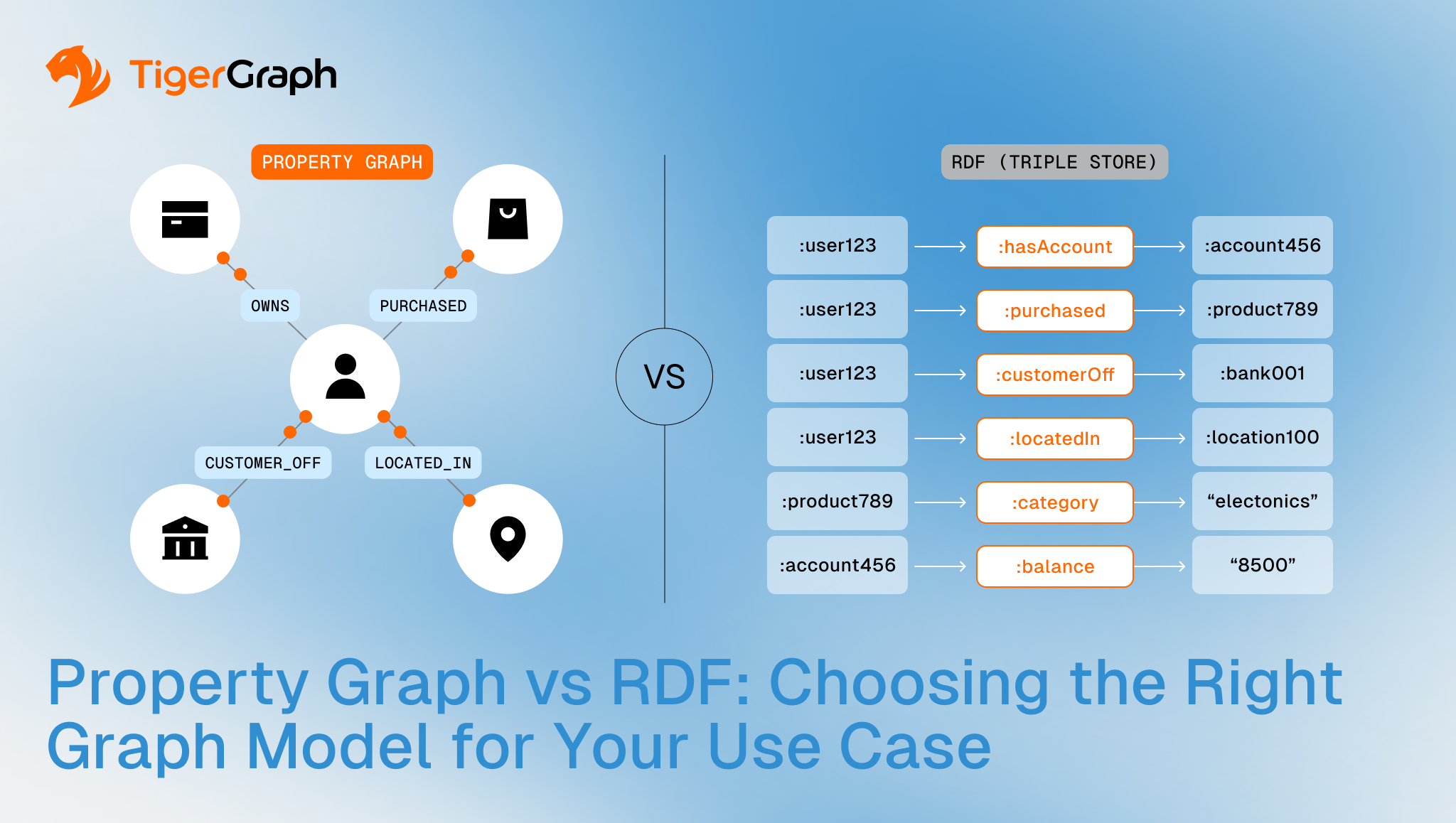
A property graph, or labeled property graph (LPG), represents data as a network of entities and relationships where both carry labels and properties directly. A user entity can have a name and join date; a “purchases” relationship connecting it to a product entity can have a quantity and timestamp. Context lives on the entities and connections themselves, so the same graph can model an account-transaction network for fraud detection and a product-interaction network for recommendations without a separate redesign.
Property graphs are queried using pattern-matching languages designed for connected data: GSQL (TigerGraph’s query language), openCypher, and ISO GQL – which became the first international standard query language for property graphs in 2024. The model and the database architecture are co-designed for operational workloads on an organization’s data: fraud detection, supply chain resilience, IT operations modeling, real-time personalized recommendations, and now knowledge graphs for AI. The emphasis is on making richly connected operational data easy to model, query, and analyze at enterprise scale.
What Is RDF?
RDF (Resource Description Framework) is a W3C standard that represents all information as triples: subject, predicate, object (for example: “Account_123 – owns – Card_456”). Every entity and relationship can be identified by a URI, providing the potential for RDF data to be portable and linkable across sources that use different naming conventions – a foundational property of the semantic web.
RDF data is queried using SPARQL, a W3C standard query language well-suited for ontology reasoning and federated queries across linked data sources. An example of ontology reasoning is “isOfficerOf *Controls ⇒ hasSigningAuthority”. RDF data is stored in a type of database called a triple store, which is optimized for those workloads but generally does not match the throughput or analytical query performance of property graph databases built for enterprise operational scale. RDF optimizes for semantic interoperability and standards-based reasoning rather than high-throughput operational analytics.
The Key Differences That Drive the Choice
The table below summarizes the five most consequential differences for enterprise teams evaluating these models. The sections that follow explain each dimension in depth.
| Property Graph | RDF | |
| Data model | Entities and relationships as first-class objects; both carry properties directly | Subject-predicate-object triples; multiple triples required to express rich relationships |
| Query language | GSQL, openCypher, ISO GQL – pattern matching via path traversal | SPARQL – constraint satisfaction via triple joining |
| Performance profile | Optimized for high-throughput, real-time operational analytics | Optimized for ontology reasoning and federated queries |
| Data interchange | Designed for standalone deployments. Entity resolution required when combining sources. | Designed for data interchange – worldwide standard for atomic data units (triples), support for global URIs. |
| Primary use cases | Fraud detection, supply chain, cybersecurity, customer intelligence | Ontology management, linked data, semantic web publishing, W3C-compliant data exchange |
The differences in the table are not simply implementation choices. They reflect fundamentally different design objectives. Property graphs optimize operational relationship analytics, while RDF optimizes semantic interoperability and formal knowledge representation.
The main differences between property graph and RDF are found in these five categories:
- Data modeling approach: in a property graph, an entity and a relationship are first-class objects with their own set of properties. This allows complex, rich data to be modeled naturally. In RDF, all information is broken into atomic triples, and expressing the same relationship with multiple attributes requires multiple triples and often an auxiliary node. For operational enterprise data, which is usually attribute-rich and relationship-dense, property graphs model the domain more directly. As operational data becomes more connected and attribute-rich, this modeling advantage becomes increasingly significant.
- Query expressiveness for analytical workloads: property graph query languages like GSQL and openCypher are designed for the analytical patterns enterprises need, that is, pattern matching, path finding, subgraph analysis, and aggregation across relationship networks. SPARQL is powerful for ontology reasoning and federated queries, but was not designed for the complex multi-step analytical queries that drive fraud detection, supply chain analysis, or cybersecurity workloads. The practical result is that property graph databases typically express enterprise analytical queries more concisely and execute them faster. When the workload centers on path analysis, pattern matching, and relationship exploration, the query model naturally aligns with the questions being asked.
- Performance at operational scale: property graph databases are architected for concurrent, high-throughput query workloads with real-time data ingestion. They maintain sub-second query performance for analytical queries spanning billions of relationships while supporting concurrent workloads. Triple stores are generally optimized for ontology operations and SPARQL queries rather than the throughput and latency requirements of real-time operational analytics. Teams building systems that need to answer analytical questions in milliseconds across live enterprise data will generally find property graph databases better matched to that requirement. Operational performance is ultimately determined by how efficiently the database traverses relationships under real production workloads, not by how quickly it retrieves individual records.
- Interoperability and standardization: RDF’s standardization of the atomic unit of data – the triple – coupled with URI-based global identifiers make it inherently interoperable; that is, data from one RDF source can be combined with data from another because entities have the same structure and have universally resolvable identifiers. This is the model’s defining strength for linked data use cases. Property graph databases use local identifiers, which require explicit identity resolution when combining data across sources. For enterprise use cases that involve linking data across organizational boundaries (government-linked data, cross-institutional research), RDF’s interoperability model is a genuine advantage.
- Tooling ecosystem and developer accessibility: openCypher, the query language used by Neo4j, Memgraph, and several other property graph databases, including TigerGraph, is one of the most widely adopted graph query languages, with a developer base spanning hundreds of thousands of practitioners. SPARQL has a well-established community in the semantic web and library science contexts, but a smaller footprint in enterprise software engineering. Teams evaluating the practical availability of developers and tooling will generally find the property graph ecosystem larger for operational analytics workloads.
When to Choose a Property Graph
Choose a property graph when relationships drive operational decisions rather than simply describing the underlying data.
- Operational analytics with real-time requirements: if your application must query live data and return results in milliseconds as a transaction occurs, as is the case with fraud and threat detection, dynamic recommendation serving, and live supply chain monitoring, a property graph database is the appropriate foundation. These workloads require throughput and latency characteristics that property graph databases are architecturally designed to deliver.
- Attribute-rich, multi-domain enterprise data: when entities carry many properties and relationships also carry context (the amount of a transaction, the timestamp of an access event, the confidence score of an entity match), property graphs model this naturally. If your team works with financial, operational, security, or behavioral data, you will find the property graph to be a better fit.
- Multi-step analytical queries across large graphs: use cases like fraud ring detection (finding circular relationships across accounts and transactions), supply chain impact analysis (tracing consequences through 10+ tiers of a supplier network), or attack path analysis (mapping routes through a network of access permissions) require deep, multi-step queries across billions of connected records at low latency. Property graph databases handle this class of query natively.
- Graph data science and machine learning integration: property graph databases directly include or integrate with graph data science libraries to support algorithms such as centrality, community detection, and path analysis. These algorithms generate relationship-based features used by machine learning models. If your team is building AI-assisted analytics on graph data, you will generally find this integration more mature and performant in the property graph ecosystem.
In general, a property graph is the better choice when the workload is operational analytics, the data is attribute-rich, the query requirements involve multi-step relationship analysis at speed, and the team is building a system that needs to scale to enterprise data volumes with real-time response requirements.
When to Choose RDF
Choose RDF when semantic interoperability, standards compliance, and ontology reasoning are more important than real-time operational analytics.
- Ontology management and knowledge representation: RDF with OWL (Web Ontology Language) is the standard for formal ontology work. It works by defining entity types, relationship constraints, and inference rules in a way that can be shared, validated, and reasoned over. Teams whose primary goal is to model a formal knowledge domain with reasoning support should consider RDF/OWL.
- Linked data and cross-organizational data integration: when the requirement is to link data across organizational or system boundaries, where entities need globally unique, resolvable identifiers (e.g., government open data, research data repositories, cross-institutional data sharing), RDF’s URI-based model provides a standardized interoperability layer that property graphs do not offer natively.
- Publishing semantic web data: if the goal is to publish machine-readable data that conforms to semantic web standards (schema.org, Dublin Core, FOAF) for consumption by external systems or search engines, RDF is the natural choice. RDF was designed in conjunction with those standards.
- Compliance with W3C standards in regulated publishing contexts: certain government, library science, and academic publishing workflows require compliance with W3C RDF standards. In those contexts, the choice is defined by the compliance requirement rather than performance characteristics.
What About Knowledge Graphs?
A knowledge graph is an application concept, not a storage model. It is a structured representation of entities and relationships that embodies domain context – and it can be implemented on either a property graph database or a triple store. This distinction is important because “knowledge graph” describes what you are building, while property graph and RDF describe how the underlying data is modeled.
The choice follows the same logic as the broader model decision. Knowledge graphs built for operational use (connecting customers, accounts, products, and transactions into a model that drives real-time analytics) belong on a property graph. Knowledge graphs built for semantic interoperability (publishing machine-readable ontologies, linking institutional data sources through shared URI identifiers) belong on a triple store. Many enterprise architectures use both: a property graph for analytics, an ontology layer for governance.
TigerGraph and the Property Graph Model
TigerGraph is a property graph database implementing the labeled property graph model. It is purpose-built for operational analytics use cases where a property graph is the appropriate choice and requires real-time relationship analysis across enterprise-scale, connected data.
Additionally, TigerGraph has:
- GSQL and openCypher on a single engine: TigerGraph’s primary query language is GSQL, a SQL-like graph query language designed for complex analytical queries across large, connected datasets. It also supports openCypher, the most widely adopted open graph query language, through the same high-performance, parallel processing engine, enabling teams already familiar with openCypher to query TigerGraph without changing existing query patterns.
- Enterprise-scale operational analytics: TigerGraph’s property graph architecture supports real-time data ingestion and sub-second query performance for analytical queries across billions of connected records (third-party benchmark). This is the performance profile that operational use cases such as fraud detection, supply chain analysis, cybersecurity threat detection, and customer 360 require at enterprise scale.
- Deep link analytics across multi-step relationships: TigerGraph enables complex multi-step relationship analysis by tracing connections across many degrees of separation in real time. This capability underpins many enterprise graph analytics use cases, as relationship queries that would require multiple expensive joins in a relational database execute as single queries in TigerGraph, with performance that scales as the graph grows.
- AI-ready property graph: TigerGraph’s Graph Data Science Library provides graph algorithm support for property graph analytics, including path analysis, centrality, community detection, and similarity, which generate relationship-based features for machine learning models. This makes the property graph model a strong foundation for AI systems that reason over connected data rather than isolated records.
Choosing Between Property Graph vs RDF
Both property graph and RDF are valid graph models, but they are not interchangeable. They were built for different problems, and they perform differently across different workloads. The choice should be driven by workload requirements rather than popularity or search visibility. Organizations achieve the best outcomes when they begin with the business problem and allow that problem to determine the graph model—not the other way around.
As a practical guideline, choose a property graph for operational enterprise analytics: real-time querying, attribute-rich data, multi-step relationship analysis, and AI integration at scale. Choose RDF for semantic web standards, ontology management, and linked data interoperability. Many enterprises successfully use both models, each where its strengths are most valuable. In modern enterprise architectures, these approaches are often complementary rather than mutually exclusive.
For your team evaluating graph databases to power operational analytics (fraud detection, supply chain analysis, cybersecurity, customer intelligence), TigerGraph’s property graph implementation is purpose-built for those workloads. The combination of GSQL expressiveness, openCypher support, and enterprise-scale performance makes it a strong foundation for operational graph analytics at any scale.
TigerGraph combines the flexibility of the labeled property graph model with enterprise-scale performance, making it well suited for operational workloads where connected data drives real-time decisions.
To explore how TigerGraph’s property graph implementation can power your analytical workloads, read more about TigerGraph’s graph database technology, start a free trial, or request a demo.
FAQs
What is the difference between a property graph and RDF?
A property graph represents data as entities and relationships where both carry properties directly, such as labels, timestamps, amounts, and confidence scores. RDF represents all information as subject-predicate-object triples with globally unique URI-based identifiers. Property graphs are designed for operational analytics at scale; RDF is designed for semantic web standards, ontology management, and linked data interoperability. They are not competing solutions to the same problem.
Which is better for enterprise analytics: property graph or RDF?
For most enterprise analytics workloads (fraud detection, supply chain analysis, cybersecurity threat detection, and customer intelligence), a property graph database is the better-matched foundation. Property graph databases are optimized for high-throughput, real-time analytical queries across attribute-rich, highly connected data. RDF triple stores are better suited to ontology reasoning, linked data integration, and semantic web publishing.
What is a labeled property graph (LPG)?
A labeled property graph (LPG) is the formal name for the property graph data model. “Labeled” refers to the type labels attached to entities (such as “Account” or “Customer”) and relationships (such as “owns” or “transfers-to”). “Property” refers to the key-value attributes stored on both entities and relationships. GSQL, openCypher, and ISO GQL are all query languages built for the LPG model.
Does TigerGraph support RDF or SPARQL queries?
TigerGraph does not natively store or query RDF data. It implements the labeled property graph model and supports GSQL and openCypher as its query languages. For organizations that need to integrate an RDF-based ontology layer with an operational graph analytics platform, TigerGraph can serve as the high-performance analytics layer while a triple store handles ontology management and semantic interoperability functions.
When should an enterprise use a triple store instead of a property graph database?
A triple store is the better choice when the primary requirement is ontology reasoning, W3C RDF/OWL standards compliance, or cross-organizational linked data integration where entities need globally unique, resolvable URI identifiers. Government open data platforms, academic research repositories, and cross-institutional publishing workflows are common triple store use cases. For operational analytics with real-time performance requirements, a property graph database is typically the better fit.