
Summary
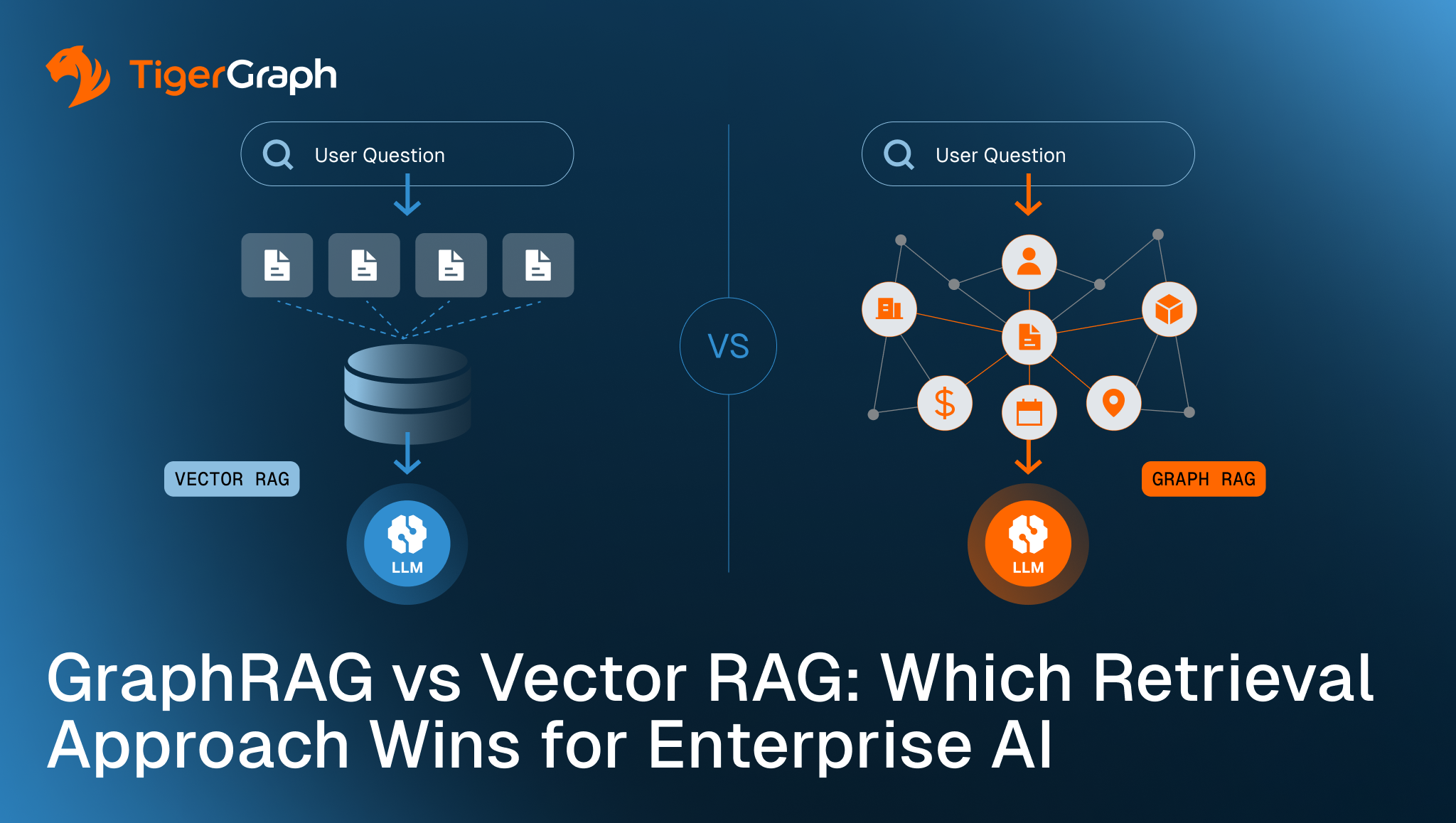
- Vector RAG retrieves text by semantic similarity, which works well for broad, unstructured lookup but struggles when an answer depends on relationships between entities.
- GraphRAG retrieves connected context (entities, relationships, rules, and grounded text) from a knowledge graph, making it stronger on multi-step, relational, and policy-aware questions.
- The widest gaps between the two approaches are multi-hop accuracy and explainability: vector RAG shows retrieved chunks, GraphRAG shows the connected evidence path behind an answer.
- In production, the strongest architecture is rarely one or the other; it’s hybrid retrieval, where vector search finds entry points and graph retrieval assembles the connected context.
- The right approach depends on the question pattern: simple lookup favors vector RAG, while fraud, compliance, healthcare, and supply chain questions favor GraphRAG or hybrid retrieval.
Every serious enterprise GenAI deployment eventually reaches the same architecture decision: how should the system retrieve the right context before the model answers? For some teams, that means vector RAG. For others, it means GraphRAG. Increasingly, it means both.
The choice matters because retrieval quietly defines the accuracy ceiling of every downstream AI application. A vector-only RAG system that should have used graph structure may return plausible but wrong answers when a question depends on connected facts. A GraphRAG system without vector retrieval may struggle across broad, messy document collections where the first problem is simply finding relevant text. The limitation is rarely the language model. More often, it is the retrieval architecture supplying the model with incomplete context.
So the real question in GraphRAG vs vector RAG is not “which one wins?” It is: which retrieval mode fits the workload, and when should enterprises combine them? This guide compares both approaches across accuracy, explainability, scale, and use-case fit, then explains why hybrid graph-and-vector retrieval is becoming the production default.
You’ll learn:
- The strengths and limits of vector RAG and where it breaks down
- The strengths and limits of GraphRAG and what it adds
- How the two approaches compare across the dimensions that matter for enterprise AI
- Why hybrid retrieval is becoming the production default, and which approach fits your use case
Vector RAG: Strengths and Limits
Vector RAG is the pattern most teams start with when building a retrieval-augmented generation application. Source documents are split into chunks, each chunk is converted into an embedding, and those embeddings are stored in a vector database. At query time, the system embeds the question, retrieves the closest chunks by semantic similarity, and the LLM generates an answer from those chunks.
Where it works well:
- Broad unstructured text. PDFs, help center articles, policy documents, product docs, transcripts, analyst reports, knowledge-base entries – vector RAG handles this volume without requiring a modeled knowledge graph first.
- Fast prototyping. Embeddings, an index, and an LLM are enough to get a working application running.
- Single-hop lookup questions. “What is the company policy for jury duty?” or “Where does the API documentation explain OAuth token renewal?” – similarity search retrieves the right passage quickly.
Where it breaks down:
Vector search does not naturally understand that a customer belongs to an account, that the account owns several products, that one product is affected by a support incident, and that the incident is governed by a premium SLA. Those connections may exist somewhere in the text, but similarity does not preserve the path between them. Similarity identifies related content. It does not preserve the business relationships that explain why that content matters. This creates four production problems:
- Multi-hop questions fail. Many business questions require connecting facts across entities; similar chunks are not connected evidence.
- No structural awareness. Hierarchies, taxonomies, ownership structures, policy rules, and dependencies aren’t preserved by similarity search.
- Limited explainability. The audit trail is “these chunks were retrieved,” not “this reasoning path supports the answer.”
- Sensitivity to drift. Performance depends on chunking strategy, embedding model choice, metadata quality, and content changes.
GraphRAG: Strengths and Limits
Instead of retrieving isolated chunks by similarity alone, GraphRAG retrieves context from a knowledge graph: a connected model of entities, relationships, rules, and supporting text. At query time, the system identifies the entities in the question, follows the relevant relationships, assembles the connected context, and passes that grounded context to the LLM. Instead of asking the language model to infer relationships, GraphRAG retrieves those relationships directly as part of the evidence.
Where it works well:
- Multi-step accuracy. Retrieval doesn’t approximate relationships through embedding proximity; it retrieves the actual connected context. A fraud assistant can check whether two applicants share a device, address, employer, or transaction pattern. A supply chain assistant can trace which products, customers, and regions are affected if a supplier plant goes offline.
- Structural and business-rule awareness. Product hierarchies, supplier dependencies, customer-account relationships, and compliance rules can be represented directly in the graph and used before the LLM generates an answer.
- Explainability. GraphRAG can show which entities, relationships, policies, and source records contributed to the response — often the difference between a useful AI assistant and a black-box experiment that can’t be approved for production. For regulated enterprise AI, that traceability is often as important as answer accuracy itself.
Where it has trade-offs:
- More up-front work, especially extracting entities and relationships from unstructured documents.
- Less necessary for simple lookup. “Find me text about X” questions don’t need graph structure.
- A different operational capability. Running a graph database at production scale is a different skill set than running a vector index.
GraphRAG vs Vector RAG: A Comparison
The table below summarizes how GraphRAG and vector RAG compare across the dimensions that matter most for enterprise AI. The right choice is rarely “pick one forever.” It is to identify which dimension is critical for the workload: breadth, structure, explainability, setup speed, or operational scale.
| Dimension | Vector RAG | GraphRAG |
| Retrieval mechanism | Retrieves chunks by semantic similarity | Retrieves connected entities, relationships, rules, and grounded text |
| Accuracy on multi-hop questions | Limited when answers depend on connected facts | Strong when answers depend on relationships and dependencies |
| Accuracy on broad unstructured lookup | Strong for large text corpora | Useful when text is linked to entities, but not always necessary for simple lookup |
| Relationship and business-rule awareness | Weak unless encoded as metadata or prompt rules | Strong because structure and rules are part of retrieval |
| Explainability | Shows retrieved chunks | Shows the connected evidence path behind the answer |
| Up-front setup cost | Lower; faster to prototype | Higher; requires graph modeling or extraction |
| Stability under content change | Sensitive to chunking, embeddings, and reprocessing | More stable when entities and relationships persist |
| Best-fit question types | Single-hop lookup questions, such as “Which document explains our supplier onboarding policy?” | Relationship-dependent questions, such as “Which products and customers are affected if this supplier goes offline?” |
| Best-fit enterprise contexts | Knowledge search, content discovery, documentation Q&A | Fraud, compliance, healthcare, supply chain, customer 360, regulated AI |
The most important differences are not retrieval speed or implementation effort. They are multi-hop accuracy, explainability, and the ability to reason over connected enterprise data. Those are increasingly the characteristics that separate production AI systems from successful pilots.
In commercial deployments, those are often the dimensions that matter most. A customer-facing AI assistant in banking, insurance, healthcare, or government cannot simply return a plausible paragraph. It must answer from approved context, respect policy, and show why the response is defensible.
This is where the knowledge graph vs vector database decision becomes more than a storage debate. Vector systems are excellent at finding semantically similar text. Knowledge graphs are better at preserving the business structure that makes enterprise answers correct.
Why Hybrid Retrieval Is Emerging as the Enterprise Default
In production, the question is increasingly not “GraphRAG or vector RAG?” The stronger architecture is often “vector first, graph next, LLM last.”
A typical hybrid retrieval pipeline works like this. Vector search identifies an initial set of relevant text chunks, documents, or entities. That step gives the system breadth across the long tail of enterprise content. Then graph retrieval expands from those entry points into the relevant structure: accounts, products, suppliers, providers, transactions, policies, cases, owners, dependencies, permissions, and source records. The LLM receives a richer context package: not just similar text, but similar text connected to the enterprise facts that explain what the answer means.
This hybrid pattern is becoming the enterprise default for four reasons.
First, accuracy compounds. Vector retrieval finds likely starting points. Graph retrieval adds the relationship context that prevents the LLM from treating related but disconnected facts as interchangeable. This is especially important when questions require several reasoning steps across real-world enterprise data. The two retrieval methods solve different problems, which is precisely why they work so well together.
Second, explainability is preserved. Even when vector search helps find the entry point, the graph component can show how the system moved from the question to the evidence. That gives reviewers, auditors, and business users a way to inspect the answer.
Third, coverage stays broad. Graph-only systems can struggle when the question is a loose semantic lookup over a huge document corpus. Vector retrieval handles that long tail, while the graph adds structure when structure matters.
Fourth, operations become simpler when both capabilities live in one platform. Maintaining a separate graph database, vector database, synchronization pipeline, access-control layer, and retrieval orchestrator can become expensive and fragile. Reducing architectural complexity is becoming just as important as improving retrieval quality for enterprise AI teams moving into production.
Choosing the Right Approach for Your Use Case
Instead of selecting a retrieval architecture based on technology preferences, organizations should begin by understanding the kinds of questions their AI systems must answer. Retrieval requirements almost always follow question patterns.
Internal knowledge search and document Q&A: Start with vector RAG. It is the fastest path to useful search across policies, documentation, support content, contracts, and internal knowledge bases. Add GraphRAG when users begin asking questions that depend on entities and relationships, such as “Which customers are affected by this product change?” or “Which policy applies to this business unit and region?”
Customer-facing AI in regulated industries: Use GraphRAG or hybrid retrieval. Banking, insurance, healthcare, and government AI systems need traceability, policy awareness, and controlled access to sensitive data. A vector-only architecture can retrieve similar text, but it does not naturally explain the relationship path from evidence to answer.
Clinical decision support and prior authorization: Use hybrid retrieval. Vector search can cover clinical literature, policy text, medical guidelines, and benefit documents. Graph retrieval can ground the answer in the patient’s connected context: diagnoses, medications, providers, prior claims, authorization rules, and care history. See TigerGraph’s healthcare solutions for production examples.
Fraud and compliance assistants: Use GraphRAG. Fraud, AML, KYC, sanctions risk, and compliance investigation are inherently relational. The important question is rarely whether a document mentions a name. It is whether entities, accounts, transactions, devices, addresses, and behaviors form a pattern that requires review. This is also where explainability is non-negotiable. Explore TigerGraph’s financial crime detection capabilities.
Supply chain and operations assistants: Use GraphRAG. These questions are network-shaped by nature: “What does this disruption affect downstream?” “Which suppliers share the same exposed component?” “Which customers will be impacted if this route fails?” Graph retrieval is a natural fit because the answer depends on dependencies. See TigerGraph’s supply chain analysis solutions.
Marketing and content generation over open corpora: Vector RAG is usually sufficient. When the goal is to retrieve examples, summarize documents, or generate content from broad unstructured sources, structural reasoning is often less important. Add graph only when campaign, customer, product, or compliance relationships materially affect the output.
For teams evaluating knowledge graphs vs RAG, the practical answer is that knowledge graphs do not replace RAG. They make RAG more accurate when enterprise context depends on relationships.
GraphRAG and Vector RAG Are Complementary, Not Competing
GraphRAG and vector RAG are complementary retrieval modes. Vector RAG gives enterprise AI breadth across unstructured content. GraphRAG gives it connected context, explainability, and policy-aware reasoning.
As GenAI moves from pilots to production, accuracy, traceability, and operational efficiency become the deciding factors, and those factors increasingly favor graph-grounded or hybrid retrieval over vector-only systems.
TigerGraph is built for this production reality: an enterprise-grade graph database for real-time, connected AI, with graph and vector capabilities in a single platform. Explore TigerGraph’s GraphRAG capabilities, explore pricing and free trial options, or request a demo to see hybrid retrieval at enterprise scale.
FAQs
What is the difference between GraphRAG and vector RAG?
Vector RAG retrieves text by semantic similarity. GraphRAG retrieves entities, relationships, rules, and grounded text from a knowledge graph, adding the connected structure that vector retrieval lacks.
Is GraphRAG better than vector RAG?
GraphRAG is better for multi-hop, relational, regulated, and explainable AI use cases. Vector RAG remains useful for single-hop lookup across unstructured text, and most enterprise deployments benefit from hybrid retrieval.
When should I use a knowledge graph instead of a vector database?
Use a knowledge graph when relationships matter to the answer, when explainability is required, when entities are central to the domain, or when questions involve customers, providers, products, suppliers, transactions, policies, or dependencies.
What is hybrid GraphRAG?
Hybrid GraphRAG combines vector search and graph retrieval in one pipeline. Vector search provides breadth across unstructured text, while graph retrieval adds structure, policy context, and explainability.
What is the best database for GraphRAG?
The best database for GraphRAG should support real-time connected-data retrieval, hybrid graph and vector search, enterprise scale, governance, and explainability. TigerGraph is purpose-built for these requirements.