
Summary
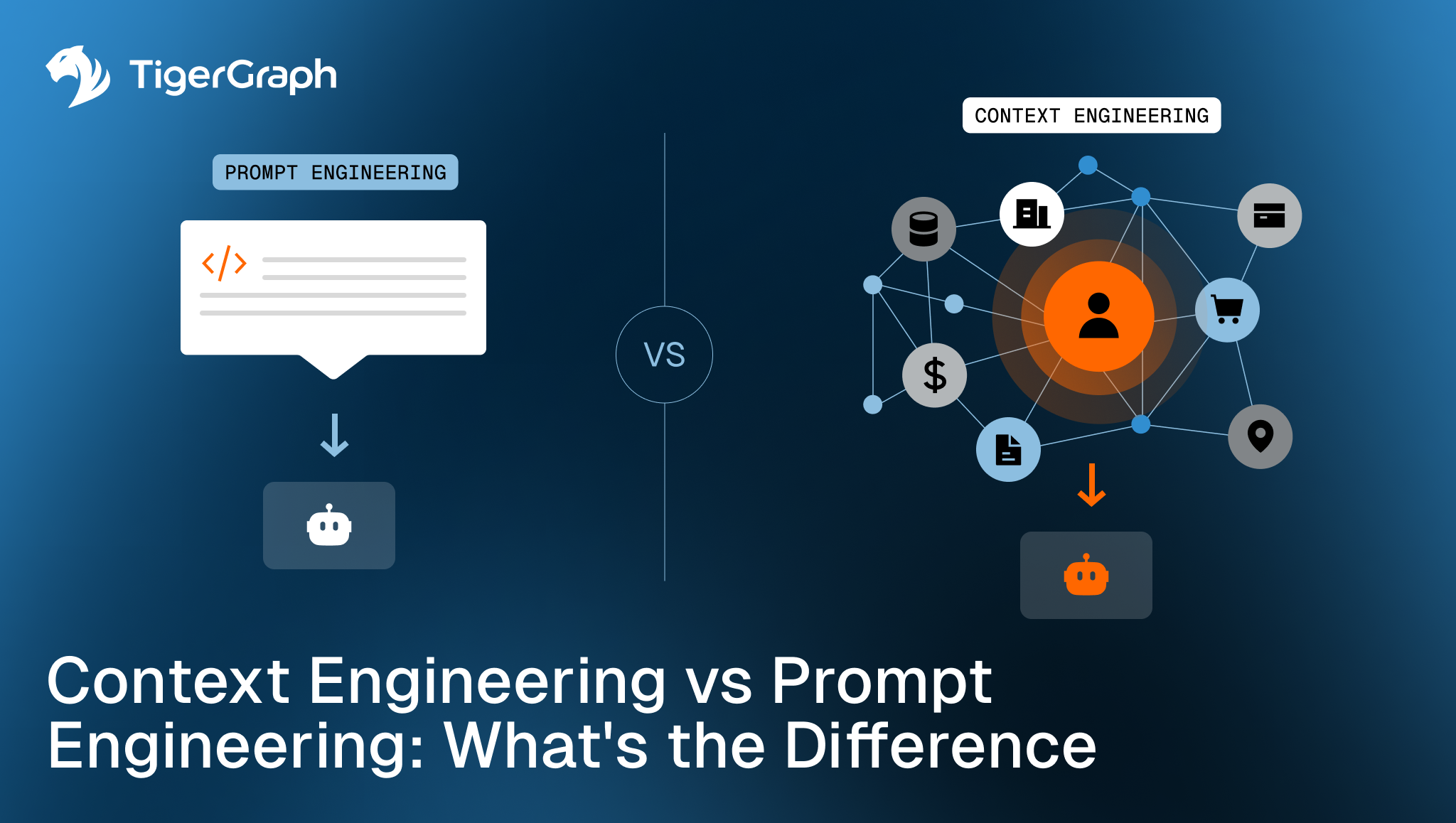
- Prompt engineering shapes how a language model is instructed; context engineering shapes what information the model can reason from.
- Enterprise AI agents fail not because of poor instructions, but because they work from stale, incomplete, or disconnected information: a context engineering problem.
- Context engineering determines what is retrieved, how it is structured, what is remembered, and what is excluded before a model responds.
- Graph-powered retrieval gives AI agents connected entity context rather than isolated text fragments, making responses more accurate and explainable.
- TigerGraph combines native graph architecture with hybrid graph and vector search to support production-grade context engineering for enterprise AI.
Enterprise AI teams are discovering that a well-crafted prompt is not enough. When AI agents move from demos into production environments, a new class of failures emerges: the model followed the instruction correctly but reasoned from an incomplete picture. It missed a linked account. It cited a stale policy. It assessed risk without seeing the full network of connected entities behind the case. The failure is not one of instruction. It is one of information.
Prompt engineering shaped the first wave of enterprise AI adoption. Teams learned that framing a request more clearly, with better examples, defined output formats, and precise constraints, could dramatically improve response quality. But as organizations scale AI from experiments to production agents, the bottleneck is shifting. The problem is no longer only how to ask the model a better question. It is whether the model has the right information, in the right structure, at the right moment, to reason accurately. For enterprise AI, context quality increasingly determines whether even the best prompts produce reliable outcomes.
Prompt engineering and context engineering are related, but they operate at different levels of the AI stack. Prompt engineering shapes the instruction. Context engineering shapes the information environment around that instruction: retrieved knowledge, structured enterprise data, tool outputs, memory, policies, constraints, and real-time operational state. Confusing the two leads to misplaced investment. A team may spend weeks refining prompt phrasing while the model is still working from stale, incomplete, or disconnected data. Optimizing instructions cannot compensate for missing or poorly structured enterprise knowledge.
The difference matters because enterprise AI agents are not simple chatbots. They investigate fraud, summarize customer risk, triage security incidents, support field operations, recommend next-best actions, and reason across complex business processes. These workflows require more than a well-written prompt. They require connected context for AI.
You’ll learn:
- The difference between prompt engineering and context engineering, and why both matter for production AI
- Where prompt engineering alone reaches its ceiling for enterprise AI agents
- How graph-powered retrieval changes what context engineering can deliver
- How TigerGraph supports context engineering at enterprise scale
What Is Prompt Engineering?
Prompt engineering is the practice of crafting the instructions, examples, roles, and formatting rules given to a language model so it produces the desired output. Its purpose is to improve how the model performs a task—not to expand what the model knows.
A prompt may include:
- A system instruction that defines the model’s role
- A user request that describes the task
- Examples of desired outputs
- Formatting rules
- Constraints on tone, scope, or structure
- Step-by-step reasoning guidance
- Rules for using or avoiding certain information
Prompt engineering is useful because language models are sensitive to instruction design. A vague prompt often produces a vague response. A clear prompt with examples, constraints, and a defined output format can produce a much better result.
For example, asking a model to “summarize this report” may produce a generic summary. Asking it to “summarize this report for a CFO, focusing on cost exposure, revenue risk, and recommended next actions in five bullets” gives the model a much clearer task.
That is the strength of prompt engineering: it improves task clarity. Well-designed prompts help models apply available information more consistently and predictably.
Where Prompt Engineering Works Well
Prompt engineering is especially effective for tasks that are self-contained and well-defined. These include:
- Summarizing a document already provided to the model
- Extracting fields from a known text format
- Classifying support tickets
- Rewriting content for a specific audience
- Generating code from a clear specification
- Converting unstructured text into a structured output
In these cases, the model either already has enough general knowledge to complete the task or receives the required information directly in the prompt.
Prompt engineering also helps enforce consistency. It can tell the model how to structure an answer, which assumptions to avoid, which tone to use, and what kind of reasoning to apply. For many single-turn AI tasks, that may be enough.
Where Prompt Engineering Breaks Down
Prompt engineering has a clear boundary: it can only shape how the model uses the information available to it. It cannot give the model information it does not have. That becomes a serious limitation in enterprise environments. No amount of prompt refinement can compensate for information that was never retrieved in the first place.
A prompt alone cannot tell an AI agent the current status of a customer account, the latest transaction history, the ownership structure behind a vendor, the downstream systems affected by a compromised credential, or the risk exposure created by a supplier disruption. That information lives in enterprise systems, not in the model’s pre-trained knowledge.
Prompt engineering also struggles when tasks require continuity across multiple steps. An AI agent investigating a fraud case may need to gather account data, compare behavioral history, identify related entities, check shared devices, evaluate prior alerts, and generate a recommendation. A better prompt may improve the agent’s format or tone, but it will not solve missing, stale, or poorly structured context. This is where prompt engineering hits its ceiling. The limitation is architectural rather than linguistic.
What Is Context Engineering?
Context engineering is the discipline of designing and managing the full information environment an AI model uses at inference time. It answers a different question from prompt engineering. Prompt engineering asks: “How should we instruct the model?”
Context engineering asks: “What does the model need to know right now to complete this task accurately?” That includes:
- Retrieved documents
- Structured enterprise data
- Knowledge graphs
- Customer, account, product, device, transaction, or policy data
- Tool outputs
- Workflow state
- User history
- Agent memory
- Business rules
- Security and compliance constraints
- Real-time operational signals
In other words, context engineering is not just about writing better prompts. It is about engineering the information layer around the model. The objective is to ensure that the model receives information that is current, relevant, connected, and decision-ready.
A strong context engineering strategy determines what information should be retrieved, how it should be ranked, how it should be structured, what should be remembered, what should be excluded, and how the system should avoid overloading the context window with irrelevant or conflicting data.
This is why the phrase “context window vs prompt” matters. The prompt is the instruction. The context window is the model’s working environment. If that environment is incomplete or noisy, the model may still produce a confident answer, but it may not produce a correct one.
Prompt Engineering vs Context Engineering: Key Differences
The easiest way to understand prompt engineering vs context engineering is to compare the layers they affect.
| Prompt Engineering | Context Engineering | |
| Layer | Instruction | Information |
| Focuses on | Wording, examples, roles, constraints, output format | Retrieval quality, data freshness, memory, tool integration, context window composition |
| Solves | Task clarity | Information readiness |
| Breaks down when | The model lacks relevant information | The task instruction is vague or misdirected |
| Enterprise challenge | Relatively solved once prompt design matures | Becomes the harder problem as AI scales to live, connected data |
The table highlights an important architectural distinction: prompt engineering improves how AI uses information, while context engineering improves the quality of the information AI uses. Enterprise AI requires both, but context increasingly becomes the limiting factor as systems move into production.
The two disciplines are complementary. A model with excellent context but vague instructions may fail to apply the information correctly. A model with excellent instructions but poor context may produce a well-formatted wrong answer.
For enterprise AI, context quality usually becomes the harder problem once basic prompt design is in place. This is especially true when AI systems must reason over live, connected, organization-specific data.
Why Context Engineering Becomes the Bottleneck at Enterprise Scale
In simple AI applications, prompt improvements can produce major gains. A chatbot answering general FAQs or a classifier labeling short text may not need complex retrieval, memory, or tool orchestration.
Enterprise AI agents are different. They operate in environments where the most important information is proprietary, dynamic, and distributed across many systems. A customer service agent needs account status, product ownership, recent interactions, entitlement rules, and escalation history. A fraud investigation agent needs identity signals, transaction patterns, shared devices, linked accounts, geolocation history, and prior risk indicators. A cybersecurity agent needs user permissions, system dependencies, alerts, assets, vulnerabilities, and attack paths.
None of this can be solved by prompt wording alone. The model needs context that is:
- Current
- Relevant
- Structured
- Connected
- Traceable
- Governed
- Specific to the task
Production AI succeeds when these characteristics become properties of the retrieval architecture rather than responsibilities delegated to the language model.
Without that, AI agents compensate by making repeated retrieval calls, asking follow-up questions, or reasoning from partial evidence. This increases latency, cost, and failure risk. Worse, a context error early in a multi-step workflow can cascade through every later step.
If an agent starts with the wrong customer identity, misses a related account, or retrieves an outdated policy, every subsequent action may be built on the wrong premise. That is why context engineering AI is becoming a core enterprise architecture concern. It is not just an AI tuning exercise. It is a data infrastructure problem. Organizations increasingly compete on the quality of their context engineering rather than the sophistication of their prompts alone.
Where Graph-Powered Retrieval Changes Context Engineering
The most important context engineering decision is retrieval architecture: how the AI system finds, structures, and delivers relevant information before the model responds.
Many AI systems rely heavily on vector search. Vector search is valuable because it finds semantically similar content. It can retrieve documents, passages, tickets, or knowledge base entries that are similar to a user’s question.
But enterprise context is not only semantic. It is relational. Enterprise reasoning depends on understanding how business entities connect, not simply on retrieving documents that discuss similar topics. A fraud agent does not only need documents that mention an account. It needs to understand how that account connects to other accounts, devices, transactions, addresses, beneficiaries, and prior alerts. A cybersecurity agent does not only need a policy document about access control. It needs to understand which user has access to which systems, what assets are exposed, and how one compromised credential could affect downstream systems.
Vector search can retrieve relevant text. But it does not inherently explain the relationships between enterprise entities.
Graph-powered retrieval fills that gap. A graph database stores entities and the relationships between them as structured, queryable data. For context engineering, this means an AI agent can receive a connected view of the business situation rather than a collection of isolated fragments. Instead of then asking the language model to infer relationships, graph-powered retrieval supplies those relationships directly as part of the context.
Instead of retrieving only documents similar to “suspicious account activity,” a graph-powered system can assemble context around the account, linked identities, shared devices, transaction flows, known risk markers, and related cases. That context gives the model a better foundation for reasoning.
This is the difference between text similarity and relationship intelligence.
Prompt engineering cannot compensate for missing relationships. If an AI agent cannot see that two accounts share the same device, that a vendor connects to a sanctioned entity, or that a compromised credential reaches a critical application, no prompt can make it reason over that missing connection. Graph-powered retrieval makes those connections visible.
Why Hybrid Graph and Vector Search Matter
The strongest context engineering approach does not treat graph and vector search as competing options. It combines them.
Vector search helps retrieve semantically relevant unstructured content: documents, policies, emails, tickets, reports, transcripts, and knowledge base articles.
Graph search helps retrieve structured relationship context: customers, products, devices, accounts, transactions, suppliers, systems, events, and risk indicators.
Together, they support richer LLM context design. For example, an AI agent evaluating a customer risk question may need both:
- Relevant policy documents and case notes
- Connected account, identity, transaction, and behavioral context
A vector-only approach may retrieve the right policy language but miss the customer’s broader relationship network. A graph-only approach may expose the connected data but miss relevant narrative details in documents. A hybrid approach gives the agent both.
That is the foundation of GraphRAG: retrieval that combines knowledge graphs, relationship-aware context, and semantic search to make AI responses more accurate, explainable, and useful. GraphRAG is fundamentally a context engineering strategy rather than simply another retrieval technique.
TigerGraph as a Context Engineering Platform for Enterprise AI
TigerGraph is built for organizations that need AI systems to reason over relationships, not just isolated records.
As an enterprise-scale graph database, TigerGraph provides the connected data foundation required for production context engineering. It helps teams build AI agents that can access relationship-aware, real-time, explainable context across large enterprise datasets. Its purpose is not to replace language models, but to improve the quality of the context they receive before generating an answer.
That matters because enterprise AI agents are only as reliable as the context they can use.
Relationship-Aware Retrieval
TigerGraph enables context engineering systems to retrieve connected business context, not just semantically similar text.
For fraud, this may include customers, accounts, devices, transactions, addresses, and risk signals. For cybersecurity, it may include users, permissions, assets, alerts, vulnerabilities, and affected systems. For supply chain, it may include suppliers, facilities, shipments, parts, products, routes, and customers.
This is Relationship Intelligence in practice: giving AI agents the connected context they need to understand how one entity, event, or risk factor relates to another.
Real-Time Analytics for Production Agents
Enterprise context cannot be stale. A risk score, customer status, transaction pattern, or system alert may change minute by minute.
TigerGraph supports real-time analytics across connected data, helping AI agents reason from current operational context rather than static snapshots. This is critical for use cases such as fraud detection, cybersecurity, customer intelligence, supply chain risk, and operational decision intelligence.
Hybrid Graph + Vector Retrieval
TigerGraph’s hybrid graph + vector search supports both semantic similarity and relationship-aware context. This gives AI teams a stronger foundation for GraphRAG and context engineering because they do not have to choose between unstructured content retrieval and structured relationship analysis. They can combine both in one AI workflow.
Explainable and Traceable Context
Enterprise AI must be explainable. Leaders need to know not only what the agent concluded, but what information influenced that conclusion.
Because graph-powered context is built from explicit entities and relationships, the system can trace the evidence behind an answer. This matters for regulated industries where AI recommendations must be auditable, defensible, and governed.
In high-stakes workflows, explainability is not optional. It is the difference between an AI assistant that is interesting and an AI system that can support production decisions.
MCP-Based Integration with AI Agent Frameworks
TigerGraph connects to AI agents and orchestration frameworks through its MCP Server, giving teams a standardized interface to integrate graph-powered context engineering into their existing agent architectures. Context engineering investment in TigerGraph scales across agent use cases rather than being rebuilt for each application.
The Shift from Prompts to Context Is an Architecture Decision
Prompt engineering and context engineering are not competing disciplines. They solve different problems. Prompt engineering helps the model understand what to do. Context engineering ensures the model has the right information to do it well. The two disciplines are complementary, but they influence different layers of the AI stack.
For simple tasks, better prompts may be enough. But for enterprise AI agents that reason across customers, accounts, transactions, systems, policies, risks, and real-time events, prompt engineering alone reaches a ceiling. The limiting factor becomes context quality. That is why context engineering is becoming a strategic investment for enterprise AI: it determines whether agents can access current, connected, governed, and explainable information at the moment of decision. As enterprise AI matures, organizations will increasingly differentiate themselves through better context engineering rather than better prompt engineering alone.
TigerGraph provides the graph-powered context engineering layer enterprises need to move from prompt-tuned demos to production-ready AI systems. With relationship-aware GraphRAG, hybrid graph and vector search, and real-time analytics across connected enterprise data, TigerGraph helps organizations build AI agents that reason with context rather than guess from fragments. Start with the TigerGraph free trial to explore the context engineering approach for your use case, or request a personalized demo to see graph-powered retrieval applied to your data.
TigerGraph combines graph-powered retrieval, hybrid graph-and-vector search, and enterprise-scale relationship intelligence to provide the connected context foundation required for production AI agents.
FAQs
What is the difference between prompt engineering and context engineering?
Prompt engineering shapes the instruction given to a language model: the wording, examples, constraints, and output format. Context engineering shapes the information environment around that instruction, determining what the model knows at inference time. Prompt engineering solves task clarity. Context engineering solves information readiness. Production AI systems need both working together.
Why does context engineering become the bottleneck at enterprise scale?
Enterprise AI agents must reason over proprietary, dynamic, and distributed data that no prompt can supply. A fraud agent needs current account status, transaction history, and linked risk signals. A cybersecurity agent needs user permissions and live alerts. No prompt design solves this if the retrieval infrastructure does not exist. Context engineering becomes the limiting factor once basic prompt design is in place.
How does a graph database improve context engineering for AI agents?
A graph database stores entities and the relationships between them as structured, queryable data. For context engineering, this means an AI agent can receive a connected view of a business situation rather than isolated text fragments. Instead of retrieving only semantically similar documents, a graph-powered system assembles connected entity context: accounts, identities, transactions, risk markers, and the relationships between them.
What is GraphRAG and how does it relate to context engineering?
GraphRAG combines knowledge graphs, relationship-aware context, and semantic vector search before invoking a language model. It is a context engineering strategy: it enriches the model’s information environment with both structured relationship data and relevant unstructured content. TigerGraph’s hybrid graph and vector capabilities support GraphRAG in a single database, reducing infrastructure complexity for enterprise AI teams.
How does TigerGraph support context engineering at enterprise scale?
TigerGraph provides the connected data foundation enterprise AI agents need to reason accurately in production. Native graph architecture enables relationship-aware retrieval across billions of entities in real time. Hybrid graph and vector search combines structured relationship context with semantic similarity. Its explainable graph structure supports governed, auditable AI decisions. MCP-based integration connects TigerGraph to agent frameworks without rebuilding context engineering infrastructure for each new use case.