
Summary
- RAG quality ceilings are not model failures; they are retrieval architecture failures: the system cannot find, connect, or explain facts that depend on relationships between enterprise entities.
- Advanced RAG techniques, including sentence-window retrieval, HyDE, query decomposition, re-ranking, and iterative retrieval, each target a specific retrieval failure mode.
- Modular RAG composes these techniques into a production pipeline with routing, hybrid search, and multi-index retrieval to handle diverse query types efficiently.
- GraphRAG changes the retrieval question from “which passages are similar?” to “which entities are connected?” enabling relationship-aware context that advanced text retrieval alone cannot reproduce.
- Hybrid GraphRAG combines semantic search over unstructured content with graph retrieval over connected enterprise data and is the practical production architecture for most mature enterprise AI applications.
Retrieval-augmented generation (RAG) has become a standard design pattern for grounding large language models in enterprise information. Yet many teams discover the same problem after a successful prototype: better prompts, larger context windows, and more document chunks produce disappointingly small quality gains. The system can answer straightforward questions but fails when the answer depends on several sources, ambiguous entities, changing relationships, or an auditable chain of evidence. The limiting factor is rarely the language model itself. It is the retrieval architecture supplying incomplete evidence.
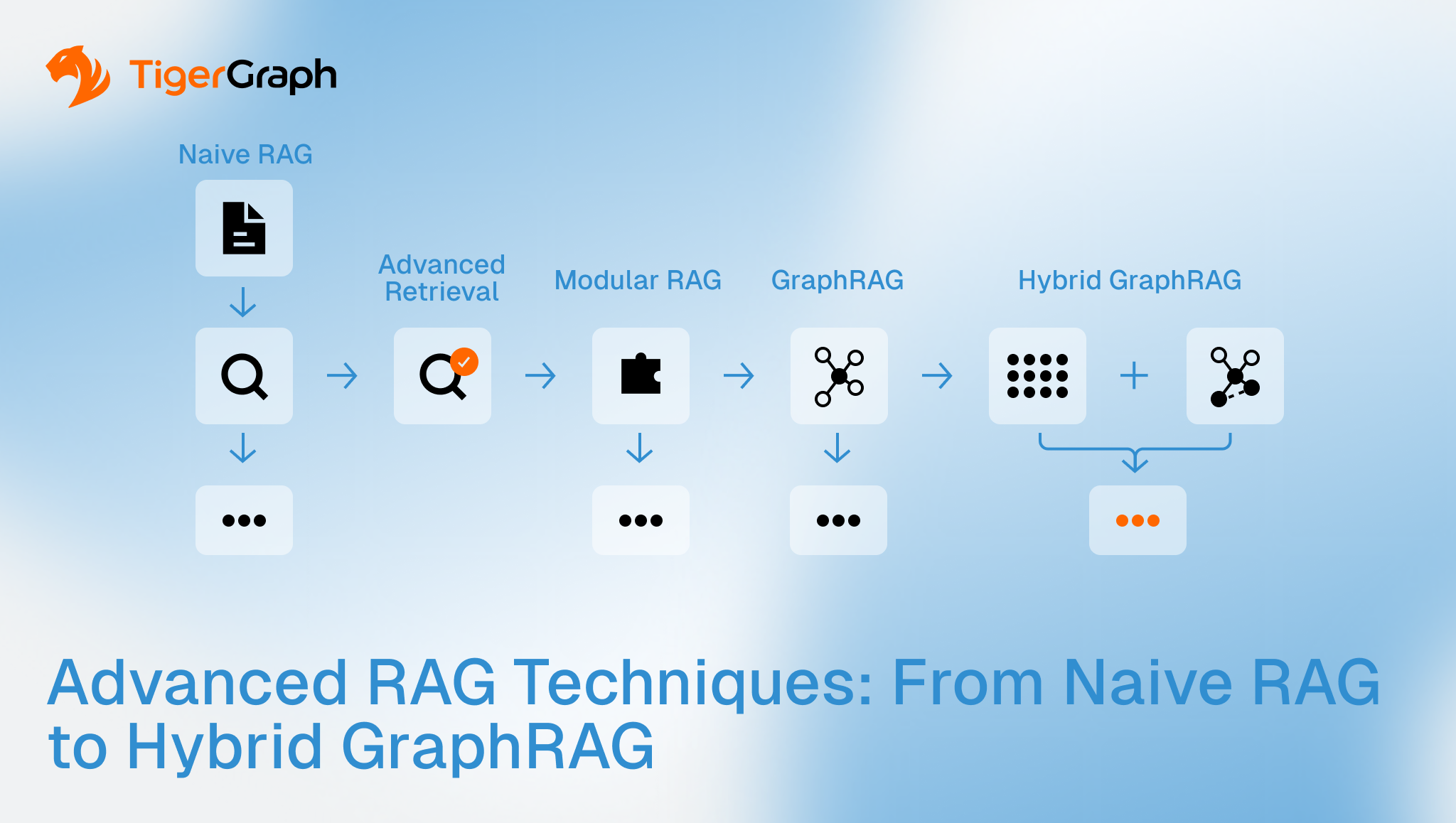
Modern RAG has evolved in stages, resulting in a family of different RAG methods. Naive RAG, Advanced Retrieval, Modular RAG, GraphRAG, and Hybrid GraphRAG each address different retrieval challenges and trade-offs. The appropriate choice depends on the application’s requirements. More recent developments, like Hybrid GraphRAG, have the most flexibility for addressing a range of requirements.
You’ll learn:
- Where Naive RAG breaks down and what each failure mode requires
- Which advanced retrieval techniques address specific weaknesses
- When to move to GraphRAG and what it adds over text retrieval
- How Hybrid GraphRAG combines semantic and relationship retrieval in production
Stage 1: Naive RAG and How It Fails
A naive RAG system follows a simple retrieve-then-generate loop: split documents into fixed-size chunks, convert each to an embedding, retrieve the top-ranked chunks by vector similarity, place those chunks in the prompt, and ask the LLM to generate an answer.
This architecture is useful because it gives an LLM access to private or updated information without retraining. Naive RAG remains a valid starting point for product documentation, policy lookup, and support content where the answer is likely to appear in one or two passages. Its limitations emerge only when enterprise questions require connected reasoning across multiple sources rather than isolated text retrieval.
Its weaknesses become visible when retrieval quality depends on more than textual similarity. Consider: “Who does Maya report to, and which projects depend on her team’s service?” One chunk may contain Maya’s reporting line, another may describe the service owner, and several others may document downstream dependencies. A one-round similarity search may retrieve only one part of that chain.
Other common failure modes include:
- Lost context: Independent chunks may omit the paragraph, section, or timeline needed to interpret a fact.
- Entity ambiguity: Two employees, products, or accounts can share the same name, but embeddings do not resolve identity by themselves.
- Incomplete grounding: When retrieved context contains only part of the answer, the model may fill gaps with plausible but unsupported language.
- Weak explainability: The application can show which chunks were retrieved but not why those facts belong together. Similarity explains why text was retrieved. It does not explain why the retrieved facts are related.
Tier 2: Advanced RAG Techniques for Better Retrieval
Advanced retrieval techniques improve the quality of evidence passed to the LLM. Each targets a specific failure mode but has limits. Collectively, these techniques improve retrieval quality without fundamentally changing the underlying retrieval model.
Sentence-Window Retrieval and Parent-Child Chunking
Fixed-size chunks force a trade-off: small chunks improve precision but may omit context; large chunks preserve context but include irrelevant material. Sentence-window retrieval separates the retrieval unit from the generation unit: the system indexes a sentence for precise matching, then returns the surrounding paragraph to the LLM. Parent-child chunking applies the same principle hierarchically.
This approach is useful for manuals, contracts, and policies where a relevant sentence depends on nearby definitions or exceptions. It does not create awareness of relationships across separate documents or business systems. Context expands locally, but relationships between independent sources remain unresolved.
Hypothetical Document Embeddings
A user’s wording often differs from the language in source material. Hypothetical Document Embeddings (HyDE) addresses this gap by asking an LLM to generate a hypothetical answer first, then using that generated text to retrieve real source material. Retrieval is guided by the shape of a likely answer rather than the original query wording.
HyDE adds a model call and depends on hypothetical text quality. Generated text is a retrieval aid only and must never be treated as a factual source. A weakness is that hallucinations in the hypothetical answer can point the subsequent retrieval in the wrong direction.
Query Rewriting and Decomposition
Complex questions often contain several retrieval tasks. Embedding a long multi-part question as a single query rarely produces complete results. Query decomposition splits the request into focused sub-questions, retrieves evidence for each, and merges the results before generation.
The main engineering risk is fragmentation: poor decomposition generates overlapping or irrelevant searches, and the final answer still requires coherent synthesis.
Re-Ranking and Reciprocal Rank Fusion
Initial retrieval is optimized for speed and recall, so the candidate set may contain relevant material without surfacing the best passages near the top. A cross-encoder re-ranker scores the query and each candidate together, reordering results with greater precision at the cost of added latency.
Reciprocal Rank Fusion (RRF) solves a related problem: combining ranked lists from multiple retrievers. A dense retriever may find semantically related passages while a keyword retriever finds exact product names or policy clauses. RRF rewards documents that rank highly across both lists without requiring comparable scoring scales. These methods improve ranking precision but still operate on document similarity rather than explicit business relationships.
Iterative and Agentic Retrieval
Some questions cannot be answered with a single retrieval round because the first result reveals what to search for next. Iterative retrieval uses earlier evidence to refine later searches. Self-RAG is one influential example: it allows a model to retrieve on demand and critique retrieved passages and generated output rather than always injecting a fixed number of passages. This flexibility improves difficult workflows but introduces more model calls, greater latency, and the risk of unproductive loops. Production implementations need explicit budgets, stopping conditions, and observability.
Tier 3: Modular RAG and Composing Retrieval Pipelines
Advanced retrieval techniques become difficult to manage when every query passes through the same growing chain of steps. A factual lookup may not need decomposition, HyDE, three retrievers, and a re-ranker. A complex investigation might need all of them.
Modular RAG replaces a fixed pipeline with configurable components that the system selects and combines according to the query, data source, latency target, or risk level. Retrieval becomes adaptive rather than uniform, allowing different questions to follow different retrieval strategies.
Query Routing: A router classifies the request and directs it to the right retrieval strategy: keyword search for policy questions, vector retrieval for conceptual questions, a structured retriever for questions that require following relationships across multiple sources. Routing reduces unnecessary cost and latency.
Dense-Sparse Hybrid Search: Dense retrieval is standard vector search conceptually similar content; sparse retrieval uses convenient . A modular pipeline runs both and merges results using RRF, combining semantic reach with precision on identifiers, acronyms, and technical terms.
Multi-Index Retrieval: Enterprises rarely have a uniform corpus. Modular RAG maintains separate indexes for product documentation, tickets, contracts, and incident reports, routing queries to the most relevant sources or retrieving across several indexes and merging the evidence.
Modular RAG is a strong pattern for diverse document Q&A. Its ceiling appears when the answer depends on explicit relationships between entities: text similarity does not establish how those entities connect. This is where retrieval quality stops being a pipeline problem and becomes a data model problem.
Tier 4: GraphRAG and Relationship-Aware Retrieval
GraphRAG changes the retrieval question. Vector retrieval asks: “Which passages are semantically similar to this query?” GraphRAG asks: “Which entities are relevant, how are they connected, and which connected facts are needed to answer the question?”
A knowledge graph represents entities such as people, accounts, products, suppliers, systems, and events together with their explicit relationships. GraphRAG uses that connected structure to assemble context for an LLM.
This adds four capabilities that advanced text retrieval cannot fully reproduce:
- Relationship-aware context: Facts are retrieved because they are connected through known business relationships, not only because their text resembles the query.
- Reasoning across relationship chains: The system connects facts across people, systems, transactions, or events.
- Fresher operational context: When relationship data changes, the updated structure becomes queryable without rebuilding an entire document embedding index.
- Traceable evidence: The application shows the relationship path and source records used to assemble an answer.
Hybrid GraphRAG: The Production Architecture
Pure graph retrieval assumes all relevant knowledge has been modeled as explicit entities and relationships. Pure vector retrieval handles unstructured text well but cannot reliably establish connections between enterprise facts. Hybrid GraphRAG combines both. The two retrieval methods solve complementary problems rather than competing ones.
A typical hybrid pipeline looks like the following: a router analyzes whether the query requires semantic content, relationship context, or both; the vector path embeds the query and retrieves relevant passages; the graph path resolves relevant entities and follows their connections; the system merges, filters, and ranks both evidence sets; and the LLM generates an answer grounded in semantic content and relationship structure.
For example, a question about supplier dependency may use vector search to find contract language about termination rights, then use graph retrieval to identify which products, facilities, and customer commitments depend on that supplier. The contract explains what is permitted; the graph explains the operational impact.
TigerGraph supports this architecture through hybrid graph and vector search, enabling semantic similarity and relationship analysis within one data layer. TigerGraph uses hybrid retrieval and connected enterprise context as foundations for Agentic AI: an agent may need to search documents, inspect connected entities, validate policy constraints, and preserve a traceable decision path. TigerGraph’s MCP tools give agents a standard AI-native way to access both meaning and structure.
Use vector-only RAG when the workload is primarily semantic document search. Use graph-only retrieval when questions are explicitly relational and required data is already structured. Use hybrid GraphRAG when unstructured content and connected enterprise data must inform the same answer, which is the common production case.
The goal is not to progress mechanically through every tier. It is to adopt the simplest retrieval architecture that reliably answers the questions your enterprise AI application must solve.
Choosing the Right RAG Tier
| Tier | Best fit | Upgrade when |
| Naive RAG | Prototypes and simple document Q&A | Relevant facts are regularly missed or returned without enough context |
| Advanced Retrieval | Focused improvements to chunking, query quality, or ranking | Different query types require different retrieval paths |
| Modular RAG | Production applications with diverse sources and query patterns | Answers depend on explicit relationships across entities |
| GraphRAG | Connected data, relationship-heavy questions, explainability | Important context also lives in unstructured documents |
| Hybrid GraphRAG | Enterprise AI combining semantic search, connected data, and real-time context | The application requires agent-driven, governed decision workflows |
Match Your RAG Architecture to the Questions You Need to Answer
The RAG quality ceiling is not a single defect. It is a sign that the retrieval architecture no longer matches the questions users are asking. Advanced retrieval techniques close specific gaps. Modular RAG assembles them into a production system. GraphRAG adds the relationship context required for connected questions and traceable answers. Hybrid GraphRAG combines structural precision with semantic search over unstructured content. Each architectural stage addresses a different class of retrieval failure rather than replacing the stages that came before it.
Most mature enterprise applications need at least modular retrieval. When the application must reason across customers, accounts, suppliers, systems, policies, or events, GraphRAG becomes the stronger foundation. When enterprise knowledge spans both documents and connected operational data, hybrid GraphRAG is the practical production architecture. The strongest enterprise AI systems increasingly combine semantic retrieval and relationship-aware retrieval because business knowledge naturally exists in both forms.
Start with the TigerGraph free trial to explore GraphRAG for your workload, or request a demo to see how GraphRAG and advanced RAG techniques apply to your enterprise data.
FAQs
What is the difference between naive RAG and advanced RAG techniques?
Naive RAG splits documents into fixed chunks, converts them to embeddings, and retrieves the most similar passages. Advanced RAG techniques each improve a specific failure mode: sentence-window retrieval adds surrounding context to precise matches; HyDE improves vocabulary matching; query decomposition handles multi-part questions; re-ranking reorders candidates with greater precision; and iterative retrieval refines searches based on earlier evidence..
When should an enterprise use GraphRAG instead of standard RAG?
GraphRAG is the stronger choice when the answer depends on how business entities connect rather than which passages resemble the query. If users ask questions that span accounts, systems, relationships, or events and need explainable answers, GraphRAG provides the relationship-aware context standard RAG cannot assemble from text similarity alone. Standard RAG remains effective for factual document lookups, policy Q&A, and question answering over relatively flat content.
What is hybrid GraphRAG and when is it the right architecture?
Hybrid GraphRAG combines vector search over unstructured content with graph retrieval over connected enterprise data, merging both evidence sets before generation. It is the right architecture when questions require both semantic content, such as contract language or policy text, and structured relationship context, such as which entities are affected and how they connect. For most mature enterprise AI applications where knowledge spans documents and operational data, hybrid GraphRAG is the practical production architecture.
What are the main limitations of vector-only RAG for enterprise use cases?
Vector-only RAG retrieves semantically similar text but does not establish how business entities connect, resolve ambiguous entity references, reflect current operational data, or produce auditable evidence chains. Advanced RAG can resolve keyword blind spots and try to answer simple multi-step questions. GraphRAG steps in to solve complex multi-step questions across disparate sources and provide compliance-grade explainability.
How does TigerGraph support hybrid GraphRAG at enterprise scale?
TigerGraph provides a native graph database with hybrid graph and vector retrieval in one data layer. Its architecture enables relationship-aware retrieval across billions of entities in real time, reflects current operational state without batch re-indexing, and produces traceable relationship paths that support explainable AI decisions. MCP-based integration connects TigerGraph to AI agent frameworks.