
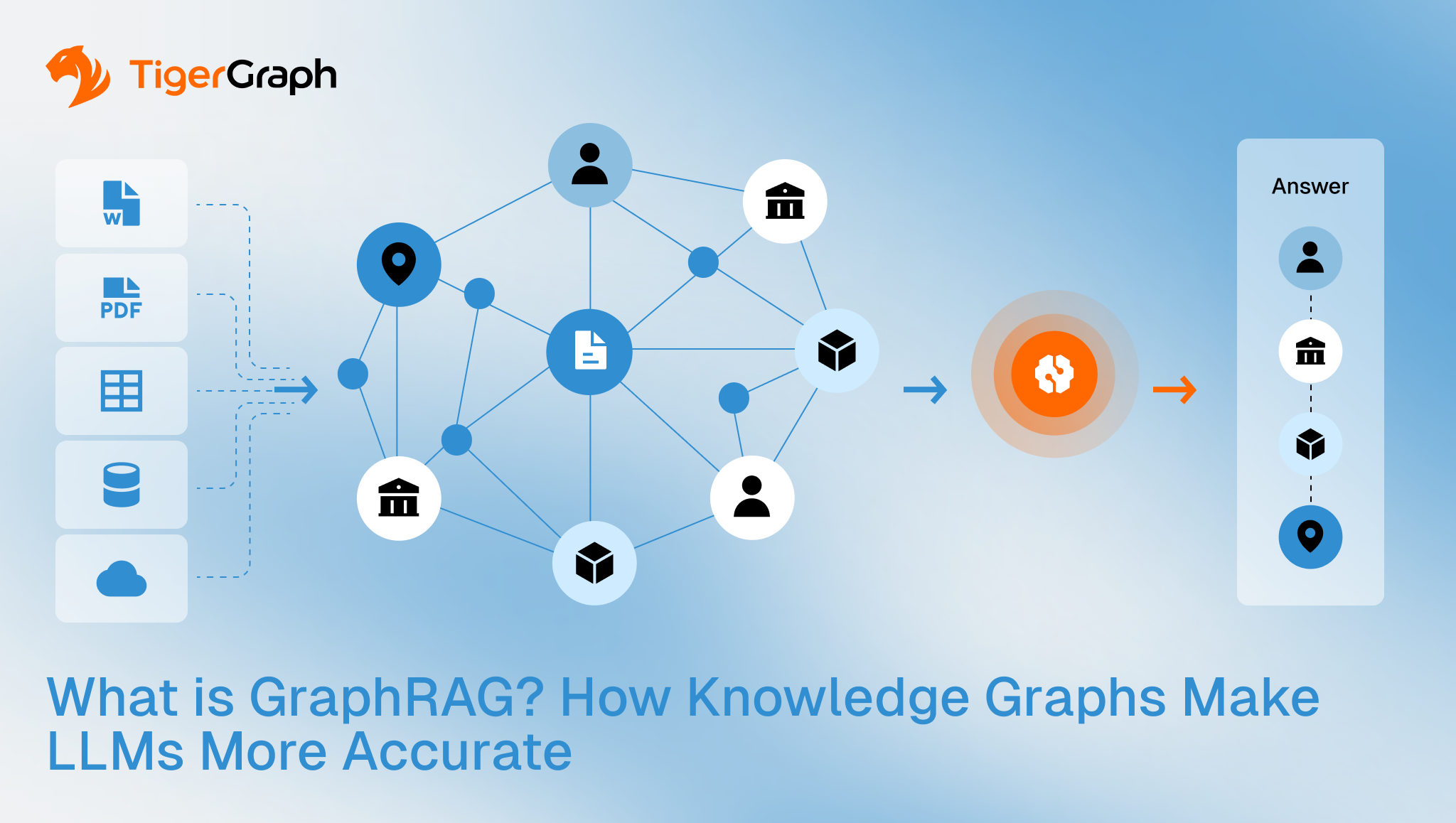
Summary
- Traditional RAG retrieves text by vector similarity, which works for simple lookups but breaks down when the answer depends on relationships spanning multiple entities, documents, or business rules.
- GraphRAG adds a knowledge graph to the retrieval step, giving the LLM structured, connected context: not just similar text, but the relationships it needs to answer multi-step and relational questions accurately.
- The core architectural difference: vector RAG finds chunks that sound relevant; GraphRAG retrieves the entities, relationships, and grounded text the LLM needs to reason correctly.
- GraphRAG is the stronger choice when questions are multi-step, policy-aware, regulated, or dependent on how business entities connect: financial services, healthcare, supply chain, compliance, and customer intelligence are the primary use cases.
- For enterprise AI moving from pilots to production, graph-grounded retrieval is becoming foundational infrastructure for AI systems that must be trusted, audited, and scaled.
Large language models are impressive at language, but unreliable when the answer depends on facts, rules, and relationships inside enterprise data. Retrieval-augmented generation was supposed to fix that by grounding LLM responses in real documents. But vector-only RAG hits an accuracy ceiling when questions require connecting multiple pieces of information. The limitation is not the language model itself. It is the retrieval architecture supplying the model with incomplete context.
A vector search system can find text that sounds relevant to a query. It does not inherently understand how suppliers, policies, products, customers, transactions, claims, or risks relate to each other. That is where GraphRAG changes the retrieval pattern.
GraphRAG adds a knowledge graph to the retrieval step. The LLM receives not only relevant text, but also the relationships between the entities in that text. For enterprise AI leaders moving GenAI pilots into production, this makes the difference between plausible answers and accurate, explainable answers.GraphRAG does not make the model smarter. It gives the model the connected context it was missing.
You’ll learn:
- Why vector-only RAG fails on multi-step and relational questions
- How GraphRAG works and the three main implementation patterns
- The architecture behind a production GraphRAG system
- Which enterprise use cases benefit most from graph-grounded retrieval
Why Vector-Only RAG Hits Accuracy Limits
Traditional RAG usually follows a simple pattern. Documents are split into chunks. Each chunk is converted into an embedding and stored in a vector database. When a user asks a question, the system embeds the question, finds the chunks with the closest vector similarity, and sends those chunks to the LLM as context.
That works well when the answer is located in one or two clearly relevant passages. It is less reliable when the answer depends on relationships that span documents, systems, or business entities. Similarity is not the same as connectivity, and enterprise reasoning often depends on connectivity.
Vector similarity is good at finding text that is about the same topic. It is not designed to preserve how entities are connected. Two chunks may be semantically similar but unrelated in the business domain. Two other chunks may be essential to the same answer but look different enough that vector search does not retrieve them together.
Consider an automotive supply chain question: “Which U.S.-bound vehicle programs are exposed to the new tariff on lithium-ion EV batteries imported from China?” A vector RAG system may retrieve one passage about the tariff and another about battery sourcing. But neither passage may explicitly connect the affected battery cells to the vehicle programs, plants, suppliers, purchase contracts, and alternative approved vendors. The LLM is then forced to infer the missing relationship. In a production AI system, that inference can become a hallucination, an omission, or a confidently wrong answer. The model is not failing because it lacks language capability. It is failing because the retrieval layer did not supply the complete evidence needed to answer the question.
This creates three major gaps for enterprise AI. First, vector-only RAG struggles with multi-step reasoning: many business questions require connecting information across customers, accounts, products, contracts, policies, or events, and similar chunks are not the same as connected evidence. Second, vector retrieval loses structural and policy context: enterprise knowledge often depends on hierarchies, approval rules, regional constraints, and dependency chains that are difficult to reconstruct from isolated text snippets. Third, vector-only RAG has limited explainability: the audit trail is a set of retrieved chunks, not a relationship path connecting the evidence to the conclusion.
GraphRAG addresses these gaps by adding a knowledge graph to retrieval, so the system retrieves connected structure rather than similar text. The shift is subtle but important: retrieval moves from finding relevant content to assembling connected evidence.
What Is GraphRAG?
GraphRAG is a retrieval-augmented generation pattern that uses a knowledge graph to retrieve structured, related context for an LLM. Instead of sending the model only document chunks, GraphRAG supplies entities, relationships, and grounded text that show how the relevant information fits together. That connected structure enables the model to reason over business relationships instead of inferring them from isolated passages.
A knowledge graph represents business knowledge as a connected network. Customers connect to accounts. Accounts connect to transactions. Suppliers connect to components. Components connect to products. Policies connect to obligations, regions, and approval rules. In a GraphRAG architecture, those relationships become part of the retrieval process.
The key difference is simple: vector RAG retrieves by semantic similarity; GraphRAG retrieves by connection. One retrieves documents that sound related. The other retrieves evidence that is actually related. There are three main implementation patterns.
Knowledge-graph-only GraphRAG uses a pre-built knowledge graph as the primary retrieval source. The system identifies the relevant entities in the user’s question, queries the graph, retrieves the connected context, and passes that structure to the LLM. This works well when an enterprise already has a mature knowledge graph or a well-defined business data model.
Hybrid graph + vector GraphRAG combines vector search and graph retrieval. Vector search identifies relevant documents, text chunks, or starting entities. The graph then expands from those entry points to assemble the connected context the LLM needs. This is often the strongest production pattern because it combines semantic similarity with relationship-aware retrieval. For most enterprises, this hybrid approach delivers the best balance of retrieval quality, implementation practicality, and explainability.
LLM-constructed GraphRAG builds a graph from unstructured documents, often by using an LLM to extract entities, relationships, summaries, and communities from a document corpus. This pattern is useful when the source data is narrative-heavy: research reports, legal files, customer notes, incident reports, or internal documentation.
In practice, enterprise GraphRAG can use an existing business graph, a graph built from documents, or a hybrid of both. The goal is the same: give the LLM connected context so it can answer relational questions with greater accuracy and explainability.
How GraphRAG Works: The Architecture
A typical GraphRAG architecture has four stages: knowledge graph construction, query understanding, graph-based context assembly, and LLM generation.
Knowledge graph construction. The graph may come from structured enterprise systems (CRM, ERP, claims platforms, supply chain) or unstructured sources (PDFs, contracts, support tickets, meeting notes). Structured sources can often be mapped programmatically. A financial institution may already know how customers, accounts, cards, and transactions relate. Unstructured sources require entity and relationship extraction so each piece of text connects back to the entity it describes. The objective is not simply to organize information. It is to preserve the business relationships the AI system will later need to reason over.
Query understanding and entity linking. When a user asks a question, the system identifies the key entities and intended relationships in the query. For the question “Which U.S.-bound vehicle programs are exposed to the new tariff on lithium-ion EV batteries from China?” the system needs to link the tariff to the affected battery category, the relevant suppliers, and the vehicle programs that use those batteries. Vector search can help find relevant documents; the graph connects those documents to the actual business relationships. This is where GraphRAG differs fundamentally from vector-only retrieval: retrieval becomes relationship-aware rather than document-aware.
Graph-based context assembly. The system retrieves the connected context required to answer the question: entities, relationships, properties, rules, and source text, rather than the most similar chunks. For a compliance question, that context might include the policy, jurisdiction, customer type, and applicable rule. For a supply chain question, it might include suppliers, components, plants, shipments, and alternative paths.
LLM generation with structured context. The model generates a response based on connected evidence rather than approximated relationships. This improves accuracy, explainability, and trust: enterprise teams can inspect the entities, source documents, and relationship paths behind the response. TigerGraph supports this with native hybrid graph and vector search in a single platform.
Enterprise Use Cases for GraphRAG
GraphRAG’s value is clearest in domains where the question is relational by nature and the answer must be explainable. The following use cases illustrate where graph-grounded retrieval moves from useful to essential. The common thread is that every use case depends on understanding how entities connect, not simply what individual documents contain.
Financial services. Fraud, AML, and KYC workflows require connecting accounts, transactions, devices, addresses, and behavioral patterns. A GenAI fraud assistant that returns an alert without a traceable evidence path cannot be approved for production. GraphRAG provides that path.
Healthcare. Clinical decision support and prior authorization require grounding AI responses in the connected context of patients, conditions, treatments, prescriptions, providers, and payer rules. A recommendation that cannot show which guidelines and patient history produced it is not clinically safe.
Supply chain. Questions like “which of our active vehicle programs sources battery cells from a supplier under the new tariff?” require traversing a supplier-component-program dependency chain. Vector search retrieves text about the tariff; only graph retrieval can follow the dependency chain to the affected programs.
Customer intelligence. Personalization and customer service AI require grounding responses in the customer’s actual journey: products owned, open issues, eligibility rules, account history. An AI assistant recommending a product the customer already owns, or missing an open escalation, is working from incomplete relationship context.
Compliance and regulatory AI. Connecting policies, obligations, jurisdictions, and customer classifications before generating a response is not optional when decisions must be defended under audit. GraphRAG makes that connection part of the retrieval step, not an inference the model has to make.
The Case for Graph-Grounded Retrieval
The questions that drive business decisions are rarely simple lookups. They ask how a customer’s risk profile connects to a counterparty exposure, how a tariff ripples through a supplier network, which policy clause applies to this customer in this jurisdiction. Vector RAG cannot answer those questions reliably because it retrieves similar text, not connected evidence. GraphRAG closes that gap, and for enterprise AI moving from pilots to production, the combination of accuracy and explainability it delivers is not optional. As enterprise AI matures, retrieval quality increasingly becomes the limiting factor in overall system quality. GraphRAG addresses that limitation by improving the quality of the evidence before the model generates an answer.
TigerGraph’s enterprise graph and vector platform is built for production GraphRAG, combining native graph traversal, hybrid graph-and-vector retrieval, and enterprise-scale performance in a single platform. As organizations move from AI experimentation to production deployment, that architecture provides the connected, explainable retrieval foundation enterprise AI requires. . Explore pricing and free trial options or request a demo.
FAQs
What is GraphRAG?
GraphRAG is a retrieval-augmented generation pattern that uses a knowledge graph to retrieve structured, related context for an LLM. It improves accuracy and explainability on questions where relationships between entities matter: multi-step reasoning, policy-aware queries, and regulated workflows where the evidence path behind an answer must be traceable.
How does GraphRAG work?
GraphRAG works by building or connecting to a knowledge graph, linking the user’s query to relevant entities, retrieving connected context from the graph, and giving that structured context to the LLM for generation. The result is a response grounded in the actual relationships between business entities, not an approximation inferred from similar text chunks.
What is the difference between RAG and GraphRAG?
Traditional RAG retrieves text by vector similarity. GraphRAG retrieves entities, relationships, and grounded text, giving the LLM the structure it needs for multi-step reasoning. The practical difference shows up on relational questions: vector RAG finds chunks about the right topic; GraphRAG finds the connected evidence that actually answers the question.
When should you use GraphRAG instead of vector RAG?
Use GraphRAG when questions are multi-step, relational, regulated, or dependent on policy and business rules: financial crime detection, clinical decision support, supply chain risk, compliance, and customer intelligence are the primary use cases. Vector RAG remains useful for simple lookup and document Q&A where the answer is contained in one or two passages.
What is the best graph database for GraphRAG?
The best graph database for GraphRAG supports real-time relationship analysis, native hybrid graph-and-vector retrieval, enterprise scale, and explainable retrieval paths. TigerGraph is purpose-built for these requirements: its hybrid graph and vector architecture enables a single query to perform both graph-based relationship retrieval and semantic similarity search, at the scale and speed that production AI systems require.