
Summary
- Context engineering is the practice of designing what information an AI model can access at inference time: not a prompt-writing exercise, but an infrastructure decision.
- Context quality determines AI agent accuracy more than model selection once basic model capability is in place.
- Most enterprise AI context problems are relationship problems: the answer depends on how entities connect across accounts, systems, transactions, and events.
- GraphRAG combines graph-structured relationship context with semantic vector retrieval to give AI agents a more complete and explainable foundation for reasoning.
- TigerGraph provides real-time relationship intelligence, hybrid graph and vector search, and explainable connected context for enterprise AI agents at production scale.
An AI agent can only reason over the information it can access at the moment it acts. If that context is incomplete, stale, fragmented, or disconnected from the business reality, even the strongest model will produce weak results. It may hallucinate, miss critical dependencies, repeat retrieval steps, or make recommendations that cannot be explained. The limiting factor is often not the model’s intelligence. It is the quality of the information environment surrounding the model.
As organizations scale AI from experiments into production, the central challenge is shifting. The question is no longer only how to build agents or write better prompts. It is whether those agents have the right information, in the right structure, at the right moment, to reason accurately. For many enterprises, context quality is becoming a more important differentiator than incremental improvements in model capability.
That is why context engineering has become a core discipline for enterprise AI. It is the practice of deliberately designing what information AI systems can access, how that information is structured, when it is retrieved, and how it is kept current.
For organizations building agentic AI systems, context engineering is not a prompt-writing exercise. It is an infrastructure decision. The quality of the context layer determines whether agents move from simple task automation to reliable operational decision intelligence. That infrastructure increasingly becomes the foundation on which trustworthy enterprise AI is built.
You’ll learn:
- What context engineering is and why it sits above prompt engineering in the AI stack
- Why context quality becomes the performance bottleneck for enterprise AI agents
- How graph-powered retrieval and GraphRAG address enterprise context requirements
- How TigerGraph supports context engineering at production scale
What Is Context Engineering?
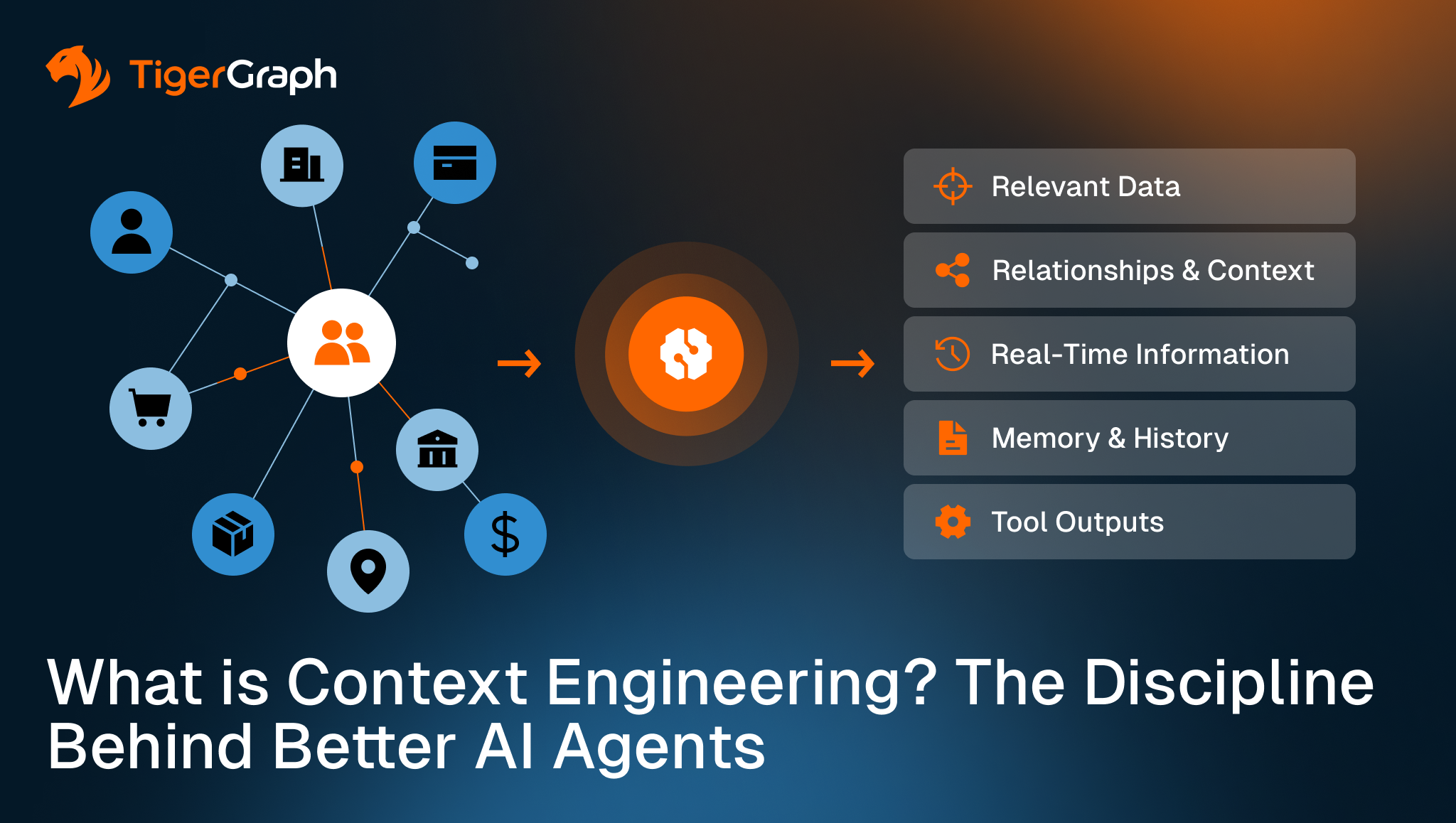
Context engineering is the discipline of designing and managing the information provided to an AI model at the time of inference. In simpler terms, it determines what the model can “see” when it is asked to reason, decide, or act. Instead of optimizing how a question is asked, context engineering optimizes what knowledge is available when the question is answered.
That context may include:
- System instructions and task-specific prompts
- Retrieved enterprise knowledge
- Conversation history and agent memory
- Tool and API outputs
- Operational data and real-time signals
- Structured business relationships
- Security and compliance constraints
The context window is the model’s working information environment. Context engineering ensures that environment contains the right information, in the right structure, at the right time. The objective is not to maximize the amount of context, but to maximize the quality, relevance, and connectedness of that context.
Why Context Quality Is the AI Performance Bottleneck
Once an organization has selected a model, context quality becomes one of the most important levers for improving agent accuracy and business usefulness. Model capability establishes the ceiling, but context quality often determines how closely production systems approach that ceiling.
Missing Context Leads to Hallucinations
Hallucinations often happen when a model lacks the factual grounding needed to answer confidently. When the right business facts are absent, the model fills gaps with plausible but incorrect information. Better context reduces that risk: if an agent can access accurate, relevant, and current enterprise data, it has less need to infer what it should have been given directly.
Disconnected Context Limits Reasoning
Many enterprise AI systems rely on document retrieval. That works when the question is “find text related to this topic.” But many business questions are not simple text-matching problems.
Consider a fraud analyst asking whether a customer account is suspicious. The answer may depend on shared devices, linked addresses, transaction patterns, known mule accounts, and prior investigation outcomes. If the agent receives only a few document fragments, it misses the broader pattern. Shallow context produces shallow reasoning. Enterprise reasoning depends on understanding how facts connect, not simply retrieving facts that appear similar.
Stale Context Breaks Operational Decisions
Enterprise agents often support workflows where conditions change quickly: fraud detection, supply chain disruption, cybersecurity response, and financial risk monitoring. If context comes from a static index updated hours ago, the agent may reason from outdated facts. For production AI, context must reflect the current state of the business. This is where real-time data analytics becomes essential.
Poor Context Increases Cost and Latency
When agents do not receive enough useful context upfront, they compensate by issuing more retrieval requests, tool calls, and follow-up queries. That slows workflows and increases operating cost. Well-engineered context reduces unnecessary retrieval cycles and helps agents reason faster with greater confidence. Higher-quality context improves not only answer quality, but also system efficiency and operational cost.
The Components of a Context Engineering System
Context engineering is a system of design choices that determine how information reaches the model.
Instructions and Guardrails
Instructions define the agent’s role, task, constraints, and expected behavior. For enterprise use, instructions also need guardrails: compliance boundaries, approval requirements, escalation rules, and limits on what actions the agent can take.
Retrieval
Retrieval is the mechanism that brings external knowledge into the context window. Traditional retrieval depends on semantic similarity, looking for text that resembles the user’s query. That is useful but often insufficient for enterprise reasoning. An agent may need to understand how a customer connects to accounts, transactions, devices, locations, and risk indicators. That requires connected context, not just similar text.
Memory
Memory allows agents to carry useful information across turns, tasks, or sessions. In enterprise workflows, memory helps agents preserve investigation history, user preferences, prior decisions, and intermediate findings. This is especially important for multi-step workflows where earlier context must shape later actions.
Tool Outputs and Context Window Management
Agents frequently call tools: databases, APIs, calculators, search systems, and workflow engines. How those outputs are structured matters. A vague response gives the model less to work with. A structured response with entities, relationships, timestamps, and source information gives the model a stronger basis for reasoning.
Context window management is the discipline of deciding what gets included, summarized, prioritized, or removed when available information exceeds what the model can process. The goal is not to fill the window with as much data as possible, but to preserve the most relevant, current, and decision-critical information.
Why Graph Is the Right Data Layer for Context Engineering
Most enterprise questions are relationship questions, which makes enterprise context a relationship problem.
A bank does not only need to know whether one transaction looks unusual. It needs to know whether that transaction connects to suspicious accounts, shared devices, unusual counterparties, and known fraud patterns. A cybersecurity team does not only need to know that an endpoint generated an alert. It needs to know which systems connect to that endpoint, which identities accessed it, and how the activity relates to previous events. A supply chain team does not only need to know that one supplier is delayed but rather which products, factories, routes, and revenue commitments are affected downstream.
Relational databases are excellent for managing structured records, but they are not designed to reveal complex, multi-level connections in real time. Vector search is powerful for finding semantically similar content, but similarity does not automatically explain how business entities relate to one another.
Enterprise AI needs relationship intelligence: the ability to understand how people, systems, transactions, events, products, and policies connect across the business. A knowledge graph provides that connected foundation, giving AI systems a structured way to reason over relationships rather than isolated data points.This is the architectural shift from retrieving information to retrieving connected business understanding.
GraphRAG as a Context Engineering Approach
GraphRAG is a retrieval approach that uses graph-structured data to provide AI models with relationship-aware context.
Traditional RAG retrieves document chunks based on semantic similarity. GraphRAG retrieves connected business context: entities, relationships, events, attributes, and supporting content that help explain how facts fit together. If an agent is investigating a customer, traditional RAG may return documents mentioning that customer. GraphRAG returns the connected picture: accounts, transactions, devices, addresses, related entities, historical behaviors, and risk signals.Rather than asking the model to infer relationships from scattered documents, GraphRAG retrieves those relationships directly as part of the evidence.
This improves context quality in several ways:
- The model receives more grounded factual context
- The agent reasons over relationships rather than disconnected fragments
- Responses become more explainable and traceable
- Repeated retrieval steps are reduced
GraphRAG does not replace vector search. The strongest enterprise AI approach combines both: vector search retrieves semantically relevant unstructured content, while graph adds the relationship structure needed to make that content more meaningful. TigerGraph supports this hybrid direction through graph and vector database integration. The two retrieval approaches solve different problems, which is precisely why hybrid retrieval is becoming the enterprise standard.
How TigerGraph Powers Context Engineering for Enterprise AI
TigerGraph is an enterprise-scale graph database built for real-time relationship intelligence. For context engineering, it serves as the connected data layer that helps AI agents reason across enterprise entities, events, and operational systems. Its role is not to replace language models, but to improve the quality of the context those models receive before they generate an answer.
Relationship-Aware Retrieval
TigerGraph enables agents to retrieve connected context rather than isolated fragments. An AI system can use TigerGraph to understand how entities relate across customers, accounts, products, transactions, devices, applications, policies, and events. Instead of asking the model to infer relationships from scattered text, TigerGraph makes those relationships available as part of the retrieval layer.
Real-Time Operational Context
Production agents need context that reflects the business now. TigerGraph supports real-time analytics over highly connected data, making it suitable for operational use cases where context cannot lag behind reality. In fraud detection, a delayed signal may mean a fraudulent transaction clears. In cybersecurity, delayed context may mean an attack spreads before the team sees the full path. Production AI requires production-grade context, and production-grade context must reflect the current state of the business.
Deep Link Analytics at Enterprise Scale
Some questions require analyzing multiple levels of connected relationships quickly. TigerGraph is designed for deep link analytics across large enterprise datasets, giving agents fast access to relevant connected context without waiting for slow backend analysis. Speed affects whether AI can be used inside operational workflows where teams need answers in seconds.
Explainable and Traceable Context
Enterprise AI must be explainable, especially in regulated or high-risk environments. Because TigerGraph organizes context around explicit entities and relationships, agent outputs can be tied back to the connected data that shaped the answer. That improves trust, auditability, and governance in high-stakes workflows.
Practical Use Cases for Context Engineering With Graph
Context engineering becomes especially valuable when decisions depend on connected data.
In fraud and financial crime, agents need to connect accounts, transactions, counterparties, identities, devices, and prior alerts. Relationship-aware context helps identify fraud rings, synthetic identities, and money laundering patterns that isolated records miss.
In cybersecurity, agents need to connect users, devices, applications, vulnerabilities, and access paths. This helps teams understand exposure, prioritize response, and explain how an event may affect critical assets.
In customer intelligence, agents need to combine customer profiles with behavior, product usage, preferences, and organizational relationships. This supports more relevant recommendations and better customer experiences.
In supply chain operations, agents need to connect suppliers, factories, logistics routes, inventory, orders, and customers. That connected view helps teams evaluate disruption impact and identify alternative paths faster.
What to Look for in a Context Engineering Data Layer
A strong context engineering foundation should support more than document retrieval. Enterprise teams should look for:
- Real-time access to current operational data
- Relationship intelligence across complex business entities
- Hybrid graph and vector retrieval
- Explainable context traceable to source data
- Scalability for production workloads
- Integration with AI agents and orchestration frameworks
- Support for operational decision intelligence, not just experimentation
Context Engineering Is an Infrastructure Decision, Not a Prompt-Writing Exercise
Context engineering is the discipline that determines how well AI agents perform in the real world. The model matters, but the information environment around the model determines whether it can reason accurately, act reliably, and support decisions that the business can trust. As enterprise AI matures, competitive advantage will increasingly come from better context engineering rather than simply adopting newer language models.
For enterprise AI, better context means connected, current, and explainable information that reflects how the business actually works. That is an infrastructure challenge, not a prompting challenge. Investing in context engineering infrastructure is what separates production-ready AI agents from well-prompted demos. Organizations that treat context as strategic infrastructure will be better positioned to build AI systems that are accurate, explainable, and operationally reliable.
TigerGraph provides that infrastructure through real-time relationship intelligence, GraphRAG, hybrid graph and vector search, and deep link analytics at enterprise scale. Start with the TigerGraph free trial to explore context engineering for your use case, or request a personalized demo to see how graph-powered retrieval improves the context quality of your AI agents.
TigerGraph combines real-time graph analytics, hybrid graph-and-vector retrieval, and enterprise-scale relationship intelligence to provide the connected context foundation that production AI agents require.
FAQs
What is context engineering in AI?
Context engineering is the discipline of designing and managing the information an AI model can access at inference time. It determines what the model can “see” when it reasons or acts: retrieved knowledge, structured enterprise data, tool outputs, memory, policies, and real-time signals. Where prompt engineering shapes the task instruction, context engineering shapes the knowledge environment around it. For enterprise AI agents, context engineering is an infrastructure decision that directly affects reasoning accuracy.
What is the difference between context engineering and prompt engineering?
Prompt engineering focuses on the instruction given to a model: the wording, examples, constraints, and output format. Context engineering operates at a higher level, determining what information the model can access before and during a task. A prompt tells an agent what to do. Context engineering determines whether the agent has the current account status, relationship data, and operational signals needed to do it correctly. Both matter, but context quality becomes the harder problem once basic prompt design matures.
Why do enterprise AI agents need graph-powered retrieval?
Most enterprise decisions depend on relationships: how an account connects to devices, counterparties, and transactions; how a compromised credential reaches critical systems; how a supplier disruption affects downstream orders. Standard document retrieval finds text that resembles a query but does not explain how business entities connect. Graph-powered retrieval provides that relationship context directly, giving AI agents a more complete and accurate foundation for reasoning across complex enterprise data.
What is GraphRAG and how does it relate to context engineering?
GraphRAG is a retrieval approach that uses graph-structured data to provide AI models with relationship-aware context before generating a response. Rather than retrieving isolated document chunks based on semantic similarity, GraphRAG assembles connected entity context: accounts, relationships, events, and risk signals. It is a context engineering strategy that improves grounding, explainability, and reasoning quality. TigerGraph’s hybrid graph and vector capabilities support GraphRAG in a single database for enterprise AI teams.
How does TigerGraph support context engineering at enterprise scale?
TigerGraph provides the connected data foundation enterprise AI agents need to reason accurately in production. Its native graph architecture enables relationship-aware retrieval across billions of entities in real time. Hybrid graph and vector search combines structured relationship context with semantic similarity. Its explainable graph structure supports governed, auditable AI decisions. Additionally, MCP-based integration connects TigerGraph to AI agent frameworks without rebuilding context engineering infrastructure for each new use case.