
Summary
- Entity resolution is the process of determining whether records from different systems refer to the same real-world entity and consolidating them into a single authoritative record.
- An identity graph is the data structure for a connected, continuously updatable model linking every identifier associated with that entity.
- If you want an identity graph to deliver its full value, it should be updated continuously and support querying and analytics in real time.
- Treating these as interchangeable causes real problems: entity resolution outputs with no persistent structure to write into, and identity graphs that go stale because the resolution process feeding them runs in batches.
- Graph databases are uniquely suited to both, matching entities through relationship patterns rather than attribute similarity alone, and maintaining the resulting identity network natively without ETL pipelines or batch delays.
- TigerGraph unifies entity resolution and identity graph maintenance into a single enterprise platform, running resolution algorithms and maintaining the live identity graph at the scale of billions of relationships.
Conflating identity graph and entity resolution is a costly mistake in enterprise data architecture. Not because the concepts are hard to separate, but because acting on stale or disconnected identity data has consequences that are hard to undo. When the two are treated as the same process, organizations build resolution pipelines with no persistent structure to write into, or maintain identity graphs that drift out of sync because the identity resolution feeding them runs in batches. The result could be fraud detection systems that miss coordinated rings because the connection data is stale or Customer 360 profiles that fragment across channels, and compliance reports that cannot trace identity lineage on demand.
Entity resolution and identity graphs are distinct but interdependent. Entity resolution answers whether two records describe the same entity. The identity graph stores what that entity looks like, across every identifier it carries, in a form that can be queried the moment a new signal arrives. Getting both right, and understanding how they connect, is the architectural foundation for fraud detection, Customer 360, and regulatory compliance at enterprise scale.
You’ll learn:
- The precise difference between entity resolution and an identity graph
- How each works and what it outputs
- Why graph databases are the right engine for both
- How TigerGraph unifies them in a single production platform
What Is Entity Resolution?
Entity resolution is the process of identifying records across disparate systems that refer to the same real-world entity (a customer, organization, product, or device) and consolidating them into a single authoritative record. It needs to handle both deterministic matching (exact agreement on known attributes) and probabilistic matching (similarity scoring when data is incomplete or inconsistent).
Entity resolution answers a deceptively simple question: are these the same entity? A financial institution might hold records for “John A. Smith,” “J. Smith,” and “Jonathan Smith” across three systems with slightly different contact details and account numbers. Entity resolution determines whether those describe one person or three, using deterministic matching where attributes agree exactly and probabilistic matching where data is incomplete or deliberately obscured, as it often is in synthetic identity fraud. The same entity resolution process applies beyond customer data: it unifies organizational records, reconciles patient records across healthcare providers, and links financial accounts to counterparties. Its output is always a record set that serves as the accurate, unified foundation every downstream system depends on.
What Is an Identity Graph?
An identity graph is a connected data structure that links every known identifier associated with a real-world entity (email addresses, phone numbers, device IDs, account numbers, cookies, loyalty IDs) into a single, unified profile. In practice, not every identity graph runs on the same foundation: some are built on relational or document stores. A graph database is what makes an identity graph perform well at scale, enabling fast, real-time queries across millions of connected identifiers..
While entity resolution answers whether records describe the same entity, an identity graph answers what we know about that entity and what the connected data around it reveals. It is not a process; it is a structure. Nodes represent the entity and its associated identifiers: email addresses, phone numbers, device IDs, cookies, account numbers, loyalty IDs. Relationships encode the connections between them, such as the same phone number linked to two email addresses, or the same device ID tied to three account registrations. As new accounts open and new devices appear, each touchpoint adds another identifier to the connected picture.
Marketing teams use identity graphs to unify consumer behavior across devices and channels for accurate personalization and attribution. Risk and compliance teams use them to surface connections between accounts and identifiers for fraud detection and identity verification. The identity graph is the live, queryable structure that makes both possible in real time.
Entity Resolution vs. Identity Graph: Key Differences
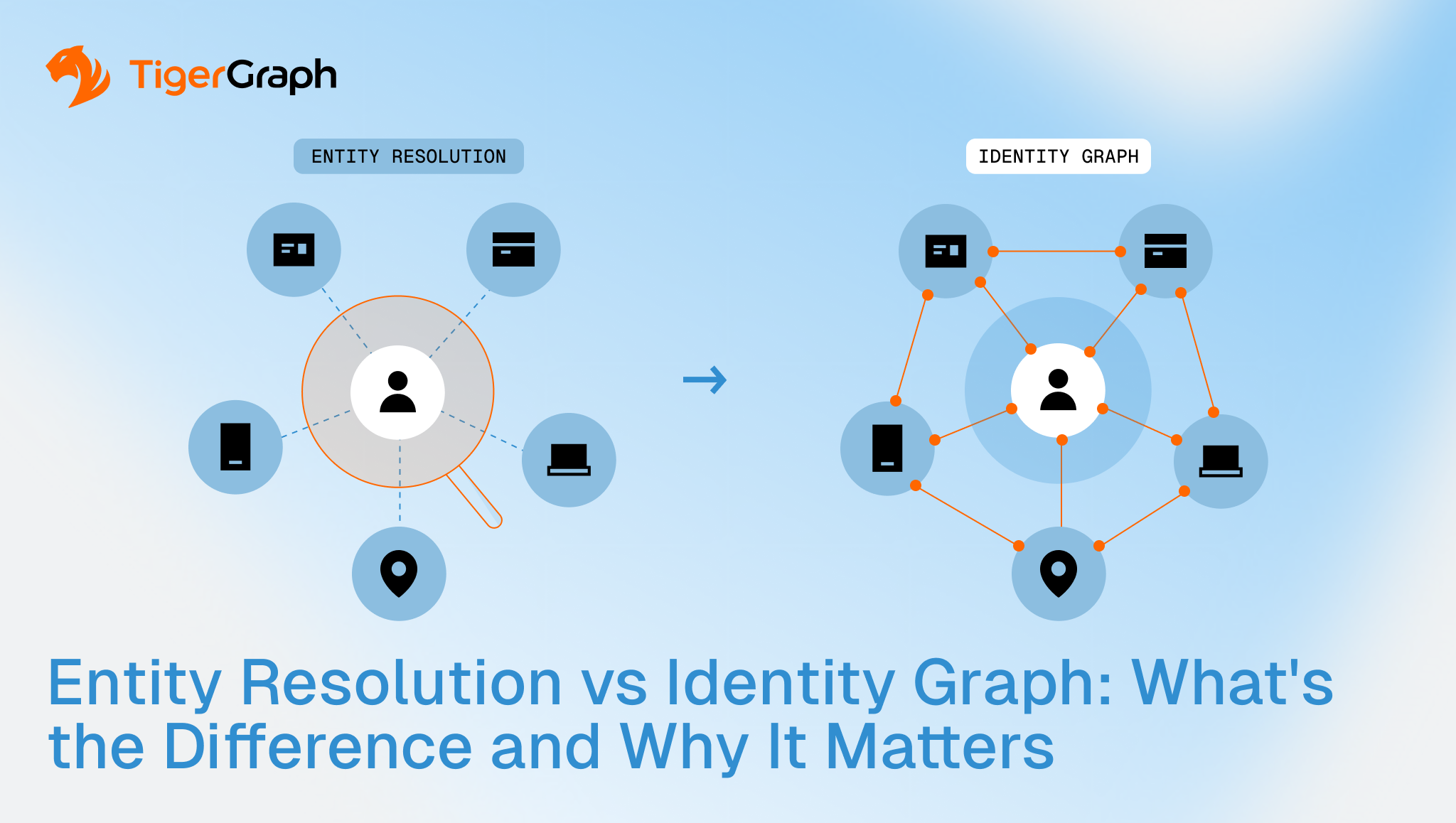
Entity resolution and an identity graph are two parts of the same system, not two names for the same thing. Entity resolution runs first: it determines whether records across disparate systems describe the same entity and consolidates them. The identity graph stores the result: a connected, persistent model that links every identifier for that entity and keeps it current as new signals arrive.
| Entity Resolution | Identity Graph | |
| Type | Process | Data structure |
| Primary output | Deduplicated record set | Connected identity model |
| Persistence | Batch result (point-in-time) | Continuously updated live structure |
| Scope | Entities of all types: customers, organizations, devices, products | Primarily person-level and device-level identity |
| Primary use cases | Fraud detection, AML/KYC, master data management | Customer 360, personalization, risk monitoring, compliance |
The most important distinction in that table is the persistence row. Entity resolution, as traditionally implemented, produces a batch result: a deduplicated record set that reflects the state of identity data at the time the entity resolution job ran. An identity graph is a live structure. It updates incrementally as new signals arrive, so the connected view of an entity is always current.
That gap matters operationally. A fraud analyst who needs to know right now whether a new account registration shares a device with a flagged entity cannot wait for the next batch entity resolution job to complete. They need a structure that reflects the current state of the identity network, continuously and in real time. That is what an identity graph provides.
Why Graph Databases Power Both Entity Resolution and Identity Graphs
Relational databases struggle at entity resolution for a structural reason. They create one table for each type of entity (customers, accounts, devices, transactions) and record relationships by storing a key from one table as a column in another. That model works when relationship depth is shallow. But enterprise entity resolution requires following chains of signals across multiple steps: for example, when matching a phone number shared by two accounts, both of which share a device with a third account. Each additional step requires another JOIN. At production scale with billions of records, those JOINs compound quickly, and queries may never complete within the required response window.
Batch processing compounds the problem. Most relational entity resolution pipelines run on a schedule, which means the identity graph they feed is always a step behind the latest activity. Introducing new identifier types (a new device category, a new account type) often requires data model changes and reengineering effort, making these systems brittle as identity ecosystems evolve.
Graph databases resolve both constraints natively and are purpose-built for the demands of enterprise entity resolution at scale.
Graph database advantages for entity resolution
The most fundamental advantage a graph database brings to entity resolution is matching entities through relationship patterns, not just attribute similarity. Two accounts might carry different names, dates of birth, and addresses, passing undetected by conventional matching, yet share a device, a phone number, and an IP address. To a graph database, that cluster of shared connections is strong evidence both records describe the same person. This is also where synthetic identities unravel: no single signal exposes them, but a graph database traces the thread across multiple weak connections and identifies the cluster. Because graph databases update incrementally as new identifiers arrive rather than reprocessing the entire dataset, they remain efficient at production scale.
Graph database advantages for identity graphs
The identity graph lives natively within the graph database, which is what makes graph the right foundation for entity resolution at scale. There is no ETL pipeline moving entity resolution outputs into a separate system, no synchronization gap between resolution and analysis. As new records are resolved, relationships are immediately reflected in the live graph. Fraud analysts detect suspicious patterns as they emerge. Compliance teams trace identity lineage on demand. Marketing systems act on current customer relationships rather than batch snapshots.
TigerGraph’s approach to entity resolution and identity graphs
TigerGraph’s entity resolution platform consolidates identity resolution and identity graph maintenance into a single, enterprise-grade system. Its massively parallel graph processing architecture enables deep link analytics across billions of relationships without performance degradation. Identity resolution algorithms and identity graph queries run within the same platform, new signals are incorporated incrementally, and your fraud analysts, marketing teams, and compliance functions all query the same live graph rather than working from stale batch outputs.
A top global bank uses TigerGraph to analyze 50 million transactions per day, a scale that illustrates the production demands that entity resolution and fraud detection place on data infrastructure. For customer intelligence, Xandr combined consumer data from 15 properties for cross-property user journey tracking, a Customer 360 architecture that depends on exactly the kind of real-time identity graph that TigerGraph maintains.
Enterprise Use Cases: Where Identity Graphs and Entity Resolution Work Together
The combination of entity resolution and identity graphs drives measurable outcomes across the most data-intensive functions in the enterprise.
- Fraud detection and financial crime. Entity resolution identifies when multiple accounts share synthetic identity signals: reused phone numbers, shared devices, similar application patterns. The identity graph stores the resulting network so your fraud analysts can explore it in real time to expose rings and clusters. Together, they shift detection from reactive transaction review to proactive network analysis, catching fraud before it scales. Together, they let risk and compliance teams move from reactive transaction review to proactively assessing risk before it scales.
- KYC and AML compliance. Entity resolution unifies fragmented customer records across business lines and geographies into a single verified identity. The identity graph maintains the full web of relationships between that identity and its associated accounts, transactions, and counterparties. The result is a continuous monitoring capability that produces explainable regulatory reporting satisfying both internal governance and external requirements.
- Customer 360 and personalization. Entity resolution links your customer’s interactions across online, mobile, in-store, and support channels into one unified record. The identity graph maintains the live connections between that record and every touchpoint as they accumulate. This powers real-time personalization, churn prediction, and cross-sell recommendations from a single, continuously updated view of the customer.
- Cross-device and cross-channel marketing. Identity resolution matches deterministic signals (email addresses, login IDs) with probabilistic signals such as device fingerprints and IP addresses to build a household-level view of the customer. The identity graph stores the resulting device map and enables accurate attribution, effective frequency capping, and consistent suppression across every channel.
- Healthcare patient identity. Entity resolution reconciles patient records across providers, insurers, and pharmacy systems where names, dates of birth, and identifiers frequently vary. The identity graph maintains the unified patient view that emerges from that entity resolution process, supporting care coordination, reducing medication errors, and providing the auditable identity foundation that HIPAA compliance demands.
Bringing Identity Resolution and Identity Graphs Together
Treating entity resolution and an identity graph as the same thing causes real operational problems: fraud that slips through because connection data is stale, customer profiles that fragment across channels, and compliance reports that cannot trace identity lineage on demand.. Getting both right means running identity resolution continuously and maintaining a live graph that reflects it in real time. TigerGraph unifies both in a single enterprise platform, so your fraud analysts, marketing teams, and compliance functions are always working from the same current view of every identity in your data. Explore the free trial or request a demo to see it in your environment.
FAQs
What’s the difference between identity resolution and entity resolution?
Entity resolution is the broader process of matching and linking records that refer to the same real-world entity (a customer, organization, device, or product) across different data sources and systems. Identity resolution is a subset of entity resolution that focuses specifically on unifying person-level and device-level entities across channels, platforms, and touchpoints. Every identity resolution system is built on entity resolution, but entity resolution applies to a wider range of entity types.
What is an identity graph?
An identity graph is a connected structure that links every known identifier associated with a real-world person, device, or account (such as email addresses, phone numbers, device IDs, and cookies) into a single, unified profile.When it’s updated continuously as new signals arrive, it reflects current data rather than the state at the last entity resolution batch run, which is what makes it most useful in practice.
What is identity resolution used for?
Identity resolution supports fraud detection and financial crime prevention by surfacing hidden connections between accounts and identities. It powers marketing personalization and attribution by unifying customer behavior across channels and devices. It also underpins compliance programs by verifying identities and maintaining accurate, auditable records across business lines and geographies.
How does a graph database improve entity resolution and identity graph maintenance?
A graph database improves entity resolution by matching entities through relationship patterns and shared connections, not just attribute similarity – exposing synthetic identities and fragmented records that rules-based systems consistently miss. It improves identity graph maintenance by storing the resulting network natively, so there is no ETL pipeline, no synchronization gap, and no batch delay between new signals arriving and the live graph reflecting them. TigerGraph’s massively parallel processing architecture enables both at enterprise scale, with entity resolution algorithms and identity graph queries running in the same platform so the graph always reflects current output.
What is customer identity resolution?
Customer identity resolution is the process of linking a customer’s interactions across channels, devices, and systems into a single unified profile. It is the operational foundation for Customer 360, real-time personalization and recommendations, and marketing attribution. Done well, your systems recognize the same customer whether they arrive via mobile app, in-store terminal, or web browser, and respond with context drawn from the full identity resolution history.