
Summary
- Most enterprises run fraud detection and risk analytics on separate platforms with separate data models, scoring engines, and analyst teams.
- A threat that spans both domains – a customer who passes sanctions screening individually but transacts with a flagged counterparty network – can move through undetected for months.
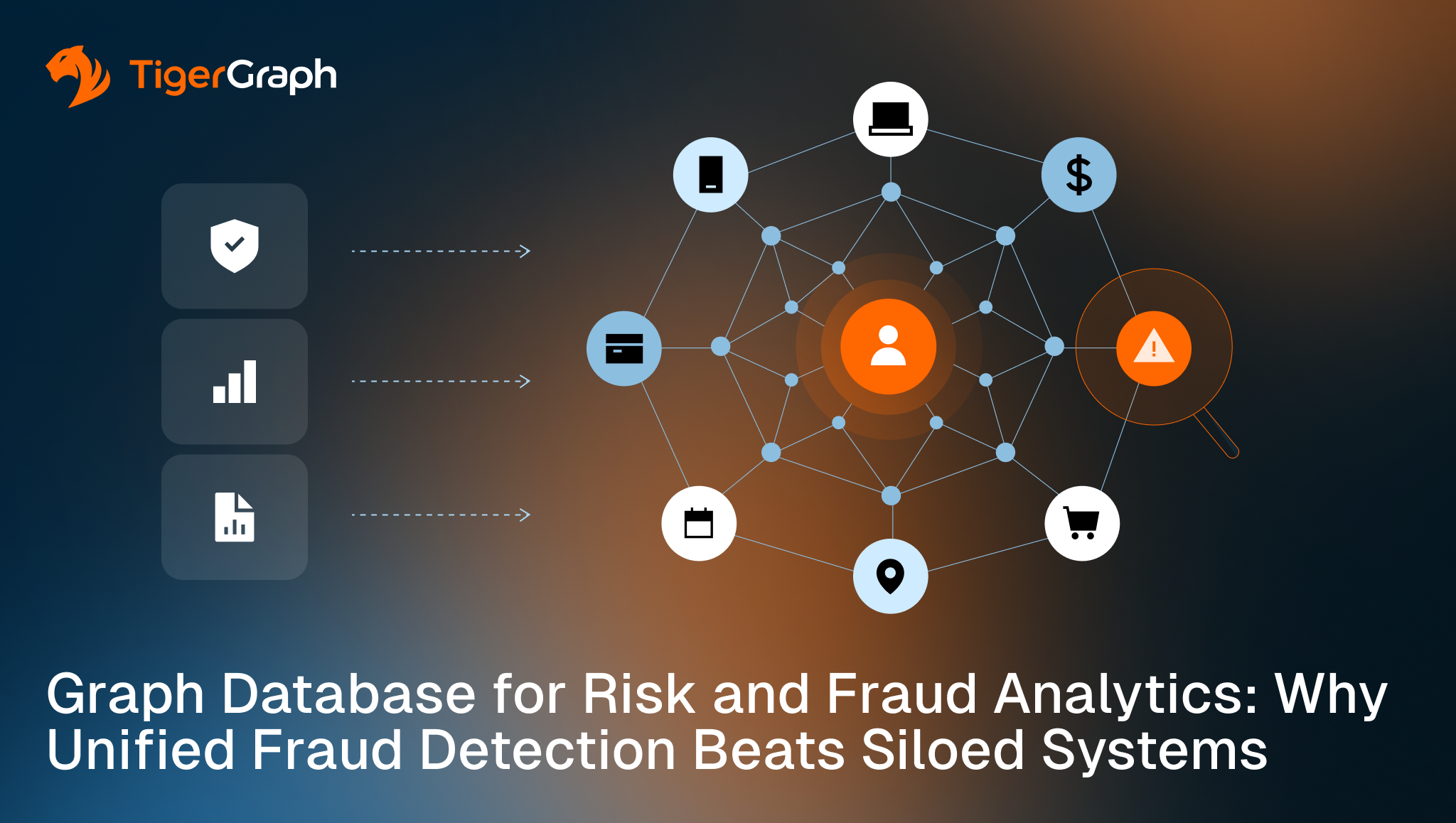
- A graph database connects customers, accounts, transactions, devices, and external risk signals into a single queryable network.
- Risk and fraud become two views of the same connected ecosystem rather than two separate workflows operating on the same underlying reality.
- Graph does not replace specialized fraud or compliance platforms. It acts as the relationship intelligence layer that connects those systems and surfaces coordinated patterns no single platform can detect independently.
- The most important capability graph adds is cross-silo pattern detection: a single query that connects a sanctions hit, a transaction anomaly, a shared device, and a beneficial ownership relationship, answered in milliseconds rather than assembled manually across systems
- TigerGraph is purpose-built for real-time, multi-hop risk and fraud analytics at enterprise scale, supporting unified detection, network-context scoring, explainable AI, and full regulatory traceability in a single system.
Your fraud team and your AML team are probably working from different platforms, different data models, and different alert queues. That separation made sense when threats were domain-specific. It does not make sense when the same bad actor is present in both – when a customer who passes sanctions screening individually is connected through three accounts and two shared devices to a counterparty already flagged by your transaction monitoring system.
Siloed platforms are not designed to see that connection. They evaluate entities in isolation, generate separate alerts, and leave analysts to stitch together the relationship manually – often weeks after the funds have moved.
A graph database approaches the problem differently. It stores customers, accounts, transactions, devices, merchants, and external risk signals as a connected network, and queries that network in real time. Risk and fraud stop being two separate disciplines and become two views of the same connected ecosystem.
You’ll learn:
- Why siloed risk and fraud systems miss the threats that matter most
- What a graph database adds to detection, scoring, and investigative workflows
- How graph compares to siloed systems across key operational dimensions
- How graph and AI combine to strengthen both detection accuracy and explainability
- Where unified graph analytics applies across banking, insurance, payments, telecom, and compliance
What Is a Graph Database for Risk and Fraud Analytics?
In a graph risk and fraud model, every entity your enterprise cares about – customer, account, transaction, device, merchant, counterparty, beneficial owner – is stored as a distinct record connected to every other entity it relates to through labeled relationship links. A customer who shares a device with another customer, who in turn has transacted with a sanctioned entity, is visible as a three-step relationship chain. That chain can be queried in milliseconds.
In a relational system, surfacing that chain requires joining five or six tables in sequence. At production scale, those joins either time out or complete so slowly that the finding arrives after the funds have already moved. Graph eliminates that assembly step: the relationships are already stored and indexed, the query returns in milliseconds, and every finding is traceable to specific relationship paths – the kind of explainability that satisfies both internal audit and regulatory review.
Why Siloed Risk and Fraud Systems Are Expensive
Most enterprises operate separate platforms for credit risk, operational risk, AML, sanctions screening, and fraud detection – each with its own data model, scoring engine, and analyst team. These systems work well within their domain. They struggle the moment a threat crosses domain boundaries, because they evaluate entities in isolation: a customer may appear low risk in your fraud platform while their broader network, visible in your AML system, connects them to suspicious accounts and sanctioned entities.
Let’s take a concrete example: a customer passes onboarding checks because their individual profile looks legitimate. Six weeks later, they transact with a counterparty already flagged in your sanctions monitoring system. But sanctions monitoring and transaction monitoring operate on separate data stores and generate separate alert queues. The relationship does not surface until a manual compliance review – long after funds have moved through multiple accounts and the window for intervention has closed.
By the time your analysts begin investigating, they spend the first several hours assembling data across systems: pulling transaction records from one platform, sanctions flags from another, device data from a third. That effort is operational overhead rather than analysis – and it is the direct cost of siloed architecture.
Graph technology addresses the root cause. Instead of generating one more alert in one more queue, it connects the data those siloed systems produce into a single queryable network, so the relationship between your customer and the sanctioned counterparty is visible the moment the first transaction occurs.
What a Graph Database Adds to Risk and Fraud Analytics
In a graph risk and fraud model, every customer, account, transaction, device, counterparty, and external risk signal is stored as an entity in a connected network. The relationships between those entities – transacted with, shares a device with, beneficial owner of, previously flagged for – are stored as first-class data alongside the entities themselves. This architecture makes four capabilities possible that siloed flat-database systems cannot deliver at production speed.
Cross-silo pattern detection in a single query. Rather than running separate queries in separate systems and then manually correlating the results, a graph query can connect a sanctions hit, a transaction anomaly, a shared device identifier, and a beneficial ownership relationship in a single operation. A customer who looks clean in isolation but is two relationship steps from a known fraud ring is visible immediately rather than weeks later.
Network-context risk scoring. Instead of assigning risk scores based only on individual customer attributes, graph systems evaluate the broader entity network surrounding each customer. A seemingly clean account receives a higher risk score because it is closely connected to high-risk entities through transactional or ownership relationships. That score is computed from the actual structure of the network, not inferred from demographic or behavioral proxies.
Unified alert correlation. Rather than generating separate alerts across multiple platforms for the same underlying activity, the graph determines whether those alerts belong to a single coordinated event and collapses them into a unified case view. Analysts work on one investigation instead of three parallel queues pointing at the same bad actor.
Full traceability for regulatory review. Every detection, every score, and every escalation decision can be traced to the specific relationship paths in the graph that contributed to it. When a regulator asks why a particular transaction was flagged – or why a particular customer was cleared – the answer is a traceable chain of relationships, not a black-box model output.
TigerGraph’s massively parallel processing enables deep relationship analytics across billions of connections without performance degradation, supporting real-time multi-step queries at enterprise scale.
Graph vs. Siloed Risk and Fraud Systems: Key Differences
Graph technology is not a replacement for specialized fraud or compliance platforms. It acts as the relationship intelligence layer that connects data across those systems and surfaces patterns no single platform can detect independently.
| Siloed Systems | Graph Database | |
| Data model | Separate tables per platform | Connected network of customers, accounts, transactions, and counterparties |
| Cross-domain pattern detection | Manual data assembly across systems | Automated relationship queries across all entity types |
| Risk scoring | Individual attributes per platform | Network-context-enriched scores |
| Alert correlation | Duplicate alerts per system | Unified case view |
| Investigative workflow | Data assembly-heavy | Analysis-heavy |
| Explainability | Rules-based reasoning | Traceable relationship paths |
| Regulatory traceability | Spread across platforms | Unified lineage in a single system |
The most operationally significant difference is the investigative workflow row. Analysts working in siloed environments spend the majority of their investigation time assembling data before they can begin analyzing it. Graph inverts that ratio: the data assembly happens at the architecture level, so analysts arrive at an investigation with the full entity network already connected and queryable. The threats that cause the largest losses – coordinated fraud rings, synthetic identity networks, AML schemes that exploit the gap between transaction monitoring and sanctions screening – are almost always cross-domain. Siloed systems allow bad actors to exploit that gap. Graph closes it.
Graph + AI: How the Combination Strengthens Detection and Decisioning
Graph provides the structural relationship context. AI provides the pattern recognition and adaptive scoring that turns that context into forward-looking detection signals. The combination is more accurate and more explainable than either produces alone.
Four ways the combination strengthens risk and fraud analytics:
Graph-computed features for ML models. TigerGraph computes features for machine learning models directly from the entity network: centrality scores, community membership, shared identifier counts, and relationship-step distance to known bad actors. These network-derived features materially improve fraud and risk model accuracy compared to models trained on tabular data alone, because they encode the structural patterns that drive real-world fraud outcomes – not just the attributes of individual entities.
Graph Neural Networks for emerging scheme detection. Graph Neural Networks (GNNs) learn from the structural patterns in the transaction and ownership network and identify configurations that historically preceded fraud or risk events. This allows the model to flag emerging schemes based on network structure before those schemes match any known rule – including bust-out fraud patterns, synthetic identity clusters, and money mule networks that appear as ordinary activity at the individual account level.
Real-time continuous monitoring. Combined with real-time relationship querying, AI can continuously monitor the network and flag suspicious changes as they occur. This is especially valuable because sophisticated fraud rarely appears as a single threshold breach. It emerges gradually through evolving connections and coordinated activity – exactly the kind of pattern that rule-based systems miss and graph-plus-AI can surface.
Explainable AI for audit and regulatory review. Instead of producing a black-box score, graph AI systems can show the exact relationship paths that contributed to a detection decision: this account received a high-risk score because it transacted with entity A, which shares a device with entity B, which is two relationship steps from a sanctioned counterparty. That level of traceability strengthens internal audit workflows, regulatory submissions, and customer dispute resolution.
Enterprise Use Cases: Where Unified Risk and Fraud Analytics Applies
A graph database for risk and fraud analytics delivers measurable value across every industry that manages financial crime risk, compliance exposure, or multi-domain fraud at scale.
Insurance fraud and underwriting risk: insurers use graph to connect claims data, underwriting profiles, provider relationships, and third-party intelligence into a single analytics layer. Staged accident rings and collusive provider networks – where multiple claimants, repair shops, and medical providers are connected through shared relationships – surface as connected patterns rather than isolated high-value claims. A fraud ring involving 12 claimants, 3 providers, and 2 repair shops that appears as unrelated individual claims in a flat system is immediately visible as a connected network in graph, triggering coordinated investigation rather than 17 separate case files.
Banking and financial services: banks use graph to unify AML, sanctions, transaction fraud detection, and credit risk into a single connected view of every customer, account, and counterparty relationship. Coordinated schemes that span multiple products, accounts, and counterparties become visible as connected patterns rather than isolated anomalies in separate queues. A top global bank uses TigerGraph to analyze 50 million transactions per day for fraud detection – a workload that requires the kind of real-time, multi-step relationship queries that graph handles natively and that relational joins cannot complete within the required response window.
Payments and fintech: payments platforms use graph to correlate device, account, IP, and merchant relationships in real time. Synthetic identities and bust-out schemes that appear legitimate in isolation become visible through network behavior: a new account that shares a device with three other recently opened accounts, all of which transact with the same merchant cluster before going silent, matches a structural pattern the graph has already learned to flag. Graph also enables real-time card-not-present fraud detection by identifying when a device or IP address is associated with multiple account identities simultaneously.
Telecommunications fraud and credit risk: telcos use graph to unify subscription fraud, SIM swap fraud, and credit risk using the same connected entity view. A SIM swap attack that targets multiple accounts linked through a shared billing address, a shared device fingerprint, or a shared referral chain is visible as a connected pattern in graph before the first successful account takeover completes. Telcos that add graph to their fraud stack report significant reductions in SIM swap fraud losses and faster identification of subscription fraud rings compared to rule-based systems operating on individual subscriber records.
Regulatory compliance and audit: compliance teams use graph to trace the full relationship history behind every flagged decision, producing the auditable lineage that regulators increasingly require for AI-assisted workflows. Every AML escalation, sanctions hit, or model-assisted decision is backed by a queryable, explainable record – not a narrative reconstructed from separate system logs after the fact.
The Intelligence Layer Siloed Systems Cannot Build
Risk and fraud analytics belong together. They depend on the same network of customers, transactions, accounts, and counterparties. Siloed platforms force enterprises to analyze that network in fragments, which is exactly what sophisticated bad actors rely on.
A graph database for risk and fraud analytics closes that gap by storing the full entity network in a single system and making it queryable in real time. Analysts investigate rather than assemble data. Detections arrive before funds move rather than after. Explainability is built into the architecture rather than retrofitted for regulatory review. Explore TigerGraph’s fraud detection solutions to see how unified graph analytics fits your risk stack, or request a demo to see real-time cross-silo detection in action.
FAQs: Risk and Fraud Analytics with Graph
What is risk and fraud analytics?
Risk and fraud analytics is the discipline of using data, statistical models, machine learning, rules, and network analysis to identify, predict, prevent, and investigate behaviors that could cause financial, operational, regulatory, or reputational harm to an enterprise. The most effective programs treat risk and fraud as connected rather than separate, because the threats that cause the largest losses almost always span both domains.
Why are risk and fraud analytics usually treated separately?
They have historically been separated by different regulatory drivers, different vendor categories, and different internal teams. The problem is that sophisticated bad actors deliberately exploit this separation – constructing schemes that pass individual domain checks while hiding their coordination in the relationships between those domains. Graph makes those cross-domain relationships visible and queryable for the first time.
How does a graph database improve risk and fraud detection?
A graph database stores the relationships between customers, transactions, devices, and counterparties as first-class data, enabling multi-step pattern detection that flat databases cannot perform at production speed. A customer who looks clean individually but is connected through three accounts to a sanctioned counterparty is visible in milliseconds. In a relational system, surfacing that connection requires multiple sequential joins that often cannot be completed within the required response window at enterprise transaction volumes.
How does AI improve risk and fraud detection when combined with graph?
AI models trained on graph-derived features significantly outperform models trained on tabular data alone, because graph features encode the network context – counterparty risk, community membership, shared identifiers, relationship-step distance to known bad actors – that drives real-world fraud and risk outcomes. Graph neural networks add the ability to flag emerging schemes based on structural network patterns before those schemes match any existing rule, which is the most significant gap in rule-based detection systems today.