
Summary
- Enterprise graph workloads are difficult not only because of data volume, but because the most valuable questions require computation across many layers of connected relationships, and that computation grows substantially as queries go deeper.
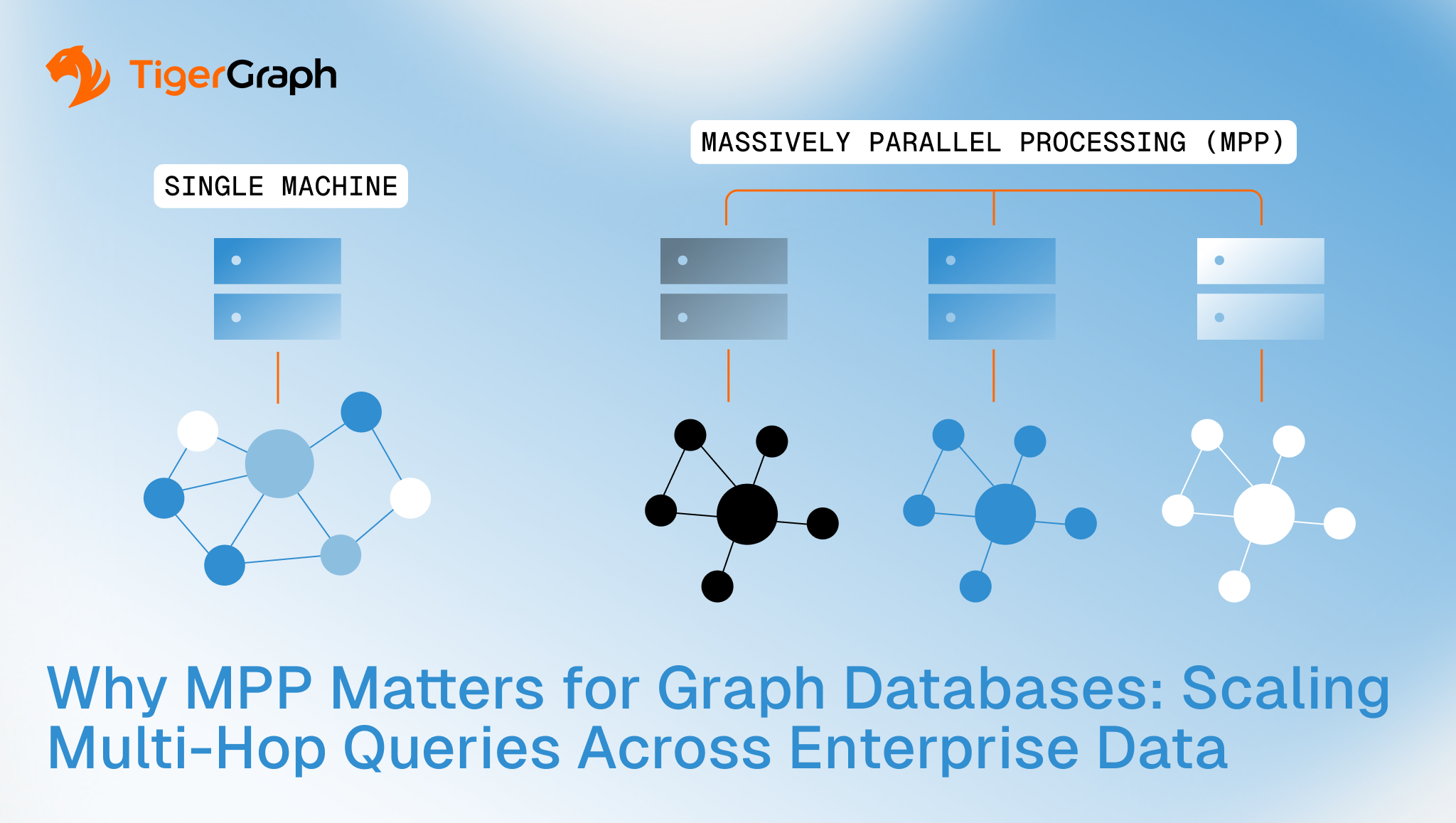
- Massively parallel processing (MPP) divides data and query execution across multiple processors so different portions of the same analytical workload can execute simultaneously rather than sequentially on one machine.
- MPP and distributed databases are not the same: a distributed database may spread storage and replicas across machines without parallelizing one complex query across the cluster. That distinction matters when evaluating graph platforms for production workloads.
- TigerGraph’s massively parallel architecture distributes graph storage and computation across a cluster, enabling both deep and broad relationship analysis across billions of relationships at production scale with GSQL’s built-in parallelism for graph operations.
- The LDBC Social Network Benchmark Business Intelligence workload, validated by an independently audited TigerGraph result at scale factor 1000, provides a standardized reference point for evaluating large-scale graph analytics capabilities.
Enterprise graph workloads are difficult to manage because the most valuable questions require computation across many layers of connected data.
A fraud team may need to determine whether a new account is indirectly connected to a known fraud ring through shared devices, addresses, merchants, and transactions. A supply chain team may need to trace how a disruption at one supplier could affect components, facilities, products, and markets several relationships away. A security team may need to identify every viable route from a compromised identity to a critical asset.
These are not simple record lookups. As a query moves through more levels of relationships, the amount of data that may need to be evaluated can grow rapidly. That is why massively parallel processing, or MPP, matters for graph databases.
An MPP database distributes computation across processing resources so many portions of the same analytical workload can execute simultaneously. For enterprise graphs, that architectural choice can determine whether deep relationship analysis remains an offline investigation or becomes part of a real-time operational system.
You’ll learn:
- Why deep relationship queries create a fundamentally different computational challenge than traditional record lookups
- How MPP distributes graph storage and computation so that one complex query can use multiple processing resources simultaneously
- Why MPP and distributed databases are different, and why that distinction matters for enterprise graph evaluation
- How TigerGraph’s massively parallel architecture enables real-time relationship intelligence at production scale
What Is an MPP Database?
An MPP (massively parallel processing) database distributes data and query execution across multiple processors or machines so different portions of the same analytical workload can execute simultaneously. It can be designed for a single multicore machine as well as a cluster of machines. Rather than relying on one processor to perform all computation, the system splits a workload into smaller units, executes them in parallel, and combines the intermediate results. The key distinction from a distributed database is that MPP is designed to use multiple processing resources for one query at the same time, not just to store data across machines or serve independent concurrent requests.
MPP commonly uses a shared-nothing architecture in which different database partitions have their own processing, memory, and storage resources.The important distinction is between concurrency and parallelism. Concurrency means several independent queries can run at the same time. Parallelism means multiple processing resources work on different parts of one query at the same time.
That difference matters for graph analytics. A platform might support many users or replicate data across several machines without accelerating one demanding query.
For enterprises evaluating graph systems, the key question is not simply, “Can this database run on a cluster?” It is, “Can one demanding relationship query use that cluster in parallel?”
Why Deep Relationship Queries Create a Different Scaling Problem
Traditional database operations often filter, aggregate, or join records according to predefined keys. Graph workloads introduce a different challenge because each step of a query can reveal another set of relationships to evaluate.
Consider a fraud investigation:
Account A is connected to a device that is also linked to Account B. Account B is associated with a transaction involving Account C, which is connected to a flagged entity.
The system may need to ask whether Account A is connected to a known risk entity even though no direct relationship exists. To answer, it must inspect connected entities, apply conditions, follow qualifying relationships, carry forward intermediate information, and repeat the process across multiple levels.
The potential search space can grow quickly. If each entity connects to an average of d=10 others, a naive exploration across k=4 levels could expose work on the order of dk = 10,000. The graph might have intersecting paths that result in fewer than 10,000 unique entities, and queries might imposing conditions that effectively filter out more entities , so d^k should be treated as an illustration rather than a universal complexity formula.
But the underlying problem remains: deeper analysis can create substantially more computation. This is precisely where database architecture affects business outcomes. If one processing path must perform most of that work, latency can rise as queries get deeper or graphs become denser. If independent portions of the operation can be distributed across cores and machines, the system can attack more of the relationship space at the same time.
For fraud detection, cybersecurity, recommendations, or supply chain operations, that difference determines whether insights arrive while a decision can still be influenced.
How Massively Parallel Processing Changes Graph Query Execution
MPP changes graph processing by distributing both data and computation.
First, the graph can be partitioned across compute resources. Large connected datasets no longer need to depend on the CPU, memory, or storage limits of a single machine. MPP and data partitioning can also accelerate the work of single multi-core machines.
Second, relationship operations can execute simultaneously. When a query reaches many relevant parts of the graph, independent work can be processed in parallel rather than sequentially.
Third, intermediate results are combined. Parallel execution is useful only if partial calculations can be synchronized and reduced into a coherent result. A fraud query, for example, might identify suspicious accounts, distribute analysis of their connected activity, calculate risk signals in parallel, aggregate those signals, and then continue to the next stage of analysis.
Finally, MPP supports scale-out. Instead of relying only on increasingly large servers, organizations can add processing capacity as data volumes and analytical workloads grow.
This does not mean parallelism makes every query automatically fast. Performance still depends on partitioning, data distribution, query selectivity, highly connected entities, network communication, synchronization, and query design. Distribution also creates overhead because machines must coordinate and exchange information when a query crosses partitions.
The architectural advantage is that MPP gives the database a way to distribute the work. That becomes increasingly important as workloads shift from shallow lookups to deep, compute-intensive relationship analysis.
An MPP Graph Database Is More Than a Distributed Database
“Distributed” and “massively parallel” are related, but they are not interchangeable.
A database may distribute data across several machines to increase storage capacity, improve availability, maintain replicas, or serve more independent requests. None of those capabilities guarantees that one complex query will execute across the cluster in parallel.
An MPP graph database is designed to make processing resources participate in the computation itself.
| Capability | Distributed Database | MPP Graph Database |
| Data can span multiple machines | Yes | Yes |
| Horizontal scaling | Often | Yes |
| Replication/high availability | Often | Often |
| Multiple queries can run concurrently | Often | Yes |
| One complex query can use multiple processing resources | Not necessarily | Core capability |
| Designed for deep relationship computation | Not necessarily | Yes |
That distinction should shape enterprise evaluations. Architecture diagrams showing several servers are not enough. Teams should test whether the queries that matter in production actually distribute their computational work.
Where MPP Graph Processing Matters Most
MPP becomes particularly valuable when an application must examine large relationship networks under tight latency requirements.
Fraud and AML
Fraud rarely appears as one obviously suspicious record. Rings can span accounts, identities, devices, merchants, transactions, and counterparties. Parallel relationship analysis helps investigators and scoring systems evaluate broader networks without reducing every decision to isolated rules.
Cybersecurity
Attack path analysis requires teams to understand how identities, permissions, endpoints, vulnerabilities, and critical assets connect. The number of possible routes can expand rapidly. Graph processing helps security teams prioritize the paths that create actual exposure instead of treating vulnerabilities independently.
Supply Chain Intelligence
A direct supplier view misses dependencies further upstream or downstream. Graph analytics can connect suppliers, components, facilities, products, logistics providers, and markets so organizations can assess where a disruption may propagate.
Customer and Entity Intelligence
Customers are connected to households, devices, channels, products, transactions, and behaviors. MPP graph analytics can evaluate those relationships at enterprise scale to support recommendations, entity resolution, and contextual decisioning.
Enterprise AI and GraphRAG
AI systems increasingly need connected context, not just semantically similar documents. Graph-based retrieval can follow relationships among entities, policies, events, and evidence, giving AI applications a structured foundation for more contextual and explainable responses.
These use cases align with TigerGraph’s positioning around real-time relationship intelligence for mission-critical enterprise workloads, including fraud, cybersecurity, supply chain, customer intelligence, and AI.
What MPP Looks Like in TigerGraph
TigerGraph is designed around enterprise-scale relationship intelligence, with massively parallel processing as a core architectural capability. In TigerGraph, MPP enables deep relationship analytics across billions of connections by distributing graph storage and computation across a cluster. This distributed foundation also supports real-time analytics and AI-ready connected data.
TigerGraph’s computational model supports parallel storage and computation across the graph, while GSQL provides built-in parallelism for graph operations and analytics. Together, these capabilities allow graph workloads to process large volumes of connected data without relying on a single machine to perform all computation.
For partitioned graphs, TigerGraph also provides distributed query execution. In this mode, participating machines execute portions of a query in parallel, with computation moving through the cluster as the query progresses. This approach can improve performance for queries that begin with large data sets or follow many relationship steps.
Distributed execution also introduces an important operational trade-off. A single query that uses more cluster workers may complete faster, but it can leave fewer resources available for other queries. In production environments, effective use of MPP therefore requires balancing query latency, throughput, concurrency, and resource utilization rather than maximizing parallelism in isolation.
TigerGraph’s performance has also been evaluated through the Graph Data Council, formerly the Linked Data Benchmark Council. Its Social Network Benchmark Business Intelligence workload measures complex analytical queries alongside data updates. The council lists an audited TigerGraph result at scale factor 1000, dated October 10, 2024.
The benchmark’s independent audit validated the query implementation and system configuration. While benchmark results cannot predict performance for every production workload, they provide a standardized reference point for evaluating TigerGraph’s large-scale graph analytics capabilities.
How to Evaluate an MPP Graph Database
Enterprise teams should benchmark architecture against the workload they actually intend to run.
Single-query parallelism. Can one complex query use multiple cores and machines, or does the cluster primarily provide replication and concurrency?
Deep-query performance. Test realistic deep relationship query patterns instead of relying on one- or two-level lookups.
Production data volume and density. A billion relationships can behave very differently depending on how densely entities are connected.
Scale-out efficiency. Determine whether adding compute resources improves the target workload enough to justify the additional infrastructure.
Mixed workloads. Measure performance while ingestion, updates, analytical queries, and application requests run together.
Communication overhead. Cross-machine coordination can become expensive. Examine how the architecture handles data movement and synchronization.
Production evidence. Favor reproducible benchmarks and independently audited results over isolated latency claims.
The most important rule is simple: benchmark the query shape, not just the dataset size. Dataset size alone says little about how a platform will perform on the depth, filters, density, concurrency, and computation your application requires.
MPP Turns Graph Scale Into Usable Relationship Intelligence
Enterprise graph scalability is not simply a question of how much connected data a database can store. The more important question is how much of that connected data the system can analyze within the application’s decision window.
As graph queries become deeper and datasets become larger, relationship analysis can create substantial computational work. Massively parallel processing provides a way to divide that work across available resources, execute independent operations simultaneously, and combine the results.
For fraud detection, cybersecurity, supply chain intelligence, customer analytics, and enterprise AI, that architectural difference can determine whether graph remains an offline analytical tool or becomes infrastructure for real-time decision intelligence.
TigerGraph is purpose-built for this class of enterprise workload: distributed, deeply connected, compute-intensive analytics that must operate at production scale.
Start free with TigerGraph Savanna, explore TigerGraph’s free tier, or request a personalized demo to see how TigerGraph can support your production graph workloads.
FAQs
What is an MPP database?
An MPP database distributes data and query computation across multiple processors or machines so different portions of the same workload can execute simultaneously.
How does massively parallel processing work in a graph database?
The database partitions data and distributes eligible portions of relationship analysis across available processing resources. Intermediate results are then synchronized or aggregated into the final query result.
Why is MPP important for graph databases?
Deep graph queries can expand the amount of relationship data that must be evaluated. MPP gives the database an architecture for processing more of that work in parallel, which becomes critical when insights must arrive while a decision can still be influenced.
Is an MPP database the same as a distributed database?
No. A distributed database may spread storage, replicas, or independent workloads across machines without parallelizing one query across the cluster. The distinction matters when evaluating graph platforms: teams should test whether the queries that matter in production actually distribute their computational work, not just whether the architecture diagram shows multiple servers.
What workloads benefit most from an MPP graph database?
MPP graph processing is particularly useful for fraud and AML networks, cybersecurity attack paths, supply chain dependencies, customer intelligence, large graph algorithms, and relationship-aware enterprise AI: any workload where the answer depends on following and computing across many layers of connected data under real-time or near-real-time latency requirements.