
Summary
- Neo4j is a capable graph database with a mature developer ecosystem, but production requirements around scale, deep relationship analytics, real-time decisioning, or graph-powered AI can prompt organizations to evaluate alternatives.
- The right Neo4j alternative depends on the specific architectural constraint driving the evaluation: scale, performance, cloud-native operations, Cypher compatibility, lakehouse integration, or open-source control.
- TigerGraph is purpose-built for distributed, massively parallel graph processing and is the strongest choice for enterprises moving from graph experimentation to production decision intelligence across large, highly connected datasets.
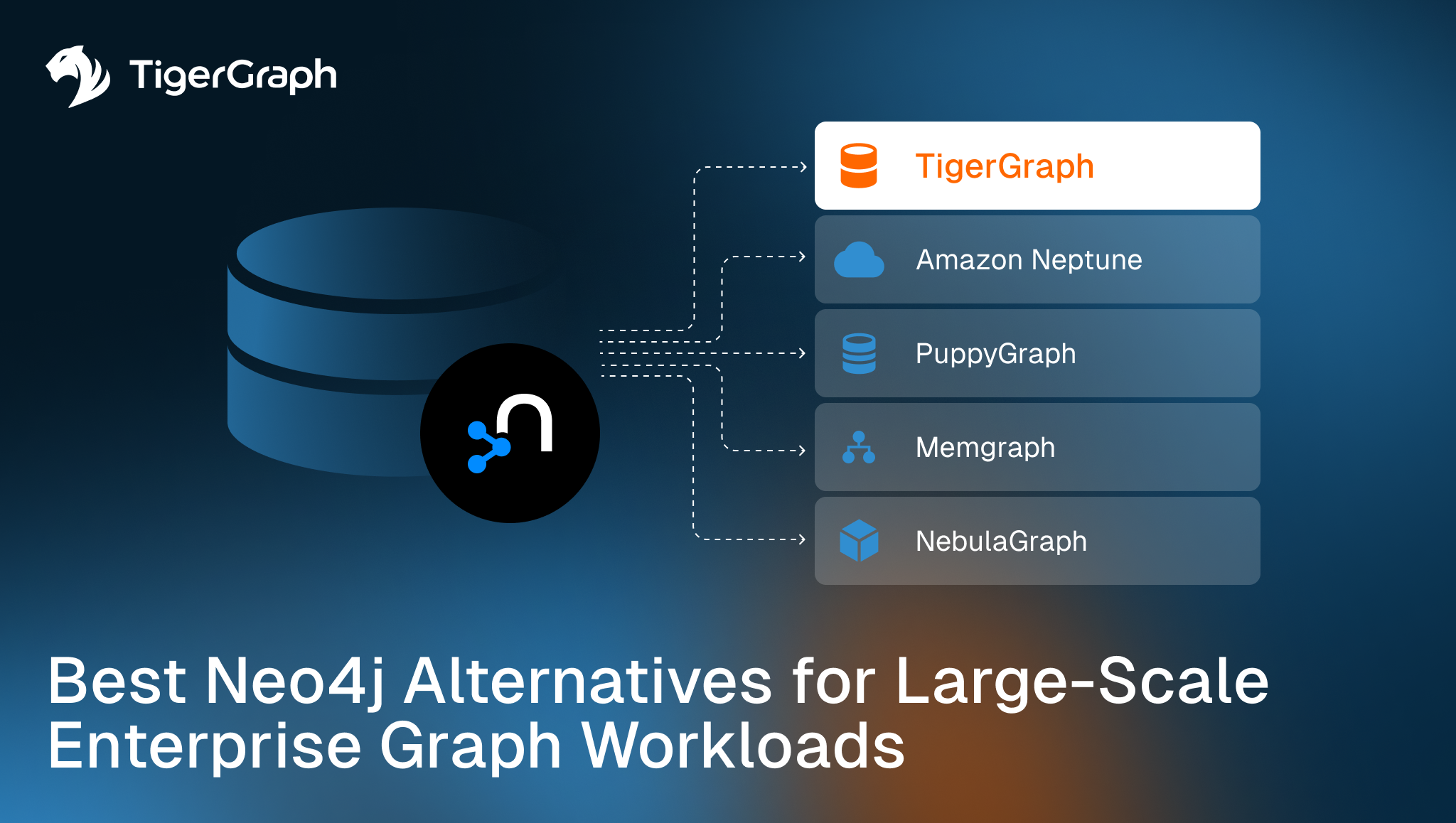
- Alternatives including Amazon Neptune, Memgraph, PuppyGraph, ArangoDB, and NebulaGraph each address different workload priorities: AWS-native operations, Cypher-compatible low latency, lakehouse analytics, multi-model workloads, and distributed open-source infrastructure respectively.
- Evaluating a Neo4j alternative should start with the queries and workloads that most constrain your target deployment, not with feature matrices or licensing comparisons.
Neo4j is often evaluated by enterprises when adopting graph technology. Its Cypher query language, developer tooling, Graph Data Science ecosystem, and growing support for GraphRAG make it a strong choice for many graph applications.
But requirements change when a graph project moves from a prototype or departmental application to a more demanding production system, especially for use cases like fraud detection, cybersecurity, customer intelligence, supply chain analysis, or enterprise AI.
At that point, teams may need to process much larger connected datasets, execute deeper relationship queries, ingest continuously changing data at high volume, or distribute workloads across infrastructure at scale. For organizations running GraphRAG or AI workloads alongside graph analytics, the same graph-scale and performance constraints apply—Neo4j supports hybrid graph and vector retrieval, but its architectural limitations at graph scale carry equally into AI retrieval workloads.
That is where Neo4j alternatives become worth evaluating.
The best Neo4j alternative is not simply another database that can store connected data. It is the platform whose architecture best matches the workload that is causing you to reconsider Neo4j in the first place.
You’ll learn:
- When production requirements justify evaluating a Neo4j alternative
- What to identify when comparing platforms: scalability architecture, deep-query performance, real-time ingestion, and AI integration
- How TigerGraph, Amazon Neptune, Memgraph, PuppyGraph, ArangoDB, and NebulaGraph each compare on the dimensions enterprise graph workloads require
- How to structure a proof of concept that answers the right question: will this platform perform better on the workload that triggered the evaluation?
What Makes a Strong Neo4j Alternative?
A strong Neo4j alternative directly addresses the architectural constraint driving the evaluation: graph scale, deep-query performance, real-time operational requirements, cloud-native deployment, Cypher migration path, or AI and vector integration. The best evaluation process starts with the specific queries and workloads that are causing problems today, not with feature matrices. Platforms that look similar in a comparison table can behave very differently under the specific relationship patterns, ingestion rates, and query depths of a production workload.
Before shortlisting platforms, identify the primary reason you are reconsidering Neo4j. Different architectural constraints point to different alternatives.
When Should You Consider a Neo4j Alternative?
Neo4j has expanded its scalability capabilities. Current Neo4j Enterprise includes replication, composite databases (aka Fabric), and sharded property databases (aka Infinigraph). Composite databases can federate queries across several constituent databases, while property sharding separates properties from the graph structure.
Those capabilities matter because the question is no longer whether Neo4j can scale. It can. The more useful question is whether its architecture is the best fit for your particular large-scale graph workload.
For example, relationships cannot span graphs in a composite database; the workaround is to introduce special duplicate “proxy” nodes that act like foreign keys in a relational database. Its property-sharding architecture also retains the graph structure within a graph shard while distributing associated properties.
Enterprises should therefore evaluate alternatives when they encounter requirements such as:
- Large, highly interconnected graphs: The workload must analyze relationships across very large datasets rather than isolate them into separate graph domains.
- Deep relationship analytics: Fraud rings, attack paths, supply chain dependencies, identity networks, and customer relationships require queries spanning many levels of connected data.
- Operational decisioning: Graph results must return quickly enough to influence transactions, alerts, recommendations, or AI responses in real time.
- High-volume data ingestion: The graph must remain queryable while transactions, events, telemetry, or customer activity continuously update it.
- Graph-powered AI: GraphRAG, agentic AI, graph machine learning, and hybrid graph-plus-vector retrieval have become production requirements rather than experiments.
- Different infrastructure economics: Some organizations need a fully managed cloud service, an open-source distributed database, an in-memory system, or a graph layer directly over an existing lakehouse.
The reason for switching should determine the shortlist.
What to Look for in Neo4j Alternatives
Before comparing products, define the workload that the replacement must handle.
Scalability architecture
Look beyond maximum advertised database size. Determine how the platform distributes storage and computation and what happens when a query crosses partitions. Large graph workloads are particularly sensitive to how relationship processing is distributed.
Deep-query performance
A graph that performs well on simple lookups may behave very differently when queries repeatedly expand through connected entities. Test the paths and relationship patterns that resemble your production workloads.
Real-time ingestion and concurrency
For operational graph applications, benchmark reads while the database is simultaneously processing updates. A fraud or cybersecurity system that performs well only on static data has limited production value.
Query and application portability
If your application already contains substantial Cypher code, openCypher support can reduce migration work. It does not guarantee a drop-in migration, however. Neo4j-specific procedures, extensions, data types, and Graph Data Science calls still need to be evaluated.
AI and analytics integration
For enterprise AI, determine whether graph retrieval, vector search, graph algorithms, machine learning, and application integration operate as separate components or as part of the same platform.
Operational complexity and total cost
Licensing is only one part of total cost. Infrastructure requirements, specialist engineering, cluster management, data duplication, migration pipelines, and operational staffing all affect the economics of a production graph system.
1. TigerGraph: Best Neo4j Alternative for Large-Scale Real-Time Graph Analytics
For organizations reconsidering Neo4j because of scale, deep relationship analytics, or production performance, TigerGraph is the strongest alternative to evaluate.
TigerGraph uses a distributed, massively parallel architecture designed to divide graph workloads across infrastructure and process operations concurrently. An independently audited LDBC benchmark describes TigerGraph as an MPP graph database using distributed native graph storage, with graph partitions processing requests in parallel.
That architectural model is particularly relevant for applications such as fraud and AML detection, customer 360, entity resolution, cybersecurity, recommendation systems, and supply chain analysis, where insight depends on analyzing many connected relationships rather than retrieving isolated records.
TigerGraph also reduces one significant barrier for teams leaving Neo4j: query-language migration. TigerGraph supports GSQL as well as the majority of openCypher features and pattern-matching elements of GQL. Existing Cypher skills therefore remain useful, although teams should still test application-specific syntax and procedures rather than assuming complete compatibility.
For AI workloads, TigerGraph combines graph relationships with vector capabilities for hybrid retrieval and GraphRAG. TigerGraph Savanna provides the managed cloud option, while self-managed deployments remain available for organizations with different infrastructure or governance requirements.
Best fit: Enterprises moving from graph experimentation to production decision intelligence across large, highly connected datasets.
Key consideration: Migration from Cypher to TigerGraph is not necessarily zero-touch. Organizations should evaluate which existing queries can use openCypher and where GSQL offers value for more advanced analytics.
2. Amazon Neptune: For AWS-Centric Graph Deployments
Amazon Neptune is the managed graph database option for organizations already operating within the AWS ecosystem and prioritizing a fully managed graph service.
Neptune is a purpose-built managed graph database supporting openCypher and Gremlin for property graphs and SPARQL for RDF. AWS positions the service for workloads including fraud detection, knowledge graphs, recommendations, identity graphs, and network security.
The primary advantage is operational integration with AWS infrastructure. Teams can adopt graph capabilities without taking on the database-management responsibilities associated with self-managed deployments.
Neo4j migrations still require compatibility testing. AWS explicitly documents differences between Neo4j Cypher and Neptune’s openCypher implementation and provides guidance for rewriting unsupported constructs and Neo4j-specific functionality.
Best fit: AWS-first enterprises seeking a managed property-graph or RDF database.
Key consideration: openCypher support reduces migration friction but does not eliminate query rewrites.
3. ArangoDB: When Graph Is Part of a Multi-Model Workload
ArangoDB takes a different approach. Instead of specializing exclusively in graph workloads, it combines graph and document capabilities within one database and uses AQL as its query language.
That can be attractive when an application genuinely requires multiple data models and the organization would rather operate one platform than separate document and graph databases.
ArangoDB Enterprise includes distributed graph options such as SmartGraphs and EnterpriseGraphs designed to improve data locality in clusters. SmartGraphs, like Neo4j’s composite graphs, requires data architects to manually design sharding rules.
The trade-off is architectural specialization. If deep relationship analytics is the dominant workload rather than one requirement among several, teams should compare a multi-model platform against databases designed specifically around large-scale graph processing.
Best fit: Applications where graph and document workloads have comparable importance.
Key consideration: Moving from Cypher to AQL requires application-query migration.
4. Memgraph: For Cypher-Compatible, Low-Latency Workloads
Memgraph is particularly interesting for Neo4j users because it uses Cypher and the Bolt protocol and provides dedicated Neo4j migration tooling. Its migration documentation even supports streaming a graph directly from an existing Neo4j instance.
Its performance strategy centers on an in-memory architecture designed for high read and write throughput. Memgraph also supports vector search and GraphRAG-oriented workflows.
Its scaling model is important when evaluating very large deployments. Memgraph’s current architecture scales reads through replicas, while writes remain centralized on a MAIN instance and scale vertically rather than through horizontal write sharding.
Best fit: Streaming, real-time, and latency-sensitive graph applications where Cypher compatibility is a high priority.
Key consideration: For very large write-heavy graphs, evaluate the vertical write-scaling model and memory requirements against expected production growth.
5. PuppyGraph: For Graph Analytics Directly on the Lakehouse
PuppyGraph represents a different category of Neo4j alternative because it does not require organizations to move all their data into a conventional graph database.
Instead, PuppyGraph maps data in warehouses and lakehouses into a graph model and queries those existing sources directly. Its architecture separates graph computation from the underlying storage and supports distributed query execution across compute nodes.
This model can be valuable for enterprises that already have large datasets in systems such as Snowflake or data lakes and want the convenience of graph analytics without building another full data-copy pipeline.
Best fit: Lakehouse-centric organizations that want to add graph querying over existing enterprise data.
Key consideration: It is a graph analytics layer rather than the same architectural category as a native graph database, so teams should benchmark latency, source-system dependencies, and operational behavior against their requirements.
6. NebulaGraph: For Open-Source Distributed Infrastructure
NebulaGraph is an open-source distributed native graph database built for horizontally scaled deployments. Its documentation describes a shared-nothing architecture with distributed storage and partitioning.
It uses nGQL, a query language designed to be compatible with openCypher concepts. However, compatibility is not complete; NebulaGraph documents syntax and behavioral differences that Neo4j teams should account for during migration.
NebulaGraph can therefore appeal to engineering organizations that prioritize open-source infrastructure and want direct control over a distributed graph environment.
Best fit: Engineering-led teams seeking a distributed open-source graph platform.
Key consideration: Expect more operational responsibility and query migration than with a closely Cypher-compatible managed platform.
Neo4j Alternatives Compared
| Platform | Architecture | Neo4j Migration | Best Fit | Main Trade-Off |
| TigerGraph | Distributed native graph + vector, massively parallel processing | Majority openCypher support; GSQL for advanced analytics | Large-scale fraud, AML, cybersecurity, customer 360, supply chain, GraphRAG | Some query and application adaptation |
| Amazon Neptune | Managed purpose-built graph database | openCypher supported with documented differences | AWS-centric enterprise deployments | AWS ecosystem dependency and Cypher differences |
| ArangoDB | Distributed multi-model database | Requires migration to AQL | Mixed graph and document workloads | Less specialized around graph-only analytics |
| Memgraph | Primarily in-memory graph architecture | Strong Cypher/Bolt compatibility and migration tooling | Low-latency and streaming graph workloads | Writes do not scale horizontally |
| PuppyGraph | Distributed graph query engine over existing data platforms | Cypher-oriented integration | Lakehouse and warehouse graph analytics | Not a traditional native graph store, lesser performance in many cases |
| NebulaGraph | Open-source distributed native graph database | nGQL is openCypher-compatible but differs in places | Self-managed distributed graph infrastructure | Greater migration and operational lift |
What Is the Best Neo4j Alternative for Your Workload?
There is no universal answer because organizations switch from Neo4j for different reasons.
If large-scale relationship analytics and real-time operational workloads are driving the evaluation, TigerGraph should be at the top of the shortlist. Its distributed MPP architecture is purpose-built around processing complex graph analytics across large connected datasets.
If the priority is AWS-native operations, Neptune offers a managed service fit for organizations within that ecosystem.
If Cypher compatibility and low latency matter more than horizontal write scalability, Memgraph is worth evaluating for those workloads.
If the enterprise wants to query lakehouse data as a graph without duplicating it, PuppyGraph offers a fundamentally different architecture.
If graph is only one part of a multi-model application, ArangoDB may reduce the number of database technologies the team needs to operate.
And if the requirement is open-source distributed graph infrastructure, NebulaGraph provides another option.
The best Neo4j alternative is therefore the one that directly addresses the architectural constraint that triggered the migration.
How to Evaluate a Migration Away From Neo4j
Switching graph databases should start with workload testing, not feature matrices.
First, identify the queries and data update patterns that matter most in production. Benchmark real fraud investigations, recommendation requests, attack-path searches, entity-resolution workloads, or GraphRAG retrieval patterns rather than generic graph examples.
Next, inventory dependencies on Cypher extensions, APOC procedures, Graph Data Science functions, drivers, visualization tooling, and application frameworks. Even platforms with strong openCypher compatibility can behave differently around Neo4j-specific features. AWS, for example, publishes dedicated guidance for rewriting Neo4j Cypher for Neptune, while Memgraph documents differences in its own Cypher implementation.
Then test the production characteristics that are easiest to overlook:
- Query latency as relationship depth increases
- Performance while data is being updated
- Scaling behavior as the graph grows
- Cluster failure and recovery
- Data-loading and synchronization requirements
- GraphRAG and vector-search performance
- Infrastructure and licensing costs at expected production scale
A proof of concept should answer one question: Will the new platform perform better on the workload that caused you to consider leaving Neo4j? For organizations evaluating TigerGraph specifically, the TigerGraph Savanna managed cloud environment provides a practical starting point for running production-representative workloads without infrastructure setup overhead.
Choosing a Graph Platform for Production, Not Just the Pilot
Neo4j remains a capable graph database with a mature developer ecosystem. The case for evaluating alternatives emerges when the workload changes.
For enterprises operating fraud detection, AML, cybersecurity, customer intelligence, supply chain analytics, or AI applications across large connected datasets, architecture determines how successfully a graph project moves from proof of concept to production.
TigerGraph is designed for that transition: distributed graph processing, real-time relationship intelligence, hybrid graph and vector capabilities, and enterprise-scale analytics in one platform. For organizations evaluating Neo4j alternatives because graph has become operational infrastructure rather than an experiment, those capabilities should be central to the decision.
Ready to evaluate TigerGraph for your workload? Start with the free tier or request a demo.
FAQ: Neo4j Alternatives
What is the best Neo4j alternative?
The best Neo4j alternative depends on why you are switching. For large-scale real-time graph analytics, TigerGraph is designed specifically for distributed, massively parallel processing across large connected datasets. For organizations within the AWS ecosystem, Neptune may be worth evaluating as a managed graph service. For Cypher-compatible low-latency workloads, Memgraph is worth evaluating. For lakehouse-based graph analytics, PuppyGraph takes a different architectural approach. For multi-model applications, ArangoDB reduces platform sprawl. For distributed open-source infrastructure, NebulaGraph is an option.
What is the best Neo4j alternative for large enterprise graphs?
TigerGraph is designed specifically for distributed, massively parallel graph processing and is well suited to enterprise workloads that analyze large numbers of connected relationships in real time. Its architecture has been validated through an independently audited LDBC benchmark, and its production deployments include large-scale fraud detection, customer 360, and supply chain analytics workloads.
Can I migrate Cypher queries from Neo4j to another graph database?
Often, but not always without modification. TigerGraph, Amazon Neptune, Memgraph, PuppyGraph, and other platforms support Cypher or openCypher to varying degrees, while Neo4j-specific procedures and extensions may require rewriting. Each platform’s migration documentation outlines which constructs are supported and which require adaptation.
Does Neo4j support distributed scaling?
Yes. Current Neo4j Enterprise releases support replication, composite databases, and sharded property databases. The important evaluation question is how those approaches behave for your particular connected workload, especially when relationships need to be analyzed across partitions or constituent graphs.
When should an enterprise replace Neo4j?
Consider alternatives when production requirements outgrow the architecture or economics of the current deployment, for example, when deep relationship queries become difficult to run at the required latency, graph size and ingestion rates increase substantially, or new AI and real-time decisioning workloads require a different scaling model.