
Summary
- Ontology and knowledge graph solve different problems: an ontology defines the concepts and structural relationships of a domain, while a knowledge graph populates that structure with real enterprise entities and relationships.
- Enterprise AI needs both layers: the ontology provides consistent domain vocabulary and data modeling rules, while the knowledge graph provides the connected, queryable context that AI systems reason over in production.
- Traditional retrieval-augmented generation retrieves text based on semantic similarity. GraphRAG extends this by retrieving entities and relationships from a knowledge graph, enabling AI to trace multi-step connections across real business data rather than returning isolated documents.
- Together, ontology and knowledge graph create an AI context layer that is more structured, explainable, and relationship-aware than unstructured documents or vector search alone.
- TigerGraph supports GraphRAG architectures by combining graph and vector capabilities. Not only does it provide the enterprise knowledge graph that agentic AI and complex reasoning workflows require, but for many use cases, its schema capabilities can also model the domain concepts and relationships needed for the ontology layer.
Enterprise AI is moving beyond simple question answering and document retrieval. Organizations increasingly want AI systems that can understand business context, connect information across systems, explain their conclusions, and reason about complex relationships.
This creates a challenge: while large language models can process enormous amounts of information, enterprise AI cannot rely on them alone to understand how a business actually works or how decisions are made. Organizations need a structured representation of concepts, entities, relationships, rules, and context that AI systems can use as a foundation for reasoning while also being available for auditing.
This is where ontology and knowledge graphs are most valuable.
An ontology defines the concepts and relationships that matter within a particular domain, while a knowledge graph applies that conceptual structure to real-world data. Combined, they can provide enterprise AI with a contextual foundation that is more structured, explainable, and connected than unstructured documents or vector search alone.
You’ll learn:
- What an ontology is and how ontology engineering supports enterprise AI
- What a knowledge graph is and how it differs from an ontology
- When enterprises need one layer, the other, or both
- How TigerGraph supports GraphRAG and connected AI applications at enterprise scale
What Is an Ontology?
An ontology is a formal representation of the concepts within a domain and the relationships between those concepts. Rather than simply recording individual pieces of information, an ontology establishes how an organization understands its world.
For example, in the context of financial services, terms such as “customer,” “account,” “transaction,” “device,” “risk,” and “merchant” are concepts that need to be defined in an ontology. With these definitions, it is then possible to establish how the terms relate to one another: customer → owns → account, or account → participates in → transaction.
The shared meaning between these definitions helps different systems and teams interpret concepts consistently, even when the underlying data comes from different sources. An ontology therefore serves as a conceptual blueprint for a knowledge system.
What Is Ontology Engineering?
Ontology engineering is the process of designing, developing, maintaining, and governing an ontology. For enterprise environments, this can include:
- Defining business concepts and terminology
- Establishing relationships between concepts
- Creating hierarchies and classifications
- Defining constraints and rules
- Aligning terminology across departments
- Mapping concepts to existing data sources
- Managing changes to the ontology over time
This is particularly important for AI because an ontology can provide a conceptual structure that helps AI systems interpret the organization’s terminology and business rules. Without this layer, an AI system may understand individual words while missing the relationships and distinctions that matter to the business.
What Is a Knowledge Graph?
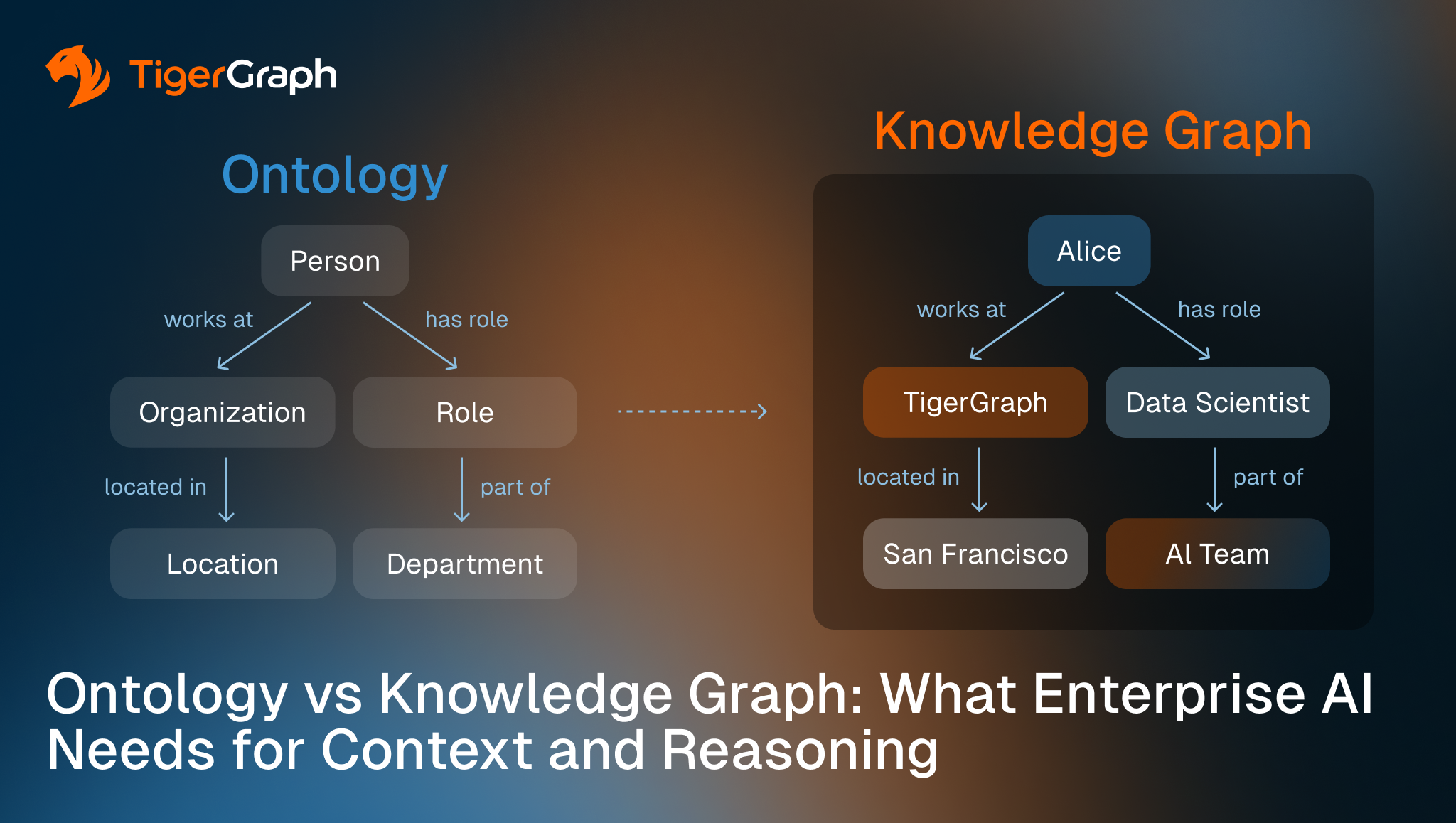
A knowledge graph represents real enterprise entities and the relationships between them as a connected, queryable network. Where an ontology defines that a customer can own an account, a knowledge graph records that Robin Lee owns Account 84729. A knowledge graph operationalizes the conceptual data model of an ontology by populating it with actual business data, making the relationships directly queryable, traceable, and available to AI systems in real time.
Ontology and knowledge graphs are closely related, but they serve different purposes. An ontology defines the meaning and structure of a domain, whereas a knowledge graph represents that structure using actual data.
For example, an ontology might define:
Customer → owns → Account
A knowledge graph can then populate that relationship with real entities:
Customer: Robin Lee → owns → Account: 84729
The ontology provides the conceptual data model, while the knowledge graph provides the populated, queryable representation. An ontology, therefore, provides the semantic foundation for a knowledge graph rather than an alternative to one.
The distinction can be summarized:
- Ontology: Defines what concepts and relationships mean.
- Knowledge graph: Represents the actual entities and relationships that exist.
- Ontology + knowledge graph: Combines semantic meaning with real-world connected data.
When Do Enterprises Need Each?
Use an ontology when the primary requirement is consistent terminology and shared meaning across systems. This is particularly valuable when AI applications cross departmental boundaries: when a risk system, CRM, and finance application all use the term “account” differently, an ontology resolves that ambiguity.
Use a knowledge graph when decisions depend on how specific entities connect. Fraud investigation, entity resolution, supply chain disruption analysis, and agentic AI all require following chains of real relationships, not just knowing what those relationships are allowed to be.
Most enterprise AI architectures benefit from both. The ontology establishes the conceptual language. The knowledge graph turns that language into operational, queryable enterprise knowledge.
Why Enterprise AI Needs Both Ontology and Knowledge Graph
In practice, when an enterprise AI agent is asked why a certain transaction was flagged as suspicious, the answer may lie in connecting several pieces of information:
Transaction → Customer → Account → Device → Merchant → Previous transactions → Risk signals → Fraud policy
A traditional retrieval system may retrieve documents describing fraud policies or the transaction itself, but that does not necessarily explain how the different entities are connected.
If an organization has only an ontology, it can define what a customer, account, transaction, device, and risk signal mean, but it does not contain the organization’s actual transaction relationships. The knowledge graph provides that missing layer by connecting the ontology’s concepts to real enterprise data.
As a schema-first property graph, TigerGraph supports ontology design with defined entity and relationship types, and strong language support to govern relationship constraints and requirements.
When data is then ingested into TigerGraph, it becomes an ontology-governed knowledge graph. It makes connected context usable across systems, particularly when AI questions depend on relationships rather than isolated pieces of information.
Where Traditional AI Approaches Fall Short
Traditional retrieval-augmented generation (RAG) typically retrieves documents or text chunks based on semantic similarity. It works well when the question can be answered from a relatively self-contained passage, but enterprise questions often require information spread across multiple documents, databases, applications, and business systems.
For instance, if an organization needs to assess which customers will be affected by a supplier’s disruption, the answer may require connecting customers, products, orders, suppliers, manufacturing facilities, geographic locations, disruption events, and the relationships between them.
Finding individually relevant documents is not necessarily enough. The AI needs to understand how these entities are connected. This is how TigerGraph’s GraphRAG extends traditional RAG: instead of retrieving only semantically similar content, GraphRAG can retrieve entities, relationships, and connected context from a knowledge graph to provide traceable, multi-level conclusions.
Ontology vs Knowledge Graph: A Comparison Table
| Industry | Ontology Alone | Knowledge Graph Alone | Knowledge Graph + Ontology |
| Supply chain | Defines concepts such as Supplier, Component, Facility, Product, Shipment, and Disruption, and how they should relate. | Connects suppliers, products, components, facilities, shipments, and dependencies. Enables multi-step relationship analysis of disruption effects. | Provides both semantic meaning and a live dependency network. AI can understand what a supplier or component represents and trace how disruption propagates across multiple tiers. |
| Cybersecurity | Defines User, Device, Threat, Vulnerability, Permission, and Attack and their semantic relationships. | Connects users, devices, applications, vulnerabilities, alerts, identities, and infrastructure to analyze attack paths. | Gives AI both security context and connected evidence, helping it distinguish entity types while investigating threats and potential attack paths. |
| Financial services | Defines Customer, Account, Transaction, Beneficial Owner, Counterparty, and Sanctioned Entity. | Connects customers, accounts, transactions, merchants, devices, addresses, organizations, and regulatory entities. | Combines semantic consistency with real-world relationships, helping AI understand what entities are, how they connect, and why those connections matter. |
| Risk and fraud | Defines Risk Event, Fraud Pattern, Actor, Transaction, Alert, and Investigation. | Reveals patterns across accounts, transactions, devices, locations, merchants, identities, and historical events. | Combines domain rules with connected evidence, allowing AI to interpret risk concepts while following the relationships that support an investigation. |
The key distinction: an ontology tells AI what a relationship means, while a knowledge graph shows which relationships actually exist.
From Semantic Models to AI Reasoning: A Case for GraphRAG
The most effective enterprise AI architecture does not require choosing one technology over another. Enterprises can combine semantic models, knowledge graphs, vector retrieval, and LLMs through GraphRAG.
TigerGraph’s GraphRAG is designed for use cases where relationship-aware context is important. While traditional RAG retrieves content primarily based on semantic similarity, GraphRAG incorporates relational information, enabling retrieval to account for how entities and concepts relate to one another.
TigerGraph’s knowledge graph can represent models such as Customer → purchases → Product with millions or billions of actual customers, products, and purchase relationships. This allows organizations to move from a conceptual data model created through ontology engineering to an operational knowledge layer that AI applications can query.
The Future of Enterprise AI Lies in Context
As enterprises adopt more AI applications, access to an LLM is becoming less of a differentiator. The more difficult challenge is providing AI with reliable, relevant, and organization-specific context.
An enterprise AI assistant that only retrieves documents may answer questions reasonably well, but an AI system that understands how customers, products, transactions, policies, systems, and events relate to one another can support much more complex workflows.
The ontology establishes the conceptual language of the organization. The knowledge graph turns that language into connected, queryable enterprise knowledge. GraphRAG then makes that knowledge available as context during AI retrieval and generation.
Ready to build your enterprise knowledge layer? Start with TigerGraph’s free tier or request a demo.
FAQs
What is the difference between ontology and knowledge graph?
An ontology defines the concepts in a domain, the types of relationships between those concepts, and rules that govern how they can interact. A knowledge graph stores actual entities and relationships based on that structure: for example, which specific customer owns which specific account. The ontology provides the semantic data model; the knowledge graph populates it with real business facts.
Does a knowledge graph require an ontology?
Every collection of data should follow some organizational plan, but the degree of semantic definition and formality depend on the use case. When we say “ontology”, we usually mean that the data’s structural and relationship rules can exist on their own, separate from and prior to the data. The appropriate level of formality depends on how much semantic consistency the application requires, how many systems need to share the same terminology, and how much machine reasoning the AI workflow involves.
What is ontology engineering and why does it matter for enterprise AI?
Ontology engineering is the process of designing, developing, and governing the conceptual data model that defines a domain. It matters for enterprise AI because AI systems that operate across multiple departments or data sources need a consistent understanding of what terms such as “customer,” “account,” or “risk event” mean. Without that shared model, an AI system may interpret the same concept differently across systems, reducing the reliability of its conclusions.
How does TigerGraph support ontology and knowledge graph for enterprise AI?
TigerGraph’s schema-first approach gives ontology engineers support for entity and relationship types, plus the capability to govern some relationship constraints and requirements. It operationalizes the knowledge graph layer by connecting actual customers, transactions, suppliers, products, systems, documents, and events as a connected, queryable network. TigerGraph combines graph and vector capabilities to support GraphRAG architectures that need both semantically relevant unstructured content and relationship-aware context from connected enterprise data. This is particularly valuable for fraud detection, entity resolution, customer intelligence, supply chain risk, and agentic AI workflows.
What is GraphRAG and how does it use a knowledge graph?
GraphRAG is a retrieval architecture that uses a knowledge graph as part of the context retrieval process rather than relying solely on semantic similarity search. Instead of returning text chunks that are mathematically similar to a query, GraphRAG retrieves relevant entities and the relationships connecting them, providing the AI with a structured, traceable context grounded in how the business actually works. TigerGraph’s GraphRAG capabilities are designed for enterprise deployments where relationship-aware retrieval and explainable AI conclusions are operational requirements.