
Summary
- Taxonomy, ontology, and knowledge graph are three different layers of structure that solve different problems. They are most powerful when used together rather than treated as interchangeable alternatives.
- A taxonomy organizes concepts into categories and improves classification, routing, and retrieval across content systems. It captures hierarchy but not complex relationships between specific entities.
- An ontology defines what concepts mean, how they can relate, and what rules apply, providing shared semantic consistency across systems that use different terminology for the same entities.
- A knowledge graph stores the actual enterprise entities and the relationships between them as connected, queryable data, enabling AI systems to reason from “Which document mentions this supplier?” to “What parts of the business depend on this supplier?”
- For GraphRAG and agentic AI, knowledge graphs are the layer that provides relationship-aware retrieval and connected context, working alongside vector search and semantic classification rather than replacing them.
Enterprise AI systems do not fail only because they lack data. They often fail because the data is poorly organized, inconsistently defined, or disconnected from the relationships that give it meaning.
That is why three concepts increasingly appear in enterprise AI architecture discussions: taxonomy, ontology, and knowledge graph. They are related, but they solve different problems.
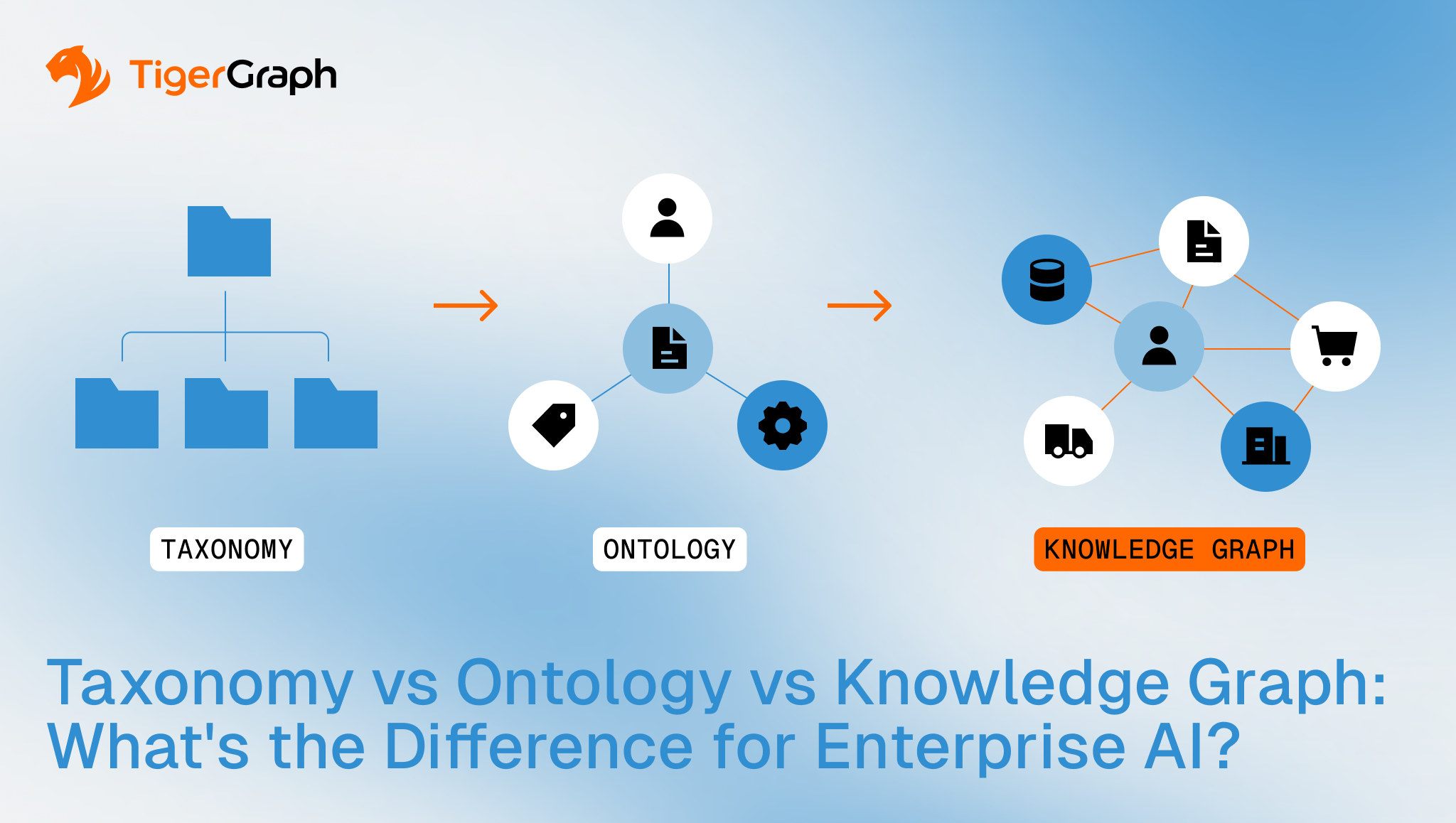
A taxonomy organizes concepts into hierarchical categories. An ontology defines what those concepts mean and how they can relate. A knowledge graph connects the actual customers, suppliers, products, policies, transactions, and events that an AI system needs to understand.
For enterprise teams, the practical question is not which term is more sophisticated. It is which layer of structure the AI system needs to answer questions accurately, retrieve the right context, and support explainable decisions.
You’ll learn:
- What distinguishes taxonomy, ontology, and knowledge graph, and why the distinction matters for enterprise AI
- What each approach can and cannot represent, illustrated with a concrete supply chain scenario
- How the three layers work together in GraphRAG and agentic AI workflows
- When enterprises need one layer, two, or all three, and how TigerGraph operationalizes the knowledge graph layer
What Is a Taxonomy?
A taxonomy is a hierarchical classification structure that organizes concepts into broader and narrower categories. It answers the question “Where does this belong?” and helps AI systems route queries, filter results, and apply consistent metadata across content collections. A taxonomy captures hierarchy but does not define multiple types of relationships or represent the actual entities and facts in a business.
A manufacturer, for example, might organize products like this:
Products
- Electronics
- Semiconductors
- Sensors
- Industrial Equipment
- Pumps
- Compressors
This structure answers a straightforward question: Where does something belong?
Enterprises use taxonomies for product catalogs, document management, metadata, data catalogs, search navigation, and content classification. They can also help AI systems route questions toward the right source. A query about centrifugal pumps, for example, can be directed toward content classified under Industrial Equipment > Pumps instead of searching every available document.
That consistency improves retrieval, but a taxonomy captures only a narrow type of meaning.
A pump may be manufactured by a supplier, installed at a facility, covered by a service agreement, made from specific components, and affected by a recall. A hierarchy cannot represent all of those relationships well. That is where ontology becomes useful.
What Is an Ontology?
An ontology formally specifies the concepts in a domain, the types of relationships between those concepts, and rules that constrain how they can interact. It answers the question “What does this mean, and how can it relate to other things?” An ontology provides shared semantic meaning across systems that use different terminology for the same entities: for example, distinguishing “customer,” “account,” and “legal entity” as distinct concepts with defined relationships between them.
An ontology defines the concepts in a domain, the relationships between those concepts, and, when needed, rules that constrain how the concepts can be used.
Consider the same manufacturer. Instead of organizing products only by category, the company defines concepts such as:
- Supplier
- Component
- Product
- Facility
- Market
It then defines relationships:
- Supplier supplies Component
- Component is used in Product
- Product is manufactured at Facility
- Product is sold in Market
The ontology describes the relational structure of concepts of the domain. This is the central distinction in taxonomy vs ontology. A taxonomy might state that a semiconductor is a type of electronic product. An ontology can also define that a semiconductor may be supplied by a supplier, incorporated into a product, manufactured at a facility, and subject to a compliance requirement.
For enterprise AI, that shared semantic data model matters because data often comes from systems that use different names or assumptions for the same concept.
Consider “customer.” One system may define the customer as an account. Another may treat a legal entity as the customer. A third may store individual contacts. An ontology can distinguish those concepts and define how they relate, reducing ambiguity when AI applications combine information across systems.
However, an ontology still describes what relationships are possible. It does not necessarily store the current facts about which specific entities are connected.
That is the role of a knowledge graph.
What Is a Knowledge Graph?
A knowledge graph stores actual business entities and the relationships between them as a connected, queryable network. It answers the question “What is connected to what, right now?” Where an ontology defines that a supplier can supply a component, a knowledge graph records that Acme Sensors currently supplies TS-400 Temperature Sensor to ColdChain Monitor X2 at Dallas Plant. Knowledge graphs are purpose-built for applications where relationships between specific entities determine the answer.
The ontology supplies the semantic data model. The knowledge graph supplies the operational data.
As new suppliers, contracts, shipments, customers, incidents, and products appear, the graph can keep incorporating those relationships.
This is why knowledge graphs are increasingly relevant to enterprise AI. AI applications often need more than definitions or similar documents. They need current context about specific entities and how those entities affect one another.
Taxonomy vs Ontology vs Knowledge Graph at a Glance
| Taxonomy | Ontology | Knowledge Graph | |
| Primary purpose | Organize and classify concepts | Define concepts, relationships, and rules | Represent connected enterprise facts |
| Typical structure | Hierarchical categories | Semantic data model with multiple relationship types | Network of entities and relationships |
| Answers | “Where does this belong?” | “What does this mean, and how can it relate?” | “What is connected to what?” |
| Typical content | Categories, topics, product classes | Classes, properties, constraints | Customers, suppliers, products, transactions, documents, events |
| Enterprise AI value | Consistent classification and routing | Shared meaning and semantic consistency | Relationship-aware retrieval, reasoning, and explainability |
Taxonomy organizes concepts, ontology defines concepts and relationships, and knowledge graphs connect real enterprise entities and facts. These are complementary capabilities, not interchangeable terms.
How Taxonomies, Ontologies, and Knowledge Graphs Work Together for Enterprise AI
The three approaches are most useful when enterprises treat them as complementary layers.
Taxonomy provides consistent classification
AI systems retrieve information from policies, catalogs, contracts, CRM records, tickets, operational systems, and technical documentation. If each source uses different categories, retrieval becomes harder to control.
A taxonomy gives those systems a consistent classification structure. It can improve filtering, routing, navigation, and metadata quality before an AI application retrieves content.
Ontology provides consistent meaning
Classification does not resolve semantic ambiguity. An ontology defines what business concepts mean and how they relate.
That becomes important when AI applications cross departmental boundaries. A risk system, CRM platform, and finance application may all use the term “account” differently. An ontology creates a shared semantic data model that helps systems interpret those distinctions consistently.
Knowledge graph provides connected context
A knowledge graph connects the actual entities an AI system needs to analyze.
Instead of retrieving isolated records about a supplier, an AI system can connect that supplier to components, facilities, contracts, shipments, incidents, alternate suppliers, and affected products.
This changes the question from “What information mentions this supplier?” to “What parts of the business depend on this supplier, and what could be affected?”
That difference is critical for enterprise AI systems that must support decisions rather than simply retrieve documents.
Why This Matters for GraphRAG
Traditional retrieval-augmented generation often retrieves text based on semantic similarity. That works well when the answer is contained in a relevant document.
But many enterprise questions are relationship questions. For example: Which active customers could be affected by suppliers connected to facilities with an unresolved compliance issue?
Answering that question may require combining supplier records, facilities, product data, customer relationships, contracts, and compliance events. Similarity search alone does not encode those dependencies.
GraphRAG adds relationship-aware retrieval by using a knowledge graph as part of the retrieval process. Instead of returning only semantically similar text, the system can retrieve relevant entities and the business relationships that connect them.
Taxonomies can help classify information. Ontologies can standardize meaning. Knowledge graphs can provide the connected facts needed to ground the response.
Vector search can still play an important role by finding relevant unstructured content. The difference is that semantic similarity and relationship intelligence work together instead of competing as separate approaches.
What About Agentic AI?
The distinction becomes even more important when AI systems move from answering questions to planning and taking actions.
An agent deciding whether to escalate supplier risk, investigate suspicious activity, or recommend an alternative product needs to understand more than the text in a document. It needs to know which entities are involved, how they are connected, what policies apply, and what downstream effects an action may create.
A taxonomy can help classify the information. An ontology can establish the meaning and allowable relationships. A knowledge graph can provide the current enterprise context the agent needs to evaluate the situation.
This is the practical role of relationship intelligence in agentic AI: supporting decisions with connected enterprise data rather than isolated records.
Do Enterprises Need All Three?
Not always.
Use a taxonomy when the main requirement is consistent classification. Product catalogs, document collections, metadata systems, and content repositories often benefit from a well-designed taxonomy without needing a more complex semantic data model.
Add an ontology when systems need shared definitions, richer relationship types, or formal rules. This is especially useful when data from different departments or applications uses inconsistent terminology for the same real-world concepts.
Use a knowledge graph when decisions depend on relationships between real enterprise entities. Fraud detection, customer intelligence, supply chain analysis, cybersecurity, entity resolution, and GraphRAG all rely heavily on understanding how records connect.
Many enterprise architectures use elements of all three without turning each into a separate platform. The goal is not to create the most elaborate knowledge data model possible. It is to create enough structure and connected context to support the decisions the application must make.
How TigerGraph Supports Ontology and Knowledge Layer Needs for Enterprise AI
TigerGraph is designed for enterprise applications where understanding relationships across large, highly connected datasets is central to the business problem.
TigerGraph’s schema-first approach is well suited for modeling ontologies that need to define how different concepts relate to one another and to include some relationship constraints.TigerGraph operationalizes the knowledge graph layer by connecting the actual customers, transactions, suppliers, products, systems, documents, and events represented by those concepts.
For enterprise AI, TigerGraph combines graph and vector capabilities so organizations can use semantic similarity alongside relationship intelligence. This supports GraphRAG architectures that need both relevant unstructured content and connected enterprise context.
Ready to build connected enterprise AI? Start with TigerGraph’s free tier or request a demo.
FAQs
What is the difference between taxonomy and ontology?
A taxonomy organizes concepts into hierarchical categories. An ontology defines concepts more formally and describes multiple types of relationships, properties, and rules between them. A taxonomy answers “Where does this belong organizationally?” while an ontology answers “What does this mean and how can it relate to other things?”
Is a taxonomy an ontology?
Not usually in practical enterprise usage. A taxonomy handles only one type of relationship: “has a subcategory of”. An ontology supports multiple relationships and therefore a richer diversity of concepts. All taxonomies can be described using ontology languages, but not all ontologies are limited to simple hierarchical classification.
What is the difference between a knowledge graph and an ontology?
An ontology defines the conceptual data model of a domain: what concepts exist and how they can relate. A knowledge graph stores actual entities and relationships based on that data model, such as which specific supplier supplies which specific component at a given facility. The ontology defines the possible; the knowledge graph records the actual.
Does a knowledge graph need an ontology?
Not always. Some knowledge graphs use formal ontologies as their semantic foundation, while others use simpler data models and typed relationships. The appropriate level of formalism depends on how much machine reasoning the application needs, governance requirements, and the complexity of the domain being modeled.
Why are knowledge graphs useful for enterprise AI?
Knowledge graphs give AI systems connected context about real enterprise entities. That can improve GraphRAG, fraud investigation, entity resolution, customer intelligence, supply chain analysis, and other applications where relationships between specific entities affect the answer, including situations where the answer must be explainable and traceable, not just plausible.