
Summary
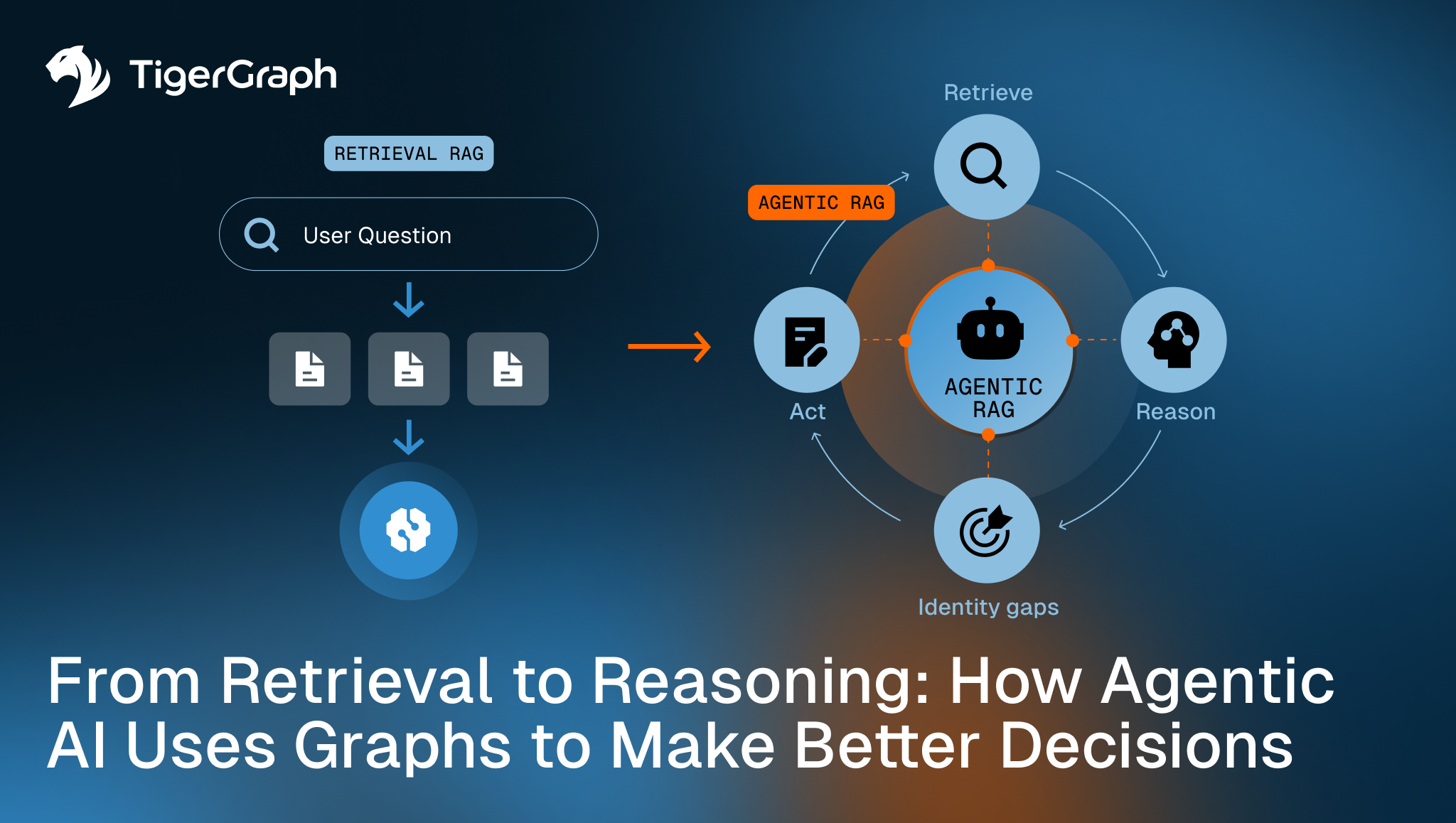
- Retrieval finds relevant content through semantic similarity; reasoning draws conclusions by following chains of connected evidence. Most enterprise AI agents do the first well and the second poorly.
- Flat retrieval produces three compounding failures in agentic systems: shallow answers, repeated retrieval loops, and hallucinated connections.
- Graph databases solve this structurally by storing entities and relationships as first-class, queryable data that agents can reason across directly.
- Enterprise scenarios in fraud detection, supply chain operations, cybersecurity, and knowledge management all require multi-step relational reasoning that semantic similarity alone cannot provide.
- TigerGraph powers graph-based agentic reasoning through relationship-aware retrieval, adaptive memory, traceable decision paths, and hybrid graph and vector search.
Most enterprise AI agents are competent at retrieval but weak at reasoning because their retrieval layer does not reflect how data is actually related. The limitation is often architectural rather than model-driven. Even highly capable language models can reason only over the context they receive. When the retrieval layer is flat, the reasoning layer inherits that flatness: agents produce shallow answers, repeat redundant queries, or hallucinate connections that are not in the data.
Graph databases close this gap by structuring enterprise data as connected relationships that agents can query and reason over directly. Agentic reasoning, the ability to form conclusions by chaining together multiple steps of evidence, becomes possible when the retrieval layer reflects actual entity relationships rather than approximating them through text similarity.
You’ll learn:
- What agentic reasoning actually requires and why flat retrieval cannot deliver it
- How graph structure enables multi-hop reasoning, entity disambiguation, and explainability
- Which enterprise scenarios expose the gap between retrieval and reasoning most clearly
- How TigerGraph makes graph-based agentic reasoning production-ready
What Agentic Reasoning Actually Requires
Agentic AI reasoning is the ability of an AI agent to form conclusions by chaining together multiple steps of evidence, not by retrieving a single best-matching passage. Retrieval supplies evidence. Reasoning transforms that evidence into decisions. Many current agentic architectures emphasize retrieval while relying on the language model itself to reconstruct the relationships needed for reasoning.
To reason rather than just retrieve, agents need structured context organized into entities and relationships that capture how those entities connect, available in real time. That context must solve four core challenges. Each challenge requires preserving relationships between pieces of information rather than simply retrieving those pieces independently.
- Multi-hop evidence chains: conclusions that require connecting facts across multiple related entities. “Which accounts are two steps removed from this flagged entity and have transacted in the past 30 days?” cannot be answered by retrieving documents about individual accounts.
- Entity disambiguation: distinguishing between entities that appear similar without their relational context, for example two suppliers with the same name operating in different regions. Semantic similarity surfaces both; relationship context separates them.
- Temporal and causal sequencing: understanding what happened before what and which events caused which outcomes. This requires structured event relationships, not document retrieval ranked by similarity.
- Explainable justification: producing a traceable chain of evidence that explains both the conclusion and the relationships supporting it. In regulated industries, this is a compliance requirement.
None of these can be met by semantic similarity alone. They require structured, queryable relationship data, which is what graph databases provide.
Why Flat Retrieval Limits Agent Reasoning
Vector search is exceptionally effective at finding semantically similar content, but it is not designed to retrieve explicit relationship structures between entities.
An agent reasoning through a supply chain disruption needs to know that Supplier A feeds Component B, which goes into Product C, contracted to Customer D. That is a causal chain of relationships. Flat retrieval primarily returns semantically relevant documents, leaving the agent to reconstruct relationship chains through additional reasoning or retrieval.
This structural gap produces three compounding failure modes:
- Shallow reasoning: the agent answers based on surface-level text matches rather than following the actual evidence chain.
- Repeated retrieval loops: without connected context, agents re-query the same sources repeatedly, trying to assemble relationships the retrieval layer cannot provide.
- Hallucinated relationships: when explicit relationship evidence is unavailable, agents may infer connections that are plausible but unsupported by the retrieved data.
TigerGraph’s agentic AI addresses this not by finding a better retrieval algorithm but by supporting a retrieval layer that stores and serves relationships as first-class data, cutting the repeated loop problem at its source.
How Graph Structure Enables Deeper Reasoning
Graph databases store entities (people, products, events, systems) and their relationships as structured, queryable data rather than as text to be interpreted. When an agent retrieves context from a graph, relationships are explicit in the data. The agent relies less on inference because the relationship structure is already represented explicitly within the retrieved context.
This enables three reasoning capabilities that flat retrieval cannot provide:
- Multi-hop path reasoning: agents can follow a chain of relationships from one entity to another across multiple steps. A single connected query can answer “who supplies the component that failed, who else buys it, and what contracts are at risk?” without multiple retrieval cycles.
- Entity relationship context: each entity arrives with its full relational context. An agent reasoning about a transaction knows the account’s history, network connections, and behavioral patterns without separate lookups.
- Real-time operational state: graph databases reflect live enterprise data, so agents reason over current relationships rather than a static snapshot from weeks ago.
With GraphRAG, TigerGraph combines knowledge graphs, vector search, and real-time enterprise data. Hybrid graph and vector retrieval combines semantic relevance with relationship-aware context within the same retrieval workflow, allowing agents to reason over both meaning and structure.
Enterprise Reasoning Scenarios: Where Graph Context Changes the Answer
Although the domains differ, every scenario requires connecting evidence across multiple entities before a reliable decision can be reached.
| Scenario | Flat retrieval | Graph reasoning | Graph results |
| A fraud investigation agent needs to determine whether a transaction is part of a coordinated ring, not just an isolated anomaly. | The agent returns articles about fraud patterns based on semantic matching. | The agent has access to the actual relationship network: shared accounts, devices, and timing patterns to reason across. | The agent traces the path of suspicious activity across connected entities and produces an explainable finding rather than a probabilistic score. |
| A supply chain agent needs to assess downstream impact when a key supplier goes offline. | The agent surfaces general supply chain content. | The agent follows the actual dependency chain to see which components, products, customers, and contracts are affected. | The agent produces a prioritized impact assessment grounded in real operational relationships, not a generic risk summary. |
| An IT and network operations agent investigating a potential breach needs to identify how far an intrusion may have spread. | The agent retrieves documents related to compromised systems and accounts, but surfaces no evidence connecting them. | The agent reasons across network topology to identify which systems connect to which, which credentials are shared, and what data could have been accessed. | The reasoning surfaces traceable decision paths that security teams can audit and act on, not a black-box alert. |
| An enterprise knowledge agent answering a complex internal query needs to synthesize information from multiple connected systems. | The agent searches repositories and retrieves the most relevant documents, but surfaces no connections between them. | The agent follows connections between people, teams, projects, products, and policies to produce an accurate, explainable answer. | Graph-assembled context enables the agent to reason across connected entities and produce a precise, sourced answer rather than a plausible-sounding approximation. |
Although these scenarios span different industries and functions, they share one characteristic: the answer requires understanding how entities connect. Graph-enabled retrieval provides that context.
How TigerGraph Powers Agentic AI Reasoning
TigerGraph extends document retrieval with relationship-aware retrieval, allowing agents to work with richer connected context throughout the reasoning process. . Because retrieved context reflects the actual structure of enterprise data, agents complete complex workflows in fewer cycles: each retrieval pass is richer, which means less repetition and fewer opportunities for the reasoning chain to degrade.
TigerGraph also supports architectures in which agents maintain adaptive memory. Rather than starting from scratch at each step, they store and retrieve structured knowledge about prior decisions and relationships discovered across a session. Earlier findings constrain and inform later retrieval, which is what allows agents to build toward a conclusion rather than circling one.
Because TigerGraph’s relational context is explicit rather than inferred, reasoning paths are traceable. Audit trails show exactly how an agent moved from retrieved data to a conclusion, a requirement in regulated industries where AI-generated answers must be verifiable before they can be acted on.
TigerGraph also connects to popular AI frameworks and language models through MCP server integration, so agents in existing stacks can access graph context without rebuilding pipelines. With TigerGraph’s GraphRAG, knowledge graph agentic reasoning draws on both vector search and real-time enterprise data together.
From Retrieval to Reasoning: Closing the Gap
Retrieval searches for content. Reasoning follows connections. The gap between them is structural, not a model problem. Model improvements alone are unlikely to close this gap because the limitation originates in the structure of retrieved context rather than in reasoning capability itself. . What closes it is a retrieval layer designed for multi-hop relational reasoning, one that stores relationships as first-class data rather than approximating them through text similarity.
Graph databases provide that layer. When agents retrieve from a graph, relationships are explicit, reasoning paths are traceable, and context reflects the current operational state of the enterprise. Agents that previously relied on inferred connections can instead reason over explicit evidence chains grounded in retrieved relationships.
For enterprises deploying AI in fraud detection, cybersecurity, supply chain management, or customer intelligence, for many enterprise AI workloads, this becomes one of the architectural decisions that most directly influences whether agents produce reliable, explainable decisions at production scale.
Explore TigerGraph’s agentic AI to see how graph-based reasoning works in production. To run it against your own data, request a demo or start with a free trial.
FAQs
What is the difference between retrieval and reasoning in agentic AI?
Retrieval is the process of finding relevant content based on semantic similarity to a query. Reasoning is the ability to form conclusions by chaining together multiple steps of evidence. Most enterprise AI agents handle retrieval adequately but struggle with reasoning because their retrieval layer returns isolated document chunks rather than connected entity relationships. When an agent cannot retrieve explicit connections, it either repeats retrieval cycles trying to assemble them or infers them incorrectly, which produces hallucinated conclusions.
Why does flat retrieval fail for multi-step enterprise questions?
Flat retrieval returns semantically similar documents; it cannot follow explicit relationships between entities. Enterprise questions that require multi-step reasoning, such as “which accounts are connected to this flagged entity through two transaction layers?” or “which downstream orders depend on this disrupted supplier?”, need relationship data, not document similarity scores. The structural gap produces three failure modes: shallow answers based on surface-level text matches, repeated retrieval loops as agents re-query the same sources, and hallucinated connections when agents infer relationships the data does not contain.
How do graph databases enable better agentic reasoning?
Graph databases store entities and relationships as structured, queryable data rather than text to be interpreted. When an agent retrieves from a graph, relationships are explicit in the retrieved context: the agent does not need to infer them from word co-occurrence. This enables multi-hop path reasoning across multiple entity layers in a single query, full relational context for each retrieved entity, and real-time accuracy because graph databases reflect live operational data rather than static document snapshots.
Does TigerGraph support explainable agentic AI?
Yes. Because TigerGraph’s relational context is explicit rather than inferred, the reasoning paths agents follow are traceable. Audit trails can show exactly how an agent moved from retrieved data to a conclusion, including which entities and relationships were involved at each step. This is a specific requirement in regulated industries (financial services, healthcare, government) where AI-generated answers must be verifiable before they can be acted on. TigerGraph’s traceability addresses this directly rather than treating explainability as a reporting layer added after the fact.
Which enterprise use cases benefit most from graph-based agentic reasoning?
The strongest candidates are use cases where the answer requires connecting facts across multiple entities and systems. Fraud investigation (tracing coordinated transaction networks), supply chain disruption response (following dependency chains from disrupted supplier to affected customer orders), cybersecurity threat analysis (connecting indicators of compromise across users, devices, and network events), and enterprise knowledge management (synthesizing information across organizational structures, products, and policies) all share this characteristic. In each case, flat retrieval surfaces relevant documents but cannot assemble the relational evidence chain the agent needs to reach a reliable conclusion.