
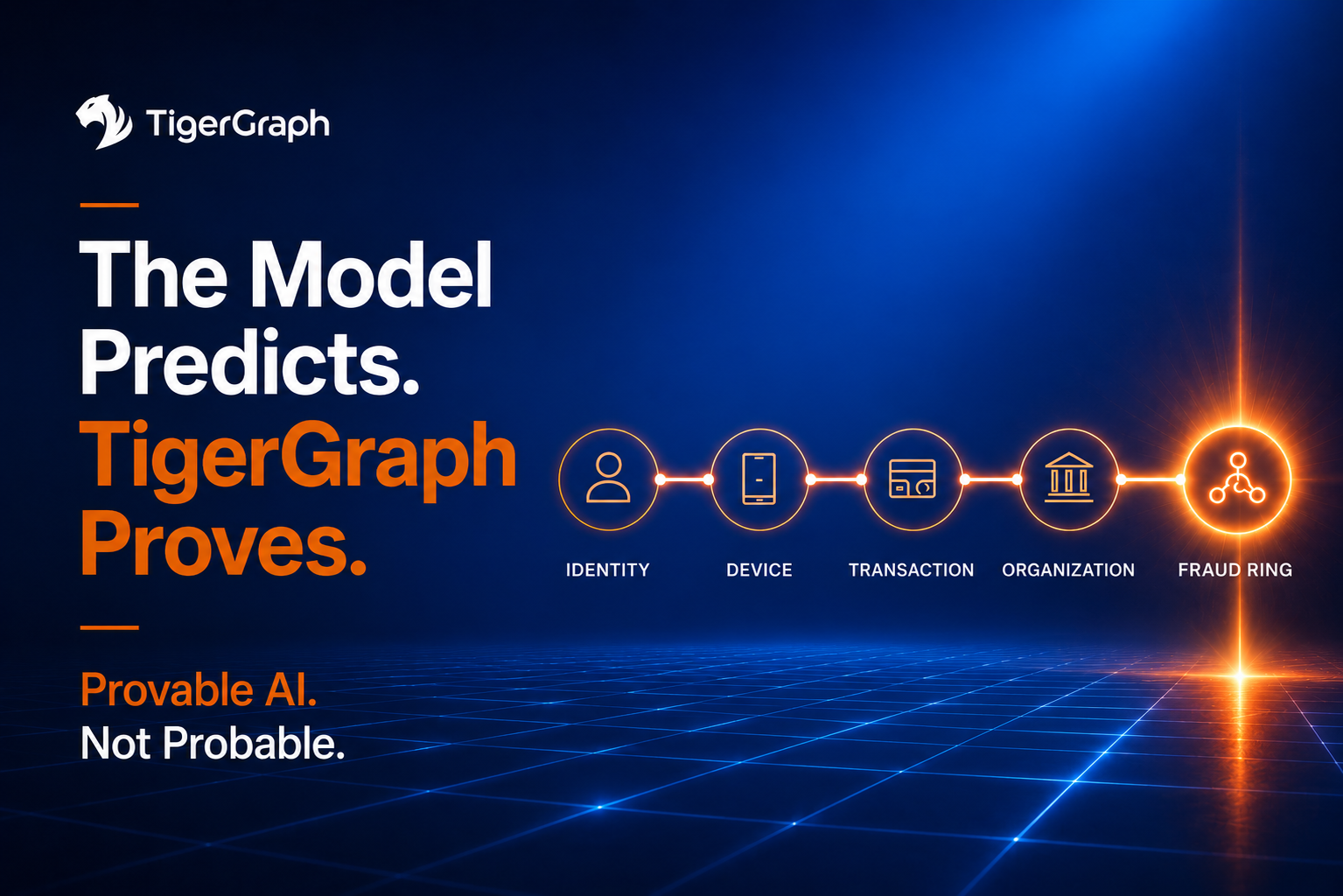
The Model Predicts. TigerGraph Proves.
AI Has a Confidence Problem. The AI industry talks constantly about intelligence. Very little about proof. That imbalance is becoming more dangerous as AI systems move closer to operational decision-making.
Because enterprise systems do not fail when answers sound uncertain. They fail when answers sound convincing without being verifiable. That is the real tension underneath the current AI cycle. The models became remarkably good at generating language. The systems surrounding them did not become equally good at preserving truth.
That imbalance is now becoming one of the defining architecture problems inside enterprise AI. Most enterprises still believe the competitive advantage will come from: bigger models, more agents, larger context windows, and faster generation.
That may define the current AI cycle. It will not define the next one. Because eventually every enterprise discovers the same thing: confidence scales faster than proof.
The Industry Optimized for Generation Before It Solved Verification
The current AI stack is exceptionally good at generating plausible answers.
- Retrieve information
- Assemble context
- Generate output
At small scale, this feels remarkably effective. But enterprise systems do not operate at small scale. They operate across: identities, transactions, workflows, organizations, decisions, and time. That is where the instability begins appearing. Because most AI systems today reconstruct understanding dynamically every time they reason. The outputs still sound intelligent. The reasoning underneath them becomes increasingly difficult to reproduce consistently.
Nothing fully breaks.
The system simply becomes harder to prove. That is the hidden weakness underneath much of enterprise AI right now: the systems generate confidence faster than they generate verification. And once AI systems begin chaining decisions together through agents, workflows, approvals, and autonomous reasoning, the verification gap compounds faster than most architectures can contain.
Retrieval Finds Proximity. Relationships Preserve Truth.
The modern AI stack increasingly behaves as if retrieval and understanding are interchangeable. They are not. McKinsey described the distinction directly: “Retrieval finds proximity. It does not create understanding. Understanding emerges from relationships.” That distinction quietly exposes the weakness underneath much of the current AI stack. Retrieval assembles fragments. Relationships preserve meaning. Reality itself is relational.
Fraud only makes sense in the context of connected entities. Identity only becomes meaningful across linked behaviors. Risk only emerges through patterns across accounts, devices, organizations, and time.
But most AI systems flatten those relationships into temporary retrieval events and ask models to reconstruct understanding afterward. That reconstruction process becomes unstable at enterprise scale. Because the AI is no longer reasoning over connected reality. It is reasoning over probabilistic approximations of reality assembled dynamically at query time. That distinction becomes increasingly dangerous once AI systems begin influencing operational decisions instead of informational ones.
Because enterprises do not merely need plausible reasoning. They need provable reasoning.
Synthetic Intelligence Scales Faster Than Verification
One of the more revealing observations in the broader AI slop discussion is how quickly synthetic systems scale once verification becomes optional. RMIT’s Information Integrity Hub framed the issue bluntly: synthetic content is becoming cheaper than truth.
That same pattern is beginning to emerge inside enterprise AI systems. Generated reasoning scales easily. Provable reasoning is much harder. That imbalance becomes structural once organizations begin deploying AI into operational workflows. Because synthetic reasoning compounds. Verification does not.
And once organizations begin chaining AI systems together through agents, workflows, and autonomous actions, the verification gap expands faster than most architectures can contain. This is where the economics of enterprise AI begin changing. The bottleneck is no longer generation. The bottleneck becomes provability.
Not: “Can the AI produce an answer?” But: “Can the organization defend how the answer was produced?” That becomes a fundamentally different infrastructure requirement.
Provability Becomes the Moat
The AI industry still treats the model as the center of the system. Increasingly, the model is only one layer. The harder problem is preserving connected understanding as systems reason across entities, workflows, agents, decisions, and time. That requires something most AI stacks still struggle to preserve: relationships. Because proof does not emerge from isolated outputs. Proof emerges when reasoning remains connected to the structure underneath reality itself. This is where TigerGraph operates differently.
TigerGraph keeps relationships structurally intact while AI systems reason. The context does not need to be reconstructed every time the system operates. The structure already exists underneath the decision itself. That changes the behavior of the entire system. Reasoning paths remain traceable. Operational context remains connected. Decisions remain explainable across workflows and time. The AI stops approximating understanding. It starts preserving it.
That distinction becomes increasingly strategic as model intelligence commoditizes. Because eventually every enterprise reaches the same realization: the competitive advantage is not the model alone. The advantage is whether the enterprise can preserve trust while the AI scales.
The Future Enterprise Stack Will Be Built Around Proof
The first phase of enterprise AI optimized for generation. The next phase will optimize for provability. That changes the architecture conversation entirely. The winning systems will not simply generate more outputs faster. They will preserve connected understanding structurally as reasoning compounds across: identities, decisions, transactions, workflows, agents, and time.
This is where relationship-preserving architectures become foundational instead of optional. Because relationships are not supplementary context. They are the structure underneath operational reality itself. And once enterprises begin deploying AI into: fraud operations, identity systems, compliance workflows, customer operations, and autonomous reasoning systems, the ability to prove why a decision was reached becomes as important as the decision itself.
That is the next AI moat emerging underneath enterprise infrastructure now. Not generation. Provability.
The Next AI Race Will Not Be About Models
The first phase of AI optimized for generation. The next phase will optimize for provability. Because eventually every enterprise reaches the same realization: a system that cannot preserve connected understanding eventually becomes impossible to trust operationally. No matter how intelligent the outputs sound.
The model predicts. TigerGraph proves.