
Summary
- The AI explainability problem is a data infrastructure problem, not a model problem. When an AI system cannot explain its decision, it is almost always because the data it reasoned over lacks the structure needed to support explanation.
- SHAP, LIME, attention visualization, and RAG citations all explain how a model behaved internally. None of them can explain which business entities were considered, how those entities were connected, and why those relationships produced the recommendation.
- A graph database stores business entities and their relationships as explicit, queryable structure. When an AI reasons over a graph, the decision path is traceable and auditable long after the recommendation was made.
- Regulated industries including banking, healthcare, and insurance face governance frameworks (EU AI Act, SR 11-7, HIPAA, Basel IV) that require organizations to explain why AI-assisted decisions were made, not just how a model processed its inputs.
- TigerGraph’s GraphRAG combines graph and vector retrieval to deliver explainable, relationship-aware AI, giving enterprises the traceable decision paths required for governance, audit, and regulatory review.
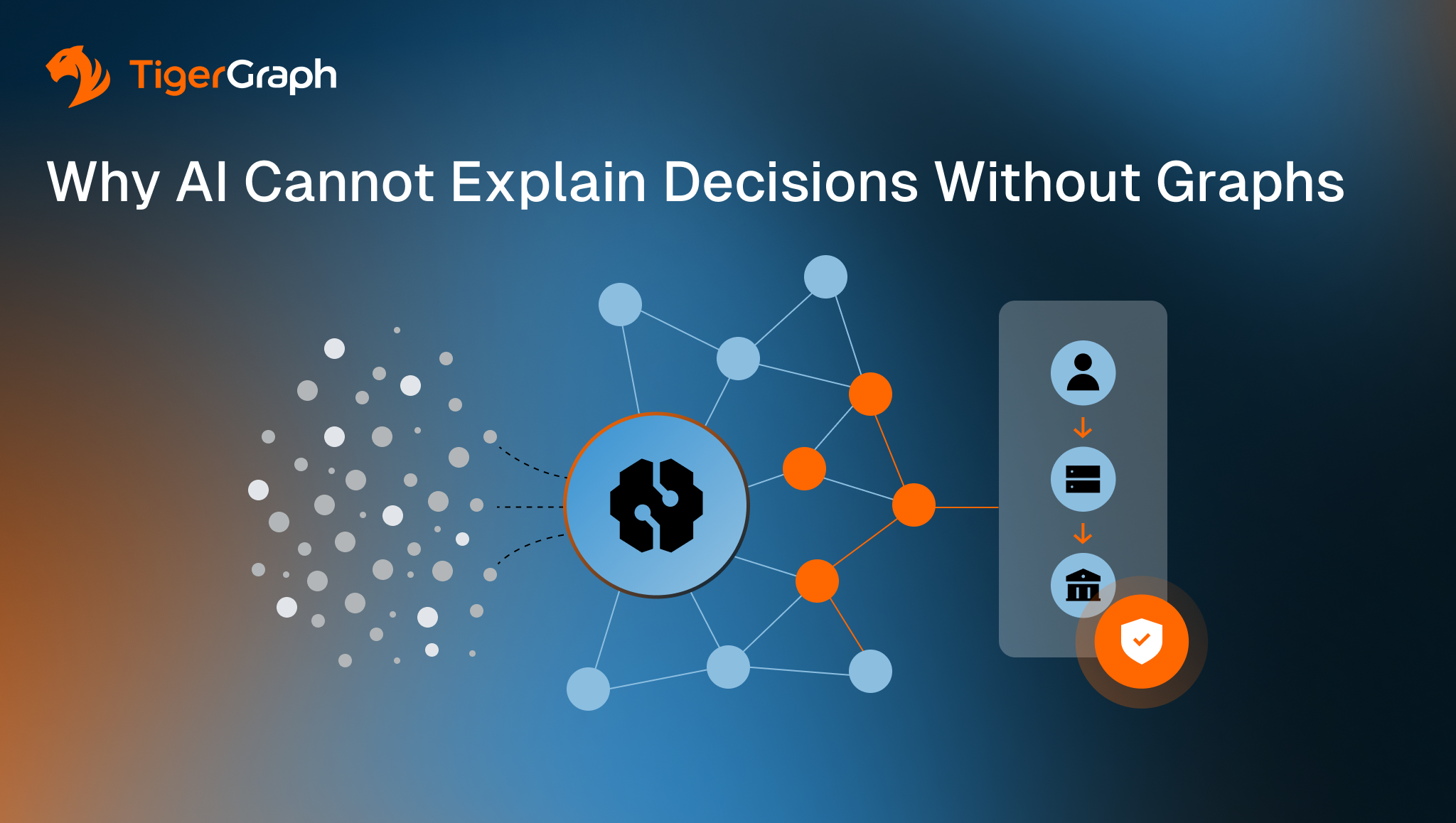
The explainability problem in enterprise AI is not a model problem. It is a data infrastructure problem.
When an AI cannot explain its decision, it is almost always because the data it has reasoned over lacks a structure that supports explanation.
Similarity scores are not explanations, and attention weights are not explanations. Explanations are structured accounts of which business entities and evidence were considered, how they were connected, and why those connections produced this outcome.
Graph databases are uniquely well suited to representing this structure because they model entities and relationships explicitly as connected, queryable data.
You’ll learn:
- Why the AI explainability gap is a data infrastructure problem, not a model problem
- How three common explainability techniques (SHAP/LIME, attention visualization, and RAG citations) each fall short of enterprise governance requirements
- How graph-based explainable AI produces traceable, auditable decision paths from connected business data
- Why regulated industries in banking, healthcare, and insurance need graph-native AI infrastructure to meet frameworks such as the EU AI Act, SR 11-7, HIPAA, and Basel IV
What Regulators and Risk Officers Actually Need
For enterprises, the challenge is not to explain every mathematical operation inside a neural network. Regulators, auditors, and risk officers are concerned with a different question: can the organization explain why an AI-assisted business decision was made? For enterprise AI, explainability is fundamentally an infrastructure capability rather than solely a property of the underlying model.
An explainable AI graph database addresses this by recording the business context surrounding each decision. Rather than attempting to interpret model parameters, it captures the entities, relationships, and evidence that informed the AI’s recommendation. Because this information is stored as connected data, it remains structured, queryable, and auditable long after the decision has been made.
To support enterprise governance, an auditable AI decisions graph should provide:
- A traceable record of the data and business entities considered during the decision
- A transparent reasoning chain showing how those entities are connected
- The ability to reconstruct and audit that reasoning after the decision has been made
Major governance frameworks (EU AI Act, SR 11-7, HIPAA, and Basel IV) each reflect this expectation in different forms. The consistent requirement is not that organizations explain a model’s internal calculations, but that they can explain the business logic behind each AI-assisted recommendation.
Why Current Explainability Approaches Fall Short
Several explainable AI (XAI) techniques have emerged, but most are designed to explain how a mathematical model arrived at an output, not the business reasoning behind the decision. This distinction becomes critical when decisions depend on relationships between people, suppliers, assets, transactions, or other connected entities.
SHAP and LIME: Explaining Features, Not Relationships
Techniques such as SHAP and LIME estimate how much individual input features contributed to a model’s prediction. They are highly effective for interpreting tabular machine learning models, helping data scientists understand whether variables such as price, inventory level, or supplier risk score influenced an outcome.
However, enterprise decisions rarely depend on isolated features. They emerge from relationships across many interconnected entities. Feature attribution can indicate that a supplier’s financial risk score influenced a recommendation, but it cannot explain how that supplier is connected to specific products, manufacturing facilities, logistics partners, or customers. As a result, SHAP and LIME provide insight into model behavior but cannot produce the entity-relationship reasoning chains required for regulatory audits or business investigations.
Attention Visualization: Looking Inside the Model
Transformer-based models expose attention weights that show which tokens or passages received greater focus during inference. These visualizations can be valuable for researchers studying model behavior or debugging language models.
For enterprise AI, however, attention is not an audit trail. Knowing that a model focused on particular words or document sections does not explain which business entities influenced the recommendation or how they relate to one another. Attention mechanisms describe internal computation, not business logic, making them insufficient for organizations that must provide structured, traceable justifications for AI-assisted decisions.
RAG Citations: Evidence Without Reasoning
Retrieval-Augmented Generation (RAG) systems improve transparency by citing the documents used as context for a generated response. This allows users to verify factual claims and inspect the source material, reducing hallucinations and improving trust.
Yet a list of retrieved documents is not the same as an explanation. Citations show where information came from, but not how the information is connected or why those relationships justify the recommendation. They cannot reveal that a supplier shares a critical component with another manufacturer, that both depend on the same logistics provider, or that a disruption propagates through multiple tiers of the supply network.
Each of these approaches improves transparency in a different way, but none was designed to represent the connected business relationships that enterprise AI decisions often depend upon.
The common limitation across all three approaches is that they explain the model rather than the business decision. Regulators, auditors, and enterprise stakeholders need to understand which business entities were considered, how those entities were connected, and why those relationships led the AI system to recommend a particular action.
| Explainability approach | What it explains | What it cannot explain |
| SHAP / LIME | Which input features contributed to a prediction | How business entities are connected; which relationships drove the outcome |
| Attention visualization | Which tokens a model focused on during inference | Which business entities influenced the recommendation or how they relate |
| RAG citations | Which documents were retrieved as context | How information across those documents is connected, or why those connections justify the recommendation |
| Graph-based explainability | Which entities were considered, how they are connected, and why those relationships produced the recommendation | Internal model parameters are not what regulators require |
What Is a Graph-Based Explainable AI?
Graph-based explainable AI is an approach that uses a graph database as the data foundation for AI decision-making. Instead of storing information as disconnected records, document chunks, or vector embeddings, it represents business entities (customers, suppliers, accounts, transactions, facilities, products) and the relationships between them as structured, queryable data.
When an AI system generates a recommendation over graph-stored data, the relationship path that supported the decision can be reconstructed and audited at any time. The graph does not explain a model’s internal parameters. It explains the connected business context that justified the recommendation, which is precisely what regulators, auditors, and risk officers ultimately need to review.
The Graph Explainability Mechanism
When a graph-based AI system generates a recommendation, the supporting evidence is not hidden inside model parameters or inferred from attention scores. The AI explainability knowledge graph already contains the connected business context, allowing the agent to reason over known relationships and produce recommendations grounded in that structure. Because every relationship is stored explicitly, the reasoning path can be reconstructed and audited at any time.
Consider a fraud investigation. Rather than simply flagging a transaction as suspicious, the system can produce a structured explanation:
User A initiated a transaction with Entity B. Entity B shares a director with Entity C. Entity C was involved in a previously confirmed fraud investigation. Based on this relationship chain, the transaction was flagged for review.
This is the type of explanation regulators, auditors, and risk officers need. It identifies the business entities considered, shows how they are connected, and documents the reasoning that led to the recommendation. The decision is no longer a black box: it is a traceable path through the organization’s own data.
TigerGraph enables this capability through graph-based explainability that provides traceable decision paths and relationship-aware recommendations grounded in real-time operational context. By combining a hybrid graph with vector retrieval, TigerGraph’s approach is context-aware and explains why a recommendation makes sense within the current business environment.
Explainable AI in Regulated Industries
In banking, healthcare, and insurance, AI explainability is not a feature: it is an operational and regulatory requirement. An auditable AI decisions graph provides this capability by making the relationships behind every recommendation explicit, traceable, and queryable.
Banking and Financial Services
Financial institutions operating under frameworks such as SR 11-7 must justify credit decisions, fraud alerts, and AML investigations. A graph provides this by exposing the chain of relationships behind a recommendation. For example, a customer shares an account with another individual linked to suspicious transactions involving a previously identified fraud ring. Rather than presenting a risk score alone, investigators can review the supporting evidence for the alert, improving both investigations and auditability.
Healthcare
Healthcare organizations increasingly use AI to support clinical decision-making, patient risk assessment, and treatment recommendations. Because these recommendations may directly influence patient care, they require explainable reasoning that clinicians can review and validate.
A graph naturally models the relationships between patients, providers, diagnoses, medications, laboratory results, and clinical guidelines. Instead of recommending a treatment based on similar patient records, graph-powered AI can trace how a patient’s medical history, existing conditions, prescribed medications, and observed symptoms connect to the recommendation, producing the kind of relationship-based explanation that clinical oversight and healthcare regulations require.
Insurance
Insurance underwriting and claims processing depend on decisions that must be documented, challenged, and audited when necessary. Whether evaluating risk, detecting fraudulent claims, or approving payouts, insurers need a clear record of the business logic behind each recommendation.
A graph models policyholders, claims, assets, incidents, service providers, and historical relationships as a connected network. When AI recommends additional investigation or identifies potential fraud, the reasoning can be traced through explicit relationship paths: multiple claims linked to the same repair facility, repeated connections between policyholders, or prior incidents involving related entities. Because these relationships remain stored in the graph, disputed decisions can be revisited and independently verified long after they were made, supporting both operational transparency and regulatory compliance.
Building an Explainable AI Infrastructure with Graphs
The starting point is modeling the business domain as a graph: representing entities such as customers, suppliers, accounts, transactions, products, or patients, along with the relationships between them, as structured data. This creates a connected representation that AI systems can reason over.
When an AI application retrieves context, it queries this graph instead of relying solely on semantically similar document chunks. The key distinction between traditional RAG and GraphRAG is precisely this: traditional RAG retrieves passages that appear relevant to the prompt, while GraphRAG retrieves a structured relationship subgraph that preserves how entities are connected.
After a recommendation is generated, the relationship path that supported the decision is recorded alongside the outcome, creating a durable audit trail. Compliance teams can later query the graph to reconstruct exactly how a recommendation was produced, inspect the entities and relationships involved, and verify whether the reasoning satisfies governance requirements. The same graph therefore serves two purposes: it provides the real-time context used by AI applications and agents, and it acts as the system of record for explainability and auditing.
With capabilities such as TigerGraph’s MCP Server, AI agents can query and update this connected context in real time, enabling transparent, relationship-aware decision-making at enterprise scale.
Explainability Starts with the Data Infrastructure
For many enterprise AI systems, explainability is fundamentally a data infrastructure problem that often presents itself as a model problem. Organizations that model business context as connected, queryable data can trace recommendations through explicit relationship paths, satisfying regulatory expectations in ways that vector retrieval and model introspection alone cannot.
Explore how TigerGraph GraphRAG combines graph and vector retrieval for explainable, relationship-aware AI. See how TigerGraph Agentic AI enables agents with real-time graph context and auditable decision paths.
Ready to build explainable AI infrastructure? Explore TigerGraph’s free tier or request a demo.
FAQs
What is explainable AI and why does it matter for enterprises?
Explainable AI refers to AI systems whose recommendations can be understood, traced, and justified by the humans who use or oversee them. For enterprises, explainability is not primarily a technical concern: it is a governance and regulatory requirement. In finance, healthcare, insurance, and other regulated industries, organizations must be able to demonstrate why an AI-assisted decision was made, which entities and evidence were considered, and how the reasoning satisfies the applicable governance framework. An unexplainable AI system creates regulatory risk, limits human oversight, and undermines trust in AI-assisted workflows.
Why can’t SHAP or LIME satisfy enterprise AI governance requirements?
SHAP and LIME explain which input features contributed to a model’s prediction. They are useful for data scientists interpreting model behavior, but they describe the model, not the business decision. Enterprise governance frameworks require organizations to explain which business entities were considered, how those entities relate to each other, and why those relationships justified the recommendation. Feature attribution cannot answer these questions because it does not represent the connections between entities. A supplier’s risk score may appear as a significant feature, but SHAP cannot show how that supplier is connected to specific products, facilities, and logistics partners across multiple tiers.
What makes a graph database better for AI explainability than vector retrieval?
A vector database retrieves content by finding passages that are mathematically similar to a query. It can surface relevant documents, but it does not represent the relationships between the business entities those documents describe. A graph database stores those relationships explicitly: a customer is connected to accounts, transactions, and counterparties; a supplier is connected to components, facilities, and products. When an AI reasons over graph data, the path from input entities to recommendation follows explicit relationships that can be reconstructed and audited. The explanation is not inferred from similarity scores. It is read directly from the graph’s connected structure.
Which regulatory frameworks require AI explainability, and what do they expect?
Several major frameworks now require or strongly imply AI explainability. The EU AI Act requires traceability and meaningful human oversight for high-risk AI systems. SR 11-7 (US Federal Reserve) requires documented model governance and auditability for model risk management. HIPAA requires that AI-assisted clinical recommendations can be reviewed and validated by clinicians. Basel IV requires documented decision processes for credit risk models. Across these frameworks, the consistent expectation is that organizations can reconstruct why an AI system made a particular recommendation, not merely how the underlying model processed its inputs.
How does TigerGraph GraphRAG support explainable AI in regulated industries?
TigerGraph GraphRAG combines graph retrieval with vector search to give AI systems relationship-aware context grounded in real business data. When a recommendation is generated, the relationship path through the graph that supported the decision is preserved alongside the output. Compliance and audit teams can query this path to reconstruct which entities were considered, how they were connected, and why those connections led to the recommendation. This makes TigerGraph GraphRAG suitable for regulated environments where AI outputs must be inspectable, auditable, and defensible to external reviewers.