
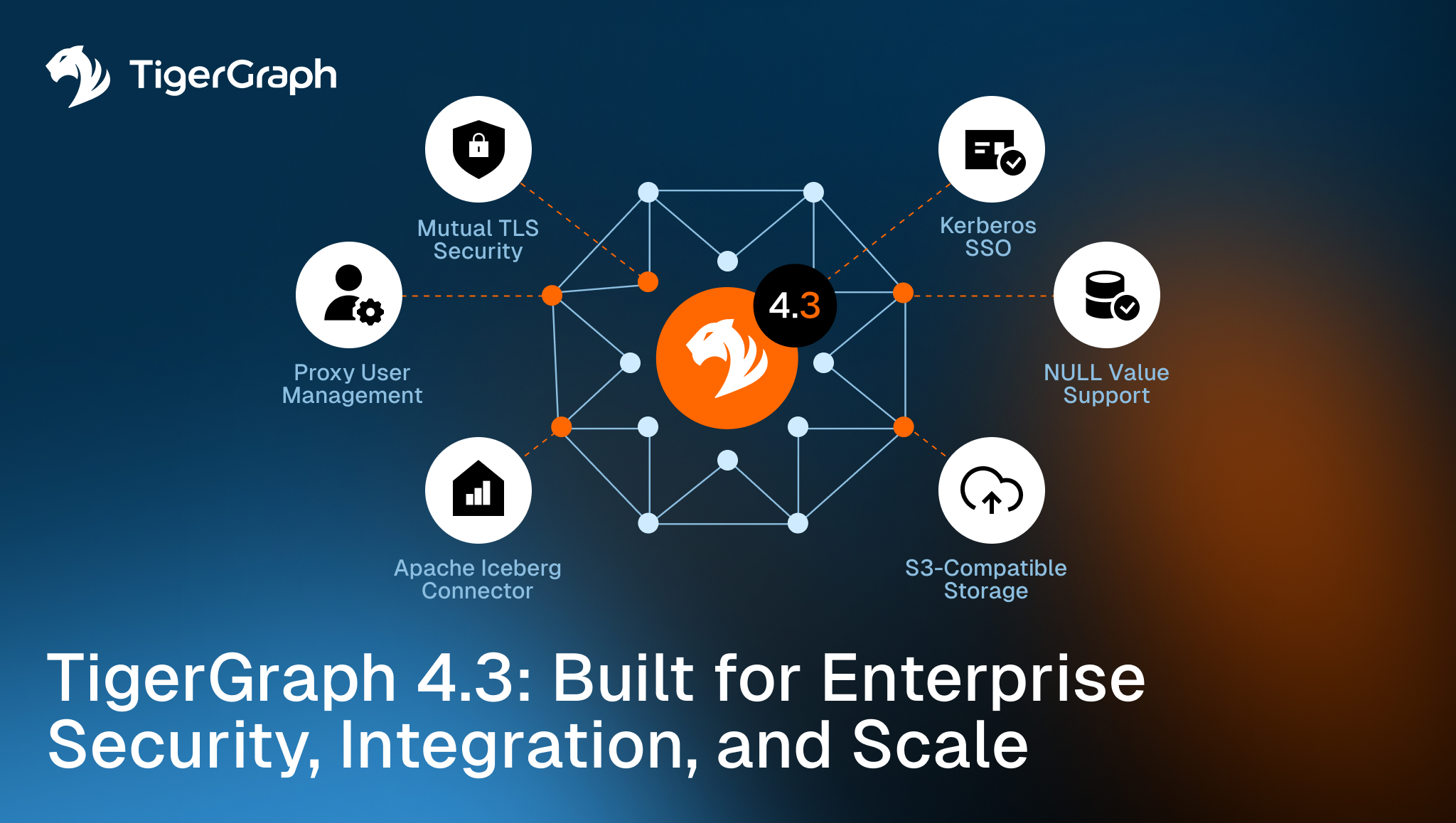
TigerGraph 4.3: Built for Enterprise Security, Integration, and Scale
Graph is becoming a core part of enterprise data and AI architecture.
The next phase of graph adoption will not be determined only by what graph technology can do. It will be determined by how securely and seamlessly graph can operate within the enterprise.
The real question is whether graph can operate within the security, identity, governance, data, and infrastructure standards that large enterprises already have in place.
- Can it pass security review?
- Can it integrate with existing identity systems?
- Can it connect to modern data platforms?
- Can it work in hybrid infrastructure without creating exceptions?
TigerGraph 4.3 is focused on answering those questions.
This release strengthens six areas that directly influence enterprise deployment: secure communication, enterprise authentication, user governance, data fidelity, lakehouse connectivity, and storage flexibility. It makes TigerGraph easier to approve, easier to integrate, and easier to operationalize in real customer environments.
Stronger Security with Mutual TLS
TigerGraph 4.3 adds support for Mutual TLS authentication.
This allows both the client and server to authenticate each other using certificates. For enterprise customers, this is important because trusted application to database communication is now a baseline requirement, especially in regulated industries.
The value is simple: stronger trust, lower unauthorized access risk, and better support for authenticated service-to-service communication in regulated environments.
Easier Enterprise Login with Kerberos SSO
Large enterprises already have identity systems. They do not want every platform to create a separate authentication model.
TigerGraph 4.3 adds native Kerberos SSO support, alongside existing options such as SAML, OIDC, and LDAP.
This makes TigerGraph easier to integrate into enterprise identity environments and reduces friction for IT and security teams.
Organizations can integrate TigerGraph with existing authentication infrastructure rather than introducing another identity system that administrators must manage.
Better Governance with Proxy User Management
Enterprise access is not just about login. It is also about user lifecycle control.
TigerGraph 4.3 introduces explicit proxy user management. Administrators can create, list, and remove proxy users directly instead of relying on implicit user creation during first login.
It also provides a more deliberate and auditable approach to managing externally authenticated identities throughout their lifecycle.
Better Data Fidelity with NULL Value Support
Enterprise data is rarely perfect or fully populated. Real-world datasets often include optional, missing, or unknown values.
TigerGraph 4.3 adds NULL value support for vertex and edge attributes defined as NULLABLE. NULL values can be ingested, the default for missing property values, the result of a computational operation, and returned in query results.
This makes TigerGraph easier to work with when customers are modeling real enterprise data, especially where missing values need to be preserved instead of forced into default values or custom workarounds.
Direct Lakehouse Integration with Apache Iceberg
Enterprise data is moving into lakehouse architectures. Graph platforms need to connect into that ecosystem, not sit outside it.
TigerGraph 4.3 introduces an Apache Iceberg Connector in preview, allowing customers to load data from Iceberg-based lakehouses into TigerGraph.
It also enables organizations to apply graph analytics to data already managed within their lakehouse architecture, reducing integration effort while supporting broader AI and analytics initiatives.
Flexible Data Export with S3-Compatible Storage
Enterprises do not all run on one cloud or one storage platform.
TigerGraph 4.3 supports writing query output to S3-compatible storage systems such as MinIO, Ceph, and Wasabi.
This additional flexibility helps enterprises integrate TigerGraph into existing storage and data pipeline architectures without requiring changes to their preferred infrastructure.
Why 4.3 Matters
It removes practical barriers that slow down production deployments:
- security approval
- identity integration
- access governance
- data fidelity
- lakehouse connectivity
- hybrid infrastructure compatibility
That is what makes this release important.
TigerGraph is not only becoming more powerful. It is becoming easier to deploy, integrate, govern, and operate at enterprise scale.