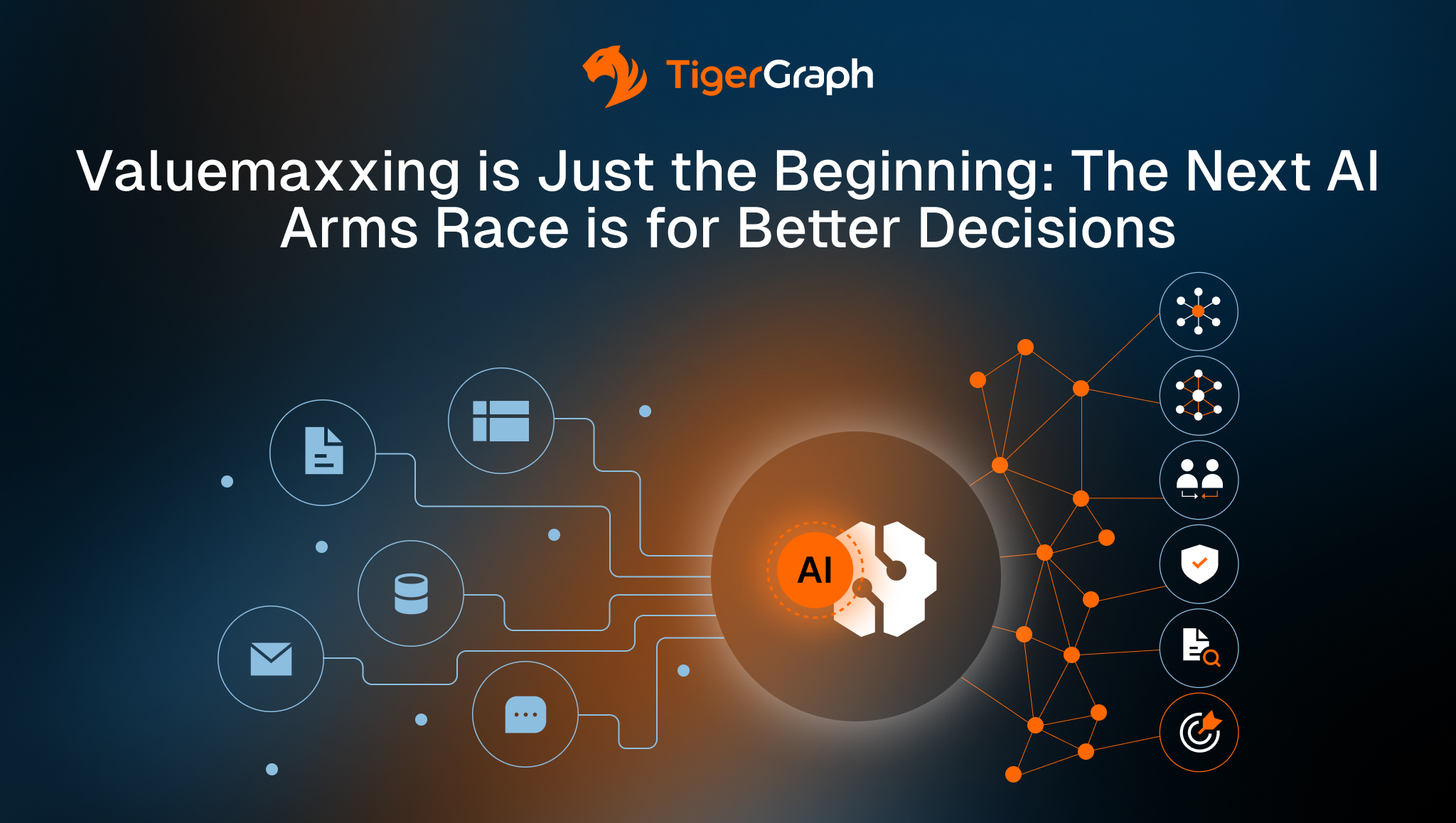
Every major technology revolution eventually forces organizations to reconsider what success means.
When a technology is new, success is measured by adoption. Organizations focus on rollout, usage, and experimentation because the first challenge is proving that the technology works at all. But once adoption accelerates, activity stops being a sufficient measure of success.
Enterprise AI has reached that moment.
The conversation shifts from Can we use it? to Are we creating measurable business value?
Over the past two years, organizations have raced to deploy large language models, copilots, coding assistants, and AI agents across nearly every business function. During that period, one metric became a surprisingly common proxy for AI success: token consumption. The more tokens employees generated, the thinking went, the more they were embracing AI and the more productive they were likely becoming. What became known as Tokenmaxxing reflected an understandable objective—accelerate AI adoption by encouraging people to use it as much as possible.
Today, that conversation is changing.
Technology leaders are not pulling back from AI. Demand for AI infrastructure, models, and enterprise applications remains strong. What is changing is how organizations evaluate success. Executives are increasingly questioning whether higher AI usage automatically translates into better business outcomes, and finance leaders are demanding clearer evidence that AI investments produce measurable returns.
That shift has given rise to a new term: Valuemaxxing.
On the surface, Valuemaxxing appears to be a financial discipline: a shift from maximizing AI consumption to maximizing the value created by it. But focusing only on budgets misses the much larger story.
Valuemaxxing is not fundamentally changing how enterprises pay for AI. It is changing how enterprises think about AI.
The first phase of enterprise AI asked whether models could generate useful answers.
The phase now emerging is asking a far harder question: Can AI consistently help organizations make better business decisions?
That is a profound shift.
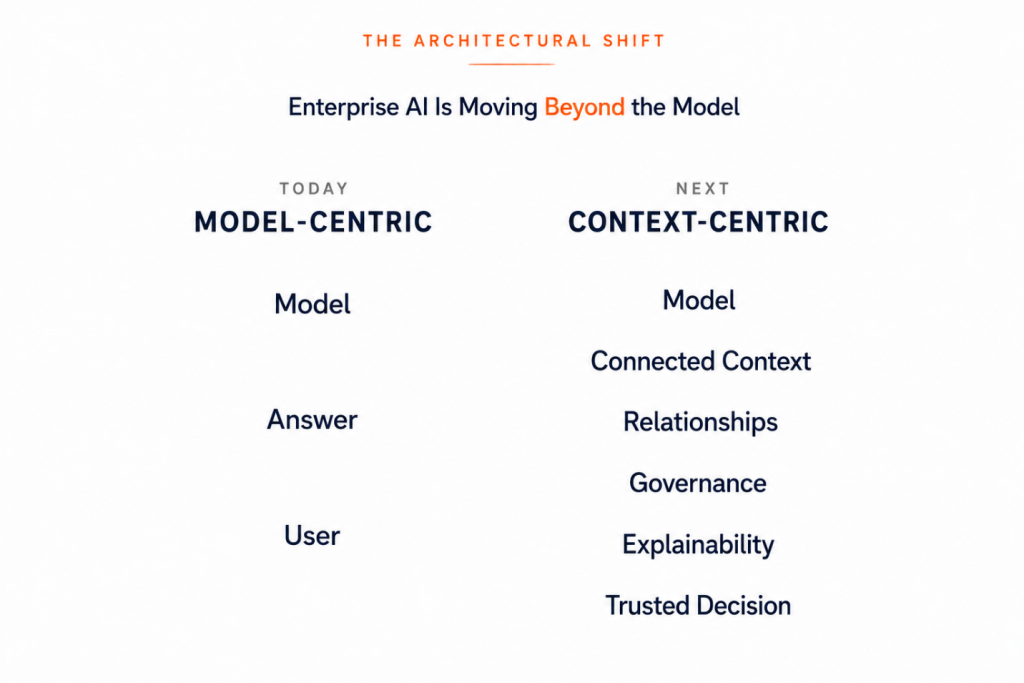
Once decision quality becomes the objective, the model is no longer the whole system, and the answer is no longer the whole outcome. The conversation necessarily moves beyond models, prompts, and tokens. It moves toward context. Relationships. Governance. Explainability. Trust.
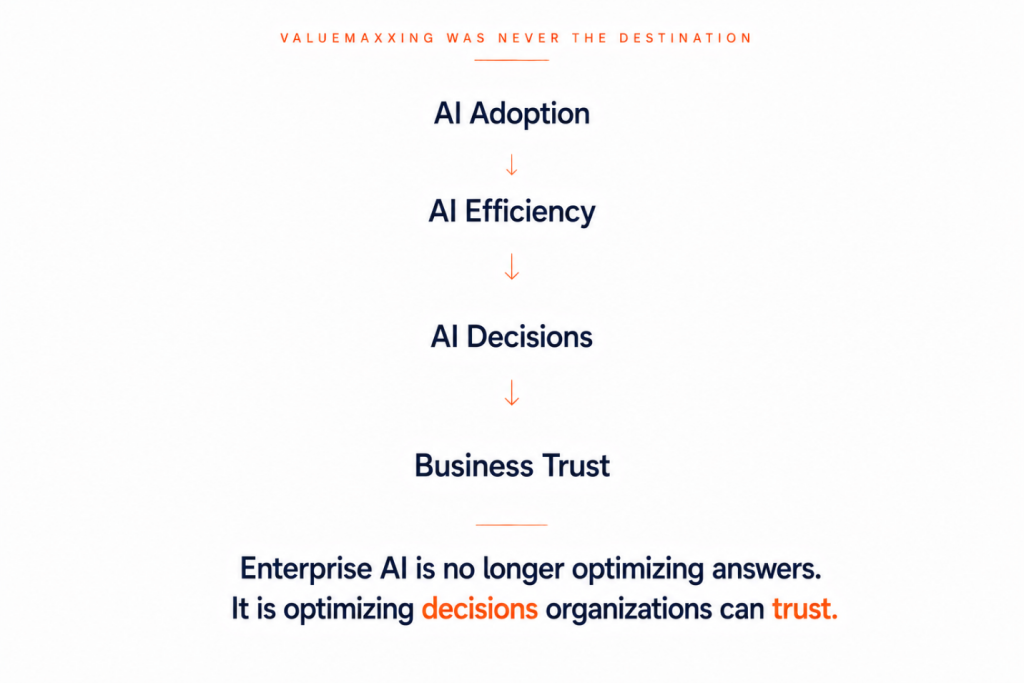
In other words, Valuemaxxing is not the destination. It is the first visible sign that enterprise AI is moving from experimentation to accountability and from generating answers to improving decisions.
Enterprise AI Has Changed What It Measures
Adoption metrics are useful until adoption is no longer the problem. Early success is measured by activity. Mature success is measured by outcomes. Enterprise AI has now reached that transition.
When coding assistants and AI agents first entered the enterprise, organizations needed a simple way to encourage adoption. Token consumption became one of the easiest AI activity metrics to observe at scale.
Leaders could easily see whether developers and knowledge workers were using AI, and higher usage often signaled greater experimentation and organizational learning. In that context, Tokenmaxxing served a practical purpose: it accelerated adoption at a time when most organizations were still discovering where AI could create value.
The problem is that adoption metrics eventually outlive their usefulness. As April Zheng of Salesforce observed in Forbes, token usage is a useful indicator that people are interacting with AI, but it cannot distinguish between productive work and wasteful consumption. Tokens measure how much AI is being used. They do not reveal whether that use improved productivity, reduced risk, lowered cost, or changed a business outcome. Similarly, DevRev CEO Dheeraj Pandey argued that organizations must evaluate token costs alongside productivity gains rather than assuming one automatically creates the other.
Finance leaders are beginning to ask the questions that every technology investment eventually faces. What business outcomes improved? Where did productivity actually increase? Which costs were reduced? What measurable value was created?
The concerns raised by investors and technology executives reflect this broader shift. Chamath Palihapitiya recently warned on CNBC that many CEOs and CFOs may not fully understand how much AI spending is occurring across their organizations until those costs unexpectedly appear in financial results. His concern was not that AI lacks value, but that organizations cannot assume AI consumption and business value are the same thing.
Across the industry, similar themes are emerging. Organizations are demanding greater accountability. Greater governance. Greater visibility. Greater control. Not because confidence in AI is declining, but because AI’s operational importance is increasing. AI is moving beyond experimentation and becoming part of core business operations. As that happens, executives expect AI investments to be evaluated with the same discipline as every other strategic technology initiative.
Valuemaxxing reflects that evolution. Organizations are moving beyond the question:
How much AI are we using? They are beginning to ask: What changed because we used it? That sounds like a subtle shift. It isn’t.
Changing what enterprises measure inevitably changes what they optimize.
And that leads to a much more important question. If organizations are no longer optimizing AI usage, what are they optimizing instead?
The Three Optimizations of Enterprise AI
Every generation of enterprise AI has been defined by a different question. Understanding Valuemaxxing requires understanding how those questions have evolved.
Phase One: Can AI Generate Better Answers?
The first wave of enterprise AI focused on capability. Could large language models write code? Summarize documents? Generate content? Reason across information?
Industry attention centered on gaining access to and deploying the most capable models. The primary optimization was model capability. The primary measure was whether the model could produce a useful answer at all. That question has not disappeared. But it is no longer enough.
Phase Two: Can AI Generate Better Answers Efficiently?
As organizations expanded AI adoption, economics became impossible to ignore.
AI usage scaled. Context windows expanded. Model choices multiplied. And the cost of every interaction became easier to see. Attention naturally shifted toward optimization. Prompt engineering. Caching. Model routing. Latency. And, most visibly, tokens.
Organizations became increasingly sophisticated at reducing the cost of generating answers while maintaining acceptable performance. Token efficiency became a meaningful operational objective because it directly influenced AI economics. This phase represented an important step in the maturation of enterprise AI. But it still optimized the mechanics of AI rather than the business outcomes AI was intended to improve.
Phase Three: Can AI Improve Business Decisions?
This is the transition now emerging across the industry. Executives are not abandoning AI. They are asking for more of it. They expect AI to create measurable business value.
That means improving fraud detection rather than simply processing more transactions.
Improving claims decisions rather than generating longer summaries. Helping customer service teams resolve issues more accurately rather than producing more responses.
Helping supply chain teams anticipate disruptions before they occur rather than simply analyzing more data.
The optimization target has fundamentally changed. The objective is no longer answer generation. It is decision quality.
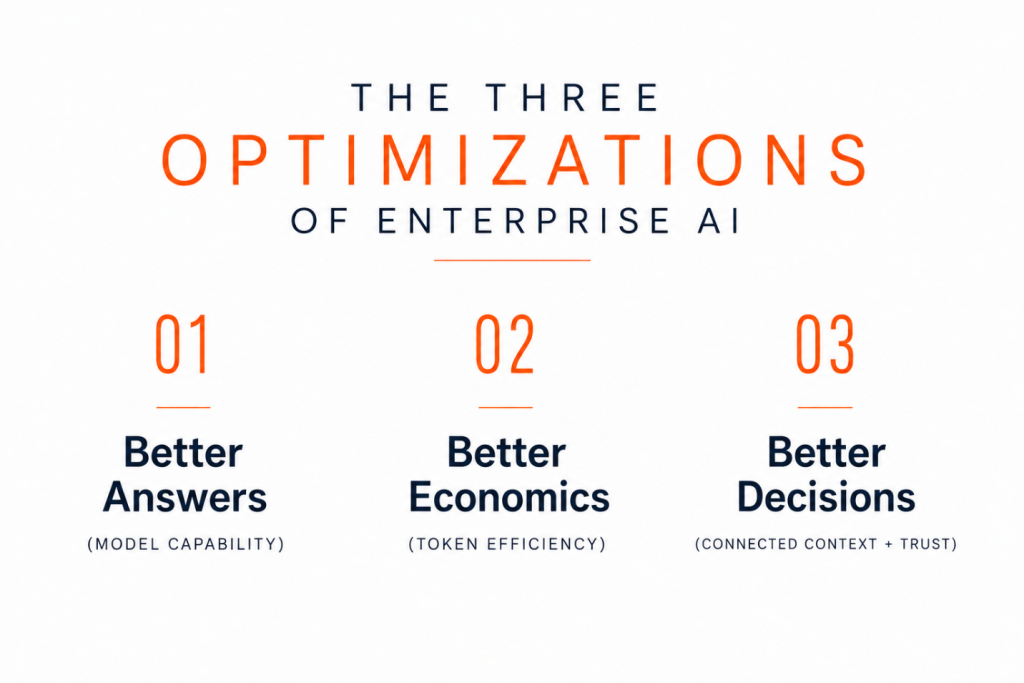
- Phase One optimized what AI could produce.
- Phase Two optimized what it cost to produce it.
- Phase Three optimizes what the business can achieve because of it.
That realization introduces the defining architectural challenge of the next generation of enterprise AI. Because better answers do not automatically become better decisions. The difference between the two is context. And understanding why may be the single most important question facing enterprise AI today.
Every Enterprise AI Decision Is Really a Context Problem
The conversation around enterprise AI has largely focused on models. Which model performs best? Which model is fastest? Which model costs the least? Those are all important questions. They are just not the questions that determine business value.
The moment AI moves from generating information to influencing business operations, the problem fundamentally changes. The objective is no longer producing a better answer. It is producing a better decision. Those are not the same thing.
A model can summarize a policy document with remarkable accuracy. It cannot responsibly approve a specific insurance claim from that document alone.
A model can identify unusual transaction patterns. It cannot determine whether a payment should be blocked without the surrounding customer, account, policy, and risk context.
A model can generate a detailed supplier assessment. It cannot responsibly recommend halting production without understanding the supplier’s dependencies, alternatives, contractual obligations, and downstream consequences.
In every case, the model may generate a recommendation or even trigger an action.
But the quality of that decision depends on information the model output alone does not contain. The business decision depends on context.
Consider a payment, viewed in isolation, it is simply a transaction. Viewed alongside the customer’s history, connected accounts, devices, counterparties, geography, previous fraud patterns, organizational policies, and regulatory obligations, it becomes something entirely different. The payment has not changed. Its meaning has.
This is the distinction that becomes increasingly important as organizations move from Tokenmaxxing to Valuemaxxing. Valuemaxxing therefore requires enterprises to measure what AI changed, not merely how much AI was consumed.
That is why executives are increasingly emphasizing accountability, governance, and measurable return on AI investments rather than usage alone. This leads to a simple but important observation: Models generate answers. Context determines whether those answers deserve to become decisions. That is because every enterprise decision is fundamentally a context problem before it becomes an AI problem.
The challenge is no longer generating another answer. It is giving AI enough of the business reality to recommend or execute the right action. But business context is not a document waiting to be retrieved. It must be intentionally constructed.
Connected Context Changes Decision Quality
Enterprise context is often treated as a data problem. It is not only a data problem. It is a connection problem.
Most large organizations already possess enormous amounts of data. The challenge is that the information required for a single decision rarely exists in one place. Customer records live in one system. Transactions in another. Identity information somewhere else.
Contracts, documents, communications, policies, and operational events are distributed across different enterprise applications, repositories, and operational systems. Individually, each system tells part of the story. Collectively, they explain the decision.
The architectural challenge is therefore not simply collecting more information.
It is assembling the precise context a particular decision requires.
Context is not more data. It is data organized around a decision. That distinction matters. More documents do not necessarily produce better judgment. A larger context window does not guarantee more relevant reasoning. Retrieval supplies information.
Decision context determines which information matters and why.
Enterprise decisions require context that is precise, relevant, and connected.
This becomes increasingly important as organizations seek greater return from AI investments. The emerging emphasis on governance, visibility, accountability, and intentional technology deployment reflects recognition that value depends on more than model capability alone.
This is why enterprise AI architecture must extend beyond the model. Competitive advantage no longer comes from connecting a model to more information. It comes from connecting the model to the information that actually determines the decision.
The organizations that produce better AI outcomes will not necessarily be those with the most data. They will be those that can turn fragmented information into decision-ready context. TigerGraph’s architectural perspective captures this shift directly:
AI Doesn’t Fail. Your Context Does.
If context determines decision quality, the defining question becomes how that context is constructed. The answer is not found inside individual records. It is found in the relationships between them.
Why Relationships Create Better Decisions
An individual record tells you what happened. Relationships determine what it means. Business context is created not only by the facts an enterprise holds, but by how those facts connect.
A customer is simply a customer. Connected to businesses, devices, accounts, previous interactions, payment methods, contracts, and support history, that same customer becomes a far richer decision context.
A supplier is simply a supplier. Connected to upstream manufacturers, logistics providers, facilities, inventory, geopolitical events, and contractual obligations, that supplier can reveal risk, resilience, concentration, and hidden dependency.
An identity is simply an identity. Connected to devices, accounts, organizations, transactions, applications, and previous behavior, that identity can be evaluated within the full pattern of relationships that establishes or undermines trust.
The underlying facts have not changed. The relationships change how those facts should be interpreted. They do not merely add information. They reveal meaning that isolated facts never could.
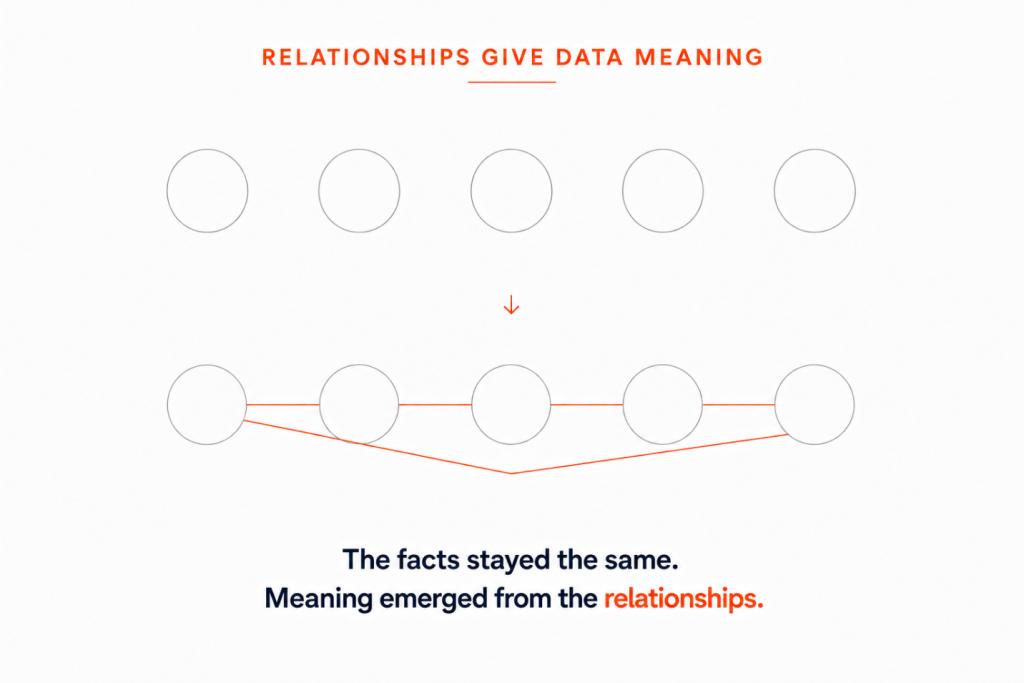
That distinction is becoming increasingly important as enterprises ask AI to participate in operational decision-making rather than simply generate content. Better decisions require more than retrieving relevant information. They require understanding why that information matters.
Relationships provide that explanation. They reveal dependencies and hidden influence.
They preserve provenance and support policy enforcement. They make reasoning traceable and decisions explainable. Relationships provide the evidence trail that turns an AI recommendation into a decision the enterprise can examine, govern, and trust.
This is why Relationship Intelligence is not simply another data layer. It is the architectural layer that allows enterprise AI to reason over the connections, dependencies, histories, and policies that define business reality, not merely retrieve isolated facts about it.
TigerGraph’s objective is not simply to help AI retrieve information, but to enable AI systems to operate with connected context, built-in policy enforcement, provenance, auditability, and explainable reasoning so decisions become provable, not just probable.
That brings us back to the central question raised by Valuemaxxing. If enterprises are moving beyond AI usage as the objective, beyond token consumption as the proxy, and toward decision quality as the outcome, then the basis of competitive advantage must change with them.
The next competitive advantage will not belong to the organizations with the largest models. It will belong to the organizations that build AI systems capable of making decisions they can trust.
The Next AI Arms Race Is for Trusted Decisions
Decision quality becomes enterprise value only when an organization is prepared to act on it. That makes trust the final and hardest optimization of enterprise AI.
Larger models, longer context windows, lower inference costs, and stronger benchmark performance will continue to improve what AI can generate. But enterprise value begins only when those outputs can improve a decision the business is willing to act on.
The organizations that create the greatest business value will increasingly differentiate themselves somewhere else. They will differentiate themselves by the quality of the decisions their AI systems enable. That requires rethinking enterprise AI itself.
Decision quality cannot be measured by token consumption. It cannot be measured solely by benchmark accuracy. It cannot be measured by response speed alone.
Enterprise decisions must ultimately be trusted.
A bank cannot approve a loan because an AI model produced a convincing paragraph.
A healthcare provider cannot recommend a treatment without understanding the patient’s complete clinical context. A manufacturer cannot reroute its supply chain based on an isolated signal. An autonomous AI agent cannot execute business actions simply because it generated a plausible recommendation.
In every case, organizations need to understand not only what AI recommends.
They need to understand why. They need confidence that each recommendation reflects sufficient, relevant, and current business context. They need confidence that it aligns with organizational policies and business objectives.
They need confidence that AI-influenced decisions can be traced to their evidence, evaluated against policy, explained to stakeholders, and defended under scrutiny. In other words, they need AI systems capable of producing trusted decisions. This is why the enterprise AI stack cannot end at the model. The discussion is no longer centered exclusively on models.
Operational AI requires an architectural layer that can provide connected context, preserve the relationships behind each conclusion, enforce policy, maintain provenance, and expose the reasoning path before an answer becomes an action.
These capabilities determine whether AI remains a helpful assistant or becomes trusted operational infrastructure capable of supporting critical business decisions. This architectural perspective aligns directly with how TigerGraph’s delivers connected context, relationship intelligence, governance, explainability, provenance, and Provable AI.
Viewed this way, the significance of Valuemaxxing becomes much clearer. It is not simply a shift in how organizations budget for AI. It is a shift in what they expect AI to deliver. The first generation of enterprise AI asked: Can AI generate useful answers?
The second asked: Can AI generate those answers efficiently? The next generation asks a far more consequential question: Can AI consistently help the business make better decisions?
Answering that question requires far more than selecting the right model. It requires the right architecture. An architecture that supplies the connected context each decision requires. That preserves the relationships that establish meaning and provenance. And that applies governance, policy, and explainability before an AI recommendation becomes a business action.
The next AI arms race will not be won by the organization that deploys the smartest model. It will be won by the organization that can turn AI intelligence into decisions it can trust and actions it can defend.
Valuemaxxing Was Never the Destination
Valuemaxxing may have begun as a response to rising AI costs and increasingly difficult questions about return on investment. But its larger significance is not financial. It reveals that enterprise AI is moving into its next stage of maturity.
The first phase proved that models could generate useful answers. The second made those answers faster, cheaper, and easier to scale. The next will determine whether AI can improve consequential business decisions without sacrificing the context, governance, and accountability enterprises require.
That challenge will not be solved by model capability alone. It will depend on whether AI can understand the relationships that give business information meaning. Whether its recommendations can be traced to evidence. Whether policies can be enforced before actions are taken. And whether the organization can explain not only what the system decided, but why.
This is the real transition Valuemaxxing exposes. Enterprise AI is moving from a technology organizations experiment with to infrastructure organizations must be prepared to rely on.
The winners will not be those that consume the most tokens, generate the most answers, or attach the largest model to the most data. They will be the organizations that turn connected context into trusted judgment and trusted judgment into confident action.