
Summary
- Retrieval-augmented generation (RAG) connects a language model to external enterprise knowledge at query time, reducing hallucinations and improving AI output for document-based applications.
- Standard RAG retrieves passages by semantic similarity, which works well for document search but fails when the answer depends on connected entities, relationships, or operational data.
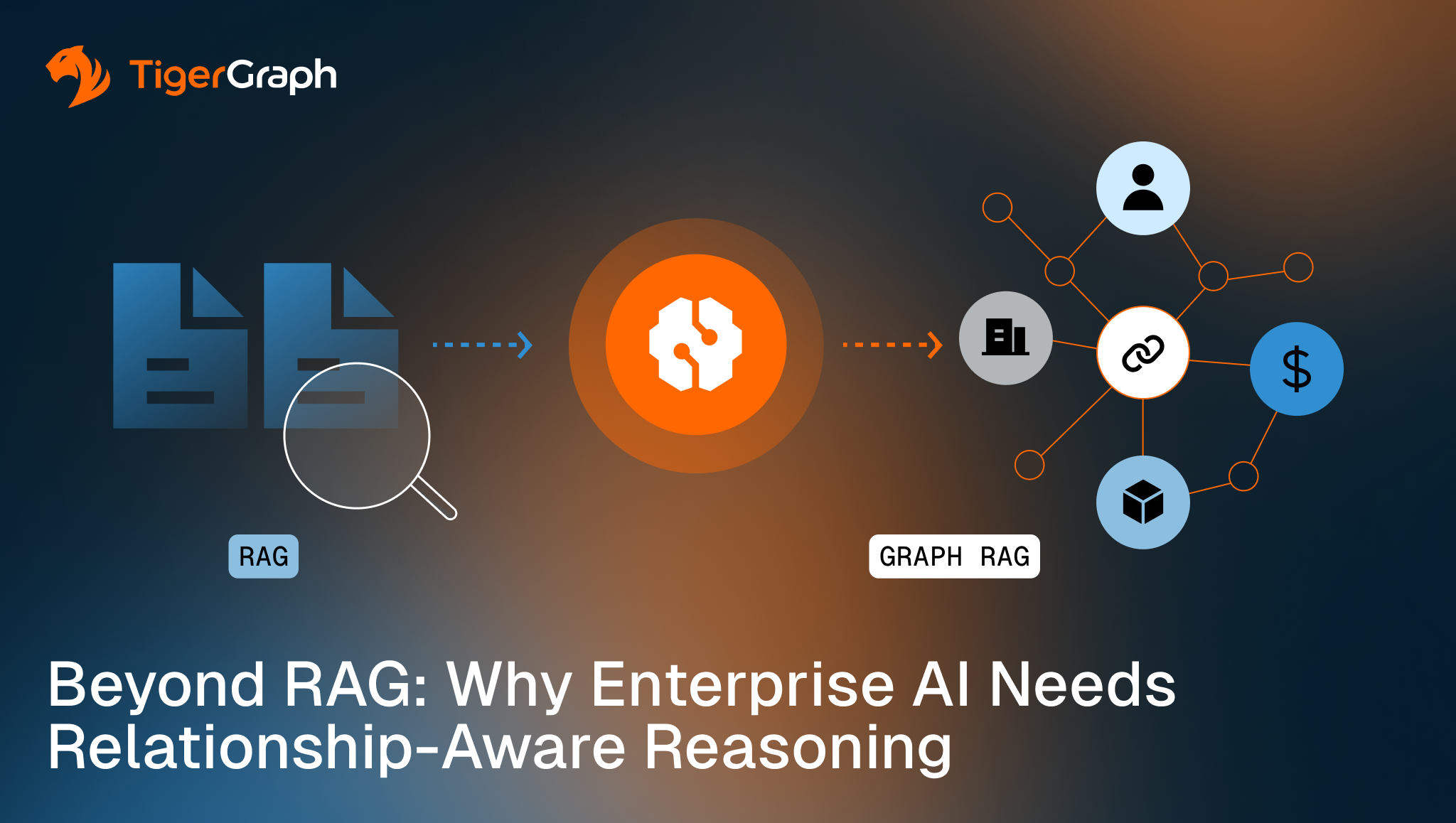
- GraphRAG extends retrieval-augmented generation by following entity connections to assemble relationship-aware context, enabling multi-step analysis, real-time data, and explainable evidence paths.
- Enterprise use cases including fraud detection, supply chain disruption, cybersecurity, and customer intelligence require connected context that similarity search alone cannot reliably deliver.
- TigerGraph supports relationship-aware retrieval through hybrid graph and vector search, real-time operational data, and MCP-based connectivity for agentic AI workflows.
Enterprise AI teams are building systems that need to investigate fraud, trace supply chain failures, assess cybersecurity risk, and understand customer relationships. These are not simple search problems, and the answer rarely sits in one document. It depends on how accounts, entities, transactions, systems, and events connect across the business. Enterprise decisions are increasingly determined by connected evidence rather than isolated information.
Retrieval-augmented generation, or RAG, was an important step forward. By grounding language models in external enterprise knowledge at query time, it reduced hallucinations and improved AI output for document search, policy lookup, and knowledge tools. For many organizations, retrieval-augmented generation became the standard AI design pattern. It fundamentally improved how AI systems access enterprise knowledge.
But as AI moves into more complex operational workflows, the limits of standard RAG are becoming clear. The most consequential enterprise questions depend on relationships: who owns what, which accounts share a device, which supplier failure affects which customer orders. Standard retrieval-augmented generation was designed to find similar text, not to follow connected facts. The next step is relationship-aware retrieval, and this article explains what that means and why it matters. The architectural challenge is no longer simply retrieving relevant documents. It is assembling the connected business context required for accurate reasoning.
You’ll learn:
- What retrieval-augmented generation is and how it works as a four-stage pipeline
- Where standard RAG falls short for enterprise questions
- How relationship-aware reasoning extends RAG for connected intelligence
- The use cases where this matters most and how TigerGraph supports them
What Is Retrieval-Augmented Generation?
Retrieval-augmented generation connects a large language model to an external knowledge source at query time. Before producing an answer, the system retrieves relevant information and adds it to the model’s context. Its core innovation is improving the quality of evidence available before generation begins.
RAG addresses two limitations of standalone language models. A model’s training data represents a fixed snapshot, and when knowledge is missing, it may generate a plausible but incorrect answer. Retrieving policies, documentation, research, or internal records reduces reliance on information stored in the model’s parameters. That makes retrieval-augmented generation a meaningful improvement for document search, support assistants, and other information-intensive applications.
For many organizations, however, retrieval-augmented generation is now the starting point rather than the destination. Enterprise questions often depend on how customers, suppliers, accounts, policies, transactions, systems, and events relate. Answering them requires connected context, not only passages that resemble a question.
How Does RAG Work? The Four-Stage Architecture
1. Prepare and index enterprise knowledge
Documents are divided into smaller passages called chunks. An embedding model converts each chunk into a numerical representation of its meaning, and those embeddings are stored in a vector database, creating a searchable source from policies, manuals, contracts, and support articles.
GraphRAG extends this stage by identifying important entities, such as customers, suppliers, accounts, products, and policies, and organizing them in a knowledge graph that records how they relate.
2. Understand the query
Standard RAG converts the query into an embedding to compare the question with indexed document chunks. GraphRAG also identifies the entities and relationships involved. A query about “the supplier flagged last week” must be linked to the correct supplier record before the system can examine its carriers, facilities, or downstream commitments.
3. Retrieve and assemble the context
Standard RAG searches the vector database for chunks closest to the query and assembles the most relevant passages as context. GraphRAG expands this by following entity connections to assemble the business context needed to answer the question. A supplier query might bring together the supplier’s carrier, parent company, open shipments, compliance history, and affected customer orders. This is the main architectural difference: standard RAG retrieves similar text, while GraphRAG retrieves connected facts. Retrieval shifts from collecting relevant passages to assembling connected evidence.
4. Generate a grounded answer
The retrieved context is added to the language model’s prompt. In standard RAG, the answer is grounded primarily in document passages. In GraphRAG, it is also grounded in structured relationships and the evidence path connecting relevant entities, which is especially valuable when an answer depends on multiple records, changing operational data, or connected relationships. The language model reasons from an evidence network rather than a collection of independent document fragments.
Where Standard RAG Falls Short
Multi-step questions require connected facts
Consider this supply chain question: “Which of our top suppliers use the same carrier as the supplier flagged for compliance concerns last week?” No single document contains the answer. The system must identify the flagged supplier, determine which carrier it uses, find other suppliers connected to that carrier, and compare them with the strategic-supplier list. Semantic similarity retrieves documents about the supplier, carrier, and compliance policy, but cannot establish that those records belong to the same relationship chain. The required information exists, but the retrieval architecture cannot assemble it into a connected explanation. The same issue appears in indirect ownership, downstream exposure, customer households, attack paths, and fraud rings.
Similar names do not always identify the same entity
Enterprise data contains constant ambiguity. Two customers may both be called Acme Corporation. A supplier may appear under its legal name in one system and an abbreviation in another. A retrieval system finds passages containing those names but does not automatically determine which real-world entity each reference represents. Reliable enterprise AI therefore depends on entity resolution: linking records that refer to the same person, organization, account, or asset while separating similarly named entities.
Stale indexes produce outdated decisions
Many RAG systems build vector indexes through scheduled ingestion pipelines. That works for content that changes weekly or monthly. It is less reliable for inventory, payments, alerts, shipment locations, and account states that change continuously. A procurement assistant may retrieve yesterday’s inventory report after stock has changed. A fraud assistant may summarize an account using information indexed before a suspicious transaction. For operational AI, “recently indexed” is not always the same as “current.”
A similarity score is not an audit trail
Standard RAG can show which passages were supplied to the model but not necessarily why they support a recommendation. Suppose a compliance assistant recommends an enhanced review of a customer. An auditor asks which ownership relationship created the exposure, which account was linked to the flagged entity, and which policy applied. A similarity score cannot answer those questions. In regulated environments, AI needs evidence that investigators and auditors can follow. Enterprise trust depends on understanding why evidence is connected, not simply why it was retrieved.
What Relationship-Aware Reasoning Adds
Relationship-aware reasoning extends retrieval-augmented generation by adding structured connections to the retrieval process. Vector search still identifies relevant documents, alerts, or cases. The system then uses identified entities as entry points into a connected knowledge layer, expanding to related carriers, facilities, parent companies, shipments, risk events, and contractual commitments.
This adds four capabilities:
- Connected context: Information distributed across systems is combined through explicit entity relationships.
- Multi-step analysis: The system follows a sequence such as supplier to carrier to port to shipment to customer commitment.
- Current operational state: When the connected layer is continuously updated, retrieval reflects recent transactions, alerts, and status changes.
- Explainable evidence paths: The system shows the relationship sequence supporting an answer.
Together, these capabilities transform retrieval from finding relevant information into constructing decision-ready business context.
This is the core idea behind GraphRAG. Rather than replacing semantic search, GraphRAG combines it with structured relationship retrieval, a natural evolution for teams that have deployed RAG and are encountering quality limits on complex enterprise questions. GraphRAG extends RAG by expanding what retrieval can represent rather than replacing the strengths of semantic search.
Enterprise Use Cases That Demand Relationship-Aware Retrieval
Each of these use cases shares the same architectural characteristic: the correct answer depends on relationships distributed across multiple systems rather than information contained within a single document.
Fraud and financial crime
Fraud is rarely defined by one suspicious transaction. Investigators need to connect accounts, devices, addresses, merchants, counterparties, beneficial owners, and payment flows to reveal coordinated behavior. A vector search retrieves cases describing similar fraud patterns but cannot establish that several accounts share the same device or route funds through the same intermediaries. TigerGraph’s fraud detection solution is designed around evaluating connected activity rather than isolated events.
Supply chain and operations
A disruption at a supplier can affect manufacturing sites, carriers, inventory positions, products, contracts, and customer commitments. Answering “Which orders are at risk, and what alternatives exist?” requires following those dependencies. Relationship-aware retrieval lets an AI application identify the affected network, evaluate alternatives, and show why each recommendation applies.
Cybersecurity
Cybersecurity evidence is inherently connected. Devices communicate with addresses, identities access systems, vulnerabilities affect assets, and alerts reference indicators. Relationship-aware retrieval identifies the actual devices, identities, applications, and alerts connected to an indicator, giving security teams a structured investigation path instead of a collection of potentially relevant documents.
Customer intelligence
Meaningful customer context is distributed across purchases, service interactions, product usage, household relationships, account hierarchies, and recent behavior. Relationship-aware retrieval determines which products the customer owns, which issues remain unresolved, and which accounts belong to the same household, producing responses with situational context rather than generic similarity.
TigerGraph: Built for Relationship-Aware Enterprise AI
Hybrid graph and vector retrieval
TigerGraph GraphRAG combines vector search, which identifies information similar in meaning, with relationship retrieval, which identifies information connected through known business relationships. TigerGraph’s vector database integration allows organizations to combine semantic search with relationship analysis in the same workflow. The result is retrieval that reflects both what information is relevant and how that information is connected.
Lower hallucination risk through connected grounding
A relationship-aware system narrows the context to facts that are both semantically relevant and connected. A standard system may find several policies containing “enhanced due diligence.” A relationship-aware system also determines which policy applies to the customer’s jurisdiction, account type, ownership structure, and current risk classification, giving the model a more precise set of facts. Grounding becomes stronger because retrieval incorporates both semantic relevance and operational relationships.
Explainable recommendations
When an AI application uses relationship paths during retrieval, those paths can be returned with the answer. A fraud recommendation shows the accounts, devices, and transactions connecting an applicant to a known ring. A supply chain recommendation shows the dependencies connecting a disruption to an exposed product. This creates an evidence trail based on business relationships, not only mathematical similarity.
Real-time operational context and agentic workflows
TigerGraph is designed for applications that analyze connected data as activity changes. That matters when decisions are time-sensitive: fraud risk changes after a transaction, cybersecurity risk after an alert, and customer intent after a service interaction. As organizations move from assistants to agents that plan and take action, TigerGraph’s Agentic AI capabilities support relationship-aware retrieval, context-guided reasoning, adaptive memory, and traceable decision paths.
When Connected Data Is the Answer, RAG Alone Is Not Enough
Standard retrieval-augmented generation solved a real problem and remains effective for document search, summarization, support applications, and question answering over relatively flat content. Enterprise AI, however, operates in a world of relationships. Customers belong to households and account hierarchies. Suppliers depend on carriers and facilities. Transactions connect accounts, devices, merchants, and owners. Security events affect identities, assets, and applications.
Relationship-aware retrieval is not a replacement for retrieval-augmented generation. It is what retrieval-augmented generation grows into when questions become more connected, operational, and consequential. As enterprise AI matures, retrieval architectures increasingly evolve from document-centric search toward relationship-centric reasoning. If your team has shipped a RAG prototype and is encountering quality limits on complex queries, the next step is relationship-aware retrieval. Start with the TigerGraph free trial to explore connected context for your use case, or request a demo to see GraphRAG applied to your enterprise data.
FAQs
What is retrieval-augmented generation (RAG)?
Retrieval-augmented generation connects a language model to an external knowledge source at query time. Before generating an answer, the system retrieves relevant information and adds it to the model’s context, reducing reliance on the model’s pre-trained knowledge and lowering hallucination risk. It is the standard design pattern for enterprise AI applications that need to answer questions using proprietary documents, policies, or operational data.
Why does standard RAG struggle with complex enterprise questions?
Standard retrieval-augmented generation retrieves passages by semantic similarity, finding text that resembles the query. It does not establish how entities connect. When an answer requires linking accounts to devices, tracing supplier dependencies, or identifying which records refer to the same real-world entity, similarity search returns the right pieces but cannot assemble the connected picture. Multi-step reasoning, entity resolution, current operational data, and auditable evidence chains all require more than semantic matching.
What is GraphRAG and how does it differ from standard RAG?
GraphRAG extends retrieval-augmented generation by following entity connections to assemble relationship-aware context. Where standard RAG retrieves similar passages, GraphRAG retrieves the accounts, relationships, events, and policies connected to the entities in a question. The result is more accurate for complex enterprise questions and produces explainable evidence paths that auditors and compliance teams can follow.
What is entity resolution and why does it matter for RAG systems?
Entity resolution is the process of linking records that refer to the same real-world person, organization, account, or asset and separating similarly named but distinct entities. Without it, a retrieval system may combine records from different entities with similar names into a single incoherent answer. For enterprise AI operating across multiple systems with inconsistent identifiers, entity resolution is a prerequisite for reliable retrieval-augmented generation. Graph is a natural platform for entity resolution and especially for integrating entity resolution and knowledge retrieval.
How does TigerGraph support relationship-aware retrieval?
TigerGraph combines a native graph database with hybrid vector and graph retrieval, real-time operational data updates, and MCP-based integration for agentic workflows. Its graph structure enables retrieval that follows entity connections rather than only matching text similarity. Explainable relationship paths accompany answers, supporting auditability in regulated environments. The result is a retrieval-augmented generation foundation capable of handling the connected, operational, and consequential questions that standard RAG was not designed for.