
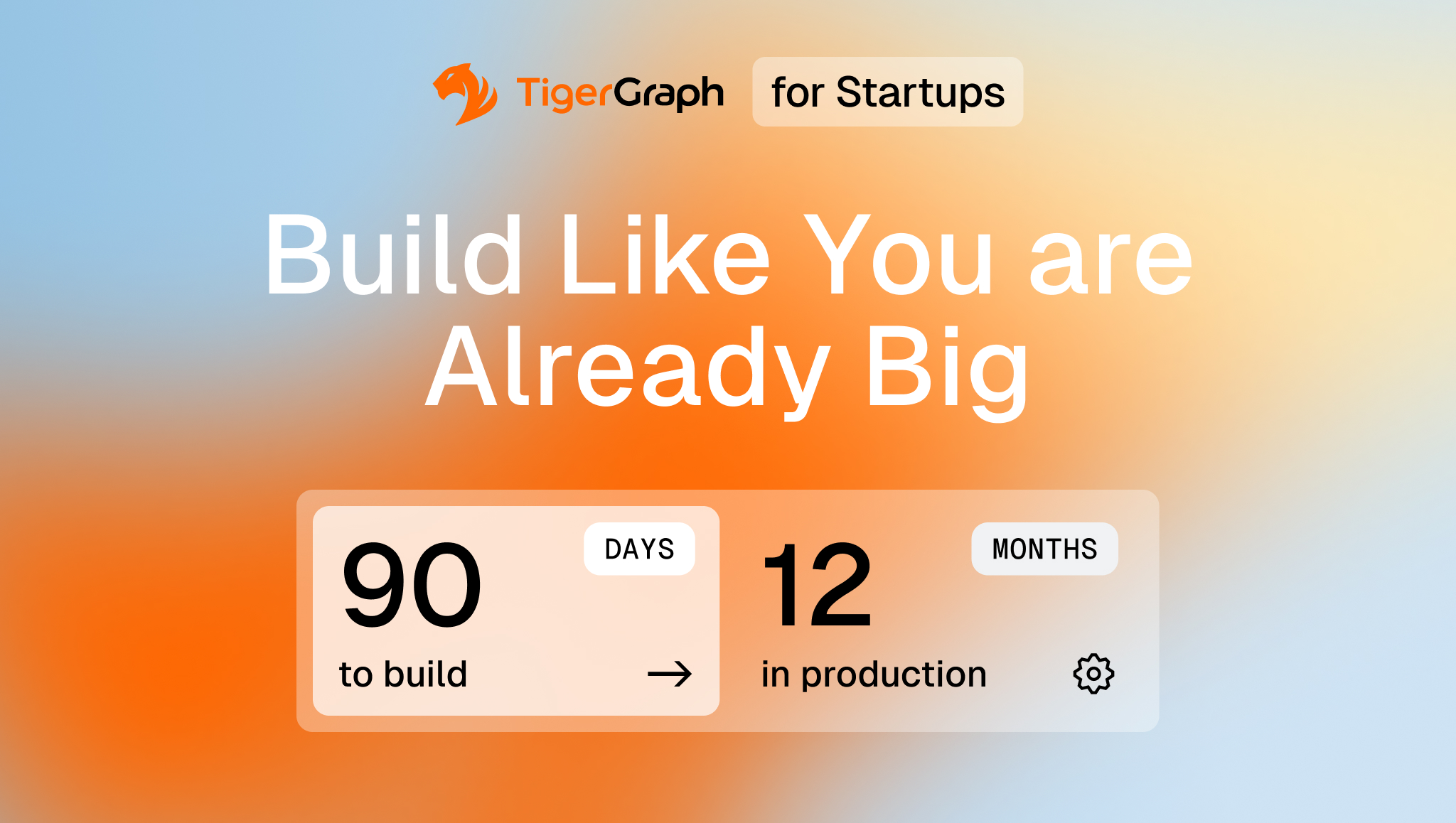
Introducing TigerGraph for Startups: graph technology at no license cost, expert architecture guidance, and a path from product development to commercial production.
The most expensive architecture decision a startup makes may be the one that works perfectly at first. With a handful of customers and manageable data volumes, an architecture can appear successful. The real test comes when customers demand capabilities the original design was never built to support.
For startups whose products depend on understanding relationships, those limitations can become fundamental.
A fraud platform that cannot trace connections across accounts, devices, and transactions isn’t simply running an inefficient query. It may be missing the very fraud its customers are paying it to detect.
Architecture doesn’t just determine how a product performs. It determines what the product can do.
That’s why we’re launching TigerGraph for Startups: to help early-stage AI and software companies build on production-grade graph technology, work directly with experienced graph architects, and reach commercial production without taking on licensing costs before they’ve established their business.
The Architecture You Build First Determines What You Can Detect Later
Consider a startup developing a fraud detection platform. Its first customers need to identify suspicious transactions. The initial architecture captures transaction amounts, account histories, device identifiers, and known risk signals. The product works.
Then a customer asks a different question. Are seemingly unrelated accounts controlled by the same fraud ring?
Answering that requires more than examining individual transactions. The platform must connect accounts to devices, devices to identities, identities to beneficiaries, and transactions to other transactions, potentially across multiple intermediaries.
A single account might appear legitimate. Its connections to dozens of other accounts may tell a very different story. Now the architectural questions become critical.
How are those relationships modeled? Can the system traverse multiple hops without unacceptable latency? What happens when millions of accounts share billions of connections? Can the platform isolate customer data while supporting a growing multi-tenant business?
These aren’t problems a startup wants to discover after signing its largest customer.
And they aren’t unique to fraud.
Identity platforms, AI agents, GraphRAG applications, cybersecurity products, and fintech systems face the same fundamental challenge: their differentiation increasingly depends on understanding how data is connected.
Get the Architecture Right Before It Becomes Expensive to Change
Building a graph application is one thing. Building one that performs reliably under production workloads is another.
The difference often comes down to decisions made long before the first major deployment: data modeling, query design, workload distribution, multi-tenancy, and how the system handles highly connected entities.
That’s where TigerGraph for Startups is different from simply offering free software.
Through the TigerGraph Architecture Lab, accepted startups can work directly with TigerGraph experts to make the technical decisions that shape their products.
A graph model that works with thousands of entities may behave very differently with billions of relationships. A query that performs well in development may struggle with highly connected data. A single-tenant architecture may become difficult to adapt when customers demand isolation and independent workloads.
Getting these decisions right early can prevent costly redesigns later.
TigerGraph experts bring experience across graph modeling, GraphRAG, hybrid retrieval, AI agent context, production architecture, performance, and scale.
The value isn’t just access to technology. It’s access to people who understand what happens when graph applications move from demonstration to production.
Build First. Win Customers. Scale When You’re Ready.
The commercial model matters as much as the technical foundation. Early-stage companies need room to validate products, secure customers, and establish revenue before infrastructure licensing becomes a significant expense.
TigerGraph for Startups provides a phased path:
BUILD — 90 days. Qualifying startups receive TigerGraph at no license cost to build and validate their products, with access to technical guidance and architecture support based on program qualification.
LAUNCH — Up to 12 months. Startups that successfully complete the BUILD phase and meet production requirements may qualify to run TigerGraph as part of their commercial products at no license cost, within program capacity limits. Qualifying deployments can support multiple customers or tenants without separate TigerGraph licensing for each one during the program.
SCALE — Grow on the architecture you’ve built. When the production period ends or usage exceeds the program allowance, companies transition to predictable startup pricing.
The principle is straightforward: a startup shouldn’t have to choose between the architecture it needs and the economics it can afford.
For selected startups with compelling products and market potential, TigerGraph may also provide go-to-market support, including customer introductions, joint selling, launches, events, and co-marketing.
Build Something Customers Can’t Get Elsewhere
Not every startup needs graph technology.
We are looking for companies building repeatable commercial products where understanding relationships creates meaningful differentiation.
That might mean exposing fraud networks competitors miss, resolving fragmented identities more accurately, giving AI agents connected business context, or tracing cybersecurity risks across interconnected systems.
The common thread isn’t the industry. It’s the product advantage that comes from understanding relationships.
Strong candidates typically have a working MVP or product, an engaged technical founder or engineering leader, and a credible path to commercial production. Priority is given to venture-backed or revenue-generating companies, particularly those through Series B.
You don’t need a finished graph architecture to apply.
We’re looking for startups building products where relationships create a competitive advantage. If that’s what you’re building, we want to work with you.