
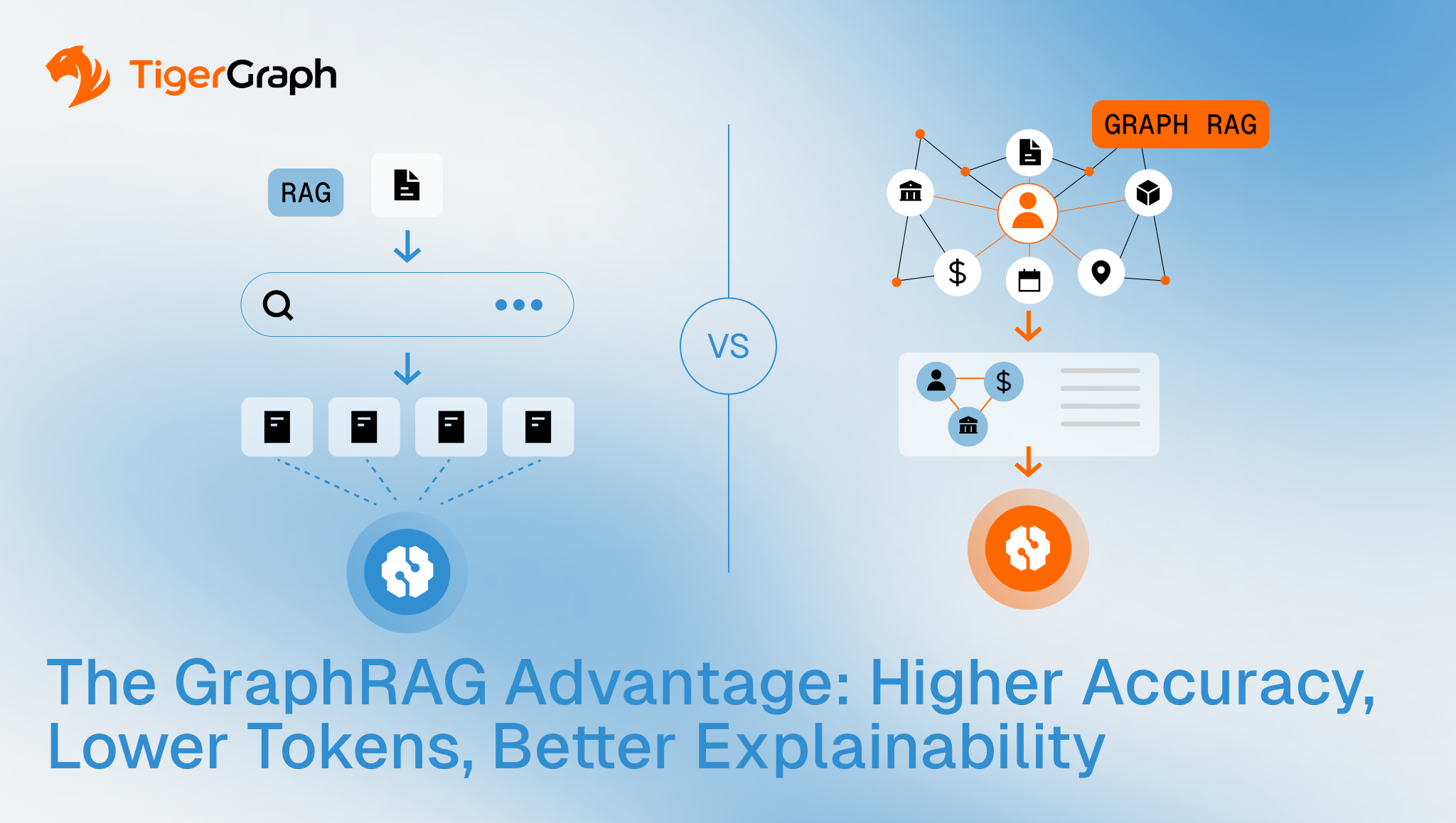
Summary
- Standard RAG retrieves document chunks by semantic similarity but cannot follow connections between entities, causing it to fail on multi-step enterprise questions.
- GraphRAG combines vector search with a knowledge graph to retrieve both semantically similar content and relational context, producing more accurate and auditable answers.
- Standard RAG is sufficient for single-document lookups and simple FAQ retrieval; GraphRAG is required when questions involve connected data across multiple entities or relationship layers.
- TigerGraph delivers production-ready GraphRAG by combining a native graph database, vector search, and real-time enterprise data in a single platform built for mission-critical workloads.
Standard RAG produces confident answers. For simple document lookups, that confidence is usually earned. For enterprise questions, it often is not. The limitation is rarely the language model itself. It is the structure of the information made available during retrieval.
Standard retrieval-augmented generation retrieves text chunks based on semantic similarity and passes them to a language model. That works well when the answer lives in a single document. It fails when the answer requires connecting information across entities, systems, and relationship layers. That covers most of what enterprise analysts, investigators, and operational teams actually need to know.
GraphRAG addresses this by extending document retrieval with relationship-aware retrieval. Instead of relying solely on semantically similar text fragments, it retrieves the entities and relationships relevant to a query, giving the model context that reflects how information actually connects. The result is higher accuracy, lower token cost, and reasoning that can be audited.
You’ll learn:
- What standard RAG is and where it structurally fails
- How GraphRAG works and what makes it architecturally different
- Which enterprise use cases require GraphRAG versus standard RAG
- How TigerGraph makes GraphRAG production-ready for enterprise teams
What Is Standard RAG?
Standard retrieval-augmented generation (RAG) is a technique in which a language model retrieves relevant document chunks via semantic similarity search, then generates a response grounded in those retrieved chunks. Text is split into fixed segments, embedded as vectors, and retrieved using cosine similarity at query time.
Standard RAG was designed to solve a specific problem: language models hallucinate when they lack grounding. By retrieving relevant documents before generating a response, RAG gives the model current, specific information rather than relying on training data alone.
The technique works well when a question has a clear document home. “What is our refund policy?” can be answered by retrieving the policy document. “Summarize the Q3 earnings call” can be answered by retrieving the transcript. These are single-source lookups, and standard RAG handles them reliably.
The architecture breaks down on connected information problems. Standard RAG cannot answer “which of our suppliers are linked to a counterparty flagged in our AML database?” because no single document contains that answer. The relevant facts are distributed across systems and connected through relationships that vector similarity cannot follow. The retrieval returns isolated chunks; the model receives fragments without the connective tissue; the answer is incomplete or wrong.
Four structural limitations define where standard RAG reaches its architectural limits:
- Multi-hop reasoning: when an answer requires connecting facts across multiple entities or relationship layers, standard RAG retrieves isolated chunks without relational structure. A query like “which accounts in this network transferred funds to a sanctioned entity within the past 60 days?” requires following transaction chains across multiple steps. Standard RAG returns documents about individual accounts but does not natively retrieve the connected relationship path required to assemble the chain.
- Semantic-only retrieval: results are driven by surface-level text similarity. Two chunks that are logically essential to an answer may be semantically distant and will not be retrieved. A sanctions database entry and a transaction record are semantically different documents, but they may be exactly the two pieces of information an AML analyst needs to connect.
- Limited explainability: because retrieval is probabilistic and chunk-based, explainability depends largely on retrieved source attribution rather than explicit relationship paths. It is difficult to audit why a particular answer was produced. For regulated industries, this is not an inconvenience; it is a compliance barrier. An AI answer that cannot be traced to specific sources and reasoning steps cannot be acted on in audit-sensitive workflows.
- Static snapshots: standard RAG typically queries a static index of embedded documents, not live operational data. Enterprise decisions, especially in fraud detection and cybersecurity, frequently require current context. A threat that emerged this morning is not in last week’s index.
What Is GraphRAG?
GraphRAG is a retrieval architecture that combines vector search with a knowledge graph to retrieve not only semantically similar content but also connected entities, relationships, and contextual paths relevant to a query. Any RAG pipeline that uses graph and vector together to retrieve data before invoking the language model qualifies as GraphRAG. It is not a single product or a proprietary architecture; it is a class of retrieval design that addresses the relational limitations of standard RAG.
The core architectural difference between GraphRAG and standard RAG is what retrieval returns and how retrieved evidence is connected before reaching the language model. Standard RAG returns the top-k most semantically similar text chunks. GraphRAG can retrieve semantically relevant content together with the connected entities and relationships that provide additional structural context.
Consider a fraud investigation query: “Is this account connected to any entities flagged in the past 90 days through more than two transaction layers?” Standard RAG retrieves documents about the account. GraphRAG follows the account’s transaction relationships through multiple layers and surfaces the connected entities that match the flag criteria. Standard RAG is not designed for multi-step relational retrieval and generally requires additional orchestration or graph-based components to reconstruct these relationships.
Because GraphRAG retrieval follows defined relationship paths, those paths can be traced. An audit trail can show exactly which entities and relationships contributed to an answer – a requirement in fraud investigation, supply chain compliance, and regulated financial services.
The comparison below reflects the retrieval characteristics of standard RAG and GraphRAG architectures rather than specific vendor implementations.
GraphRAG vs. RAG: Key Differences
| Capability | Standard RAG | GraphRAG |
| Data storage | Text split into fixed segments, embedded as vectors, retrieved by cosine similarity. | Interconnected entities with explicit relationships. Retrieval follows relationship links to surface information a vector similarity search would miss. |
| Retrieval method | Surface-level text similarity. Semantically distant chunks are missed even when logically essential. | Combines embedding-based semantic search with graph-based structural search. The graph fills in the relational context that vectors cannot provide. |
| Multi-hop relationships | Not supported. Isolated chunk retrieval cannot follow chains of entity relationships. | Native and fast. Retrieval follows multi-step relationship paths as part of the query. |
| Explainability | Probabilistic and opaque. Difficult to audit why a specific answer was produced. | Decision paths are traceable. Audit trails show how the model reasoned from retrieved entities to a conclusion. |
| Operability | Data updated in batches; retrieval reflects a static snapshot. | Graph database updated continuously; retrieval reflects current operational state. |
| Best-fit workloads | Single-document lookups, FAQ retrieval, simple semantic search. | Fraud detection, supply chain analysis, cybersecurity, customer intelligence, agentic AI. |
The most consequential difference in enterprise deployments is the multi-hop column. Standard RAG does not retrieve across relationship layers: not slowly, but not at all. If your AI system needs to answer questions that connect multiple entities across systems, standard RAG often proves insufficient.
When Standard RAG Is Sufficient
Standard RAG is the right retrieval architecture for a well-defined class of problems where questions have clear document homes and answers do not depend on connecting information across entity types.
- Internal knowledge search: employee-facing tools that answer questions using policy documents, HR guidelines, or procedural manuals. The answer to “what is the approval process for budget overruns?” exists in a single document.
- Customer-facing FAQ systems: support tools that retrieve product documentation or troubleshooting guides. Single-source retrieval is appropriate when questions are scoped to one domain.
- Document summarization: use cases that ask the model to synthesize or condense a specific document or set of documents. The retrieval is bounded and relational structure is not required.
- Semantic search over unstructured content: finding relevant articles, research papers, or product descriptions based on meaning rather than keyword matching. This is the original use case RAG was designed for, and it performs well.
The common thread: the answer lives in a retrievable document, not in the relationships between entities across multiple systems.
When GraphRAG Becomes the Better Architectural Choice
GraphRAG becomes necessary when enterprise questions require following connections across entities, systems, and relationship layers. This is the dominant query pattern in operational analytics, risk management, and AI-assisted decision-making. These workloads depend on connected evidence that spans multiple entities, systems, or events.
- Fraud and financial crime detection: identifying a fraud ring requires surfacing entities connected through multiple transaction layers. Standard RAG retrieves documents about individual entities; GraphRAG retrieves the network. A prominent bank uses TigerGraph to analyze 50 million transactions per day for fraud signals that flat retrieval cannot surface.
- Cybersecurity threat analysis: connecting indicators of compromise across assets, users, and events requires relational retrieval in real time. The threat pattern is defined by the connections, not by any single document. Context engineering at this level requires graph structure.
- Supply chain and operations: answering “which of our suppliers are exposed to a disrupted logistics partner?” requires multi-entity reasoning across a connected operational graph. This is precisely the multi-hop failure mode of standard RAG.
- Customer intelligence: understanding a customer’s full relationship with a business, including products held, interactions, household relationships, and risk signals, requires connected retrieval that flat chunks cannot provide.
- Telecom and network operations: network fault analysis requires connecting relationships between devices, configurations, and events. A knowledge graph of network topology makes this tractable for AI-assisted diagnostics.
- Enterprise AI assistants: internal AI tools that answer questions drawing on live operational data, organizational policies, and entity relationships benefit directly from graph-augmented retrieval. The accuracy difference between standard RAG and GraphRAG is most visible here, where question complexity is high and wrong answers carry real operational cost.
TigerGraph GraphRAG: Connected Intelligence for Enterprise AI
TigerGraph delivers connected context for enterprise AI by combining a native graph database, vector search, and real-time enterprise data in a single platform. The result is GraphRAG retrieval that can combine relationship-aware context with current operational data rather than relying solely on periodically refreshed document indexes.
TigerGraph’s GraphRAG implementation provides four capabilities that enterprise deployments require and standard RAG cannot deliver:
- Relationship-aware retrieval: queries follow entity relationships through multiple layers, returning structured context rather than similar text fragments.
- Hybrid graph and vector search: a single query performs both semantic similarity search and graph-based relational retrieval together, surfacing content that neither approach would find alone.
- Real-time operational context: TigerGraph’s graph database updates continuously from live enterprise data sources, so retrieved context reflects current entity state rather than a batched snapshot.
- Traceable decision paths: because retrieval follows defined graph relationships, the path from query to retrieved context to model answer can be fully audited. This is what makes GraphRAG answers actionable in regulated industries rather than simply plausible.
TigerGraph’s agentic AI architecture extends these capabilities into autonomous workflows. Agentic systems that rely exclusively on document-centric retrieval may accumulate retrieval gaps across multi-step reasoning chains because each reasoning step depends on the completeness of previously retrieved context. TigerGraph’s graph-structured retrieval grounds each reasoning step in accurate relational context, which is why agentic systems built on TigerGraph achieve meaningfully lower error rates and operate within token and latency budgets.
TigerGraph also integrates with enterprise AI infrastructure through MCP-based connectivity, allowing popular language models to connect directly to graph retrieval tools without bespoke integration work. For teams building custom retrieval logic, GSQL provides a SQL-familiar query language that lowers the learning curve for data engineers transitioning from relational environments.
Solution kits for fraud and financial crime detection, customer intelligence, cybersecurity, supply chain management, and telecom operations accelerate time to production for teams deploying GraphRAG on real enterprise data. These pre-built accelerators cover the graph data models, retrieval patterns, and integration templates that enterprise teams would otherwise build from scratch, reducing a months-long implementation to weeks.
GraphRAG Is an Architectural Advantage
The primary advantage of GraphRAG is architectural rather than model-driven. It is structural. Graph-based retrieval achieves higher accuracy, lower token cost, and traceable reasoning because it matches the relational structure of the problems enterprises need to solve.
GraphRAG retrieves connected evidence that reflects both semantic relevance and relationship structure, allowing the language model to reason over more complete context. The model reasons over structured context rather than noisy chunks, which reduces hallucination and improves the quality of every inference step.
For enterprises deploying AI in fraud detection, cybersecurity, supply chain management, or customer intelligence, GraphRAG is not a future investment. It is the retrieval architecture that makes those use cases tractable today. Standard RAG becomes increasingly constrained when enterprise questions depend on reconstructing connected business context across multiple systems and entities.
With GraphRAG’s traceable decision paths, every answer can be audited. Every retrieval step can be explained. That is not a nice-to-have capability for regulated industries; it is the condition under which AI-generated answers can be acted on.
Explore how TigerGraph GraphRAG delivers connected context for enterprise AI. To see it in action against your own data, request a demo or explore pricing and the free trial.
FAQs
What is the difference between GraphRAG and standard RAG?
Standard RAG retrieves document chunks based on semantic similarity and passes them to a language model to generate an answer. GraphRAG replaces flat chunk retrieval with graph-structured retrieval: it follows relationships between entities to surface connected context that vector similarity search cannot reach. The core difference is functional, not performance-based. Standard RAG does not support multi-step relational reasoning at all; GraphRAG does it natively.
Does GraphRAG replace standard RAG entirely?
GraphRAG is not a replacement for standard RAG in every context. For single-document lookups, FAQ retrieval, and simple semantic search, standard RAG is sufficient and easier to implement. GraphRAG becomes necessary when questions require connecting information across multiple entities, systems, or relationship layers; this is the dominant query pattern in enterprise operational analytics, fraud detection, cybersecurity, and supply chain management. Most enterprise deployments use graph and vector retrieval together, with the graph layer handling relational queries and the vector layer handling semantic similarity.
Does TigerGraph support GraphRAG natively?
Yes. TigerGraph combines a native graph database with integrated vector search in a single platform, which means a single query can perform both relational graph retrieval and semantic vector search together. This native hybrid capability is the technical foundation of TigerGraph’s GraphRAG implementation. TigerGraph also supports real-time data ingestion, so retrieved context reflects current operational state rather than a batched document index. MCP-based connectivity allows popular language models to connect directly to TigerGraph’s graph retrieval tools.
When should an enterprise move from standard RAG to GraphRAG?
The signal is when your AI system produces answers that require connecting information across multiple entity types or systems and standard RAG consistently misses or misreads those connections. Specific indicators include: AI answers that fail on questions involving more than two entities; high hallucination rates on relational or network-level queries; inability to audit why a specific answer was produced; and retrieval results that are semantically close but logically irrelevant to the actual question. If your use cases include fraud detection, cybersecurity threat analysis, supply chain disruption modeling, or customer intelligence across fragmented data sources, GraphRAG is the appropriate architecture.