
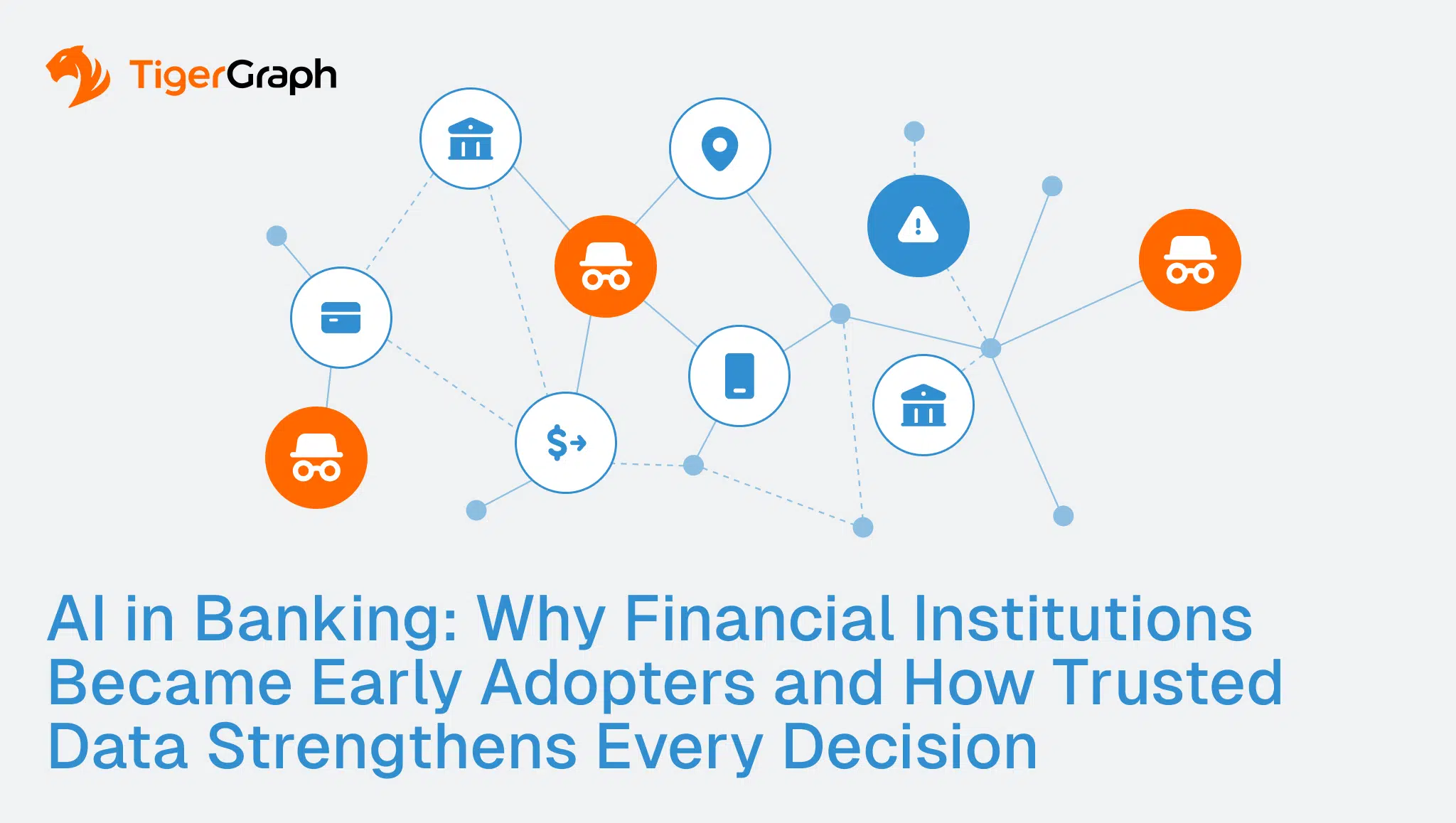
AI in Banking: Why Financial Institutions Became Early Adopters and How Trusted Data Strengthens Every Decision
Banks stepped into AI long before the rest of the world caught on. Not because they were chasing the “futuristic innovation” trend, but because they operate in a reality where hesitation is expensive and ignorance is dangerous.
A single missed fraud ring, a miscalculated risk score, or an unexplained anomaly can cascade through an entire financial system. When you process millions of events every hour, guessing is not an option.
AI gave banks speed. But speed alone was never enough. They quickly learned that the real advantage emerges only when AI is paired with data that is connected, contextual, and explainable. That is where graph technology reshaped the industry.
This is the story of why banks were early adopters, what they learned along the way, and why the next stage of AI in banking depends on trusted data more than anything else.
Why Banks Moved First
Banks deal with more complexity per second than most industries face all day. They are faced with a steady stream of transactions, accounts, merchants, devices, behaviors and regulatory pressures. And they all collide in real time.
A typical day might include:
• a few million transactions
• thousands of fraud signals, each potentially meaningful
• customers bouncing across apps and devices
Systems that must work flawlessly, with zero excuses. There is no “slow down and analyze this later.” Banks need immediate insight. It can’t come after a batch job, manual review, or when a system finally syncs.
So, they adopted AI early, out of necessity. And they discovered something that shaped every major initiative that followed: AI only works when the data foundation is trustworthy.
JPMorgan Chase: What an Early Adopter Actually Looks Like
JPMorgan Chase is a strong example because they leaned into AI with a clear purpose. They sought to connect signals that were impossible to understand in isolation.
They had fraud data scattered across accounts, merchants, devices and regions. The signals were there, but the connections were not. And without connections, AI models had nothing solid to reason with.
By implementing TigerGraph, JPMorgan unified more than 350 million relationships across their ecosystem. Suddenly, patterns that once hid in plain sight started surfacing:
- devices linking transactions across unrelated accounts
• merchants connected through multi-hop fraud chains
• false positives shrinking because risk became explainable
• investigations moving from hours to seconds
The lesson? AI becomes reliable when the relationships behind the data are visible.
Where Banks Use AI Today
Banks use AI in more places than most customers realize, but the pattern is consistent. Every meaningful use case relies on understanding both the signal and the relationships surrounding it.
Fraud Detection
AI is great at flagging things that “look weird.” Maybe a transaction happens at a strange hour, or a device fingerprint appears out of nowhere, or someone suddenly behaves like a totally different customer. That part is easy.
The problem is that weirdness on its own means nothing. It is just noise until you understand whether it connects to anything else.
This is where the graph steps in. A graph reveals suspicious events and connected patterns, like the same device used across multiple accounts or shared merchants across multiple disputes. It might even be a cluster of chargebacks originating from the same location or sharing a behavioral footprint
A graph maps upstream and downstream context, helping the bank distinguish between a one-off oddity and a coordinated attack.
Identity and Account Linking
Identity is a mess in every system, everywhere. People have multiple email addresses, phone numbers, old addresses, joint and business accounts, inconsistent spellings, reused device IDs, and every kind of clerical error imaginable.
AI can find similarities in all of this chaos. It surfaces those two profiles that seem alike, two accounts that might belong to the same person, two transactions that might share a hidden trail. But AI has no idea if those similarities actually mean anything.
The graph does. Graph connections confirm whether those “maybes” are real, from the shared devices, overlapping KYC documents and common merchants to the same IP during login or a hidden chain of transfers.
This is what stops false alarms and exposes the quiet fraud networks that have survived by looking normal on the surface. Graph reasoning turns identity data from a pile of guesses into something trustworthy.
Customer Journey and Personalization
AI does a nice job estimating what a customer might want next. It predicts intent based on past behavior, similar users, sentiment, whatever signals it has access to.
But real journeys are messy. People bounce between mobile and desktop, abandon carts, come back later, interact with support, browse three products before buying a fourth, and AI cannot stitch that together without help.
The graph shows the actual path, so the model is not guessing, it is seeing the full sequence of events.
Personalization becomes specific rather than generic because it is grounded in structure, not guesswork.
Operational Resilience
AI is pretty good at spotting spikes. It could be a surge in latency, an odd batch of failed payments, or a sudden cluster of login attempts. But a spike is only a spike. It does not tell you what it touches or how fast it spreads.
The graph shows the blast radius.
It reveals how a single failure in one upstream system affects downstream processes. The graph shows the pathways, the dependencies, and the ripple effects.
This is critical in banking, where one malfunction can disrupt thousands of transactions in minutes. AI sounds the alarm. The graph tells you where the fire is burning and how fast it is moving.
Why Banks Need a Trusted Data Foundation
Most banks do not struggle with collecting data. They struggle with connecting it. This is because customer profiles may sit in one system, device histories in another, and merchant data in a legacy database. And transactions are typically split across product lines.
An AI model trained on isolated inputs cannot reason. It can only guess.
A graph foundation solves this by consolidating identity and mapping accounts and relationships. It connects devices across behaviors, supports multi-hop analysis and maintains explainability for regulators
That last point is critical, because banks must show their work. Graphs give them a way to do that.
Banks rely on the combination of AI and graph reasoning to uncover coordinated fraud spanning multiple institutions.
It helps banks refine credit scoring with relational indicators and improve segmentation by understanding cross-channel behavior. This capability dramatically shortens investigation cycles, as banks can monitor high-risk accounts in real time.
AI Trends Shaping Modern Banking
Three trends define where banking AI is headed:
- Hybrid Retrieval for Explainability: Banks want models that can show how they arrived at an answer. Combining semantic retrieval with graph paths makes this possible.
- Real-Time Risk Scoring: Fraud and behavioral drift happen fast. Connected data ensures models are not operating on stale snapshots.
- Multi-Domain Analytics: The same event can affect fraud, credit, AML, identity, operations, and customer experience. Graph schema ties these domains together.
TigerGraph Supports Stronger AI for Banks
TigerGraph’s architecture gives banks the clarity and performance they need:
- real-time graph traversal
- schema-driven governance
- parallel computation
- identity resolution at scale
- multi-hop reasoning across billions of relationships
It does not replace AI, but reinforces it.
TigerGraph provides the structural clarity, consistency, and explainability required for AI to operate in high-risk financial environments. It lets banks ground every decision in connected, verified data instead of isolated signals.
Summary
Banks leaned into AI in banking earlier than most. They see complexity and risk collide constantly. They learned that models only deliver useful output when the data underneath is connected, consistent, and trustworthy.
Artificial intelligence in banking can surface signals, but without structure those signals do not mean very much. That structure comes from graph technology, which shows how events, entities, and behaviors actually relate to one another.
TigerGraph gives banks the ability to see those relationships as they form.
Any institution that wants to move its AI for banking efforts forward needs that connected foundation. TigerGraph provides the engine, the tools, and the scale required to support the kind of high-volume, highly regulated environments where banks operate.
Explore the TigerGraph platform to understand how graph-powered context enhances AI in banking and finance, enabling faster, more accurate, and fully explainable models.
Frequently Asked Questions
1. Why did banks adopt AI earlier than most industries?
Banks adopted AI early because they operate in real time under high financial and regulatory risk. They process millions of transactions every hour, where a single missed fraud signal or risk anomaly can cause cascading losses. AI provided the speed required to evaluate events instantly, but banks quickly learned that speed only delivers value when decisions are based on trustworthy, connected data.
2. Why does AI in banking require connected data to be effective?
AI models can detect patterns and anomalies, but without context they cannot understand meaning. Connected data shows how customers, accounts, devices, transactions, and merchants relate to one another. This context allows banks to distinguish isolated anomalies from coordinated activity, dramatically improving accuracy, trust, and decision quality.
3. What role does graph technology play in modern banking AI?
Graph technology provides the structural foundation that allows AI to reason over relationships in real time. By modeling how entities connect across accounts, devices, and behaviors, graphs enable multi-hop analysis, expose hidden fraud networks, and deliver explainable results that traditional databases cannot support.
4. How does graph technology improve fraud detection and reduce false positives?
Fraud rarely occurs as a single event. Graphs reveal connected behavior, such as shared devices across multiple accounts or transaction patterns spanning merchants and regions. This relationship-based insight helps banks identify coordinated fraud while reducing false positives by explaining why a transaction is truly risky or safe.
5. Why is explainability critical for AI in banking?
Banks must demonstrate how decisions are made to regulators, auditors, and customers. Graph-based AI provides built-in explainability by showing the exact relationships and paths that led to a decision. Instead of black-box scores, banks gain transparent, defensible reasoning that builds trust and meets regulatory requirements.