
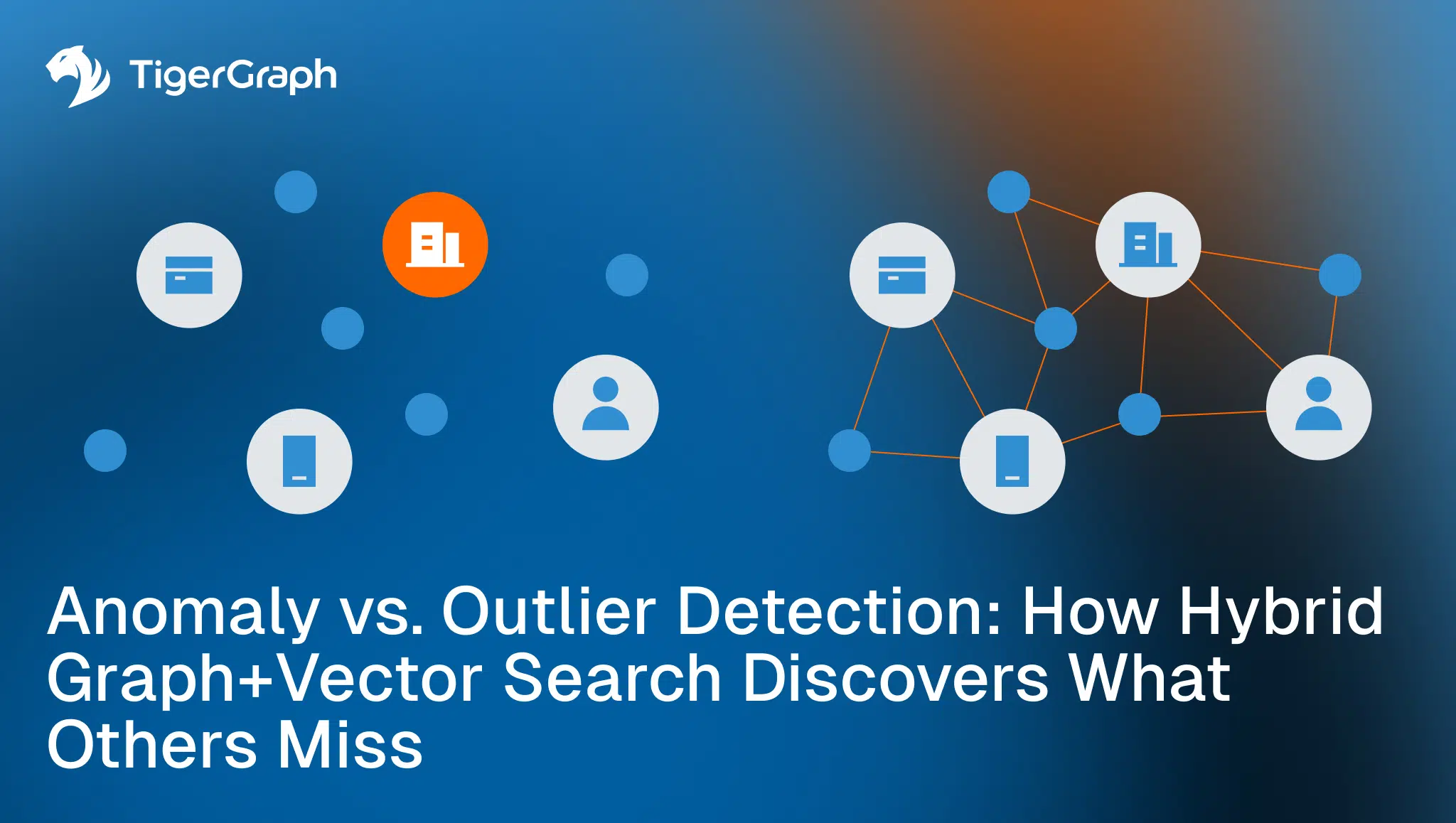
Anomaly vs. Outlier Detection: How Hybrid Graph+Vector Search Discovers What Others Miss
The terms anomaly detection and outlier detection are often used interchangeably, but they represent two distinct strategies for identifying irregularities in data. Understanding the difference is foundational to building effective detection models, especially in critical areas like fraud prevention, cybersecurity, and supply chain resilience.
Anomalies are signals—unexpected patterns that deviate from typical behavior and often hint at emerging risks or hidden opportunities. Outliers are data points that fall outside expected ranges, and although unusual, they don’t always indicate a problem or reveal a deeper story.
This difference matters. In high-stakes environments, the ability to distinguish between the two can mean the difference between stopping a breach and missing it entirely or uncovering a vulnerability before it becomes a crisis.
This is where HybridGraph+Vector Search comes in.
By combining graph-native anomaly detection with vector-based contextual search, TigerGraph delivers anomaly insights that go beyond surface-level irregularities to surface patterns that traditional methods overlook.
Let’s explore that distinction and explain why Hybrid Graph+Vector Search redefines anomaly detection—and how organizations can surface threats and opportunities faster, with more context than ever before.
The Outlier/Anomaly Distinction
At first glance, anomalies and outliers may seem interchangeable; both represent data points that deviate from the norm. However, in practice, they serve very different purposes and understanding that distinction is critical for building robust detection models.
Chart: https://gigazine.net/gsc_news/en/20140702-lionel-messi-analysis/
Outlier Detection: Finding the Obvious
Outlier detection focuses on identifying individual data points that are numerically distant from the rest of the dataset. These are often singular events that stand out sharply against expected values, like a single fraudulent credit card charge that’s dramatically higher than typical monthly transactions. It’s isolated, identifiable, and usually easy to flag.
Traditional detection models excel at this kind of surface-level anomaly. They work well when the data point is visibly out of range and disconnected from larger patterns. In manufacturing, for example, a sensor’s unusually high pressure reading might signal a fault, while in banking, a single large withdrawal might raise an alert.
Anomaly Detection: Finding the Hidden Patterns
Anomaly detection, on the other hand, goes deeper. Rather than just spotting isolated data points, it identifies unexpected patterns or sequences that deviate from normal behavior. These are the types of signals that don’t look suspicious in isolation—but when viewed as part of a larger context, they reveal a broader risk.
Take money laundering as an example. An individual transaction may seem legitimate on its own. But when transactions are mapped across multiple accounts, locations, and timestamps, they often reveal complex, hidden behaviors that indicate illicit activity. Traditional models often miss these patterns because they are trained to look at each data point independently, without accounting for contextual relationships.
This is where graph technology changes the game.
Thanks to graph-native anomaly detection, TigerGraph is able to map the relationships between data points, surfacing hidden connections that linear models often miss. It’s not just about flagging the outlier—it’s about understanding its role in the bigger picture.
Why do Traditional Methods Fall Short?
Traditional anomaly detection methods often rely on statistical models or simple rule-based systems to flag outliers. While effective for spotting individual data points that deviate from expected ranges, they struggle when patterns are distributed across multiple entities or evolve over time.
Context matters. An outlier detection model might catch a single large transaction, but it won’t recognize that the same account interacts with multiple shell companies in different regions, at just the right times to avoid suspicion. That’s a pattern, not an outlier—and identifying it requires understanding relationships, not just raw values.
This is where graph-native detection sets a new standard.
Unlike flat datasets, graph technology maps the connections between data points, uncovering complex behaviors that traditional models simply can’t visualize. This allows one not just to see the spike, but understand how that spike fits into a broader network of activity.
When graph technology is combined with vector-based contextual search, it goes even deeper. Hybrid Graph+Vector Search surfaces hidden risks faster and with greater clarity . It allows users to search for anomalies and the context around them.
Multi-Layered Anomaly Detection
In complex networks, anomalies are often buried beneath layers of interconnected events. TigerGraph’s Hybrid Graph+Vector Search is purpose-built to efficiently reveal these hidden signals. Graph traversal maps relationships across transactions, accounts, and entities, exposing interdependencies that would otherwise go unseen. This contextual awareness helps identify communities of behavior that hint at coordinated activities—insights that would be nearly impossible to spot through traditional methods alone.
Vector search adds another layer of precision. By analyzing vector embeddings, TigerGraph surfaces behaviorally similar patterns, even if structurally distinct. This capability highlights accounts or transactions that mimic fraudulent activities, bringing forward anomalies that evade detection in standard searches. Together, these capabilities provide a multi-layered understanding of anomalies, ensuring that risks are uncovered and fully contextualized for strategic action.
Beyond Detection: Explanation and Context
Hybrid Graph+Vector Search goes beyond detection to understanding, though. Anomalies are not just flagged, they are explained.
Visual graph representations illustrate how each anomaly connects within its network, providing an intuitive view of its impact.
Contextual deep dives clarify what happened and why it happened, revealing the underlying mechanisms that allowed the anomaly to occur.
This transparency extends further with traceable paths, enabling analysts to understand the’ progression of threats and their potential spread. With this insight, organizations can respond faster and more strategically, cutting off threats before they escalate.
Anomaly Detection Continues to Evolve
Anomaly detection has evolved, and TigerGraph’s Hybrid Graph + Vector Search is at the forefront of that transformation.
Because it blends graph-native analysis with vector-based similarity, TigerGraph surfaces both expected and hidden anomalies faster than traditional methods. And it goes a step further by revealing the relationships and contextual patterns behind those anomalies, empowering organizations to act decisively.
As data complexity grows, the ability to search across both graph relationships and vector-based similarities becomes a competitive advantage.
Surface what others miss. TigerGraph’s Hybrid Graph + Vector Search reveals not just irregular data points, but the full, contextual story behind them.
Try it for free at https://tgcloud.io and see anomaly detection evolve.
Frequently Asked Questions
1. What is the Difference Between Anomaly Detection and Outlier Detection in Machine Learning?
Outlier detection identifies individual data points that fall outside expected numerical ranges. Anomaly detection identifies unusual patterns, sequences, or behaviors that deviate from normal system activity. Outliers are often isolated events; anomalies typically emerge from relationships across multiple entities, time periods, or interactions. In complex environments like fraud or cybersecurity, anomaly detection provides deeper insight because it captures contextual risk, not just statistical deviation.
2. Why do Traditional Anomaly Detection Models Miss Complex Fraud and Cyber Threats?
Most traditional models analyze data points independently using statistical thresholds or rule-based logic. They struggle when suspicious behavior is distributed across accounts, devices, or time windows. Modern threats are networked and coordinated. Detecting them requires understanding entity relationships, interaction paths, and behavioral similarity — capabilities that flat, table-based systems are not designed to support.
3. How does Hybrid Graph and Vector Search Improve Anomaly Detection Accuracy?
Hybrid graph and vector search combines relationship analysis with behavioral similarity search. Graph traversal reveals multi-hop connections across entities, while vector embeddings identify patterns that are semantically similar even when structurally different. Together, they reduce false positives, surface hidden coordinated behavior, and provide richer contextual insight than standalone anomaly detection systems.
4. What Industries Benefit Most From Hybrid Anomaly Detection Approaches?
Industries with complex, interconnected systems benefit the most. Financial services use hybrid detection to uncover layered fraud and money laundering networks. Cybersecurity teams use it to trace lateral movement across identities and assets. Supply chain and telecom operators use it to detect cascading disruptions across dependent systems. Anywhere risk spreads through relationships, hybrid graph-based detection provides stronger visibility.
5. How does Hybrid Anomaly Detection Support Explainable AI and Regulatory Compliance?
Hybrid detection models produce traceable relationship paths and similarity evidence that explain why an anomaly was surfaced. This improves auditability and regulatory defensibility because analysts can show how entities connect and how behavior compares to known patterns. Instead of a black-box score, investigators receive contextual reasoning they can review, reproduce, and justify.