
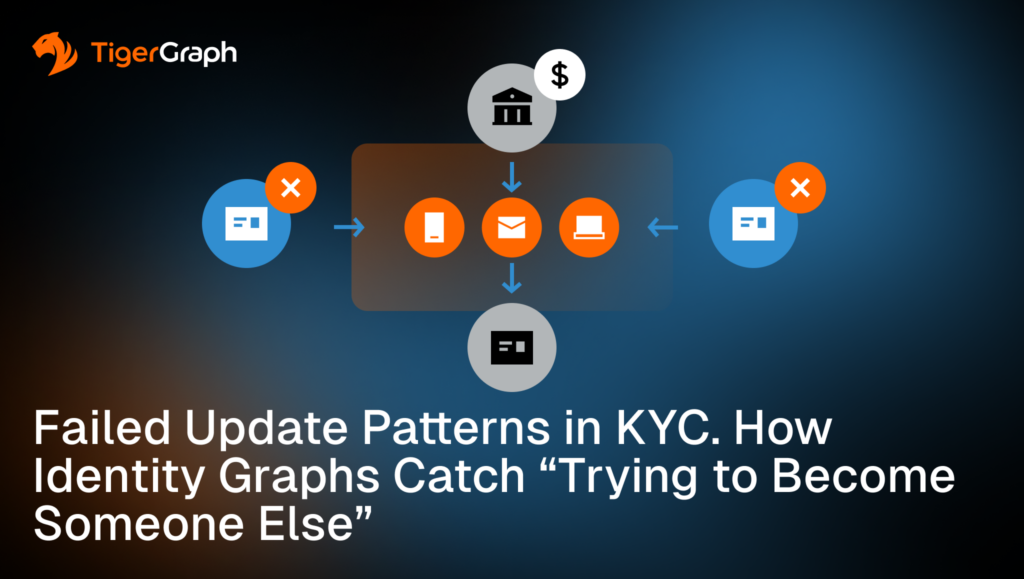
Failed Update Patterns in KYC. How Identity Graphs Catch “Trying to Become Someone Else”
Profile updates are a routine part of know-your-customer (KYC) operations. Customers change phone numbers, addresses and contact details. Systems validate those updates and either accept or reject them. What happens when those updates fail?
In most programs, a failed update is treated as a local issue. The attempt is reviewed, retried or closed. The outcome is logged and the workflow moves on. At that level, failed updates appear operational, not risky.
That framing only works when failures are isolated.
The problem emerges when the same types of update failures repeat across identities that are connected to one another. At that point, the issue is no longer whether a single update failed. The issue is whether the identity state is degrading across a broader set of linked records.
This is where many programs lose visibility. It is also where connected analysis becomes useful.
Key takeaways
- Failed profile updates are common in KYC. What matters is when the same failures repeat across identities that are connected to each other.
- The risk signal does not come from one failed change. It comes from patterns. The same updates failing repeatedly, across linked records, in shared contexts.
- Graph-based workflows make these patterns visible by showing which identities are connected and preserving the relationship paths that explain why they are reviewed together.
Why Failed Updates are Often Reviewed too Narrowly
When review workflows focus on a single profile at a time, teams cannot easily see whether similar failures are occurring elsewhere in the environment. The information exists, but the pattern does not surface.
What appears to be routine friction at the record level may reflect a broader integrity issue when viewed across connected identities.
The constraint is the review scope.
How Repeated Update Failures Show Up in Practice
When teams look beyond individual profiles, this pattern tends to appear in a few consistent ways.
Some identities repeatedly fail to update high-impact fields.
These fields often include phone numbers, email addresses, physical addresses or other attributes central to verification and access workflows. The signal becomes stronger when the same fields fail across multiple connected profiles.
Update attempts cluster around shared infrastructure.
Identities linked through shared devices, contact points or access patterns may show similar update behavior. This indicates a shared surface where the identity state is being challenged repeatedly.
Failures coincide with other forms of identity drift.
Repeated update failures often appear alongside changes in declared information, channel usage or access timing. None of these elements is decisive on its own. Together, they justify closer review.
The value here is observational. Teams are identifying repeatable behavior across connected records, not inferring motivation. Connected analysis fills these gaps.
What Connected Analysis Adds
At this stage, the challenge is consistency. Graph-based analysis helps address it in three practical ways.
First, it groups identities based on explicit connections.
Many programs rely on similarity scores to decide whether records might represent the same real-world entity. A similarity score is a numeric estimate of how closely two records match based on shared attributes such as names, addresses or identifiers. These scores are useful for prioritization, but they do not explain why records are related.
Connected analysis complements this by grouping identities based on documented relationships, such as shared devices, shared contact information, shared infrastructure or prior linkage decisions. This allows teams to review identities linked by evidence, not just by statistical resemblance.
Second, it preserves connection paths as evidence.
When identities are reviewed together, investigators need to show not only which records were grouped, but how they are connected. A connection path is the sequence of relationships that links one identity to another. Preserving that path allows reviewers, QA teams, and auditors to understand and reproduce the decision using the same evidence.
Third, it supports variable-depth review.
Some patterns are visible after a single relationship step. Others only emerge after several. Graph traversal is the process of following relationships step by step across connected entities. It allows reviewers to expand the scope of analysis as needed without deciding in advance how many steps the review must include.
This supports relationship-based evidence rather than opaque outputs, giving teams a way to explain decisions using concrete connections instead of abstract scores alone.
With this context in place, the next step is to ensure that update behavior is captured and modeled in a way that supports connected, repeatable review.
Modeling Update Behavior for Reviewable Workflows
To support this type of analysis, programs typically need a few foundational elements.
Update attempts captured as events.
The workflow should retain what was attempted, when it occurred, and whether it succeeded or failed. Without this history, repetition cannot be evaluated.
Explicit modeling of identities and shared infrastructure.
Profiles, accounts, devices, contact points and documents must be represented in a way that supports consistent linkage across systems.
Clear, program-defined linkage rules.
Teams should document which relationships justify connected review and how far that review should extend. This keeps decisions consistent and explainable.
How TigerGraph Fits the Workflow
The operational challenge is reviewing failed updates in the connected context without manually reconstructing evidence.
Graph workflows address this by storing relationships directly and returning connection paths as part of the query output. TigerGraph supports this by enabling:
- Multi-hop (multi-step) traversal across identity and shared infrastructure relationships
- Pattern-based expansion from one update event to a connected set of identities
- Repeatable queries that return both results and the evidence used to derive them
Thresholds, escalation criteria and remediation decisions remain program-defined. The graph workflow ensures the supporting evidence is available and reviewable.
Practical Next Steps for Teams
- Reframe update failures as patterns to review instead of isolated events. Focus on failures that affect verification, access or downstream risk assessment.
- Define how identities should be grouped for review. Document which relationships justify connected analysis and how much expansion is appropriate.
- Require connection evidence in escalations. If identities are reviewed together, the connection path should be part of the case record.
- Keep conclusions disciplined. Repeated failures indicate identity pressure points to watch, not wrongdoing.
Failed updates look routine when reviewed one profile at a time. They become meaningful when the same failures repeat across connected identities.
This pattern challenges programs to answer a basic operational question. Can investigators see which identities share the same update behavior and explain why they were reviewed together?
When the answer is no, the gap is not data availability. It is the absence of a connected, reviewable context, and TigerGraph is uniquely positioned to help teams solve this. Reach out to learn more.
Frequently Asked Questions
1. What are Failed KYC Profile Update Patterns?
Failed KYC profile update patterns occur when attempts to change customer information—such as phone numbers, email addresses, or physical addresses—are repeatedly rejected by verification systems. While a single failed update may be routine, repeated failures across related identities can indicate attempts to alter identity attributes in ways that bypass verification controls.
2. Why can Repeated Profile Update Failures Signal Identity Risk?
Repeated profile update failures may indicate that someone is attempting to change identity information in ways that conflict with existing verification data. When the same types of updates fail across multiple linked profiles, it may suggest coordinated attempts to modify identity attributes across related accounts or entities. Investigating these patterns helps compliance teams identify potential identity manipulation risks.
3. How can Identity Graphs Help Detect Suspicious KYC Update Behavior?
Identity graphs connect profiles, accounts, devices, and contact details into a network of relationships. By analyzing these connections, investigators can detect when failed update attempts repeat across linked identities that share infrastructure such as devices, contact points, or login patterns. This network-based analysis reveals behavioral patterns that would not appear when reviewing profiles individually.
4. What Types of Connections Help Investigators Identify Coordinated Identity Updates?
Connections that can reveal coordinated update activity include shared devices, common contact details, linked accounts, shared addresses, or overlapping login infrastructure. When several identities connected through these relationships show similar update failures, investigators can examine the pattern as a broader identity integrity issue rather than isolated events.
5. Why is Connection-path Evidence Important in KYC Investigations?
Connection-path evidence shows exactly how identities are linked through shared attributes or infrastructure. Instead of relying only on similarity scores or alerts, investigators can review the relationship chain connecting profiles. This makes decisions easier to explain during compliance reviews and ensures that KYC investigations remain transparent and reproducible for auditors and regulators.