
From Compliance to Competitive Moat: Takeaways from Fintech Meetup 2026
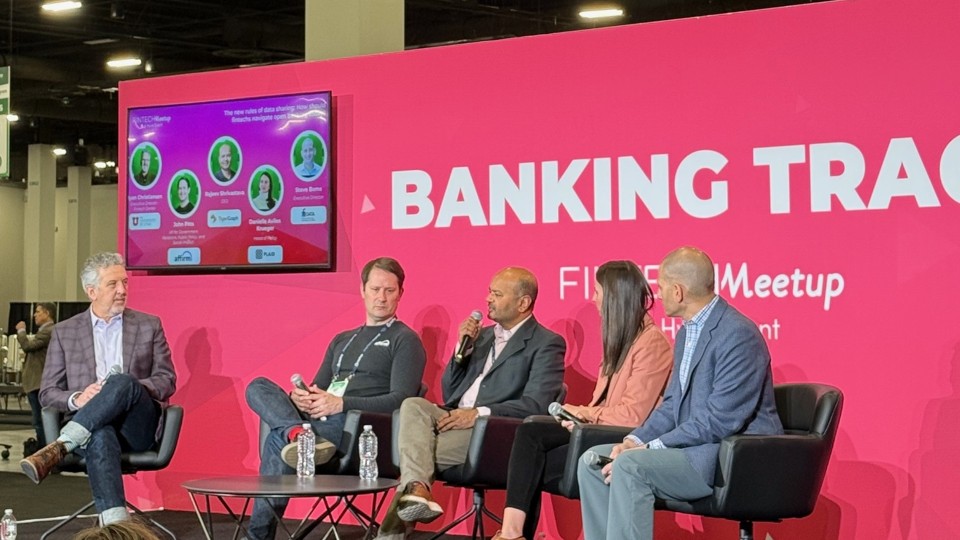
Last week at Fintech Meetup 2026 in Las Vegas, the atmosphere was a clear signal: open banking has moved from experimentation to infrastructure. I had the privilege of joining the panel, “The new rules of data sharing: how should fintechs navigate open banking today?” alongside Steve Boms Executive Director – FDATA North America, Danielle Aviles Krueger, Head of Policy Plaid, @John Pitts, VP Public Policy at Affirm and moderated by Ryan Christiansen Executive Director, University of Utah Fintech Center had a very candid discussion on where things stand.
The room was laser-focused on a single challenge: fulfilling CFPB Rule 1033 mandates while turning compliance into a strategic advantage. But compliance is not the problem, architecture is. Here are the takeaways and the responses I shared regarding how TigerGraph is helping institutions navigate this new landscape.
1. Navigating the Regulatory “Shifting Sands”
In an environment where rules evolve weekly, the biggest mistake is “hard-coded” compliance. Most systems are designed to pass audits, not to adapt. If you build a rigid system to satisfy today’s specific paragraph, you will be tearing it down by next year.
- Build for Logic, Not Rules: Regulations change, but the underlying relationships don’t. I strongly recommend using a flexible graph schema that allows you to add new regulatory attributes without rebuilding your entire data pipeline.
- Proactive Governance: Explainability must be native to the system, not added later. I don’t think you should wait for the audit. It is best to implement AI governance that provides “explainability” by default. If you can’t show why a model flagged a transaction, you are already behind the regulatory curve.
2. The 2026 Fee Battleground: Trust as a Commercial Asset
As “free” data sharing ends, the market is shifting from access to accountability. TigerGraph acts as the Trust Engine that turns a compliance headache into a commercial asset. We discussed viewing open banking as a security filter rather than a hole:
- For Banks (The Fraud Shield): Fraud is not a transaction, it is a network. Link APIs with internal ledgers to spot multi-hop fraud rings and synthetic identities in real-time.
- For Fintechs (Signal over Noise): Data quality is now a competitive differentiator. Verified data connections replace brittle “screen scraping,” leading to cleaner, faster KYC.
- For Consumers (Permissioned Protection): Trust becomes monetizable. Users gain a secure ecosystem where their identity is harder to steal, justifying the shift toward fee-based models.
3. Solving the Liability Stalemate with “Provable Accountability”
TigerGraph transforms liability from a “he-said, she-said” negotiation into a deterministic system based on evidence.
- Digital DNA: Every interaction is captured as part of a connected system. An immutable map of every data exchange allows multi-hop graph traversal to pinpoint failure points in milliseconds.
- Pre-emptive Risk Gates: Risk must be prevented at the point of interaction, not analyzed after the fact. Link identity (KYC) with real-time behavior (KYT) to flag bot-driven API calls at the gateway before a leak occurs.
- The “Shared Truth” Layer: A shared graph eliminates ambiguity. Both parties see the same forensic evidence trail, slashing dispute resolution time and legal discovery costs.
The Bottom Line
When you treat data as a network rather than a series of isolated silos, compliance becomes a natural outcome of the architecture.
The winners of Fintech Meetup 2026 will be the firms that keep their architecture modular. If a new regulation is introduced tomorrow, you should be updating queries, not rebuilding systems. This is the difference between systems built for compliance and systems built for longevity.
Is your data architecture a rigid wall or a flexible map? If you are rethinking this, we should talk.