
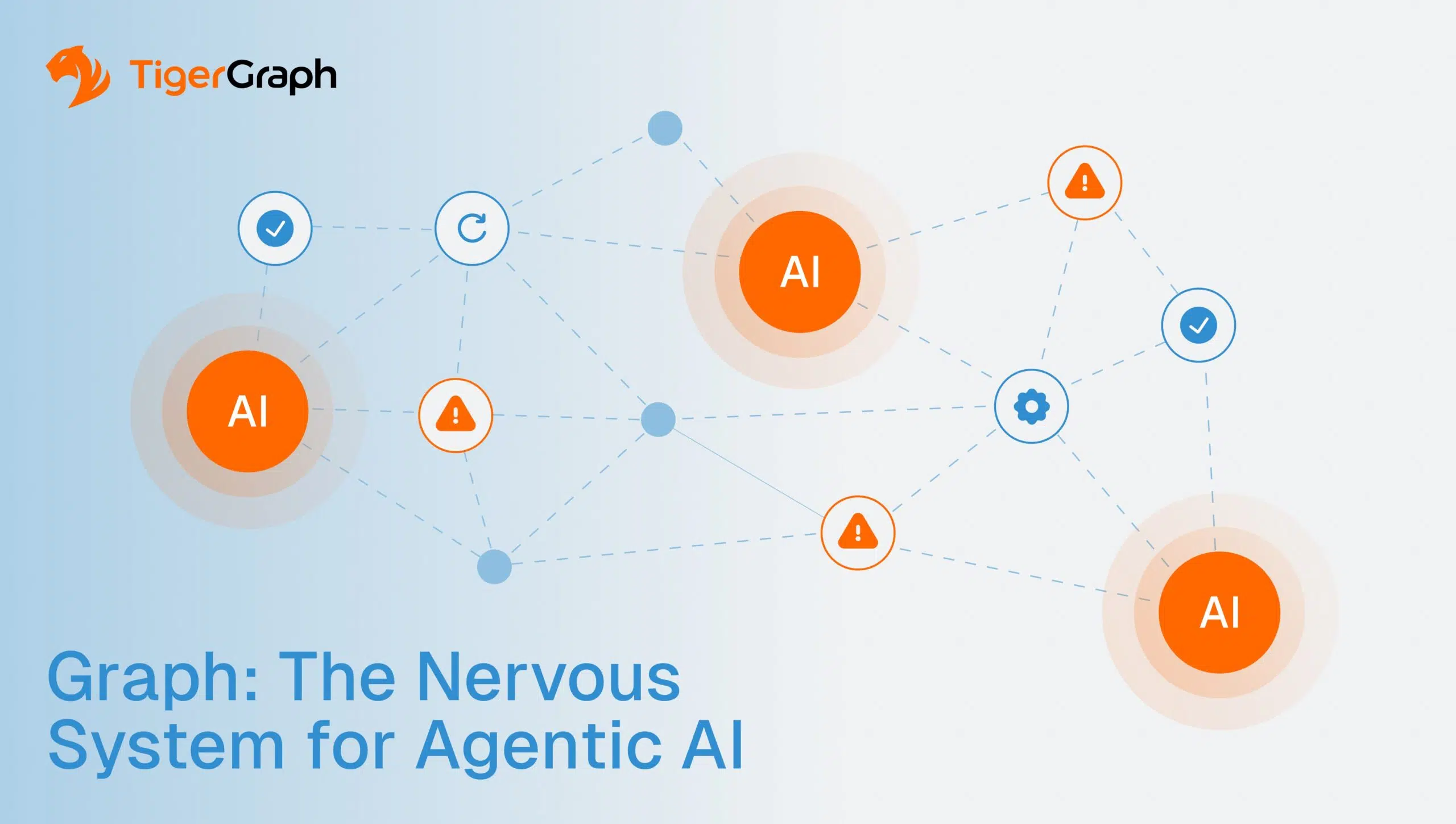
Graph: The Nervous System for Agentic AI
Why agents need more than prompts—they need connected intelligence.
Agentic AI is evolving fast. We’ve moved beyond simple tools that complete tasks and entered an era where autonomous agents can plan, act, collaborate, and even adapt to their environment. But no matter how clever your prompts or how powerful your model, autonomy falls apart without connected context.
That’s why graph technology isn’t just useful, it’s foundational. In the same way a nervous system allows a living being to interpret signals, coordinate actions, and respond to change, graph acts as the operational nervous system of agentic AI. It connects the pieces, enables awareness, and turns agents from isolated actors into situated, intelligent systems.
And TigerGraph delivers that nervous system at enterprise scale.
From Prompted Output to Situated Intelligence
Most AI agents today operate like really smart assistants stuck in a loop. You give them a prompt—a task or a goal—and they respond. Maybe they follow a predefined script, maybe they chain together multiple steps with some clever reasoning. But behind the scenes, it’s still surprisingly shallow.
These agents don’t really understand where they are, what they’ve already done, or how their actions fit into a larger context. They can’t recall past interactions the way a human would. They can’t tell if two tasks conflict, or if a previous decision is shaping what’s happening now. They’re executing commands, not navigating a world.
That’s because the infrastructure powering most of these systems is still built on a foundation of flat memory, disconnected data sources, and stateless execution. It’s like trying to run a city using only sticky notes. Nothing is truly linked. Nothing is aware of cause and effect, or able to reason through messy real-world dynamics.
If we want agents to stop reacting and start reasoning, we need to give them structure.
Structure means:
- A way to connect people, systems, history, and goals—not just recognize them in isolation.
- A way to reason about what happened before, what’s happening now, and what constraints exist in the environment or organization.
- A way to adapt as relationships change, goals evolve, and new information comes in—because that’s how the real world works.
Graph is that structure.
It gives AI agents a map, not just a memory. With a graph, agents can understand relationships, navigate context, and make informed decisions grounded in their surroundings, not just their last prompt. And that’s the difference between an assistant that answers and an intelligent agent that understands.
Why Graph Is the Nervous System and Not Just a Database
Your nervous system does far more than store information. It senses the world around you. It interprets signals in real-time, coordinates your movements, adapts to changes, and helps you respond appropriately—even under pressure. It keeps you aware, connected, and functional.
That’s exactly the kind of intelligence we need to build into AI agents. Not just recall, but real awareness. Not just output, but context-driven action. And that’s where graph technology comes in.
When it’s embedded into agentic systems, graph becomes more than just a data model. It acts as the nervous system of the entire architecture—the layer that makes agents truly responsive and situationally aware. Graph is the connective tissue between:
- Memory and action – helping agents remember what’s already happened so they can act with continuity and foresight.
- Intent and impact – allowing them to understand how their decisions ripple outward through people, systems, and other agents.
- Entities and environment – giving agents a model of the world they’re in, not just the task they’re doing.
This isn’t some abstract concept. It’s the real-world difference between an LLM that spits out an answer and an agent that knows who it’s working for, why it’s taking that action, and how to adjust as conditions shift.
TigerGraph makes this real. It’s not just a backend. It’s the operational nervous system for next-generation agents enabling them to think in context, act with purpose, and function inside complex, multi-agent, multi-stakeholder ecosystems.
What the TigerGraph Graph Database Adds to the Nervous System
Many graph databases can model relationships, but few can support real-time, enterprise-grade intelligence for autonomous agents. Here’s where TigerGraph stands apart:
- Schema-first modeling: Define complex relationships up front: Roles, teams, workflows, trust layers so agents have a reliable context for decision-making.
- Parallel graph traversal: TigerGraph’s native engine lets agents query across deep relationship chains in milliseconds, without sacrificing speed or scale.
- Streaming graph updates: The graph isn’t a static map. With TigerGraph, it evolves in real time, reflecting what just happened, what’s changed, and what matters now.
- Integrated AI and GNN support: Agents can reason not only across static connections, but dynamic patterns using graph neural networks or custom ML pipelines that learn from structure, not just content.
The result? Agents that know what they’re doing, why it matters, and what to do next.
Situational Intelligence That Adapts
Imagine a network of agentic systems managing vendor onboarding for a global enterprise. One agent vets documentation, another handles compliance checks, and a third sets up access credentials.
Now imagine:
- A vendor name triggers a watchlist match.
- The compliance agent adjusts the workflow.
- The credentialing agent sees the escalation and pauses provisioning.
- A risk agent is activated and begins multi-hop investigation based on known relationships.
This is not prompt chaining. It’s real-time, situational reasoning powered by graph.
TigerGraph enables these agents to share structured context, adapt to new inputs, and coordinate behavior across the system. And that’s not just intelligence, it is system-level awareness.
Build AI Agents That Understand the World They Work In
Autonomy without structure is fragility, and prompting without context is guesswork.
If you want your agents to be more than reactive tools and understand the environment they’re acting in, they must adapt to the dynamics around them, and work as intelligent components in a larger system. Accomplishing this requires more than LLMs—you need graph.
TigerGraph is a graph database and the nervous system for agentic AI, offering the infrastructure to build agents that observe, adapt, and align.
Build AI Agents That Think, Not Just React.
Your agentic AI doesn’t just need data—it needs awareness. TigerGraph provides the connective intelligence that turns inputs into understanding, and actions into informed outcomes.
Explore TigerGraph Cloud for free and bring your agents to life with graph-native situational intelligence. https://tgcloud.io