
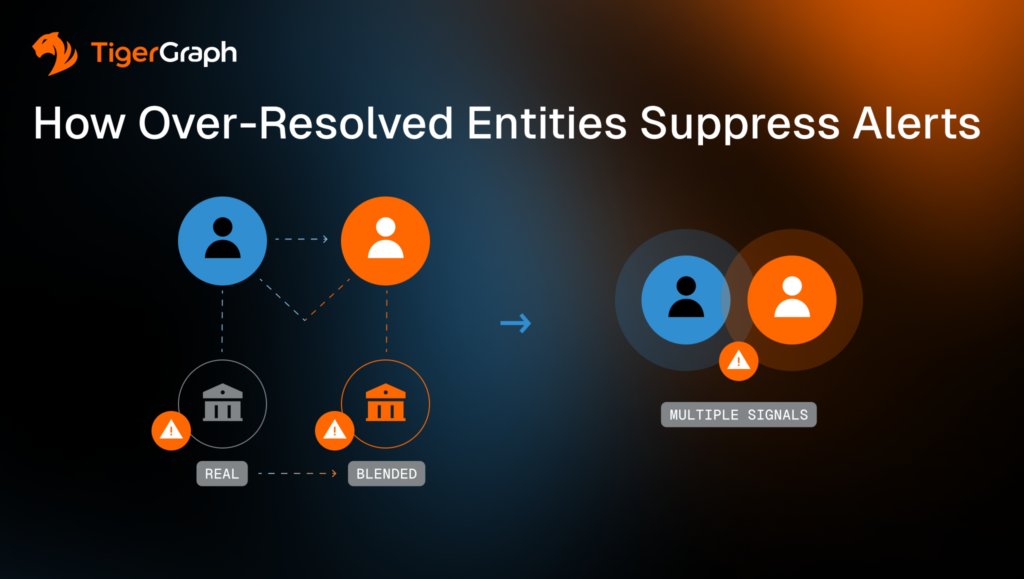
How Over-Resolved Entities Suppress Alerts
Most monitoring failures are discussed as detection problems, meaning missed rules, weak thresholds or gaps in coverage. Less attention is paid to a quieter failure that sits upstream of detection and quietly reshapes what the system can see: Over-resolved entities.
When entity resolution collapses multiple real-world identities into a single profile, alerts do not disappear because risk is absent. They disappear because risk is blended, averaged or suppressed inside an entity view that no longer represents a coherent subject.
This is how false negatives form even when detection logic behaves exactly as designed.
Key takeaways
- Over-merging can suppress alerts even when risky behavior is present.
- Blended entity views dilute signals and alter how thresholds, baselines, and suppression logic behave.
- False negatives often originate in entity structure, not in detection logic.
- Graph-based analysis helps surface where merged entities hide conflicting behavior and exposure.
To understand why these false negatives form, it helps to look at how detection systems depend on entity resolution in the first place.
Why False Negatives Often Start With Entity Resolution
Detection systems assume that the entity being evaluated represents a single, coherent subject. Transaction monitoring, behavioral baselines, alert thresholds and suppression rules all rely on that assumption.
When an entity is over-merged, the assumption breaks.
Distinct behaviors, usage patterns and risk profiles are treated as belonging to one identity. This does not always produce obvious contradictions. In many cases, it produces something more subtle.
It produces normal-looking averages.
High-risk activity can be absorbed into a larger pool of unrelated low-risk behavior. This means thresholds are no longer crossed and alerts no longer fire. Suppression logic activates because the merged entity appears established, previously reviewed or historically low risk.
Nothing looks broken, but risk is no longer visible.
When this assumption breaks, its effects surface in a small set of repeatable operational patterns.
How Over-resolved Entities Suppress Alerts in Practice
This failure mode tends to appear in a small number of recurring patterns.
Risk dilution through aggregation
When multiple identities are merged, high-risk behavior can be blended with unrelated low-risk activity. Scoring models and rules evaluate the combined view rather than the underlying fragments. The result is a lower apparent risk profile, even though the risky behavior persists.
Alerts suppressed by inherited history
Merged entities inherit history that may not belong to all underlying identities. Prior clearances, account age, or historical trust signals can suppress alerts that would have fired if the activity were evaluated independently.
Conflicting behaviors hidden inside one profile
Incompatible patterns coexist without triggering review. Because the system treats them as a single entity, contradictions are normalized instead of flagged.
Repeated remediation without resolution
Teams adjust thresholds, retrain models or tune rules, but the same issues recur. The root cause is not detection logic. It is an entity view that no longer represents a single subject.
None of these failures requires bad rules; they occur because of a distorted identity surface.
What makes these patterns persistent is how difficult they are to see using traditional, record-centric views.
Why Flat Views Struggle to Catch Over-merge Failures
Over-merge failures are often obscured. From a record-centric or flat view, the entity looks complete. It has attributes, history and activity across channels and time.
What is missing is structural clarity.
Flat views make it difficult to see whether behaviors, relationships and activity clusters actually belong together or only appear coherent because they were forced into a single profile. Without examining how evidence connects internally, teams cannot easily identify where aggregation has gone too far.
This is why false negatives caused by over-merging often persist across model versions, rule changes and review cycles.
Addressing this gap requires examining how evidence holds together structurally, not just how it appears in isolation.
What Connected Analysis Adds
Connected analysis shifts the focus from attributes to structure. So, instead of asking whether an entity looks risky overall, it asks whether the evidence that makes up the entity belongs together.
This approach supports alert quality in several ways.
It exposes internal separation
Graph analysis can show whether behaviors, devices, accounts or relationships form distinct sub-clusters inside a merged profile. Weak or fragmented connectivity is often the first sign that aggregation has exceeded structural coherence.
It makes dilution visible
By examining how risk signals are distributed across connected components, teams can see where high-risk evidence is being absorbed into unrelated activities.
It preserves paths as evidence
When alerts are suppressed, connected analysis allows teams to show which relationships and behaviors contributed to that outcome. This supports QA, escalation review and model governance.
It separates structure from judgment
The graph returns connected context. Decisions about splitting, escalation or suppression remain governed by policy and human review.
Making structure visible creates a clear path from diagnosis to practical remediation.
Applying this Insight Operationally
Reducing false negatives caused by over-merging does not require abandoning automation. It requires adding structural checks upstream.
Programs typically benefit from:
- Monitoring for internal fragmentation within resolved entities
- Reviewing alert suppression decisions when merged profiles contain conflicting behavior
- Prioritizing remediation where aggregation affects detection outcomes
- Treating repeated suppression as a signal of possible resolution failure, not reviewer error
When alert suppression changes materially after a merge, that merge should be reviewable. Entity structure should be part of the explanation, not an assumption.
How TigerGraph Fits the Workflow
The operational challenge is understanding how entity structure determines whether alerts appear at all.
Graph workflows support this by storing relationships directly and returning connected context as part of the output. Teams use this to:
- Examine whether merged entities contain structurally distinct neighborhoods
- Identify where aggregation changes risk visibility
- Review suppression decisions with connection-level evidence
The system does not decide whether an alert should fire. It provides the structural clarity needed to understand why an alert did or did not appear.
When entity resolution collapses distinct identities into a single profile, risk does not disappear. It becomes harder to see.
By making internal structure visible and reviewable, teams can identify where merges suppress alerts, dilute signals and undermine confidence in outcomes. This allows remediation to focus on the failures that matter most to detection, escalation, and auditability.
Over-resolved entities quietly change what the system can detect, and graph technology helps head this off. Contact TigerGraph to see how connected, reviewable identity context helps teams surface suppressed alerts and correct over-resolved entities before they distort outcomes.
Conclusion
Over-resolved entities don’t break detection, they quietly change what gets seen. When distinct identities are collapsed into one profile, risk doesn’t disappear. It gets diluted, averaged, and often suppressed. The system still runs. The alerts just stop showing up where they should.
This isn’t a detection problem. It’s an identity problem. You don’t fix it by tuning rules. You fix it by making entity structure visible and verifying that what’s been merged actually belongs together. Because detection is only as good as the entity it evaluates.
Frequently Asked Questions
1. What are Over-Resolved Entities and How do They Suppress Risk Alerts?
Over-resolved entities occur when multiple identities are merged into one profile, causing risk signals to blend and reducing the likelihood that alerts are triggered.
2. Why do False Negatives in Fraud Detection Often Originate From Entity Resolution?
False negatives often originate from entity resolution because merged identities distort behavior, causing detection systems to evaluate averaged or diluted risk signals.
3. How does Merging Multiple Identities Into One Profile Distort Risk Signals?
Merging identities distorts risk by combining unrelated behaviors, lowering apparent risk levels and masking high-risk activity within broader low-risk patterns.
4. How can Organizations Detect When Entity Resolution is Hiding Risk Instead of Revealing it?
Organizations can detect hidden risk by analyzing structural inconsistencies, such as fragmented clusters or conflicting behaviors within a single entity profile.
5. What Role Does Structural Analysis Play in Improving Alert Accuracy and Detection Quality?
Structural analysis improves accuracy by evaluating how data connects, ensuring that risk signals are assessed within the correct context rather than diluted through aggregation.