
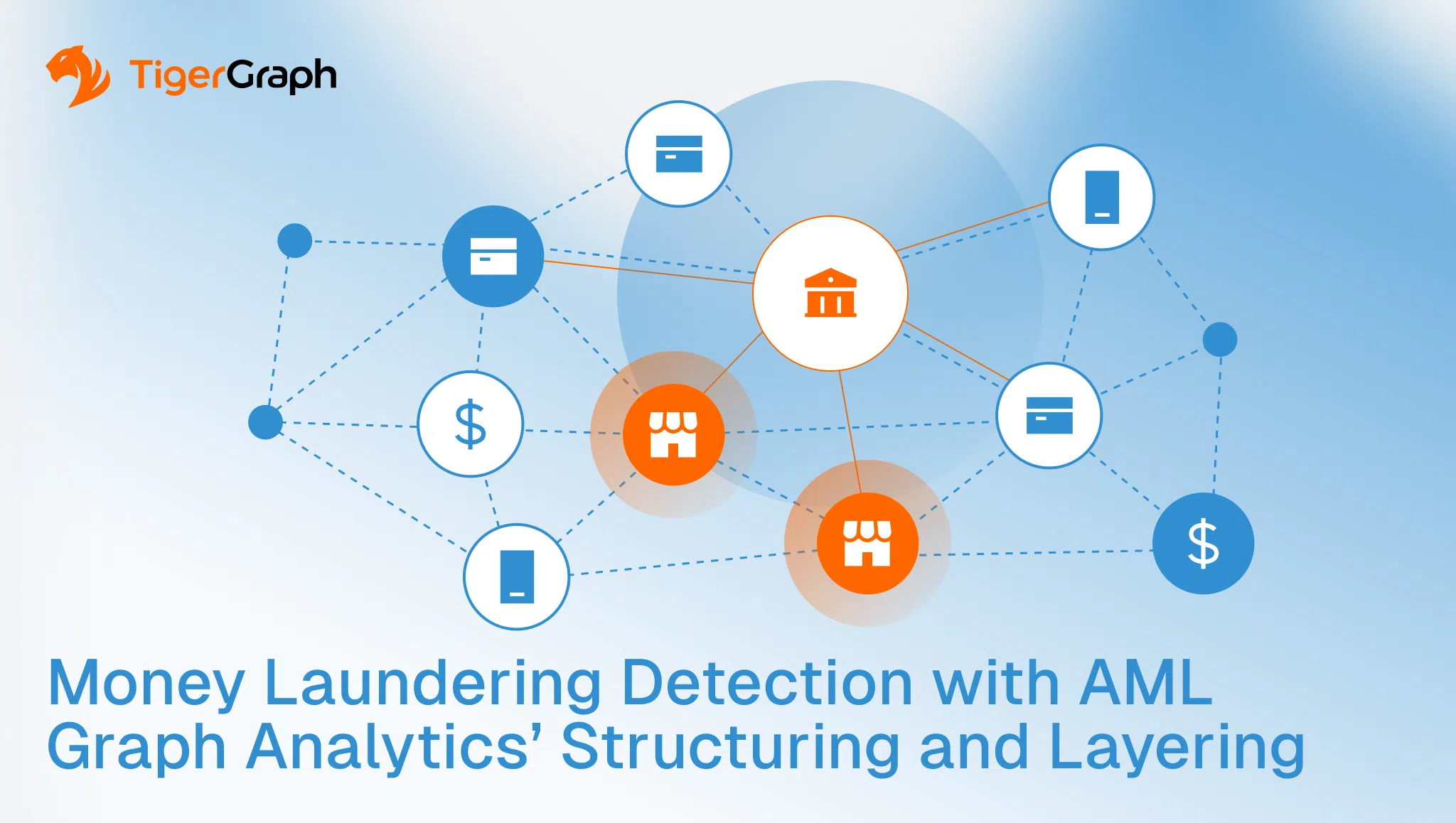
Money Laundering Detection with AML Graph Analytics’ Structuring and Layering
Funds move through accounts, intermediaries, shell companies and payment channels in ways designed to break the trail.
Traditional transaction monitoring tools flag isolated events but miss suspicious activity patterns that are part of a bigger story and only make sense when you view related accounts, people, and activity together in a connected-entity view. This means that critical connections can sit right next to each other in the data but remain invisible unless the information is analyzed as a network.
AML graph analytics helps teams see how money moves through that network by making relationships queryable, not implied. It turns structuring, layering and other evasive behaviors into recognizable patterns instead of scattered activity.
Key Takeaways
- Structuring and layering are network problems, not single-transaction problems.
Suspicious behavior often only becomes visible when accounts, entities and transactions are analyzed together in a connected view.
- Graph analytics exposes patterns traditional monitoring misses.
Multi-hop tracing reveals splitting, layering chains, reconsolidation and suspicious intermediaries without manual data stitching.
- Banks already have the data—graphs make it usable.
Connecting existing transaction, KYC and ownership data into a graph model turns scattered records into actionable financial crime insights.
- Advanced network analytics strengthen AML detection.
Community detection, flow analysis and centrality scoring identify coordinated and evasive behavior beyond static rules.
- TigerGraph enables real-time, enterprise-scale AML investigations.
High-performance graph traversal, entity resolution and AI integration support production-ready structuring and layering detection.
Why AML Programs Struggle With Structuring and Layering
Structuring and layering are designed to slip past monitoring tools that look at transactions one by one. Many transaction monitoring stacks evaluate each payment, transfer, or withdrawal as a standalone event before the broader network context is assembled. This approach works best for single-event rules, not network-based money laundering detection.
Criminals know this. They break large movements of money into many smaller ones, route funds through multiple intermediaries, and create activity patterns that appear harmless until all the pieces are connected.
The difficulty is not that banks lack data. It is that the data is scattered and often examined in isolation.
Financial institutions face several challenges when capturing financial crime analytics.
- Transaction information sits in separate systems for cards, wires, ACH, digital banking, and internal transfers. These systems often do not “see” one another.
- Customer and ownership records may be incomplete or inconsistent, which leads to duplicate identities or unclear links between related accounts.
- Criminal networks move across several hops, with activity that can span several relationship steps (for example, account → counterparty → intermediary → destination), which can be difficult to review with row-by-row monitoring alone.
- Static rules age quickly, requiring tuning to keep pace with laundering tactics that evolve and adapt much faster than rule sets can be updated.
Structuring and layering succeed because they hide in the spaces between these systems. Each individual action looks ordinary. The suspicious behavior only emerges when all the actions are viewed together and the relationships between them become visible.
Graph analytics closes those gaps. By connecting the information banks already have, it reveals how transactions, customers, accounts, devices and behaviors relate to one another, making it possible to detect patterns that traditional AML tools overlook.
How a Graph Database for AML Detects Structuring and Layering
A graph database for AML represents accounts, customers, devices, merchants and transactions as points in a connected network, with the movement of funds drawn as links between them. This transaction monitoring mirrors how laundering operates in real life. Money moves, branches and loops back. It hides in the structure of the activity, not in any single row of data or single transaction record.
Once activity is modeled as a network rather than a table, the behaviors behind structuring and layering become much easier to see.
- Splitting Patterns (Structuring)
Structuring involves breaking a large amount of money into many smaller transfers to avoid detection thresholds. In a graph, this shows up as one source node fanning out into multiple low-value transactions in a short window of time. Analysts can view the entire branching pattern at once instead of scanning dozens of isolated records that never appear connected in a spreadsheet. - Layering Chains
Layering hides origin and ownership by routing funds through several accounts, often across institutions or jurisdictions. Graph traversal follows these paths step by step, revealing sequences that traditional tools miss because the transactions live in separate tables, systems or time ranges. The chain becomes visible as a continuous path rather than a scattered trail. - Integration
After funds are split and layered, they often converge again. Integration can be hard to spot with table-based queries unless the workflow already knows which accounts to connect and how far to expand the search. In a graph, the moment multiple paths flow back into the same account, that node stands out. - Suspicious Intermediaries
Some accounts behave like hubs, repeatedly passing money between unrelated entities with no clear business purpose. AML graph analytics can highlight these accounts because their connectivity and repeated routing roles become measurable. Their role in the network becomes obvious, even when the individual transactions appear benign.
Table-based queries can handle many AML needs. When a review requires repeated “follow-the-money” steps across accounts, intermediaries, and time windows, a graph model can reduce the manual stitching needed to assemble the full pattern. Graph analytics is built for exactly this kind of reasoning, which is why it consistently outperforms table-based approaches in detecting structuring, layering and other forms of financial crime.
The Data Required for AML Graph Analytics
Graph analytics does not require new datasets. It requires banks to connect the datasets they already have, linking them so investigators can query connections consistently across workflows.
Typical sources include
• account and ownership records
• Know Your Customer (KYC) and customer profile information
• transaction histories across payment rails
• merchant information
• device IDs and login activity
• internal product relationships
• sanctions and watchlist results
When these are linked in a graph model, laundering stops hiding in individual records and becomes a visible pattern of relationships.
The Cross-Bank Challenge
Structuring may take place inside one institution while layering unfolds across several others. Graphs do not remove this limitation, but they can strengthen what is visible inside the institution’s perimeter and make the internal evidence easier to review and share.
Banks can:
• reveal the portion of the activity happening inside their perimeter
• produce connected graph outputs regulators can use in cross-bank investigations
• identify where suspicious paths suddenly break, often indicating the funds left the institution
Graphs give banks the clearest possible view of what is visible, even if global tracing requires government stitching.
How TigerGraph Supports AML Detection
AML teams deal with fast-moving data and extremely complex relationships. Suspicious behavior often hides several hops away from the first alert, and the volume of transactions grows constantly. TigerGraph is a graph database for AML designed for production-scale workflows that support money laundering detection, including structuring and layering investigations. It keeps the full structure of the data intact and lets investigators move through it quickly and accurately.
Real-Time Multi-Hop Transaction Tracing
Money laundering travels through long chains of accounts, devices, merchants and intermediaries. TigerGraph supports multi-hop transaction tracing by following connections across accounts, intermediaries, devices and destinations within program-defined limits.
In environments that require near-real-time review, this can be implemented as real-time graph traversal, where the workflow expands from an alert to connected entities and returns the path as evidence.
This helps teams detect structuring patterns where one source splits into many smaller transfers and trace these long layering chains. Banks can identify circular flows that send funds back through related accounts and spot convergence points where fragmented funds come back together.
These insights are hard to produce in traditional databases because they require following relationships step by step.
High-Performance Graph Analytics
TigerGraph supports advanced analytical techniques that reveal suspicious behavior inside complex financial networks. These include:
- community and cluster detection to identify groups of accounts acting together
- connected-component analysis to understand how entities relate across large datasets
- flow analysis, to track how money moves through the system
- centrality scoring to highlight accounts acting as hubs or bottlenecks
- anomaly detection to surface unusual patterns that typical rules miss
These algorithms help analysts see both local and network-wide risks in ways that event-based monitoring cannot.
Entity Resolution AML for a Clean Network View
AML investigations fall apart when duplicate or inconsistent identities spread across systems. TigerGraph brings all records for a real person or entity together, including accounts, aliases, devices and other identifiers. This creates a single connected view of who is involved, how they are related and where they appear across the network. A clean entity view dramatically reduces false positives and improves the accuracy of downstream alerts.
Integration with AI and Hybrid Search
AI models perform better when their reasoning is grounded in real structure. TigerGraph provides that grounding. It can:
- supply graph context to a large language model (LLM) before analysis so the model starts with accurate relationships
• validate model-generated findings by checking them against the true transaction structure
• provide explainable paths and connections that reduce ambiguity and prevent misinterpretation
This gives AML teams the benefit of AI without the risk of “black-box” conclusions.
Enterprise-Scale Performance
AML data grows continuously. Transaction volumes increase, new channels emerge and customer networks become more complex. TigerGraph is designed to maintain low latency even when graphs contain billions of relationships. This supports near real-time detection workflows where delays are unacceptable.
Summary
Money laundering works by breaking connections apart. Graph analytics puts those connections back together with AML graph analytics. By modeling accounts, transactions, merchants and behaviors as a network, financial institutions can detect structuring and layering patterns that traditional systems miss.
TigerGraph strengthens transaction monitoring work with real-time traversal, advanced analytics, entity resolution and hybrid AI integration that supports enterprise-scale AML programs.
If your team is evaluating a graph database for AML or needs stronger detection of structuring and layering, TigerGraph can help. Connect with our team to review AML graph models, explore reference architectures and see how high-performance graph technology improves financial crime detection.
Frequently Asked Questions
1. What is Structuring in Money Laundering and How can Banks Detect it More Effectively?
Structuring in money laundering is the deliberate splitting of large sums of money into multiple smaller transactions to avoid regulatory reporting thresholds and monitoring triggers. Detecting structuring requires identifying transaction patterns across accounts, time windows, and related entities—not just single transfers. Graph analytics improves detection by revealing branching patterns, shared intermediaries, and coordinated activity across multiple accounts that would otherwise appear unrelated in traditional transaction monitoring systems.
2. How does Layering Differ From Other AML Red Flags, and Why is it Harder to Identify?
Layering is a money laundering technique designed to obscure the origin of funds by moving them through multiple accounts, entities, jurisdictions, or financial institutions. Unlike simple threshold breaches or single suspicious transfers, layering creates multi-step transaction chains that only become visible when analyzed as a network. Graph-based AML systems can trace multi-hop fund flows, detect circular movements, and highlight reconvergence points that table-based systems often miss.
3. Why are Traditional AML Transaction Monitoring Systems Insufficient for Network-Based Financial Crime?
Most legacy AML systems evaluate transactions individually using static rules or threshold logic. This approach struggles to detect coordinated activity, shared intermediaries, mule networks, or cross-channel laundering patterns. Financial crime today behaves like a network, not isolated events. Graph analytics enables connected analysis across accounts, devices, merchants, and ownership records, reducing manual data stitching and improving detection of complex money laundering schemes.
4. What Data Sources are Most Important for Building an Effective AML Graph Model?
An effective AML graph model connects customer profiles, account ownership records, transaction histories across payment rails (ACH, wires, cards, digital banking), device identifiers, merchant data, sanctions lists, and internal product relationships. The key is not collecting new data, but linking existing data so investigators can analyze relationships consistently. When these datasets are modeled as a graph, suspicious money movement patterns become structurally visible instead of buried in siloed systems.
5. How can Graph Analytics Improve AML Explainability and Regulatory Reporting?
Regulators increasingly expect financial institutions to demonstrate clear investigative reasoning behind suspicious activity reports (SARs). Graph analytics strengthens explainability by producing traceable transaction paths, visual network evidence, and measurable risk signals such as centrality, flow concentration, and cluster behavior. This allows compliance teams to present defensible, evidence-backed narratives rather than rule-trigger summaries, improving audit readiness and regulatory confidence.