
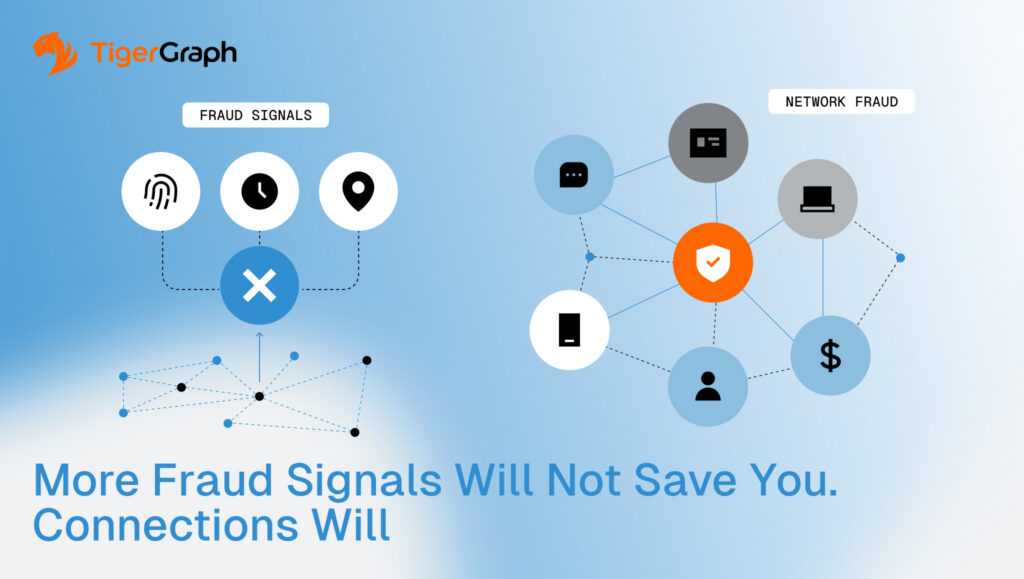
More Fraud Signals Will Not Save You. Connections Will.
Fraud teams today can collect hundreds of behavioral and technical signals during a single verification session.
- Device fingerprints.
- IP reputation.
- Session timing.
- App store attributes.
- Mobile device movement signals.
- Session switching patterns.
Ten years ago, the challenge was signal scarcity. Teams wished they had more visibility. That is no longer the problem. The problem today is signal saturation. Modern fraud systems are overwhelmed because they struggle to understand how that data connects. And that distinction changes everything.
Key Takeaways
- Capturing more signals does not automatically improve fraud detection.
- Stacking isolated signals can increase noise and false positives.
- Synthetic identity and GenAI-driven fraud operate across networks.
- Signals gain meaning when evaluated in relational context.
- Graph analytics enables multi-layer reasoning across entities.
The Fraud Signal Explosion
Verification workflows can now capture over one hundred attributes in a single interaction. These signals fall into several categories:
- Technical attributes such as VPN usage or device configuration
- Behavioral patterns such as mouse movement or session timing
- Derived measures such as account switching frequency
On paper, this looks like progress. More signals should mean more precision. But fraud does not stand still, and as defenses improve, fraudsters adapt.
- Synthetic identities reuse devices across accounts.
- GenAI tools automate realistic behavioral patterns.
- Fraud rings distribute activity across mule networks and shared infrastructure.
As adaptation increases, the value of any single signal decreases. This is where stacking enters the conversation.
When Fraud Signal Stacking Stops Working
Signal stacking combines multiple risk indicators to increase detection confidence. It works well when fraud is isolated and predictable, but it struggles when fraud becomes coordinated.
- A VPN flag alone may not indicate fraud.
- Unusual session timing may not indicate fraud.
- A device reset may not indicate fraud.
Individually, these signals are weak. Even together, within a single session, they may remain ambiguous. The shift happens when those same signals appear across connected accounts, shared IP ranges, and coordinated transaction paths.
Now the pattern changes. The signal is no longer just behavioral. It becomes structural.
Traditional rule engines and flat machine learning models evaluate signals within single sessions or single accounts. Coordinated fraud does not operate within those boundaries. It spreads across them. To understand why stacking fails in these cases, we have to look at how modern fraud actually behaves.
Fraud is a Relationship Problem
Fraud today is relational by design.
- Synthetic identities link to shared devices.
- GenAI-driven attacks reuse infrastructure across campaigns.
- Account takeovers cluster around reused credentials and recovery flows.
The central question shifts. It is no longer, “How many signals are present?” It becomes, “How are these signals connected across entities?”
A device used once tells one story, and a device shared across ten accounts tells another. An IP address appearing in a single session may be noise, but the same IP appearing inside multiple high-risk clusters signals coordinated activity. A newly opened account may look clean, yet the same account indirectly connected to sanctioned entities through ownership chains may carry hidden exposure.
These are network-level insights that require tracing relationship paths rather than counting attributes. That is the transition point from stacking signals to modeling structure.
From Fraud Signal Stacks to Fraud Signal Graphs
The next stage in fraud detection is understanding how they connect.
Graph modeling treats users, accounts, devices, transactions, and IP addresses as connected entities. Their relationships are stored explicitly rather than inferred on demand. This changes what fraud teams can see. They can:
- Identify shared infrastructure across accounts
- Detect tightly connected clusters of coordinated behavior
- Trace indirect exposure across ownership or transaction chains
- Evaluate whether a suspicious session sits inside a larger fraud network
Instead of evaluating signals in isolation, organizations evaluate them in context. So, although a single weak signal may be meaningless, ten weak signals connected across a network may indicate organized activity. That difference often determines whether fraud is detected early or after losses escalate.
This structural perspective becomes even more important as automation accelerates.
GenAI Raises the Stakes
Generative AI has made it easier than ever to imitate real users online. Automated bots can now:
- Replicate natural typing and browsing patterns
- Create synthetic profiles that appear realistic
- Randomize session behavior to avoid simple detection rules
In other words, surface-level signals are easier to manipulate.
Fraudsters can make an individual account look normal. They can make a single session appear legitimate. What they struggle to fake at scale is structure.
When fraud spreads across accounts, devices, and infrastructure, the connections between those entities leave patterns behind. Those patterns are harder to disguise than isolated behaviors. Connections remain even when individual attributes change.
This is why fraud detection must move beyond counting signals. The real advantage comes from understanding how signals relate to one another across a network. Not just what exists, but how it connects.
Structural Advantage in Fraud Defense
Fraud detection maturity is no longer measured by the number of signals captured.
It is measured by how well those signals are connected and analyzed.
Organizations that treat risk indicators as isolated data points face increasing false positives and missed coordinated fraud.
Organizations that model relationships explicitly gain visibility into fraud rings, infrastructure reuse, and indirect exposure before damage spreads.
As fraud becomes more distributed and more automated, relationship-aware detection becomes essential.
This is not about replacing signals. It is about placing them within structure.
Moving Beyond Signal Stacks
Collecting 100+ signals per session is technically impressive, but understanding how those signals connect across millions of users is strategically decisive.
TigerGraph enables fraud teams to model users, devices, sessions, transactions, and infrastructure as a connected graph. By storing relationships explicitly and enabling deep traversal across entities, organizations can detect coordinated fraud patterns that flat rule engines and isolated models miss.
Today’s fraud is a network problem.
Reach out today to learn how TigerGraph supports relationship-aware fraud detection at enterprise scale.
Frequently Asked Questions
1. What is The Difference Between Fraud Signals and Fraud Connections in Detection Systems?
Fraud signals are individual indicators like device or behavior data, while fraud connections reveal how those signals link across accounts, devices, and networks—exposing coordinated activity.
2. Why does Adding More Fraud Signals Often Increase False Positives Instead of Accuracy?
Adding more signals increases false positives because isolated indicators create noise without context, making it harder to distinguish legitimate behavior from coordinated fraud.
3. How do Fraudsters Exploit Isolated Signal-Based Detection Systems?
Fraudsters exploit these systems by spreading activity across multiple accounts and devices, ensuring each individual signal appears normal while the broader pattern remains hidden.
4. How does Relationship-Based Analysis Improve Detection of Coordinated Fraud?
Relationship-based analysis improves detection by connecting entities across multiple layers, revealing shared infrastructure, clusters, and multi-step fraud patterns.
5. What Makes Network-Level Fraud Detection More Effective Than Session-Level Analysis?
Network-level detection is more effective because it evaluates how signals propagate across connected entities, identifying patterns that cannot be seen within a single session.