
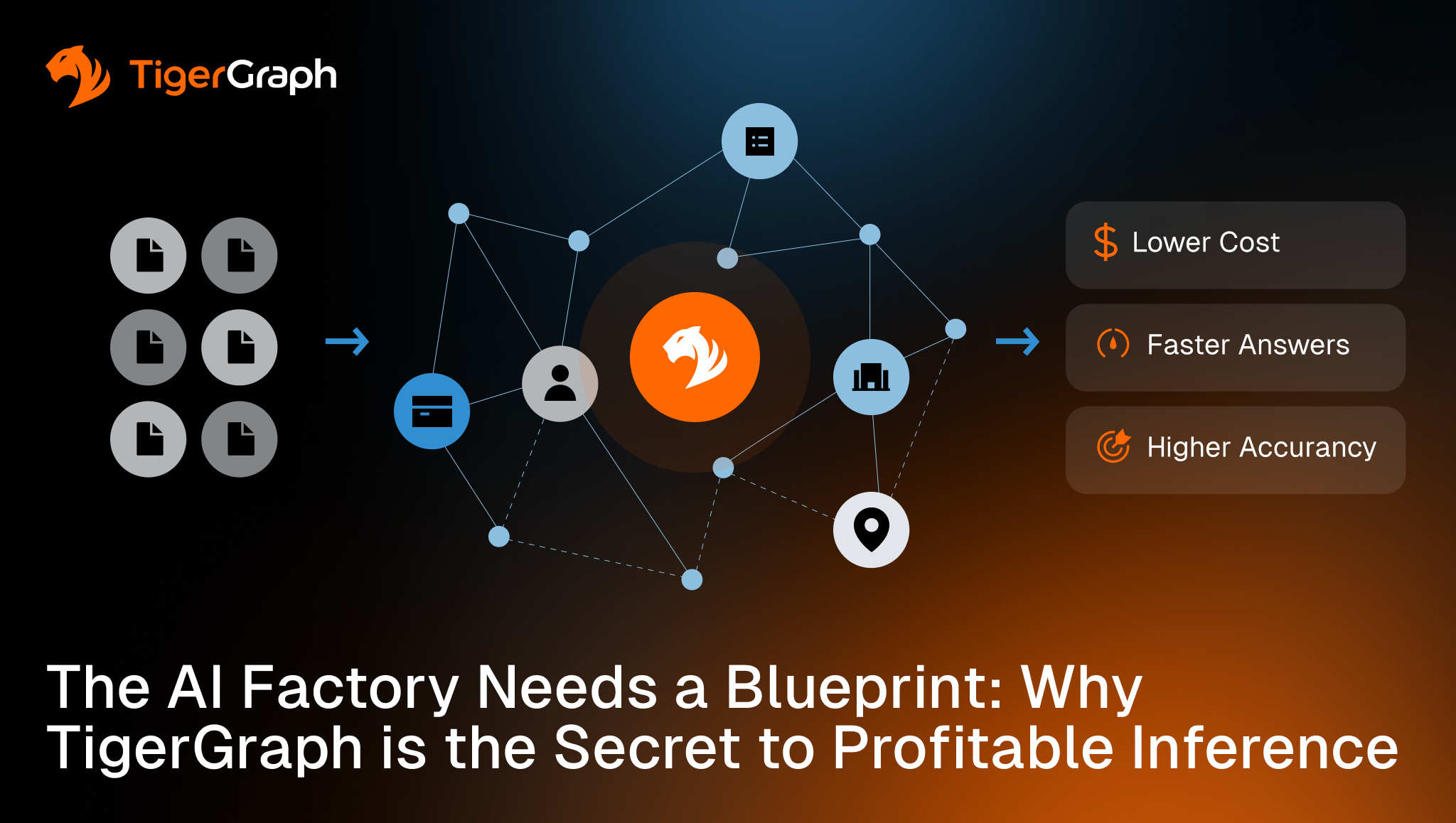
The AI Factory Needs a Blueprint: Why TigerGraph is the Secret to Profitable Inference
At GTC 2026, Jensen Huang announced a fundamental shift in the global economy: we have moved from the era of training to the era of Inference. I think this is not just a model shift, it is a systems shift. Data centers have evolved into AI Factories—industrial-scale plants designed to turn raw data into high-value “Intelligence Tokens.”
But a factory is only as successful as its yield. In the AI world, “yield” is defined by Tokenomics: the cost, speed, and accuracy of every word your AI produces. In my view, yield is ultimately determined by the quality of the inputs and not the sophistication of the model.
If your inference engine is fed vague, approximate, or siloed data, your AI Factory becomes a “token burner”—consuming expensive compute to produce hallucinations or “scrap.” I think we are misdiagnosing this as an LLM problem when it is fundamentally a data architecture problem
“If NVIDIA is building the AI Factory, TigerGraph is building the Blueprint and real-time context layer. Without the Graph, the Agents lack the structure to act efficiently.”
The Problem: The “Context Window” Tax
Most companies today rely on standard Vector RAG. It retrieves data based on “similarity”—finding text chunks that look like the question. Because it’s imprecise, developers are forced to “stuff” the LLM’s context window with dozens of text fragments, hoping the answer is hidden somewhere inside.
I think this approach optimizes for recall, not for correctness.
This creates a massive Token Tax:
- High Latency: Processing thousands of irrelevant tokens slows down the agent’s response time.
- High Cost: You pay for every “maybe” token you send to the inference engine (AWS Bedrock, Vertex AI, Groq).
- Diluted Accuracy: The more noise in the prompt, the more likely the LLM is to miss the signal and hallucinate.
In effect, you are paying to increase uncertainty.
Vector RAG optimizes for recall. It does not optimize for precision, structure, or decision-grade context.
TigerGraph: High-Fidelity Context, Zero Waste
TigerGraph sits in the Retrieval Layer of the stack. It isn’t a generation tool. I think of it as the system that ensures the model is grounded in reality. Instead of feeding the LLM a pile of “probably related” documents, TigerGraph provides the precise Blueprints of the data through GraphRAG.
By traversing relationships in real-time, TigerGraph delivers a “High-Octane”deterministic, explainable subgraph of facts, not probabilistic text fragments. You send fewer tokens, but they are the right tokens. I don’t think the goal is more context. The goal is correct context.
1. Stopping “Money Mule” Fraud Rings
- The Vector Way: The LLM analyzes individual accounts that look similar to past fraud. It misses the hidden network. You send thousands of tokens of transaction history, and the LLM still “guesses.” I would characterize this as pattern matching without understanding.
- The TigerGraph Way: The LLM is given a structured map of a 4-hop fraud ring. It sees that five “normal” accounts share a single burner phone fingerprint three layers deep.
- The Tokenomics: The AI Factory identifies the threat instantly because it’s reasoning over a network of connected facts, not a sea of text.
Outcome: Earlier detection, lower false positives, and materially reduced fraud losses.
2. Global Supply Chain Resilience
- The Vector Way: You feed the LLM 10,000 tokens of news articles and supplier lists. The model spends compute “guessing” dependencies across a fragmented document set.
- The TigerGraph Way: You feed the LLM 200 tokens of exact, multi-hop relationship data. It sees the direct path from a closed port to your Tier 3 supplier.
- The Tokenomics: You get a 100% accurate answer at 5% of the token cost.
Outcome: Faster disruption response and measurable reduction in operational risk.
Why Graph Retrieval Outperforms Vector-Only RAG
TigerGraph’s advantage is most pronounced where relationships are the data. It solves the “Inference Gap” through:
- Multi-hop Reasoning: It traverses connections across entities (e.g., “find all suppliers connected to this risk event within 3 hops”) in a single query—something vectors simply cannot do.
- Structured Knowledge: Entities and attributes are explicitly modeled. The LLM receives precise context rather than fuzzy text chunks ranked by cosine similarity.
- Real-time Traversal: TigerGraph is engineered for speed across trillion-edge graphs. It ensures retrieval never becomes the latency bottleneck in the inference pipeline.
I would summarize this simply: this is the difference between searching for similar text and understanding the system itself.
Solving the “Tokens per Watt” Equation
Jensen Huang noted that “Interactivity is Smartness.” To make AI agents truly interactive and agentic, we must reduce the friction of retrieval.
By grounding the LLM in a Deterministic Knowledge Graph, you transform your inference factory from a creative writer into a precision-engineered reasoning engine. TigerGraph doesn’t make the LLM smarter on its own; it makes the inputs to the LLM decision-grade, explainable, and operationally reliable.
The Bottom Line
Inference engines provide the power, but TigerGraph provides the path. By delivering structured, relationship-aware context, TigerGraph ensures that every token generated by your AI Factory is an investment in accuracy, not a gamble on similarity. It’s a complementary partnership: the inference engine is the engine; TigerGraph is the fuel quality.
TigerGraph doesn’t just run the inference, it makes the inference worth running. Is your AI Factory optimized for profit? Stop burning your token budget on similarity. Let’s talk about how GraphRAG can cut your token waste and maximize your inference ROI.