
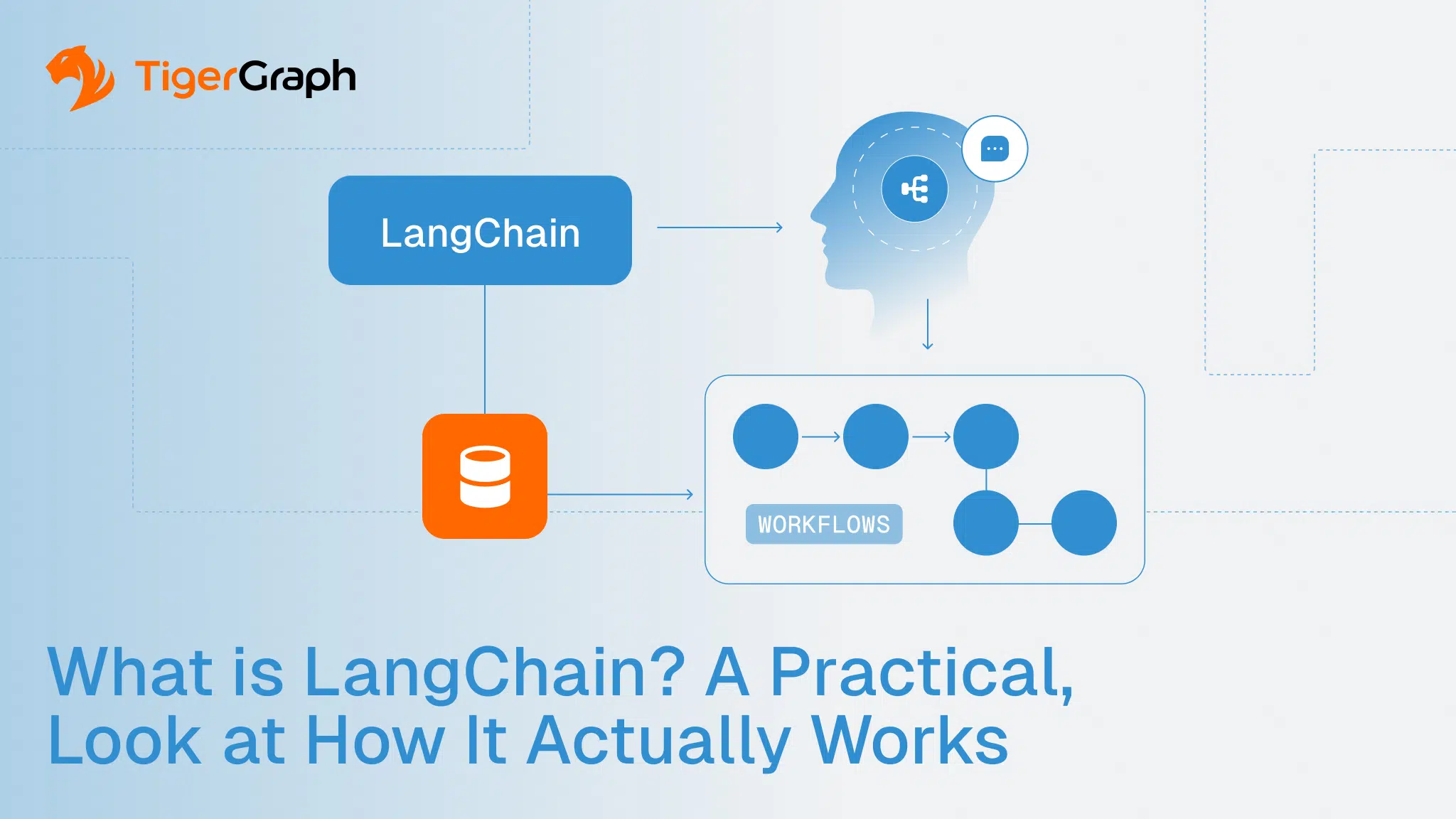
What is LangChain: A Practical, Grounded Look at How it Actually Works
LangChain is a framework for easily building AI applications from large language models (LLMs), data sources, and other tools. It lets users focus on the workflow rather than low-level details.
This article gives a clear LangChain overview, explains how LangChain works, and shows why pairing LangChain with TigerGraph gives enterprises the structure, speed, and context LLMs cannot create on their own.
Why People Keep Talking About LangChain?
LangChain exists because language models are great at generating responses that are fluent but might not be correct. By themselves, they cannot keep track of long reasoning chains, nor decide which tool to use, and they certainly cannot authenticate their own answers.
So, when people search for LangChain, they are often looking for a way to turn an LLM into something more useful than a chatbot guessing at the next word.
LangChain provides the scaffolding around LLMs to make real applications. It manages prompts, attaches tools, creates workflows and lets a model act in a controlled, predictable way.
But even with all that orchestration, an LLM still needs contextual guidance. This is where TigerGraph steps in.
- LangChain manages the workflow.
- TigerGraph anchors it in relationships that actually reflect reality.
LangChain as The Framework Behind AI Workflows
Real AI applications need to do more than just call an LLM one time. They need:
- Preparation: Employ a prompt template to ensure that requests follow predictable guidelines. Then, search for supplementary information to add context and ranking.
- Generation: This could be a single LLM prompt→response, but complex tasks may require a series of LLM prompt→response→evaluate iterations.
- Delivery: The response needs to be validated and transformed, based on the needs of the particular request.
Developers searching for how LangChain works are usually trying to connect an LLM to something concrete, such as documents, APIs, or a database. LangChain makes that possible. But the moment you want context that spans more than one hop of understanding, embeddings hit their ceiling.
This is the gap that graphs fill. Graph context provides factual structure, so the system has a memory that isn’t just token-based guessing. Graph is the tool; LangChain integrates the tool into the workflow.
What Does LangChain Do That an LLM Cannot?
A model alone can’t sequence actions, remember decisions, or interrogate its own output. LangChain can. This is what LangChain does that matters in enterprise work:
- Standardizes how you talk to the model.
- Keeps your workflow modular instead of a spaghetti bowl of prompts.
- Makes retrieval repeatable instead of “sometimes correct.”
- Lets you wrap LLM calls with logic that prevents catastrophic nonsense.
But even the cleanest LangChain design will struggle if the underlying data is unstructured chaos. TigerGraph brings the order. It gives the workflow something real to reason over.
How LangChain Works with External Data (And Why Structure Matters)
Under the hood, LangChain retrieves information using loaders, vector stores, document retrievers, and conversational memory. That works well for text search, but it does not understand relationships.
This is why pairing LangChain with TigerGraph becomes such a powerful combination. Vector search provides similarity and TigerGraph provides semantic structure. One tells you, “These documents seem related.” The other tells you why.
When people ask how LangChain works, the answer is usually incomplete without acknowledging that retrieval is the weakest part of the system. Graph context strengthens it immediately.
Is LangChain Free? Is it Open Source? Here’s the Straight Answer
Yes, the core library is free and open source. A separate company LangChain Inc. offers enterprise tools and services based on LangChain, but the underlying framework is available to anyone.
TigerGraph also offers a free Community Edition for experimentation, which makes combining the two a low-friction way to test hybrid graph-LLM workflows.
LangChain AI: What Happens When You Add Real Structure
Searches for LangChain AI are usually from teams trying to build real retrieval-augmented systems. LLMs can generate fluent answers with confidence, but they cannot anchor themselves to facts.
That is why LangChain plus TigerGraph becomes something different. LangChain organizes the pipeline and TigerGraph accelerates reasoning with actual connections between entities.
- Making multi-hop logic real instead of heuristic.
- Exposing why something appears in the retrieval window.
- Creating explanations instead of vaguely similar embeddings.
- Preventing hallucinations because they only return what exists.
This is where the combination stops being “cool” and starts being operationally useful.
LangChain Framework Architecture (The Real Parts That Matter)
A typical LangChain framework deployment revolves around four components:
| Component | What It Really Does |
|---|---|
| Prompt Templates | Makes prompts consistent for better quality control and user experience |
| Chains | Create multi-step flows LLMs can’t manage alone |
| Agents | Let the model choose tools safely within guardrails |
| Retrievers | Bring external data into the workflow |
TigerGraph slots into the retriever layer, providing high-performance, schema-driven retrieval the model can lean on without guessing.
LangChain Applications That Actually Deliver Value
Here are LangChain applications that work especially well when paired with graph intelligence.
Customer Support Intelligence
LangChain handles classification, rewriting, and workflow routing. TigerGraph connects issues, products, prior cases, and user behavior into something the system can reason over.
Fraud Investigation
Embeddings will tell you two cases “seem similar.”
TigerGraph tells you:
- these accounts share a device,
- that device links to a merchant,
- the merchant links to a suspicious cluster.
LangChain orchestrates the workflow and the graph provides the evidence.
Enterprise Search
LLMs interpret the question; graphs interpret the context.
This is why the combination outperforms vector-only pipelines.
Process Optimization
LLMs summarize workflow states and TigerGraph reveals why they exist.
Together they surface the real bottlenecks.
Why Use LangChain in a Graph-Centered Stack?
There are a dozen ways to answer why use LangChain, but the simplest is this: LangChain gives you control over the model’s behavior.
TigerGraph gives you control over the model’s knowledge. One organizes. One explains. Neither can replace the other.
Tips for Using LangChain with Graph Systems
- Start retrieval design before prompt design.
- Keep embeddings tied to graph entities, not loose documents.
- Use graph filters to constrain the RAG surface area.
- Store reasoning paths so outputs are auditable.
- Test TigerGraph queries directly before piping them into chains.
- Stabilize your schema early—LLM workflows magnify ambiguity.
- Keep vector and graph retrieval cooperative, not competitive.
LangChain Company vs. LangChain Library (The Practical Distinction)
Searches for langchain company or langchain library reflect confusion. The library is open source. The company provides hosted tooling on top of it. You can use one without the other.
TigerGraph integrates with both. The distinction hardly matters once you’re in production.
Table: What LangChain Handles vs. What TigerGraph Handles
| Task | LangChain | TigerGraph |
|---|---|---|
| Prompt management | ✓ | — |
| Multi-step logic | ✓ | — |
| Tool execution | ✓ | — |
| Multi-hop reasoning | — | ✓ |
| Entity-level context | — | ✓ |
| Relationship validation | — | ✓ |
| High-performance traversal | — | ✓ |
Together, they create explainable, grounded AI, instead of offering fluent guesses.
Summary
What is LangChain? A powerful framework for coordinating workflows around large language models. It brings structure to prompts, tools and retrieval.
But even the best LangChain pipeline is only as smart as the data behind it.
Pairing LangChain with TigerGraph gives AI real context, real structure, and real reasoning power. The combination makes hybrid RAG systems faster, more reliable and far more explainable.
Frequently Asked Questions
1. How does LangChain help turn large language models into real applications?
LangChain provides orchestration around LLMs by managing prompts, tools, memory, and multi-step workflows. This allows developers to build reliable applications instead of relying on one-off model calls that lack control, validation, or structure.
2. Why does LangChain still need structured data to work effectively in enterprise systems?
LangChain coordinates how an LLM operates, but it does not supply factual grounding on its own. Without structured data, retrieval relies on embeddings that capture similarity but miss relationships, making it difficult for the system to reason across entities or validate outcomes.
3. How does combining LangChain with a graph database improve AI accuracy?
LangChain manages the workflow, while a graph database supplies entity relationships and multi-hop context. This combination enables AI systems to retrieve information that is not just relevant in language, but accurate in structure—reducing hallucinations and improving explainability.
4. What types of problems are poorly suited for LangChain without graph context?
Problems involving dependency analysis, entity resolution, fraud investigation, supply chain reasoning, or customer intelligence suffer without graph context. These tasks require understanding how things connect, not just how similar they sound.
5. When should teams consider adding a graph layer to a LangChain-based system?
Teams should add a graph layer when AI outputs must be verifiable, auditable, and grounded in real relationships. If a system needs multi-step reasoning, relationship validation, or consistent explanations, graph-based context becomes essential.