
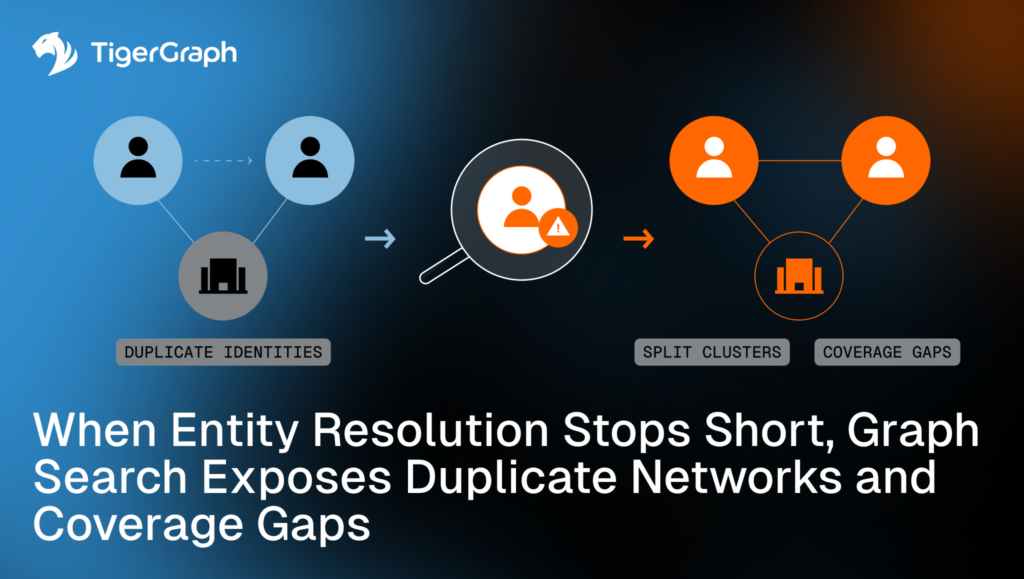
When Entity Resolution Stops Short, Graph Search Exposes Duplicate Networks and Coverage Gaps
Entity resolution (ER) quality issues surface as blind spots. They could be duplicate identities that never converge, clusters that should be connected but are not, or networks that stop expanding even though relevant data exists.
These failures are difficult to detect because they do not always trigger alerts or obvious errors. Resolution appears to function, but coverage is incomplete and confidence is misplaced. Over time, this creates inconsistent reviews requiring repeated remediation and gaps in downstream decision-making.
Graph search supports entity resolution quality assurance by making these structural issues visible and reviewable.
Key takeaways
- Many ER failures persist because teams cannot see what was not connected, not because links were made incorrectly.
- Duplicate networks, split clusters and coverage gaps are structural problems that flat views struggle to expose.
- Graph search allows teams to test resolution completeness by exploring neighborhoods, overlaps and missing connections directly.
To understand why these issues persist, it helps to examine how ER quality is typically reviewed today.
Why ER Quality Issues are Hard to Spot with Record-Level Review
Most ER quality checks focus on individual matches. Was this link correct? Should these two records have merged? Did this attribute justify the decision?
Those checks matter, but they miss a broader question. Is the resolution outcome complete?
Record-by-record review cannot easily show whether:
- Multiple clusters represent the same real-world entity
- A resolved entity stopped expanding too early
- Similar networks exist that were never connected
- Evidence exists but was never evaluated by the resolution process
From a flat perspective, each cluster may look internally consistent. The problem only becomes clear when clusters are compared to one another or examined in the context of the surrounding network.
This is where ER QA often stalls. Teams can verify correctness locally, but they cannot assess coverage globally.
When ER is evaluated structurally instead of record by record, the same failure patterns surface repeatedly.
How Structural ER Failures Typically Show Up
When teams step back and examine resolution outcomes structurally, several recurring patterns emerge.
Duplicate networks that never converge
Multiple resolved entities represent the same real-world subject but remain separate because no single attribute crosses a matching threshold. Each cluster looks valid on its own. Taken together, they indicate fragmentation. This often occurs when identifiers rotate, data sources arrive asynchronously or linkage rules apply unevenly across systems.
Split clusters caused by partial linkage
Some entities expand initially, then stop. Additional related records exist, but they are never pulled into the cluster. The resolution logic technically worked, but coverage is incomplete. These gaps are easy to miss because no error occurs. The system simply never looks further.
Coverage gaps around shared infrastructure or behavior
Entities that share devices, contact points, counterparties, or access patterns may never be evaluated together if those relationships are not part of the resolution scope. As a result, meaningful connections remain outside the resolved view, even though the data exists.
None of these patterns implies bad data or faulty algorithms. They indicate that resolution logic was never tested for completeness. These patterns are not hard to explain, but they are hard to see with the tools most teams rely on.
Why Traditional QA Methods Struggle
Sampling individual matches cannot reveal missing structure any more than threshold tuning can expose what was never evaluated. Even manual review struggles because reviewers are asked to inspect entities, not networks.
The limitation is visibility. Without a way to explore how entities relate to one another across the full graph, teams cannot:
- Identify where clusters overlap but remain disconnected
- See whether the resolution stopped prematurely
- Compare structurally similar networks
- Test whether coverage aligns with policy intent
This is why entity resolution quality issues persist across model updates and rule changes. The same blind spots remain.
Addressing this visibility gap requires a way to explore identity structure beyond individual entities. Addressing this visibility gap requires structural exploration of identity context. Graph search enables that exploration directly.
What Graph Search Adds to ER QA
Graph search reframes ER quality from correctness to completeness. Instead of asking whether a specific link is right, teams can ask structural questions about the resolved environment.
Finding duplicate networks
Graph search allows teams to explore neighborhoods around resolved entities and compare them. Overlapping attributes, shared infrastructure or converging relationship patterns become visible even when they were never linked directly. This makes duplicate-resolution outcomes reviewable rather than hypothetical.
Identifying split clusters
By expanding outward from a resolved entity, teams can see where connectivity drops off. If additional relevant records exist just beyond the resolved boundary, that gap becomes explicit. This helps distinguish between legitimate resolution limits and accidental truncation.
Exposing coverage gaps
Graph search can reveal areas of the network that were never included in resolution logic, even though they participate in relevant relationships. This is especially important for shared infrastructure, intermediaries and behavioral signals that are often evaluated downstream but excluded from ER scope.
Preserving evidence for QA and remediation
When gaps are found, graph search preserves the paths that demonstrate what was missed. This allows QA teams to document why coverage was incomplete and remediation teams to adjust logic with confidence. The goal is not to force more merges. It is to make the resolution surface observable.
Once these gaps are visible, the question becomes how to operationalize that insight consistently. Effective ER QA with graph search typically includes:
- Exploring resolved entities outward to test whether expansion aligns with policy intent
- Comparing structurally similar clusters to identify fragmentation
- Reviewing areas where linkage stops unexpectedly
- Documenting missing relationships as QA findings, not assumptions
This shifts QA from pass-or-fail decisions to structural assessment.
Supporting this kind of QA at scale requires more than ad hoc exploration.
How TigerGraph Fits the Workflow
The operational challenge is performing searches at scale with consistent logic and outputs that can be reviewed and defended.
TigerGraph supports ER QA by enabling:
- Graph search across identity, attribute, infrastructure and behavioral relationships
- Controlled expansion to explore neighborhoods beyond resolved entities
- Repeatable queries that surface duplicate networks, split clusters and gaps
- Path-level evidence that supports QA findings and remediation decisions
The system does not decide whether resolution is correct. It provides the structural visibility needed to evaluate whether resolution is complete.
When entity resolution is evaluated structurally, silent failures become diagnosable instead of persistent. TigerGraph enables teams to explore identity structure at scale, surface duplicate networks and coverage gaps, and preserve the path-level evidence needed for QA and remediation.
If entity resolution completeness is a priority in your program, contact TigerGraph to see how graph-native search makes structural QA operational.
Frequently Asked Questions
1. How can Banks Detect Gaps in Entity Resolution for Fraud and AML Investigations?
Banks can detect entity resolution gaps by analyzing identity relationships across the full network of customers, devices, accounts, and transactions. Traditional ER validation reviews individual matches but rarely shows whether related entities were never connected. Graph search enables investigators to explore the surrounding identity network and identify disconnected clusters, duplicate identities, and missing relationships that indicate incomplete entity resolution coverage. This approach helps fraud and AML teams uncover hidden identity networks that standard record-level reviews cannot detect.
2. Why do Fraud and AML Systems Miss Duplicate Identities Even When Entity Resolution is Deployed?
Fraud and AML systems often miss duplicate identities because entity resolution typically relies on attribute matching thresholds such as names, addresses, or identifiers. When identifiers change, data arrives asynchronously, or relationships exist across multiple systems, these thresholds may never trigger a merge. As a result, multiple identity clusters representing the same real-world entity remain separate. Graph-based analysis exposes these duplicate identity networks by revealing shared infrastructure, overlapping attributes, and common behavioral patterns.
3. What are the Biggest Entity Resolution Challenges in Financial Crime Detection?
Financial institutions commonly face several entity resolution challenges:
-
Fragmented identities across systems such as customer onboarding, payments, and digital channels
-
Synthetic or manipulated identity attributes used in fraud schemes
-
Shared infrastructure signals like devices, IP addresses, and contact points that are not included in ER logic
-
Incomplete cluster expansion where relevant records remain outside resolved entities
Graph analytics helps address these challenges by examining the broader network structure of identities and uncovering connections that traditional entity matching approaches overlook.
4. How does Graph Technology Improve Entity Resolution for Banking and Financial Services?
Graph technology improves entity resolution by modeling how identities relate across accounts, transactions, devices, and counterparties rather than evaluating records independently. This network-based approach allows financial institutions to detect connections that span multiple identifiers and data sources. By exploring identity neighborhoods and relationship paths, graph search helps fraud, AML, and KYC teams identify duplicate networks, uncover hidden ownership structures, and validate whether identity resolution results are complete.
5. How can Graph Analytics Help Fraud and AML Teams Investigate Identity Networks?
Graph analytics enables investigators to visualize and explore the relationships between customers, accounts, devices, and transaction behaviors. Instead of reviewing individual alerts or records, investigators can examine the broader network surrounding an entity to identify suspicious patterns such as shared infrastructure, coordinated activity, or previously unresolved identity clusters. This network perspective helps fraud and AML teams detect organized fraud rings, synthetic identity networks, and hidden relationships that traditional investigation tools may miss.