
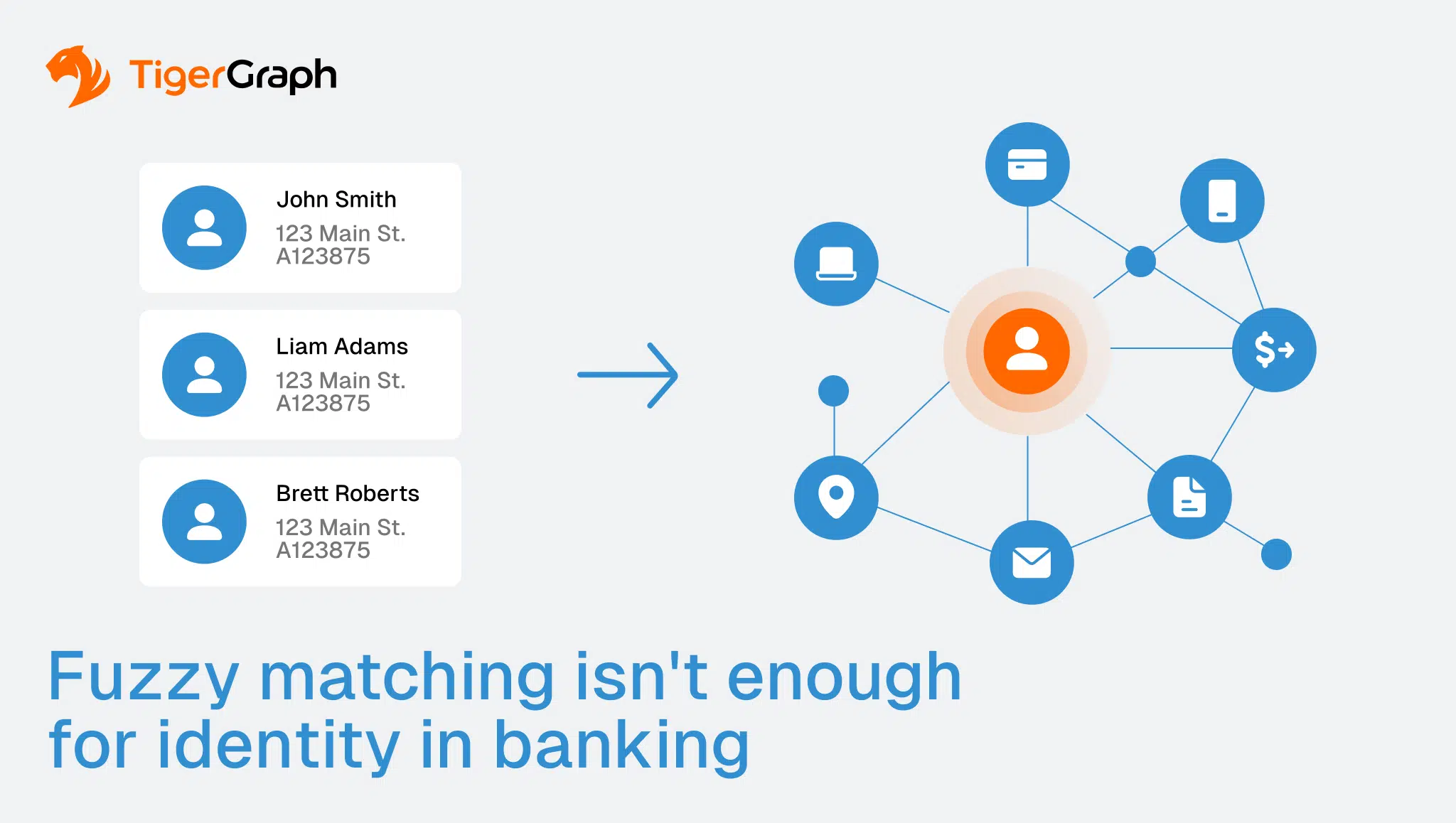
Why Matching Scoring Isn’t Enough for Identity in Banking
Identity is the heart of modern banking. Every compliance check, every AML investigation, every onboarding workflow ultimately depends on answering one deceptively simple question: who are we really dealing with? This is the challenge of identity resolution in banking.
And the stakes could not be higher.
Fail to identify a bad actor, and you risk money laundering, fraud losses, and regulatory penalties. Fail to correctly recognize a legitimate customer, and you frustrate them with false positives, long onboarding times, or unnecessary investigations. Either way, the consequences are financial, reputational, and operational.
But identity data in banks is anything but clean. Names are misspelled. Addresses change. Phone numbers get recycled. Customers appear across multiple lines of business under slightly different profiles. A single “real person” may exist as half a dozen records, none of which tell the full story.
Traditionally, banks have leaned on match scoring to bridge the gaps. This includes similarity scoring (typos, misspellings), substitution scoring (Blvd ↔ Boulevard, Jack ↔ John, Mumbai ↔ Bombay), and weighted scoring of attributes (name, DOB, phone number, address). These methods improve basic data hygiene, but fuzzy matching limitations remain. Even with substitution and weighting, match scoring only looks at fields in isolation and misses the broader relational context that matters for identity resolution in banking.
Where Match Scoring Falls Short
Match scoring is widely used in banking, but its limitations are becoming painfully clear. Its focus on individual fields like names, addresses, and emails ignores the richer relational context of customer identity. And that narrow approach introduces four critical flaws:
- Records in isolation.
Match scoring compares strings field by field, treating them as disconnected entries. But real-world identity spans products, devices, geographies, and counterparties. A customer listed as “Jon Smith” in one system and “John Smythe” in another might not register as a match, even though both connect to the same passport number or mobile device. By ignoring connections, match scoring delivers an incomplete picture. - False positives.
Similarity scores cut both ways. Two unrelated people with similar names or nearly identical addresses may be flagged as duplicates. Analysts then spend hours investigating matches that go nowhere. The more false positives flood in, the harder it becomes to focus on signals that matter. While match scoring is useful for catching typos and substitutions, its reliance on similarity scores increases false positives in large-scale banking environments. - Missed sophisticated fraud.
Criminals understand how match scoring works, and they know how to outsmart it by creating synthetic identities designed to look distinct on paper, but which share subtle relational ties. We see the same phone number used across multiple accounts, repeated IP addresses, or overlapping ownership structures. Match scoring can’t connect those dots, so the fraud slips through. This is why regulators are emphasizing entity resolution for AML and KYC as a discipline that goes beyond match scoring. - Poor scalability.
As banks operate across more countries, identity data grows exponentially more complex. Different languages, alphabets, and address formats multiply the possibilities for variation. What looks like a simple transliteration error to a human appears as an entirely new customer to a string-matching system. The outcome is either missed matches or an avalanche of false positives that swamp compliance teams. Even advanced match scoring methods struggle to scale across diverse languages and jurisdictions.
Taken together, these flaws leave institutions exposed. Compliance teams waste resources chasing false alarms. Regulators demand precision and auditability that similarity scores alone cannot provide. And bad actors exploit the blind spots, moving money through gaps fuzzy logic was never designed to close.
Why Graph Transforms Entity Resolution
Graph technology changes the field of play by shifting from matching (exact or fuzzy) to connecting relationships. This is the essence of graph-powered identity resolution.
Instead of comparing one record to another in a vacuum, graph builds a connected network of customers, accounts, devices, and transactions. It’s in those relationships that true identity and true risk become visible.
Consider duplicate customer records. A fuzzy match might hesitate to connect “Jon Smith” and “John Smythe.” But a graph model instantly highlights that both tie back to the same phone number, passport ID, or employer. The relational evidence confirms the match with higher confidence.
Graph also cuts through false positives. Two “Jane Lees” may appear similar in isolation, but if one is connected to Hong Kong retail accounts and the other to London pension assets, with no shared devices or addresses, the graph shows immediately that they are different people. Analysts avoid wasting time on dead-end investigations.
The same principle applies to fraud. Fraudsters often reuse pieces of infrastructure, like addresses, merchants, or devices, across otherwise distinct synthetic identities.
Graph traversals can follow these shared anchors across multiple hops, exposing the collusion and fraud rings that fuzzy matching misses entirely. Instead of a collection of similarity scores, the investigator sees a network of relationships that tells the full story.
And unlike brittle rules-based systems, graph scales naturally with complexity.
Whether it’s reconciling names across alphabets, normalizing addresses across jurisdictions, or mapping thousands of accounts to a single high-risk hub, graph models preserve context without breaking.
TigerGraph, for example, has proven the ability to support billions of transactions per day with queries returning in milliseconds, making enterprise-grade entity resolution not just possible, but practical.
By moving beyond string similarity to relationship-driven resolution, graph delivers what banks need most: fewer false alarms, faster investigations, and greater confidence that they truly know their customers.
Real-World Outcomes of Graph-Powered Entity Resolution
When Tier-1 banks apply graph-powered entity resolution, the results show up across compliance, operations, and risk management.
- Cleaner customer records. Instead of juggling partial identities scattered across silos, banks unify records into a single, consistent customer profile. That improves reporting accuracy, reduces duplication, and strengthens the foundation for every compliance and risk decision. This strengthens customer identity verification banking processes.
- Operational efficiency. By slashing false positives, graph frees analysts from wasted investigations. Alerts are triaged faster, genuine risks surface sooner, and resources are redeployed from low-value checks to higher-value analysis.
- Audit-ready transparency. Graph doesn’t just show that two records were matched; it shows why. Investigators can demonstrate to regulators exactly which connections triggered the match, whether a shared device, a common beneficial owner, or overlapping transactions. That explainability builds confidence with auditors and supervisors.
- Reduced fraud losses. Fraud rings and synthetic identities designed to evade string similarity are exposed through their shared infrastructure. Detecting those relationships earlier prevents cascading financial losses and reputational damage. Banks applying fraud detection with graph analytics can uncover hidden mule accounts, synthetic IDs, and collusion rings earlier.
For CDAOs and VP Data Science leaders, graph elevates entity resolution into a strategic advantage.
Why Now?
The pressure to get identity right has never been greater. Regulators like FinCEN, AMLD in Europe, and FATF globally are demanding more transparency and traceability. They no longer accept “black box” similarity scores; they expect clear evidence trails showing how entities are connected and why alerts are escalated or dismissed.
At the same time, fraudsters are innovating faster than quarterly compliance cycles. They exploit gaps in siloed systems, stitching together synthetic identities, laundering funds across borders, and hiding behind corporate structures that fuzzy matching cannot untangle. Every blind spot is an opportunity for loss.
Meanwhile, customer expectations are rising. Legitimate applicants don’t tolerate delays caused by false positives. If onboarding is slow or intrusive, they walk away, and competitors with smoother digital experiences win the relationship.
That’s why graph-powered entity resolution isn’t a “nice to have.” It’s essential for banks that want to stay ahead of regulators, outpace fraudsters, and meet customer expectations. The institutions that act now will gain cleaner data, stronger compliance, and faster investigations. Those who delay risk higher costs, greater exposure, and mounting regulatory scrutiny.
Legacy fuzzy matching limitations are no longer acceptable; regulators expect graph-powered identity resolution to underpin explainability.
The question isn’t whether to move beyond fuzzy matching, it’s how quickly.
Cleaner data. Stronger compliance. Lower risk.
Reach out for more info on how to use graph-powered identity resolution to strengthen entity resolution for AML and KYC, reduce fuzzy matching limitations, and accelerate customer identity verification banking. And experience fraud detection with graph analytics in minutes by launching your free TigerGraph instance at tgcloud.io.