
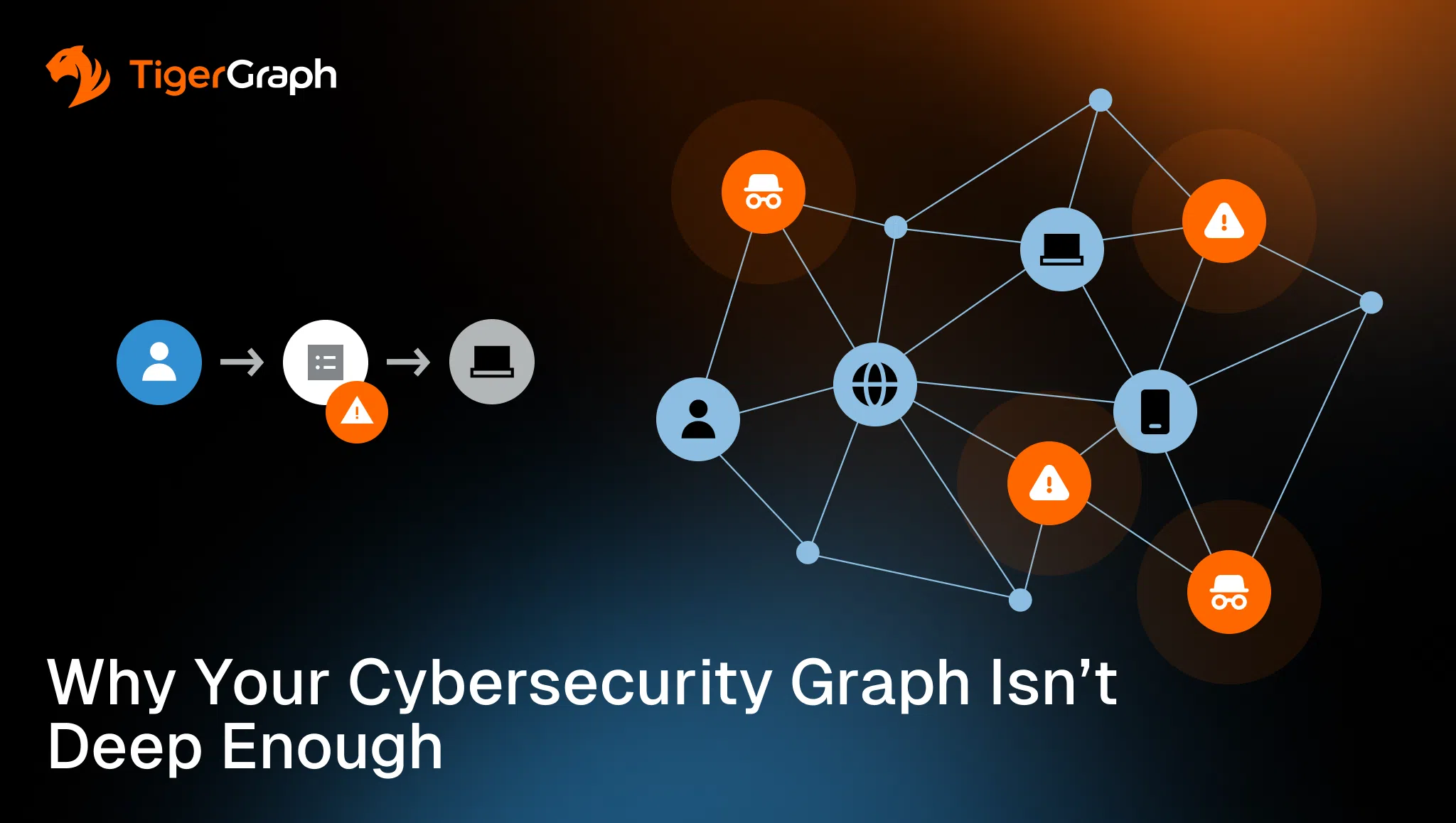
Why Your Cybersecurity Graph isn’t Deep Enough
Many organizations have introduced graph technology into their cybersecurity stack. They connect users to IP addresses, devices to sessions, and domains to authentication attempts. Compared to flat reporting tables, this represents real progress.
But connecting adjacent events is not the same as modeling attack structure.
Modern attacks are not isolated anomalies. They are coordinated, multi-step campaigns. Attackers probe credentials, reuse infrastructure, pivot between systems, escalate privileges, and test lateral pathways before triggering visible impact. Each step may appear benign when viewed alone. The risk emerges from the chain.
If your graph only captures surface-level relationships, you are detecting events. You are not detecting campaigns. Depth is the difference.
Key Takeaways
- Cyber threats unfold across multi-step relationships, not single events.
- Shallow graph models mirror logs instead of revealing coordinated campaigns.
- Infrastructure reuse and lateral movement are structural patterns.
- Schema depth determines whether detection is reactive or investigative.
- Structural visibility enables resilience, not just alerts.
To understand what that depth actually looks like in practice, we need to examine how most cybersecurity graphs are structured today.
One Hop Detects Symptoms. Depth Detects Structure.
A typical shallow model connects a user to a login event and then to an IP address. When the IP appears suspicious, an alert fires. That workflow improves visibility over flat logs, but it remains event-centric.
Attackers rarely reuse infrastructure in isolation. They distribute activity across shared IP ranges, rotate credentials, move laterally between accounts, and test privilege boundaries gradually. What looks like several small irregularities may actually be a coordinated progression.
To reveal that progression, the graph must support something called “multi-hop traversal.”
Multi-hop traversal means following a chain of connected relationships across more than one step. Instead of examining a single direct connection, analysts move from one element in the system to the next, and then to the next again, tracing how entities are indirectly linked across the environment.
In graph terms, each element in that chain is called a node. A node simply represents a thing in the system. It might be a user, a device, an IP address, a credential, or a server. The connections between them represent how those things interact.
For example, an analyst might begin with a compromised account, follow its connection to a device, then follow that device to other accounts, then follow those accounts to shared credentials, and from there into privileged systems or sensitive data stores. Each step is a “hop.” The sequence of hops reveals how access expands and risk spreads across the environment.
When that chain is visible, the campaign becomes visible. And without multi-hop traversal, that sequence often disappears into separate tables and time windows.
One of the clearest examples of this structural visibility appears in how attackers reuse infrastructure.
Infrastructure Reuse Is a Network Signature
Attackers rarely build everything from scratch for each intrusion. Reusing infrastructure is efficient, and a single command-and-control server can support multiple attacks. A compromised VPN endpoint can provide access to several accounts. A leaked credential set can be tested across many systems.
From the defender’s perspective, those events may appear unrelated at first. One account looks compromised. Then another. Then a third. Individually, each alert may seem minor. Together, they point to shared infrastructure.
When these shared elements are modeled in a graph, they become visible as common connection points. If several compromised accounts all connect back to the same server, device, or credential source, that shared component begins to stand out. It accumulates connections and becomes a structural focal point in the network.
That focal point is evidence of coordination.
Without structural modeling, each compromised account generates a separate investigation. Analysts respond to symptoms. With deeper graph modeling, those symptoms resolve into a single connected campaign. The insight does not come from a threshold being crossed, but from seeing the density of connection around shared infrastructure.
And infrastructure reuse is only the beginning. The more important shift occurs when we change how security events themselves are represented.
Event Modeling Changes the Question
Infrastructure reuse reveals coordination. But the deeper shift happens when security events themselves are modeled differently.
In many environments, events are stored as isolated records. A login happens, a privilege change occurs or a file is accessed. Regardless of what it is, each event lives in a log line.
Graph modeling connects those events to the entities involved. A login connects to a user and a device. A device connects to other accounts. A privilege escalation connects to systems and data stores. Once events are connected, the question changes.
Instead of asking, “Was this login unusual?” analysts can ask, “Where did this login lead?” Instead of asking whether an event crossed a threshold, they can trace how access expanded after it occurred.
The focus shifts from spotting anomalies to understanding movement. That shift depends on how the graph is structured, otherwise known as its schema.
Schema Depth Determines Security Depth
Graph technology alone does not create structural visibility. The design of the model determines what is possible. If a graph connects users only to login events and IP addresses, investigation stops there. The system mirrors the log format.
If the graph includes devices, network segments, applications, databases, privilege levels, and cross-account reuse, analysts can follow how access moves across layers. The depth of these data layers should reflect how attackers actually operate. But it must also remain usable. If queries are too slow or too complex, analysts will not rely on them.
When the graph is designed around real attack paths, and analysts can trace those paths quickly, the system stops behaving like a log viewer. It begins to behave like a map of your environment.
And when security teams can see that map, they can do more than respond to alerts. They can understand how access moves, where risk concentrates, and which systems are most exposed.
Tactical Alerts Versus Structural Resilience
Shallow graph models improve alert generation. They help security teams detect suspicious IP addresses or unusual login patterns more efficiently. Deep graph models answer different questions. They:
- Reveal which accounts connect secure and insecure zones.
- Expose clusters of coordinated activity.
- Highlight infrastructure components that enable lateral movement.
- Show which nodes would amplify risk if compromised.
These insights inform containment strategy, network segmentation, and how access permissions should be structured across users and systems.
Resilience depends on understanding how a compromise could move through the system. That requires structural depth. Which leads to the central distinction.
Structural Depth Mirrors Reality
Modern cybersecurity is not about defending a perimeter. It is about managing interconnected systems. The question is no longer whether an event looks suspicious. It is how far a compromise could travel.
A shallow graph reflects log relationships and a deep graph reflects system structure. Only one of those mirrors how attackers actually move.
Structural depth is not an enhancement. It is foundational to modern threat detection and containment. If your current graph cannot reconstruct a multi-step attack path quickly and clearly, it is not deep enough.
Contact TigerGraph
Modern attacks unfold across layered, interconnected systems. Detecting them requires more than surface-level relationships.
TigerGraph is built for deep relationship traversal at enterprise scale. It enables security teams to model infrastructure reuse, lateral movement, privilege escalation, and cross-account propagation as connected structures.
Contact TigerGraph to learn how structural depth can move your cybersecurity program from alerting to investigative insight.
Frequently Asked Questions
1. What Is Structural Threat Detection and Why Does it Outperform Traditional Event-Based Security?
Structural threat detection analyzes how activities connect across users, devices, and systems—revealing coordinated attack campaigns, not just isolated alerts.
2. How does Multi-Hop Analysis Expose Hidden Cyber Attack Paths That Traditional Tools Miss?
Multi-hop analysis traces relationships across multiple entities, uncovering lateral movement, credential reuse, and attack progression that single-event monitoring cannot detect.
3. Why do Modern Cyber Attacks Require Network-Level Visibility Instead of Isolated Alerting?
Because attackers operate as coordinated networks, not single events—network-level visibility exposes shared infrastructure, patterns, and pathways that signal active campaigns.
4. What Role does Graph Depth Play In Detecting Lateral Movement and Privilege Escalation?
Graph depth enables visibility across multiple layers of relationships, allowing teams to trace how access expands across accounts, systems, and sensitive data.
5. How can Cybersecurity Teams Move From Reactive Alerts to Proactive Threat Investigation?
By modeling relationships across the environment and analyzing connected activity, teams can identify attack paths early and prioritize high-risk structural vulnerabilities.