
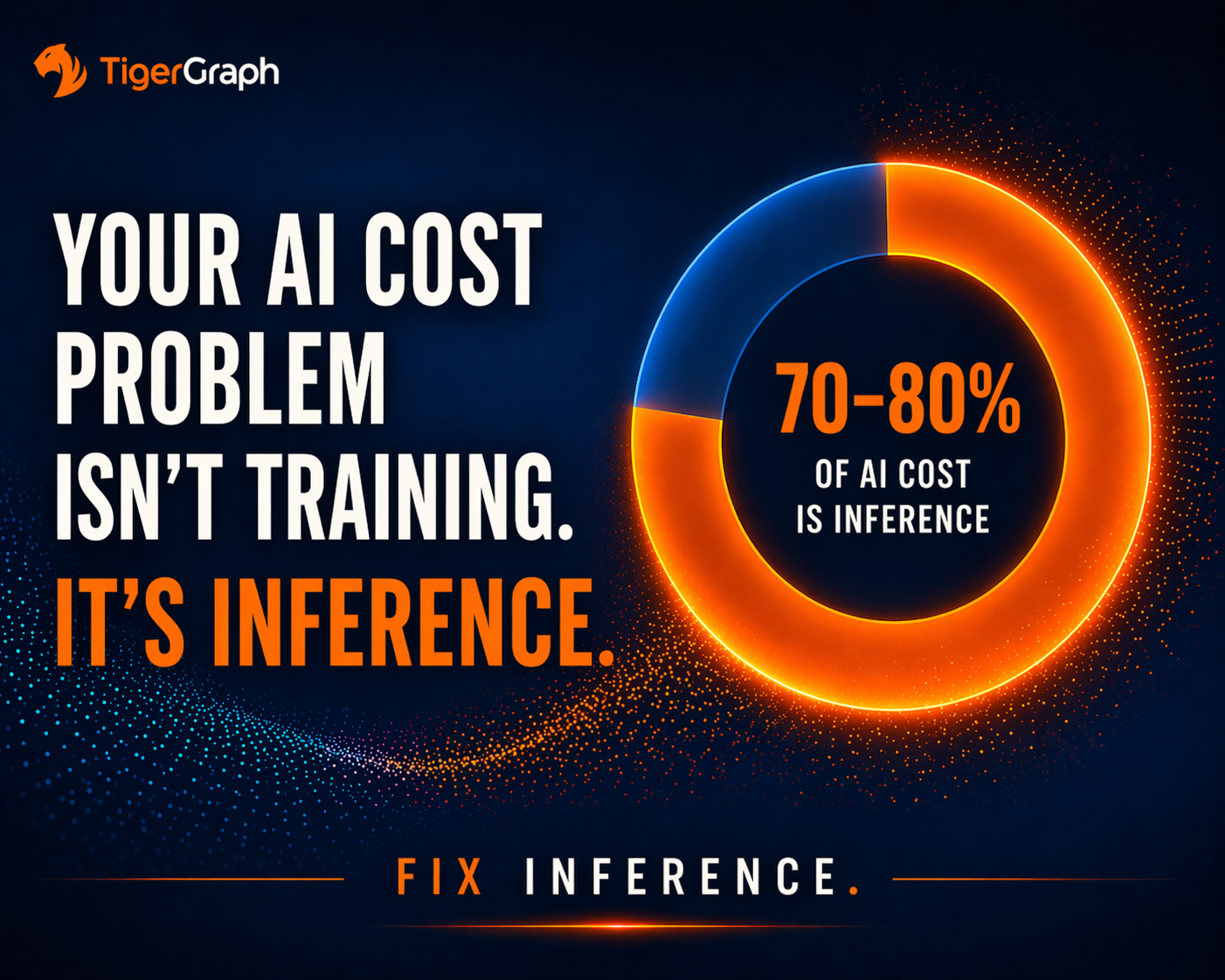
Your AI Cost Problem Isn’t Training. It’s Inference.
Training gets the headlines because it is visible, expensive, and easy to measure. It is where GPUs are purchased, clusters are built, and model benchmarks are set. But once a model is deployed, training largely disappears from the day-to-day reality of an enterprise system.
Inference does not.
Inference is where AI runs continuously, across every query, every agent step, every automated decision. It is not a discrete event. It is a system under constant load, and like any system at scale, the cost is not determined by peak events, but by what happens on every request. That is where AI becomes expensive. And increasingly, that is where it becomes unsustainable.
The Real Misconception
Most teams still think AI cost is driven by training: model size, training cycles, and infrastructure footprint. That framing misses where systems break. Training is bounded. It runs on a schedule, within a known envelope of compute.
Inference is unbounded. It scales with usage, and usage compounds. What begins as a simple model call becomes a chain of calls across services, workflows, and agents, each carrying context, each consuming compute, each adding to the total work the system must perform.
The result is not linear growth. It is compounding load.
Where the Cost Actually Emerges
At the level of a single request, inference appears simple: a prompt goes in, a response comes out. But that abstraction hides where the work happens.
Before a model produces a single token, it must process every token it receives. Those tokens are loaded into memory, transformed into embeddings, and passed through attention layers that compute relationships across the entire sequence. The model is not reading text; it is performing dense computation over it.
What looks like “AI cost” is often just the cost of forcing a language model to behave like a database, a search engine, and a reasoning system at the same time.
And it pays that cost on every request.
Why Context Becomes Expensive
Transformer architectures require tokens to attend to one another, which means the amount of computation grows faster than the number of tokens themselves. As context windows expand, the model must evaluate more relationships, hold more state in memory, and perform more work before it can begin generating an answer.
This is why context size is not a neutral choice. It directly determines how much computation the system performs. You’re not paying for intelligence. You’re paying for unnecessary computation.
The Real Problem
Most enterprise retrieval systems are designed to avoid missing information, so they optimize for recall. They retrieve broadly: multiple documents, expanded queries, fallback chunks, and additional context to increase coverage. That approach works in isolation. It fails at scale.
Because broad retrieval creates large, noisy prompts, and those prompts force the model to spend compute resolving what is relevant. Instead of reducing uncertainty, excess context increases it, introducing conflicting signals and forcing the model to do more work to arrive at an answer.
Most teams don’t hit a model limit. They hit a context limit first.
What Breaks at Scale
This is rarely visible early. Systems perform well in testing, where context sizes are controlled and usage is low. The problem emerges as systems are adopted. More workflows depend on the model. More context is added to support those workflows. Requests become heavier, even though the model itself does not change.
Over time:
- latency becomes inconsistent
- throughput declines
- GPU utilization spikes
- cost accelerates non-linearly
Not because the model is inadequate. Because the work per request keeps increasing.
The Real Shift
This is not an optimization problem. It is a placement problem. The question is not how to make the model more efficient. The question is which work should never reach the model in the first place.
Where TigerGraph Becomes Inevitable
When raw documents are passed into an LLM, the model is forced to identify entities, infer relationships, and determine relevance on the fly. That is relationship-oriented computation, and it is being executed in the most expensive layer in the system. That is the mistake. Relationship traversal does not belong inside the model. It belongs in a system designed to do it efficiently.
TigerGraph moves that computation out of the model and into a graph layer built for it. It resolves entities, relationships, and multi-hop connections before inference begins, returning a small, precise set of connected facts instead of large volumes of loosely related text. What disappears is not just tokens. It is entire classes of computation:
- repeated relationship inference
- attention over irrelevant data
- redundant reasoning cycles
The model is no longer asked to discover structure. It is given structure. That is what makes the system efficient.
From Cost Problem to Power Problem
At small scale, inefficient inference looks like cost. At scale, it becomes infrastructure. Every unnecessary token consumes compute. Every additional computation occupies GPU time. Across millions of requests, which translates directly into energy demand. The 19-gigawatt gap is not just a supply problem. It is the downstream effect of billions of inefficient inference calls, each doing more work than necessary.
The Real Takeaway
Training is bounded. Inference is not. And when inference is inefficient, the system doesn’t just get expensive, it becomes unsustainable. Not because the models are too large, but because each request is doing work it never should have done.
The future of AI will not be defined by the systems that consume the most compute. It will be defined by the systems that waste the least.